
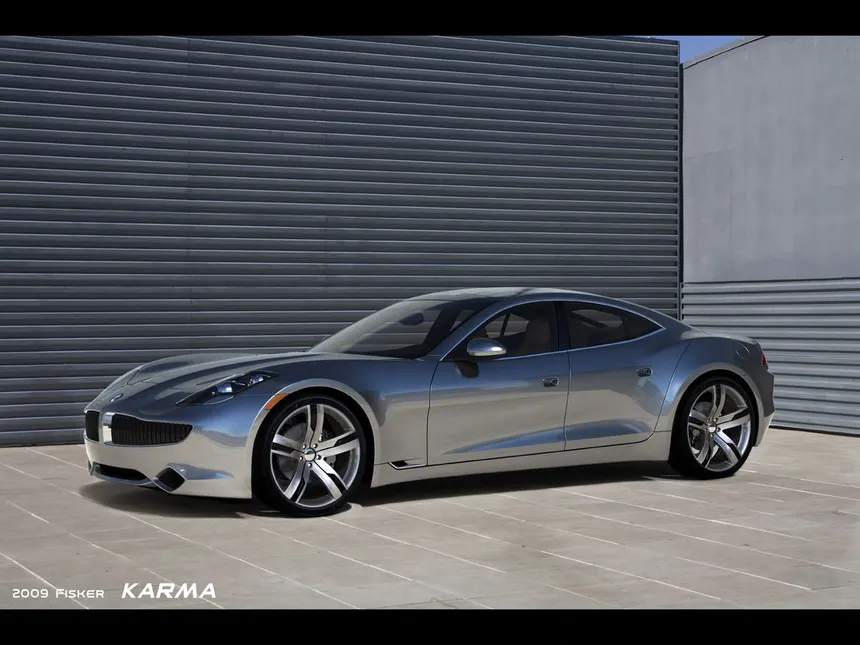
Fisker Karma — The Car That Arrived Too Early to a World That Wasn’t Ready
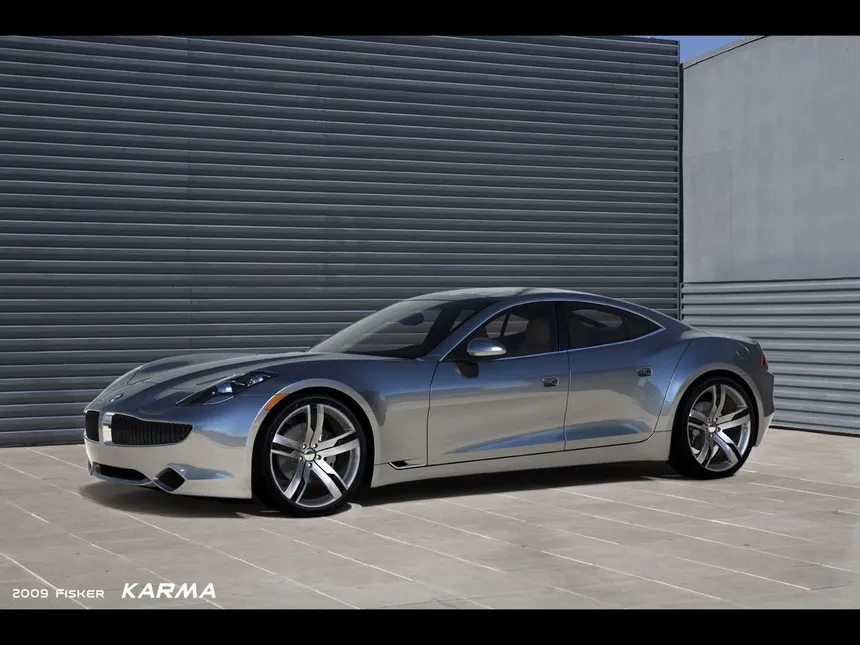
Some cars are born to change the rules. And some cars are born to prove the rules aren’t ready for change. The Fisker Karma was both. And it paid for it with its own existence.
Think about it for a second. It’s 2007. Tesla has just unveiled the Roadster, an electric toy for Silicon Valley millionaires with an eco-conscience complex. Toyota has been selling the Prius for years as if it were an act of faith rather than a car. And into that scene walks Henrik Fisker — the Dane who designed the BMW Z8 and the Aston Martin DB9 — with an idea that sounded like madness: a luxury plug-in hybrid sports sedan so beautiful you wouldn’t care whether it polluted or not. Though it didn’t.
That was the opening act of a tragedy involving hurricanes, defective batteries, Tesla lawsuits, a ghost investor who promised a hundred million and left thirty thousand dollars in the account, a rejected proposal to Sergio Marchionne that could have changed Fiat’s history, and a fire at a New Jersey port that destroyed 338 cars in a single night.
Welcome to the Fisker Karma. Get ready to feel frustrated.
The man behind the lines
Henrik Fisker was born in Allerød, Denmark, in 1963. As a kid he spotted a Maserati Bora on the highway and started sketching cars in notebooks. That image chased him his entire life. He graduated in transportation design from the Art Center College of Design in Vevey, Switzerland, in 1989, and landed straight at BMW Technik, Munich’s advanced design studio.
His first project there was an electric car. The BMW E1, a city car concept that never reached mass production but hid an ambitious plan: to use its engineering as a platform for an electric BMW 3 Series throughout the 1990s, targeting 40,000 units a year. It never happened. But the seed was planted.
Fisker designed the Z8. Designed the X5. Became president of Designworks in California. Then in 2001 he left for Aston Martin, where he led the production design of the DB9 and V8 Vantage. Two cars that, if you look at them today, remain among the most elegant things the industry has ever produced.
But Fisker didn’t want to design cars for other people. He wanted to build his own.
In 2005, with his partner Bernhard Koehler, he founded Fisker Coachbuild in Orange County, California. The idea was to revive the art of bespoke coachbuilding. Their first car was the Fisker Tramonto, a roadster based on the Mercedes-Benz SL 55 AMG. The second was the Fisker Latigo CS, built on a BMW 645Ci. Only 17 Tramontos were ever made. Beautiful, exclusive, irrelevant.
And then Quantum Technologies showed up with something that changed everything: an extended-range electric vehicle system developed for military applications that they wanted to bring to the civilian market. Fisker had the design for a perfect sedan but no powertrain. Quantum had the powertrain but no car. In September 2007, Fisker Automotive was born.
The Italian who lit the fuse
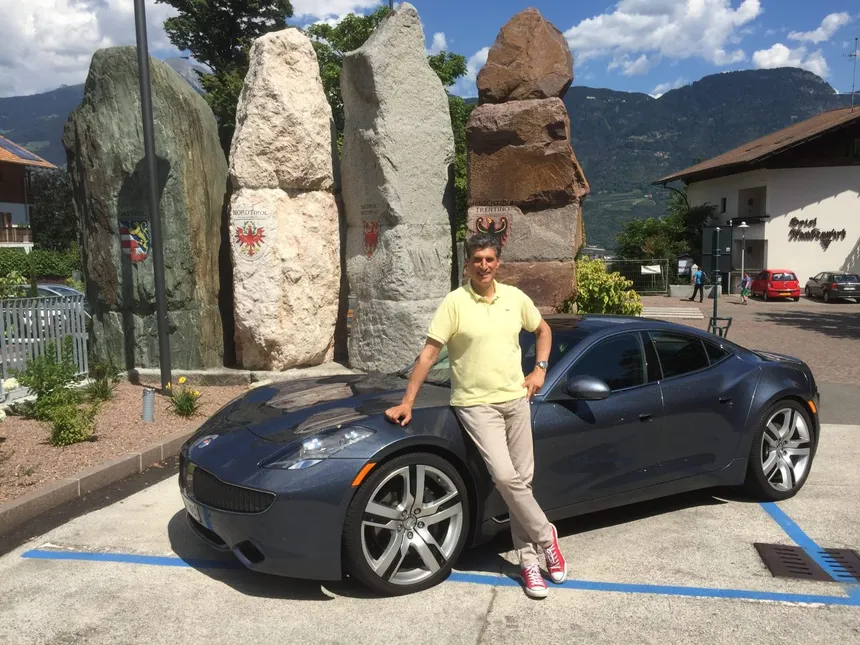
But to be born you need money. And the first cheque didn’t come from Silicon Valley or Wall Street. It came from an Italian businessman born near Venice and raised in Merano, in South Tyrol. His name is Gianfranco Pizzuto. Franco, to those who know him.
Franco — that’s what those who know him call him, and that’s what we’ll call him too, because he opened the doors to this story without conditions — had co-founded FAE Group in 1989 with three partners, a leading manufacturer of agricultural, forestry and construction machinery that today turns over more than €200 million a year.
But in April 2007, after months of tensions with his senior partner over control of the company, Franco made a decision that had nothing to do with Fisker. He left FAE. It wasn’t automotive passion. It was survival. His wife had shown him an article about burnout symptoms. There were ten warning signs. Franco was nearly at the end of the list. “What’s money worth if you lose your health?” — he tells us today, almost twenty years later.
He left FAE without knowing what he’d do next. And then he met Henrik Fisker. He saw the Karma project. And what he saw changed his life: “A charismatic person, a hugely talented designer who had drawn a car with breathtaking lines and innovative technology. It was love at first sight. For the project.”
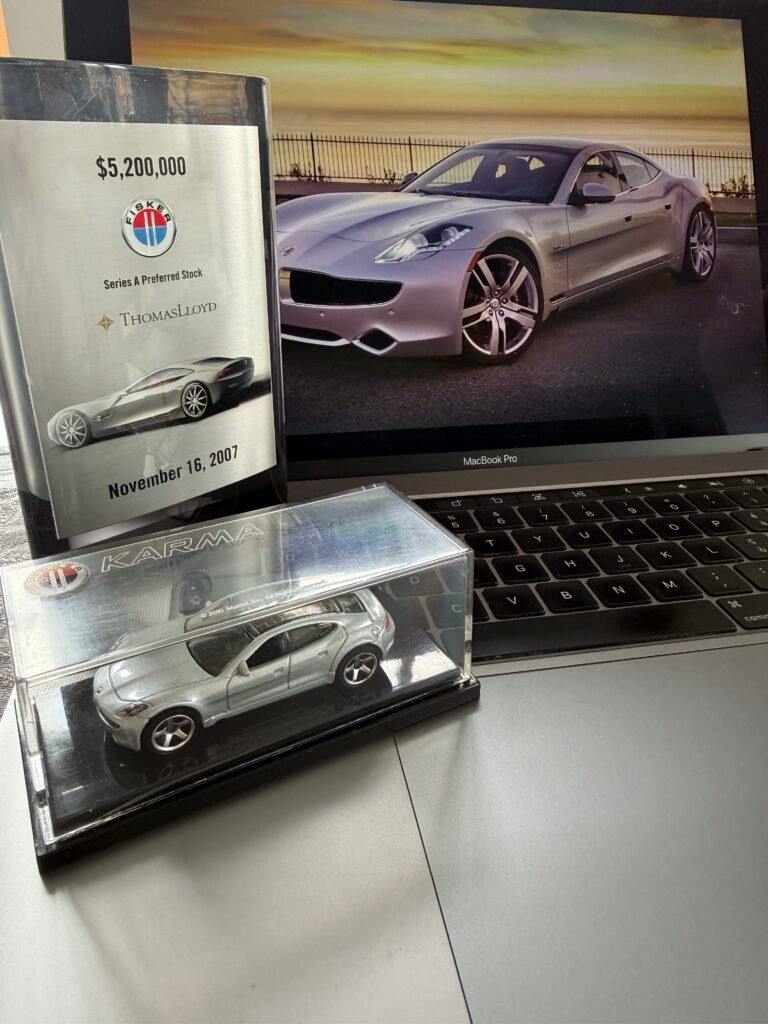
On November 16, 2007, Franco put $2 million on the table as Fisker Automotive’s first investor. Only after confirming his money had reached the account did David Anderson from Palo Alto Investors contribute the remaining $3.2 million to close the first funding round — the “Series A Preferred Stock” — totalling $5.2 million. That money was used to build the first show cars that would go to the Detroit Auto Show and then to Europe.
That first cheque lit the fuse. Then came Kleiner Perkins and even Leonardo DiCaprio. In total, Fisker raised over $1 billion in private investment. In September 2009, the U.S. Department of Energy granted the company a $528.7 million loan under the Advanced Technology Vehicles Manufacturing Loan Program.
A Dane with an eye for lines. An Italian who had just left behind 18 years of his business life. Over a billion dollars. And a car that was going to change everything.
Or so they thought.
The machine
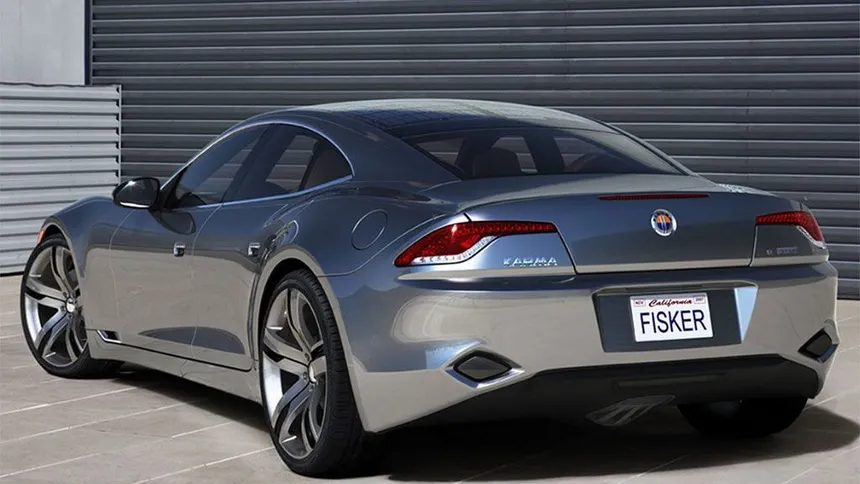
The Fisker Karma debuted in January 2008 at the Detroit Auto Show. And when people first saw it, the silence lasted three seconds before the applause.
It was obscenely beautiful. Lines that seemed to be in motion even with the car standing still. A four-seat sedan with no door handles — they opened via an electronic button on the door panel. A steering wheel with paddles that didn’t shift gears but switched driving modes. A start button engraved with the letters “EVer” — an acronym coined by the Fisker team itself, standing for Electric Vehicle with Extended Range. Every detail was a manifesto.
Underneath that skin worked a series hybrid powertrain called Q-Drive. Two 150 kW electric motors positioned ahead of and behind the rear axle, delivering 300 kW of electric power — approximately 408 hp. A 20.1 kWh lithium-ion battery manufactured by A123 Systems in Massachusetts. And a GM Ecotec turbocharged 2.0-litre four-cylinder engine producing 250 hp that didn’t drive the wheels — it functioned exclusively as a generator to feed the motors and recharge the battery. Torque: over 900 lb-ft through a single-speed transmission with a 4:10 differential.
The EPA rated it at 52 MPGe in pure electric mode with 50 miles (80 km) of electric range. In gasoline-only mode, 20 MPG. Total combined range: 300 miles (50 miles electric plus 250 miles gasoline, 9.2-gallon tank). Top speed: 125 mph. Zero to 60 in 6.1 seconds. Kerb weight: approximately 5,300 lb (2,400 kg).
To put those figures in context against what existed in 2011: a Porsche Panamera S Hybrid did the sprint to 60 in about 5.4 seconds with 380 hp and cost around $95,000. A Tesla Roadster Sport delivered 288 pure electric hp and hit 60 in 3.7 seconds, but it was a niche two-seater with barely enough room for a gym bag. And then there was the Chevrolet Volt, launched in 2010 with the same technical concept as the Karma — gasoline engine as generator, electric propulsion — but at $40,000 and with no luxury pretensions. The Volt sold over 20,000 units in 2012 alone. The technology worked. The question was whether the market was ready to pay $102,000 for it wrapped in designer bodywork. The Karma offered something none of the three had: a four-seat sedan, plug-in hybrid, with 408 hp and lines that hadn’t come out of a design committee. But those 5,300 pounds made themselves felt. Heavily.
And here comes the Karma’s most absurd irony. Despite having a wheelbase 9.4 inches longer than the Porsche Panamera, the EPA classified the Karma as a subcompact. Subcompact. A five-metre, $102,000 sedan slotted into the same category as a city runabout. The reason? The cabin’s interior volume was tiny. The 20.1 kWh battery sat in a massive centre console running the full length of the car, making the Karma a strict four-seater with less rear seat room than a Honda Fit and half the boot space of a Kia Rio. All that exterior beauty came at a price: living inside it was an exercise in compromise.
But what blew your mind wasn’t the numbers. It was the concept.
The roof carried a standard-fit solar panel that powered the climate control system. The paint used recycled glass flakes in a finish called Diamond Dust. The carpet plastics came from recycled materials. The dashboard wood was salvaged from California wildfires or recovered from the bottom of Lake Michigan. The leather came from Bridge of Weir, a Scottish tannery committed to sustainability. And all of this in a car priced from $102,000 for the EcoStandard base model up to $116,000 for the top-spec EcoChic, an “Animal Free” version that eliminated every animal-derived component.
It was a luxury PHEV with a conscience. A car that wanted to prove you could be fast, gorgeous, and responsible all at once. In 2011.
Read that again. In 2011.
The ghost investor and the thirty thousand dollars
What comes next has never been told before. It’s an exclusive that Franco shared with NEC.
Fisker Automotive needed capital to grow. Henrik Fisker and Bernhard Koehler believed in a Pakistani-origin investor called Mansoor Ijaz who promised to invest $100 million. Franco met him at the Geneva Motor Show in March 2009. “I immediately had the impression I was dealing with a blowhard, a charlatan,” he recalls. “I told Henrik and Barny, but they wouldn’t listen. They thought I was jealous because he could invest a much bigger sum than mine.”
Franco preferred to continue with other investors they already knew who had rejected Fisker’s new valuation as too high. Mansoor had accepted it. The $100 million was supposed to arrive in April 2009. May passed. June. July. August came. The money never showed.
Fisker Automotive’s bank account held $30,000. Thirty thousand. For a company that had raised millions. For a company that was showing two prototypes — a Karma and a Sunset — at Pebble Beach and Monterey.
Franco made a decision that cost him a fortune but saved the company. He flew to Oregon to visit Ray Lane, one of the senior partners at Kleiner Perkins, who was on holiday with his family. As the first investor, Franco held anti-dilution protection rights. He gave them all up. He accepted Lane’s valuation: $0.30 per share. Henrik and Barny’s previous valuation had been $10.
From $10 to $0.30. Franco lost almost all the value of his investment in a single afternoon.
“If I hadn’t accepted Ray’s offer, Fisker Automotive would have gone bankrupt in August 2009. It was the beginning of the end, with the only consolation that by doing so, I made the production of the Fisker Karma possible.”
Franco calls it “the greatest of the three cardinal errors.” Not his error. The cardinal error of Fisker’s story. Believing in the wrong man.
Production and the first blows
Production was scheduled for late 2009 in the U.S. and 2010 in Europe. It didn’t happen. Deadlines slipped again and again. But the reason for the rush wasn’t technical. It was financial. The venture capitalists were pushing to take Fisker public. That pressure created an urgency that forced the Karma into production when it needed at least another year to be perfected and made reliable. With more time, they would have caught the A123 battery problem and numerous software faults.
Finally, the Valmet Automotive plant in Finland started in July 2011, producing five cars a week. By December 2011, it was turning out 25 units a day. The first two deliveries were made in the U.S. that same July, and retail customers received their cars from November 2011.
Time named it one of the 50 Best Inventions of 2011. Top Gear Magazine awarded it Luxury Car of the Year 2011. In October that year, the first Karma delivered in the UK was auctioned for charity, fetching £140,000 — roughly $220,000.
But the Fisker story has a cruel pattern: every win was followed by a punch.
In December 2011, A123 Systems issued the first battery recall. In March 2012, the second. As soon as they identified the problem, Fisker turned to South Korea’s LG, who supplied all the warranty replacement batteries — paid for by Fisker — plus the batteries for new Karmas. But the damage was done.
Meanwhile, the fires started. A Karma caught fire in a garage in Texas. Another in a parking lot in California. Fisker launched a recall to replace a faulty cooling fan. The number of cars affected was minimal, but the reputational damage was devastating. A small brand can’t afford its name being associated with the word “fire.”
And then came Consumer Reports. They took a Karma out for a test drive in Connecticut. The car died during a speedometer calibration check. They couldn’t even finish the test. The problem turned out to be a defect from a welding robot at the factory that produced a faulty battery. But the headline was already written.
Tesla versus Fisker
There’s a chapter many people don’t know about. In 2007, Tesla had hired Henrik Fisker to carry out initial design work on the Tesla Model S. In April 2008, Tesla filed a lawsuit against Fisker Coachbuild, accusing them of having fraudulently accepted the design contract solely to access confidential information and then use it for the Karma.
Franco was in the car with Henrik when the news came. It was April 2008 and they were organising the Karma’s presentation in Merano, the town where Franco grew up. “Even though at the end of that year the California court ruled in our favour and Tesla had to reimburse our legal costs, the damage it caused was enormous,” he recalls. “We had to spend a huge amount of energy and the company’s human resources providing documents and drawings to prove the Karma project was completely different from the Tesla Model S.”
Fisker filed for arbitration in May 2008. In November, the arbitrator ruled in their favour, finding “overwhelming” evidence that Fisker had done nothing wrong. Tesla was ordered to pay $1.14 million in legal fees and costs to Fisker.
Read that number again. Tesla paid Fisker. Not the other way around.
On the impact to team morale, Franco is blunt: “It didn’t really affect our morale that much. What is certain is that Elon wasn’t liked by any of us.”
FFCA: the proposal Marchionne rejected
This part of the story has never been published. It’s a NEC exclusive, told by the man who lived it.
When Franco saw that the Silicon Valley venture capitalists were abandoning Fisker because they hadn’t managed to IPO within their timelines, he looked for another way out. And he found it in Italy.
In 2012, Fiat was in the process of acquiring Chrysler. Franco saw the perfect opportunity. He proposed directly to Sergio Marchionne and his team an unprecedented industrial operation: integrate Fisker into the merger and create FFCA — Fiat Fisker Chrysler Automobiles. Without spending a single dollar. Through a share swap only.
The vision was clear: combine Fiat’s industrial capacity, Chrysler’s North American network, Fisker’s electric technology and premium positioning, and the presence of brands like Maserati, Alfa Romeo and Lancia, which could have used the Fisker models — beyond the Karma — that were already ready. Fisker was a company with advanced technology and a recognised brand, but in financial difficulty. Acquirable on favourable terms.
Franco was convinced it was an offer that couldn’t be refused. He was wrong.
Marchionne chose not to integrate Fisker. He focused exclusively on the Fiat-Chrysler merger, which gave birth to FCA. He preferred to keep buying CO2 credits from Tesla for hundreds of millions of dollars a year. At the time, Marchionne didn’t believe in electric. He was betting on LPG, and later hydrogen.
Let’s be fair: Marchionne’s reasons for rejecting the proposal weren’t irrational. In 2012, Fisker was already dragging battery problems, production delays, and a reputation damaged by fires. Integrating a burning startup into the middle of the industry’s most complex merger was a massive risk. But the alternative he chose — buying CO2 credits from Tesla for hundreds of millions a year — didn’t exactly turn out to be a cheap strategy either.
Imagine the alternate timeline. Fiat Fisker Chrysler Automobiles. Fisker’s electric technology powering Maserati, Alfa Romeo, Lancia. Years of headstart in electric mobility. Would it have worked? Nobody can know. What we do know is what happened next: FCA paid Tesla. And the money that could have funded their own electric technology went straight into Elon Musk’s pocket.
The hurricane that chose a port
October 29, 2012. Hurricane Sandy hammers the U.S. East Coast. At Port Newark, New Jersey, an entire shipment of Karmas freshly arrived from Europe sits waiting for distribution. 338 units. Between six and eight feet of seawater swallowed them whole.
Salt corrosion caused a short circuit in one car’s vehicle control unit. It caught fire. Sandy’s fierce winds spread the blaze to 15 others. Fisker ruled out the lithium-ion batteries as a cause or contributing factor. But it no longer mattered. The images of 16 Karmas burning at a port became the visual epitaph of the brand.
Franco was at home, praying the hurricane wouldn’t reach the New York coast. Barny Koehler called him that day. “We both had tears in our eyes and were trying to give each other strength.”
Estimated loss: over $30 million. Insurer XL Insurance America initially denied the claim. Fisker sued. They reached an undisclosed out-of-court settlement.
“You ask yourself what you did wrong to deserve such bad luck,” Franco says. “You seek the closeness of your family and loved ones. You know that in the end, that’s what truly matters. The financial damage — somehow you find a way.”
The fracture
As Fisker grew, Henrik Fisker changed. The visionary designer Franco had met in 2007 became a celebrity. And the celebrity started living like one.
Franco isn’t looking for scandal, but he’s clear: “When Henrik became a celebrity, he started spending a lot of money on a lifestyle unsuitable for someone running a startup funded by investors’ money. I felt he no longer had the same warm relationship with me as in the early years. He’d become friends with Leonardo DiCaprio and I was no longer needed. I felt deeply betrayed for everything I’d done to create and then save the company.”
The venture capital pressure to IPO forced an acceleration that proved fatal. Henrik Fisker resigned in March 2013 after “disagreements with management” over business strategy. But the real fracture had started long before.
The fall
In August 2012, A123 Systems filed for bankruptcy. Fisker lost its sole original battery supplier. Production was suspended in November 2012. Approximately 2,450 Karmas built in total. Just over 2,000 sold worldwide. The original plan had been to produce 10,000 units a year. A123 had been the only supplier able to commit to those volumes, but they too were a startup.
In February 2012, the Department of Energy froze the loan at $192 million, claiming Fisker had missed its milestones. Of the $529 million approved, the government recovered roughly $53 million through company payments and the subsequent sale of the debt.
On April 5, 2013, the company laid off 75% of its workforce, keeping just 40 workers. Franco was there: “For everyone I was Franco, the Italian whose money had allowed Fisker Automotive to get started. Nobody blamed me in the slightest. I was sitting in the cafeteria at the Anaheim headquarters, devastated, with tears in my eyes, while some employees tried to comfort me.”
In November 2013, Fisker Automotive filed for Chapter 11 bankruptcy. The New York Times called it “the Solyndra of the electric car industry.”
The legacy
In February 2014, China’s Wanxiang Group purchased Fisker’s assets for $149.2 million at an auction that started at $55 million. Wanxiang already owned A123 Systems, the battery supplier whose bankruptcy had killed the Karma. Pure irony.
In 2016, the new owners relaunched the car as the Karma Revero under the Karma Automotive brand. Franco has seen and driven the Revero: “They’ve certainly improved the original design. But I haven’t understood what their strategy for the future is or how the company can sustain itself financially. I no longer have any contact with the new owners.”
Henrik Fisker founded Fisker Inc. in 2016 with his wife to produce affordable electric vehicles, starting with the Fisker Ocean. That company also filed for bankruptcy in 2024.
And Franco kept two Karmas. The very first one ever built — the show car painted in Laguna that debuted in Detroit and appeared in every early catalogue the brand produced. And Signature Edition number 61. His lucky number. The year he was born. 1961.
Would he invest again if he could go back to 2007? “Absolutely yes.”
Why? Because for Franco, Fisker wasn’t a failure. “Even though the company went bankrupt financially, you can’t say it was a failure in itself. We managed to design — starting from a blank sheet — and produce one of the most beautiful and revolutionary cars of the last twenty years. I had the enormous privilege of being a protagonist, not just an extra. How many people can say they’ve had experiences like that?”
The Fisker Karma was a car ten years ahead of its time. A luxury PHEV with a solar roof, wood salvaged from wildfires, and handleless doors in a world still debating whether EVs were “real cars.” It raised over a billion dollars. Won awards. Designed a future. And lost everything to a battery, a hurricane, a ghost investor, and an industry that wasn’t ready for what it offered.
Only 2,450 were ever made. If you see one, stop. You’re looking at the car that tried to change the world before the world wanted to change.
What Franco learned from all of it, he sums up with an image that stays with you: “In my original industry I was swimming in a fishbowl with goldfish. In the automotive and venture capital world, I found myself swimming with sharks. And the sharks won. Today I trust people less. And I pretend to be a shark myself — a small one.”
And then, in 2020, from a WhatsApp group during a pandemic, he decided to try again. But that’s another story.
NEC spoke exclusively with Gianfranco Pizzuto for this feature. All statements reflect his perspective as Fisker Automotive’s first investor and co-founder. Technical and financial data have been verified against independent public sources.
Check you’re still alive.
Greetings Franco:
I still have my 2012 Fisker Karma Signature Edition Car #13. It’s still looks and runs like brand new thanks to you and @Joe Ferrante. I drove it today in the Florida sunshine. The car looked absolutely beautiful in the sunshine with the reflection of the glass flake ‘diamond dust’ paint finish. I now have about 29,000 miles on the Fisker and I drive it back-and-forth between Ohio and Florida in the US twice a year. I still love my Fisker Karma. I know belong to the Exotic Car Club Of The Villages Florida.
Regards, Ken Buzek
Dear Ken,
Thank you so much for your message — it truly made my day.
I need to clarify that I’m Antonio, the author of the article about the Fisker Karma and Franco Pizzuto. You may have reached me through the comments or contact form on my website, Not Enough Cylinders.
However, I will make sure to forward your message to Franco, as I’m sure he will be delighted to hear that your Karma is still running beautifully after all these years.
Your story is exactly the kind of thing I love about this world — a 2012 Fisker Karma Signature Edition #13, 29,000 miles, still turning heads in the Florida sunshine. That’s not just a car, that’s a statement.
Thank you again for reaching out, and enjoy every mile.
Best regards,
Antonio Manzanero
Not Enough Cylinders
notenoughcylinders@gmail.com