ALPINA: 60 Years of the Strangest Partnership in Motoring
There’s a question that has followed ALPINA for 60 years. A question that seems simple but hides one of the most fascinating stories in European motoring.
Tuner or manufacturer?
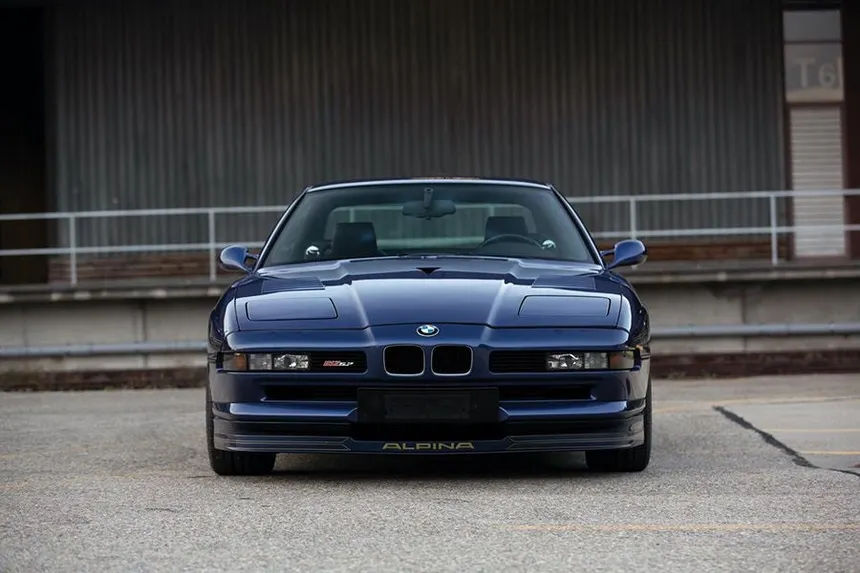
The short answer is: manufacturer. Officially recognized by Germany’s Federal Ministry of Transport since 1983 and certified by the TÜV. Every ALPINA carries its own chassis number. It’s not a modified BMW. It’s an ALPINA. Period.
But that short answer explains nothing. Because to understand what ALPINA is, you need to start with the typewriters.
From keys to carburetors
Burkard Bovensiepen was born in 1936 in Chemnitz, Germany. His father, Dr. Rudolf Bovensiepen, owned a typewriter factory called ALPINA, a name inspired by the nearby Alps at the production facility in Kaufbeuren, Bavaria. Burkard’s future was written: inherit the family business, manufacture typewriters, live a respectable life in the Bavarian countryside.
Burkard had other plans.
He trained as a toolmaker, studied mechanical engineering, then switched to business administration. Meanwhile, he developed modified carburetor intake systems to improve performance for various car brands. But only one brand set his blood on fire: BMW.
In 1963, ALPINA developed its first dual-Weber carburetor kit for the newly launched BMW 1500, a sedan with a decent four-cylinder engine that could be much better. With ALPINA’s modification, the 0 to 100 km/h time dropped from 16 to 13 seconds. Three seconds off. In 1963, that was an eternity.
And here’s the detail that changes everything. BMW tested it. Validated it. And issued an official document stating that ALPINA’s modification could be installed without voiding the factory warranty. Read that again: the manufacturer itself endorsed the tuner. In 1964. That didn’t happen. That almost never happens.
Burkard couldn’t afford a booth at the September 1963 Frankfurt Motor Show. So he did something better: he grabbed a stack of ALPINA brochures and tucked one under the windshield wiper of every BMW 1500 he could find in the show’s parking lot. He sold the first hundred carburetor kits.
On January 1, 1965, Burkard officially founded ALPINA Burkard Bovensiepen KG. In a small building attached to his father’s typewriter factory. The typewriters paid the bills. The carburetors paid for the passion.
The drivers who raced for ALPINA
This is where the story turns cinematic.
In the late 1960s, ALPINA entered motorsport. Touring cars. The category where street sedans turned into track beasts. And ALPINA didn’t mess around when it came to hiring drivers.
Niki Lauda. James Hunt. Jacky Ickx. Hans Stuck. Derek Bell. Harald Ertl. Brian Muir.
All of them raced for ALPINA between 1968 and 1973. Think about that for a second. Lauda and Hunt, the two men whose Formula 1 rivalry became legend and a Hollywood film, shared a garage before all of that. At ALPINA.
In 1970, team ALPINA won the European Touring Car Championship, the 24 Hours of Spa-Francorchamps, and swept every major German championship: road course, hillclimb, and rally. With 85 employees, ALPINA was already the largest tuning operation in Europe, ahead of Abarth in Italy.
But the moment that defined an era came in 1971. ALPINA convinced BMW that it needed a lightweight version of the 3.0 CS coupé to stay competitive in touring cars. BMW handed ALPINA project leadership. The target was cutting 130 kilograms. ALPINA’s engineers cut 215. The BMW 3.0 CSL was born — the “Batmobile” — one of the most iconic racing cars in history.
In 1973, Niki Lauda won the Nürburgring 24 Hours in an orange Jägermeister-liveried ALPINA CSL alongside Hans-Peter Joisten. That same season, Lauda set a lap record at the Nürburgring Touring Car Grand Prix of 8:17.3 minutes that stood for years for normally aspirated touring cars.
And after winning another European championship in 1977 with Dieter Quester behind the wheel of the BMW ALPINA 3.5 CSL, Burkard Bovensiepen made a radical decision: pull ALPINA out of racing. Every resource would go into developing road cars.
It was a gamble. And it paid off.
The return to tarmac
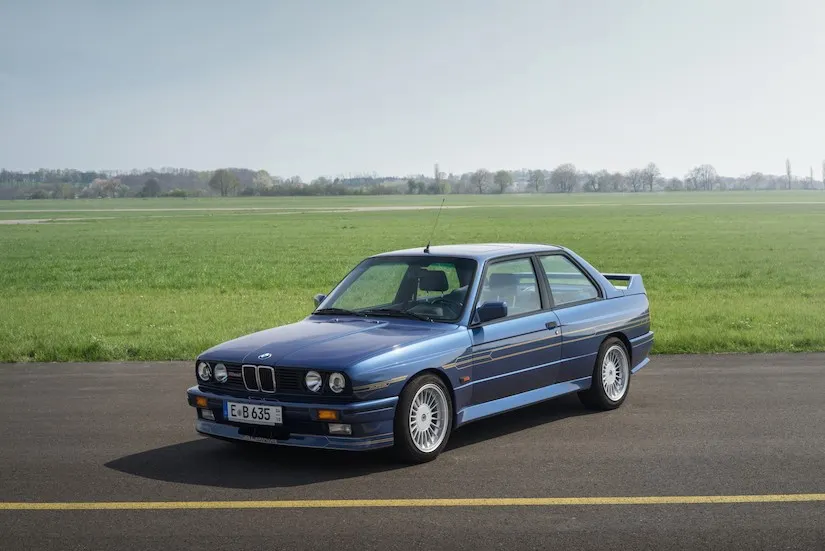
But the racing blood never fully disappeared. In 1987, ALPINA returned to the track. This time in the DTM, Germany’s touring car championship, with the BMW ALPINA M3 Group A. And they did it with a gesture that defined the brand: they installed metallic catalytic converters on their race cars. The first in DTM history. While every other team chased every tenth of a second regardless of emissions, ALPINA proved that performance and responsibility could coexist. Ellen Lohr, Andy Bovensiepen (Burkard’s son), Christian Danner, and Fabien Giroix piloted the ALPINA M3s to multiple victories.
In 1988, ALPINA pulled out of DTM again due to factory capacity constraints. Road car production always came first. But the impact was already made: ALPINA had turned metallic catalytic converters into standard equipment for DTM racing cars.
A year earlier, in 1985, ALPINA had already made a radical decision in road car production: equipping all vehicles exclusively with metallic catalytic converters instead of the ceramic units used by the rest of the industry. They were the first manufacturer in the world to do so across their entire range. Years before the major constructors adopted the technology.
1983: The question answered
In 1978, ALPINA unveiled its first complete lineup of its own cars: the B6 2.8, B7 Turbo, and B7 Turbo Coupé. They were the first cars on the market to offer electronic fuel injection across the entire range. The B7 Turbo, with 300 hp, was the fastest sedan in the world at the time.
But the question persisted. Was ALPINA a workshop that modified BMWs, or was it something more?
In 1983, Germany’s Federal Ministry of Transport provided the definitive answer: it registered ALPINA as an independent automobile manufacturer. Not a modifier. A manufacturer. With its own chassis numbers. An ALPINA’s VIN isn’t a BMW VIN with a sticker on top. It’s an ALPINA VIN that replaces the original.
That distinction isn’t bureaucracy. It’s identity. When you buy an ALPINA, your registration document doesn’t say BMW. It says ALPINA. And yet, you can buy your ALPINA at a BMW dealer, service it at a BMW workshop, and it’s covered by BMW’s warranty. A partnership unique in the entire global automotive industry. Sixty years of collaboration built on trust. Without precedent. Approximately 60,000 vehicles built across six decades. Fewer than 2,000 per year. More exclusive than a Rolls-Royce.
The sedan that went toe-to-toe with a Ferrari
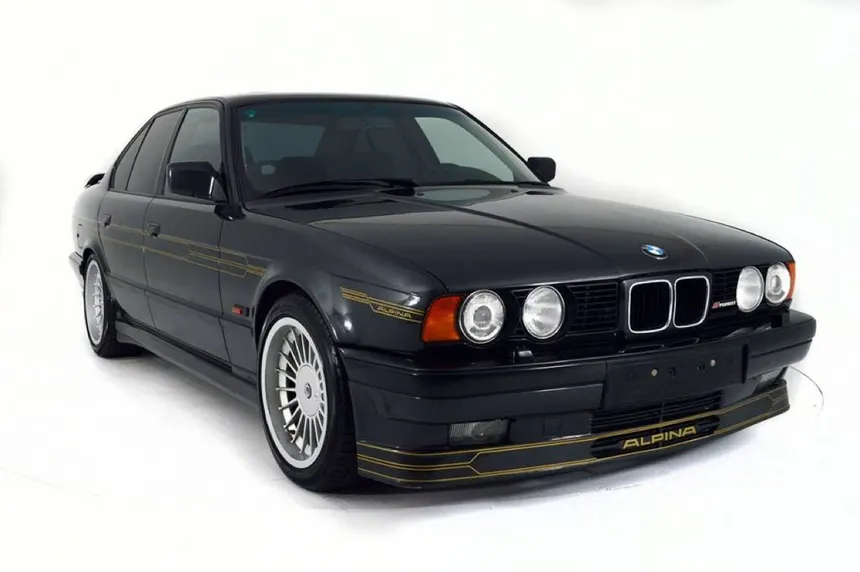
In March 1989, at the Geneva Motor Show, ALPINA unveiled the B10 BiTurbo. Based on the BMW 535i E34. Two years of development. $3.2 million invested in R&D. And the result was the fastest production sedan in the world.
ALPINA’s engineers completely disassembled BMW’s M30 engine. Forged Mahle pistons. Two water-cooled Garrett T25 turbochargers. Bosch variable boost control adjustable from the driver’s seat between 0.4 and 0.8 bar. Reinforced Getrag 5-speed manual transmission. 25 percent limited-slip differential. Bilstein suspension at the front, Fichtel & Sachs with hydraulic ride-height control at the rear. Lucas Girling 333 mm front discs with four-piston calipers — larger than those on the M5.
The result: 360 hp at 6,000 rpm. 520 Nm at 4,000 rpm. 0 to 100 km/h in 5.6 seconds. Top speed above 290 km/h. A Ferrari Testarossa, which cost considerably more, posted similar numbers. And it didn’t have four doors.
Paul Frère, legendary Belgian journalist and racing driver, wrote in Road & Track’s September 1991 issue: “For me this is the car. I think this is the best four-door in the world.”
It cost 146,800 Deutsche Marks. Nearly twice the price of a BMW M5 E34. And it became ALPINA’s best-selling model up to that point. 507 units were built between 1989 and 1994. Production ended because BMW discontinued the M30 engine. The final 50 engine blocks were shipped specifically to Buchloe so ALPINA could assemble the last 50 B10 BiTurbos.
Innovations that didn’t make noise
ALPINA was never the brand that shouted. It was the brand that did things others didn’t and let time prove it right.
In 1992, the ALPINA B12 5.7 Coupé debuted the Shift-Tronic system. The following year came Switch-Tronic: a sequential semi-automatic gearbox that allowed gear changes from the steering wheel, without a clutch, Formula 1 style. In a road-going coupé. In 1993. Years before paddle shifters became commonplace.
In 1999, ALPINA unveiled the D10 BiTurbo: the most powerful diesel sedan on the market with 245 hp. While the tuning world looked at diesel with contempt, ALPINA saw what others couldn’t. Torque. Efficiency. Grand touring capability. Diesel wasn’t a fuel for vans. It was a fuel for engineers who understood thermodynamics.
And in 2002, the ALPINA Roadster V8 marked the brand’s official entry into North America. A convertible based on the Z8 that combined V8 brutality with ALPINA craftsmanship. The first ALPINA to touch American soil.
Each of these cars was built in a way that sounds impossible today for a 300-employee company: engines were hand-assembled at the Buchloe workshop. Each engine passed through the hands of specialists with years of experience. Components were machined internally on proprietary CNC centers. And every model underwent two years of development testing at Miramas, Nardò, the Nürburgring, the Alps, Colorado, the Middle East, and Death Valley before receiving production approval.
Fewer than 2,000 cars per year. More exclusive than Rolls-Royce. And yet, most people on the street didn’t even know they existed.
The detail that explains everything
There’s a fact about ALPINA that sounds made up but is completely real: since 1979, ALPINA has operated a premium wine import division for the German market. Burkard Bovensiepen saw no contradiction. Excellence was excellence, whether it came in the form of a 360 hp sedan or a Barolo.
That detail says more about ALPINA than any spec sheet. This wasn’t a company obsessed with horsepower and lap times. This was a company obsessed with doing things extraordinarily well. If that meant importing wine, wine was imported.
The end of an era
On October 12, 2023, Burkard Bovensiepen died at age 87 after a long illness. He left behind six decades of automotive history, approximately 60,000 vehicles built, and two sons — Andreas and Florian — who had been running the company since 2002 while he focused on the wine business.
But the final chapter was already written. In March 2022, BMW Group announced the acquisition of the ALPINA brand rights. They didn’t buy the company. They bought the name. The existing collaboration agreement would remain in place until December 31, 2025.
Andreas Bovensiepen explained it plainly: BMW approached ALPINA in 2021 and told them the future was electric, that emissions regulations, software validation, and driver assistance requirements made survival impossible for small-series manufacturers without the backing of a major group.
Andreas made the decision to let go of the name and keep the company. ALPINA Classic now services the approximately 40,000 surviving vehicles from the roughly 60,000 produced over 60 years.
January 1, 2026: Goodbye and hello
On January 1, 2026, brand rights officially transferred to BMW Group. ALPINA ceased to exist as an independent entity. It is now BMW ALPINA, a standalone brand within the group, positioned between BMW and Rolls-Royce. The Bavarian equivalent of what Mercedes-Maybach is to Mercedes-Benz.
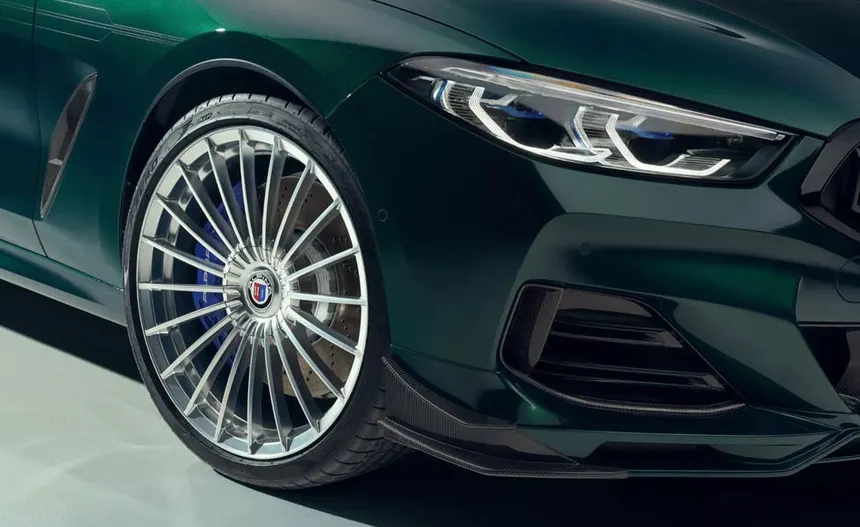
BMW unveiled a new logo. Cleaner, more modern, but retaining the classic elements: the crankshaft and carburetor body that have defined ALPINA since the 1960s. The 20-spoke wheels remain. The ALPINA colors remain. The first new BMW ALPINA will be a B7 based on the facelifted 7 Series, with production expected in late 2026.
But there’s one detail that summarizes this story better than any press release. Andreas and Florian Bovensiepen haven’t retired. They’ve founded a new company: Bovensiepen Automobile. Their first car debuted at Villa d’Este: a pillarless coupé based on the BMW M4 Convertible with Zagato-designed bodywork and 600 hp.
The ALPINA name is no longer theirs. But the Bovenspiepens are still building cars.
Because the typewriters have been dead for decades. The wines are still being sold. And the instinct to turn a BMW into something BMW didn’t know it could be remains alive in the DNA of a family from Buchloe, deep in Bavaria, in the shadow of the Alps.
Check you’re still alive.
2 thoughts on “ALPINA”