The day sim racing stopped being a hobby
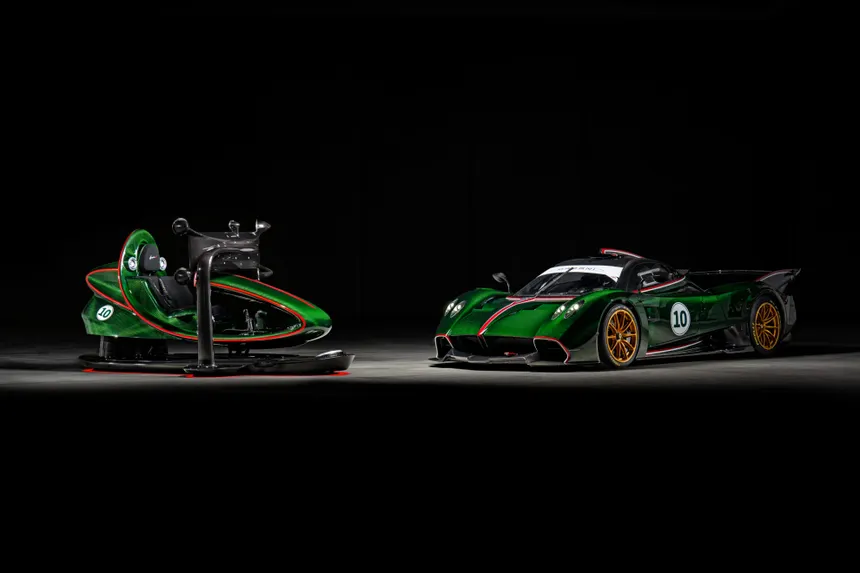
Pagani sells you a six-figure simulator with the Huayra R. And it isn’t a gift.
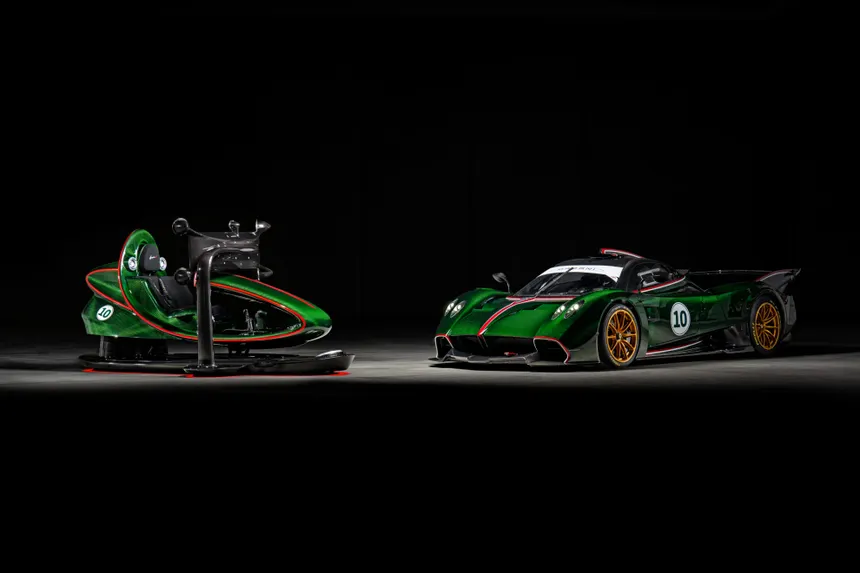
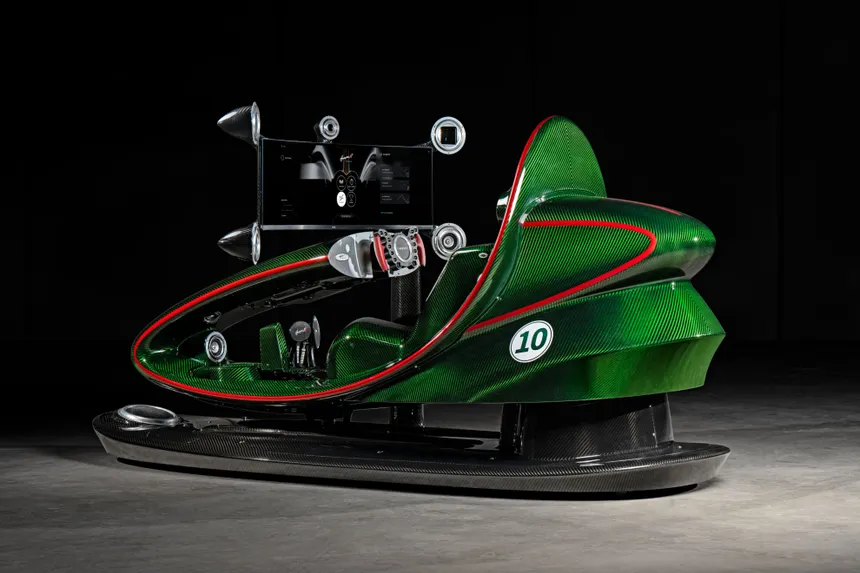
You open a box. A big one. Three metres and eleven centimetres of carbon fibre with a green tint that looks like it came out of an Italian artisan workshop — because that’s exactly where it came from. Inside the box there isn’t a car. There’s something that looks like one. A seat. A steering wheel. Pedals. Three curved screens. A sculptural structure that replicates, down to the millimetre, the cockpit of a hypercar that costs 2.6 million euros.
It’s not a car. It’s the simulator of a car. And the most striking thing isn’t what it is — it’s who delivers it to your door and why.
When Pagani sells you a Huayra R, they bring you this along with it. Not as a gift. Not as a commercial gesture. As a working tool. Because without it, you probably wouldn’t live long enough to enjoy the real car.
That sentence — that idea — is what kills sim racing as a hobby.
The car that needs a simulator
Let’s talk about the Huayra R before we go back to the simulator, because if you don’t understand the car, you don’t understand anything that follows.
Thirty units. Only thirty in the entire world. Starting price: 2.6 million euros plus taxes, as confirmed by Pagani itself when the car was unveiled in 2021. Track only. No road homologation, there never will be, there was never any attempt. It’s a car built for one thing only: being pushed to the limit on the world’s most prestigious circuits by customers who paid the equivalent of an indie film’s production budget for the privilege.
The engine is a 6.0-litre naturally aspirated V12 developed from scratch by HWA AG — the same HWA that has run Mercedes-AMG’s competition operations since 1999, founded by Hans-Werner Aufrecht, the “A” in AMG. It’s not an off-the-shelf engine adapted for the job. It’s not an existing block with modifications. It’s a new engine, built specifically for this car, delivering 850 horsepower at 8,250 rpm and 750 Nm of torque between 5,500 and 8,300 rpm, with a redline at 9,000 rpm and a weight of just 198 kilos. The whole car weighs 1,050 kilos dry. Do the maths.
The aerodynamics generate 1,000 kilos of downforce at 320 km/h. Almost its own weight pressing it into the tarmac. To give you a sense of what that means: at that speed, the Huayra R could theoretically drive upside-down inside a tunnel. Physics gets weird when you push numbers like these.
Inside the cockpit it has ABS and ESP — yes, electronic aids, contrary to what you might expect from such an extreme machine — but they’re minimal aids, calibrated for competition, which won’t save you if you enter a corner thirty kilometres per hour faster than the car can tolerate. Controls sit on the steering wheel, Formula 1 style. Engine maps. Brake bias. Suspension calibration. Pit radio. It’s a car that demands you know what you’re doing before you even try.
And here’s the problem. The typical Huayra R customer isn’t a professional driver. They’re a collector with money. Someone who’s driven road-going supercars, maybe some club-level race cars as a serious amateur, but never anything with the downforce, specific power output or limit behaviour of a full prototype. Putting that customer in the Huayra R without preparation is, literally, manufacturing an accident.
That’s where the simulator comes in.
What Pagani built
Pagani didn’t just order a simulator from a supplier and slap their logo on it. They signed with Racing Unleashed, a Swiss company founded in 2018 in Cham by serial entrepreneur Francisco Fernandez, with its production facility in Maranello — yes, that Maranello, Ferrari’s hometown, a twenty-minute drive from Pagani’s headquarters in San Cesario sul Panaro. The same company that today produces McLaren Racing’s official Motion Simulator.
They started working together in 2020. They spent over a year just on the design. What came out is something you’re unlikely to see anywhere else.
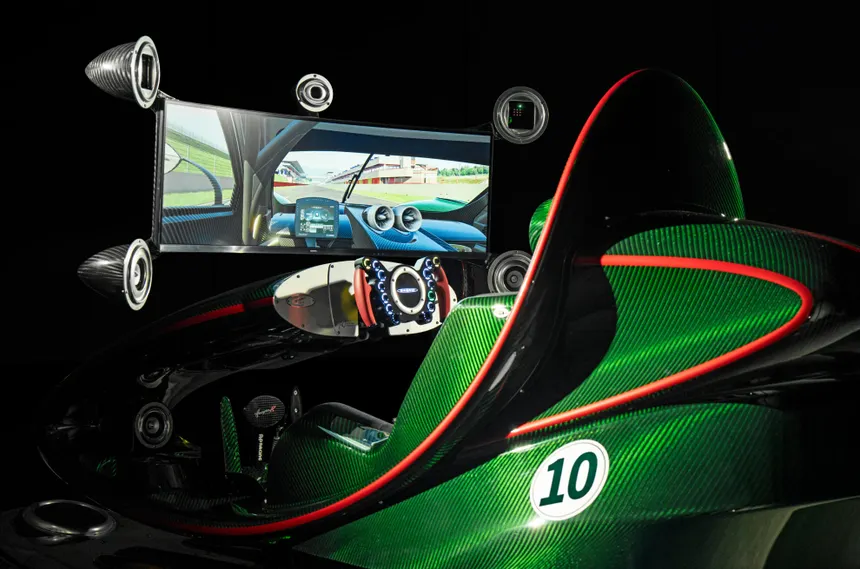
The simulator’s chassis measures 3,110 millimetres — three metres eleven — and is built in carbon fibre. And here’s the detail that should break your brain: that carbon fibre isn’t a generic material bought from a supplier. It’s carbon fibre cured in the same autoclaves as Pagani’s Atelier. The same ovens where the real Huayra’s body panels are cooked. The simulator shares its production line with the car. The same paint. The same processes. The same artisanal obsession.
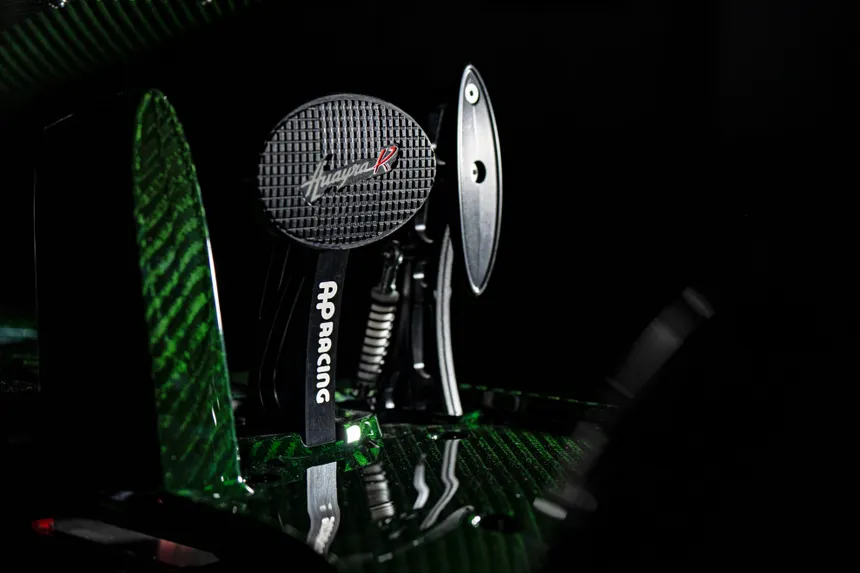
The seat, steering wheel, pedals and belts are exactly those of the Huayra R. Not replicas. The same components that come off the hypercar’s assembly bench, taken directly from there and fitted to the simulator. Some aluminium elements from the Hi-Fi system and the VR system are machined from solid billet — machining from solid — the same process used on the real cars.
The software is Assetto Corsa Pro. Not Assetto Corsa Competizione — the one enthusiasts know. Not regular Assetto Corsa either. It’s a custom, physics-focused version that Kunos Simulazioni develops for professional use. On that base, Pagani’s vehicle dynamics team rebuilt the Huayra R’s physics from the ground up. Then they did the crucial part: they put professional drivers and development pilots through back-to-back sessions between the simulator and the real car, tuning the physics model until the sensations matched. When a professional tells the engineers something doesn’t feel right, the engineers don’t argue. They adjust.
The motion system offers three degrees of freedom — pitch, roll and yaw. The belts are active: they simulate longitudinal and lateral acceleration forces by pressing on the driver’s body the way the car would on track. The 5.1 audio system features integrated kickers in the seat that reproduce the V12-R’s vibrations, recorded during actual track sessions. There’s an ABS emulator that helps modulate braking at the grip limit, exactly the way the real ABS behaves. Curved display or VR compatibility, depending on the configuration.
The price is in six figures. Pagani doesn’t publish the exact figure. If you’re on the list to buy a Huayra R, the simulator is available through the brand’s international dealer network. If you’re not on that list, it doesn’t matter.
The deeper question: why you need it
Here’s the thesis I want you to walk away with before we go any further.
Pagani didn’t build this simulator to impress you. They built it because they run a programme called Arte in Pista, a series of non-competitive events at FIA-grade circuits around the world — Le Mans, Spa-Francorchamps, Monza, Yas Marina, Imola — where owners of their track-only hypercars come together to drive their cars with full technical support from Pagani’s team: track engineers, mechanics, physiotherapists, nutritionists and driving coaches. It’s one of the most exclusive owners’ clubs on earth and arguably the best aftersales programme in the supercar world.
The simulator exists so that owners familiarise themselves with their cars and with the circuits before actually driving them. So that the first time the client brakes at Eau Rouge doing 300 km/h, they’ve already done it two hundred times virtually. So that the first time they feel 1,000 kilos of downforce pressing them into the seat at Parabolica, it isn’t a surprise. So that when the car starts talking to them — and cars like this talk a lot — they know what it’s saying.
This isn’t a luxury. It’s risk management. A client who wrecks a Huayra R on the opening lap of their first track day isn’t just a lost customer. It’s a PR problem, an insurance problem, a brand image problem. Pagani would rather spend six figures on a simulator per client than risk that outcome.
And what they’re saying without saying it is this: sim racing isn’t entertainment. It’s infrastructure. It’s part of the car’s purchase package. It’s in the spec sheet.
Sim racing reached F1 before it reached your living room
To understand why this makes sense, you need to know that sim racing as a professional tool didn’t start with hypercars. It started much earlier, and it started at the very top of world motorsport.
McLaren was the first Formula 1 team to prove that a driving simulator could be a useful tool for developing a high-performance car. Back in the mid-2000s, they opened a technical gap. Ferrari and Toyota, on their end, were quietly exploring similar technologies. From that point, the thing exploded. Today, every single team on the grid — literally all ten — operates a factory simulator. These aren’t small installations. They’re dedicated rooms at team headquarters, with aerospace-grade motion platforms, hyper-sophisticated physics engines, wraparound projection systems or LED screens surrounding the driver. McLaren’s simulator, tucked inside the McLaren Technology Centre, is one of the team’s most tightly guarded assets.
How much does one of these cost? Dynisma, founded by an engineer who previously led McLaren’s simulator team and also worked with Ferrari, sells its DMG-1 model — visuals, computing, vehicle models and terrain models included — in the region of two to three million pounds. That’s the price of a professional simulator. The custom factory rigs used by top teams cost even more.
Usage is constant. During a Grand Prix weekend, while Lando Norris and Oscar Piastri race on track, back at the MTC there are simulator drivers — Oliver Turvey and Will Stevens — running the same circuit in real time, exploring alternative setups, helping the team make strategic decisions. The simulator doesn’t switch off when the race driver gets into the car. It spins up.
That’s one piece. The other is that the race drivers themselves use the simulator as a learning tool. Fernando Alonso, during his McLaren years, burned hours of virtual time in the MP4-30 before every Grand Prix. The data a driver generates in a simulator at this level is directly comparable to real car data. It correlates. It validates. That was the historical shift — the day sim data became useful data, the sim stopped being a toy and became a tool.
Verstappen: the driver who lives with a steering wheel in his hands
Max Verstappen is a four-time Formula 1 World Champion. You know that part. What you probably don’t fully realise is how deeply sim racing is woven into his daily life.
In 2015, aged eighteen, he joined Team Redline, one of the most prestigious sim racing teams in the world. Since then he’s competed in iRacing at the highest level, with an account under his own name and — according to insiders in the sim racing community — another account under his father Jos’s name, used as a “smurf account” to race without being instantly recognised. At the iRacing Bathurst 12 Hours he posted a qualifying lap 0.45 seconds faster than the next driver. In professional sim racing, where conditions are identical and there’s no traffic to navigate, a margin like that is monstrous.
His home setup includes a Playseat F1 Ultimate cockpit designed in collaboration with F1 teams, a Simucube 2 Pro wheelbase, Heusinkveld Ultimate+ pedals, triple 32-inch curved displays. He runs iRacing for endurance training, rFactor 2 for custom physics and F1-comparable tyre models, Assetto Corsa Competizione for GT3 and GT4 work. He uses MoTeC i2 Pro and VRS telemetry to analyse brake traces, throttle curves, steering angles. The same telemetry tools as in the real car. The same level of analysis.
In May 2024, during the Imola Grand Prix weekend, while his grid rivals rested and prepared for the race, Verstappen raced simultaneously in the virtual 24 Hours of Nürburgring on iRacing with Team Redline. The man doesn’t stop. For him, sim racing isn’t an alternative to real racing. It’s part of the same profession.
Lando Norris — the reigning World Champion, title won in 2025 with McLaren — tells a similar story. Yes, he started karting at eight and became the youngest CIK-FIA KF World Championship winner ever in 2014, breaking Lewis Hamilton’s record. That’s his official path into motorsport. But in parallel, from the age of nine or ten, he had a Logitech setup at home and got into iRacing and rFactor. While he was still playing Gran Turismo on PlayStation with a gamepad, he was already moving into serious simulators. Lando has said it in interviews: he loved karting, but he loved sim racing just as much.
Today Norris races with Team Redline, like Verstappen. This year he won a 24-hour sim racing event with Verstappen as his team-mate. It’s not an anecdote, it’s a routine. There’s a subset of current F1 drivers — few, but enough to change the landscape — for whom sim racing isn’t training: it’s another professional discipline running in parallel.
And here’s the sentence you need to absorb. Sim racing is today a professional sport with its own economy. Team Redline, the squad Verstappen and Norris race for, is a professional organisation with contracts, sponsors and a calendar. There are championships — the F1 Esports Series, the 24 Hours of Le Mans Virtual, the iRacing World Championship — with six-figure prizes and audiences measured in millions. There are pure sim racing professionals who don’t compete in real motorsport and whose entire livelihood is this. If Verstappen decided tomorrow to leave F1 and live exclusively off sim racing, he could. It’s not hypothesis. It’s market reality. When a sport has professional structure, its own economy, stars who live exclusively from it and a proven pathway into real motorsport, it stops being a hobby — even if you play it from your sofa.
From a teenager’s bedroom to Formula 2
Now the part that closes the loop.
For years, sim racing as a pathway into real motorsport was a nice idea with no hard evidence. There were anecdotal cases. There were marketing programmes. But nobody had really made it to the top via that route. Until Jann Mardenborough came along.
- Cardiff, Wales. A nineteen-year-old on a gap year, playing Gran Turismo 5 on his PlayStation. A menu option appears: “GT Academy: Try-Outs”. He clicks. The rest is history: more than ninety thousand participants globally, him in the top twenty in his region, qualifying for the Race Camp at Silverstone, intensive physical and technical training, and a final twenty-minute race at the wheel of a real Nissan 370Z on the Silverstone national circuit. Mardenborough won by eight seconds. Before that day he’d never driven a high-performance car. He’d never been on a racetrack. He hadn’t done karting.
In 2013, he finished third in his category at the 24 Hours of Le Mans. Three years from his first real drive. After Mardenborough came others: Lucas Ordóñez, Wolfgang Reip. GT Academy ran until 2016 and produced a whole generation of professional drivers who’d started without ever touching a car.
The purest case, though, didn’t arrive until 2022. Cem Bölükbaşı, Turkish, made history by becoming the first F1 Esports Series graduate to reach FIA Formula 2. He’d started in motocross at five, had done national karting, but in 2017 he jumped into F1 Esports racing for Scuderia Toro Rosso Esports, where he finished fifth in the series’ inaugural edition. In 2019 he made the jump to real cars in the GT4 European Series. In 2021, Euroformula Open. In 2022, Formula 2 with Charouz Racing System. F1 Esports itself put it this way: he’s the first esports racer to compete in a top-flight single-seater championship.
Bölükbaşí said it without flinching in an interview: if he’d never been in F1 Esports, he’d never have had the chance to get into a real car. Sim racing didn’t pave his path — it built his entry door.
The quiet democratisation
What cost two or three million pounds in an F1 factory simulator a decade ago? No, that hasn’t come down. Top-end hardware hasn’t dropped that much. What has dropped — dramatically — is the tier immediately below. A professional simulator with a motion platform, direct-drive wheel, hydraulic load-cell pedals and physics-grade software is today within reach of a serious enthusiast for a sum that, while still substantial, fits into the budget of someone who used to buy a weekend sports car.
Dynisma, the company run by McLaren’s former simulator chief, sells its DMG-1 as a turnkey solution adaptable to any category. Racing Unleashed operates lounges in Zurich, Munich and Madrid where anyone can pay for a session on the same hardware used by Pagani’s customers and McLaren’s team. Consumer manufacturers like Fanatec, Simucube and Heusinkveld sell hardware that ten years ago lived only in professional drivers’ training centres.
The cascade exists. It’s real. At the top sits the Huayra R and its six-figure sister simulator. A couple of rungs down, the F1 team factory sims. A couple of rungs further down, the simulators used by F2 and F3 junior academies scouting for talent. A couple of rungs further down, the professional training centres accessible to the public — if you have the money. And at the bottom, millions of people with a home setup who take what they do deadly seriously, and who — statistically improbable but real — occasionally produce someone like Mardenborough or Bölükbaşı.
How much it costs to cross the line
Talking about democratisation without giving numbers is vapour. Let’s put concrete figures on the table, valid as of 2026, so you know exactly what it costs in euros to cross the line separating “game” from “tool.”
Serious entry threshold — roughly 600 to 800 euros. This is where it stops being gaming. A Moza R5 — 5.5 Nm direct-drive wheelbase — comes bundled with wheel and load-cell pedals for around 600 euros. For a hundred euros more, you step up to the R9, the 9 Nm version that’s the actual entry point to professional hardware. Proper direct drive: no gears, no belts, motor driving the axle directly, just like in a real car. This tier is the inflection point. Here the hardware stops simulating driving like a video game and starts transmitting you useful information about what the tyre is doing. Your brain switches modes.
Middle tier — between 2,500 and 3,500 euros. Now we’re in accessible professional territory. A Simucube 2 Sport sits at around 1,050 euros. Add Heusinkveld Sprint pedals — the tier immediately below the Ultimate+ — and a rigid aluminium cockpit. Total: between 2,500 and 3,000 euros well spent. This is the setup used by junior academies at many teams, by professional sim centres, and by real club racers training at home. With this kit, a serious enthusiast can compete online in iRacing’s top categories without being held back by the hardware.
Accessible pro — around 4,500 to 6,000 euros. Simucube 2 Pro — 25 Nm of torque, around 1,500 euros at current exchange rates — Heusinkveld Ultimate+ pedals starting at about 1,190 euros, a professional wheel from Cube Controls or Ascher Racing, rigid aluminium cockpit, ultra-wide curved display. This is the hardware Verstappen and Norris use at home. Literally. Same wheelbase, same pedals. The gap between this and what’s inside F1 factory simulators is no longer the contact hardware — it’s the motion platform, and that still costs two to three million pounds and won’t fit in a living room.
Software. Beyond hardware, the subscription. iRacing — the professional standard — costs about 13 dollars a month or 110 dollars a year, plus additional car and track licences at 11.95 or 14.95 dollars each. Assetto Corsa Competizione is a one-off purchase under fifty euros. Add rFactor 2 if you want F1-comparable physics. Realistic software budget per year: between 150 and 300 euros.
The conclusion is simple. What existed ten years ago only in professional drivers’ training centres fits today in a room in your house for the price of a family holiday. Hardware is no longer the barrier. The barrier — it always was — is time, discipline and the willingness to analyse your own telemetry until it hurts.
Where the simulator ends and the real car begins
If the physics model is precise enough. If the wheel’s force feedback is faithful enough. If the sound is recorded from the real engine. If the active belts simulate accelerations with the fidelity we’ve been promised. If the displays wrap around you or you’re wearing VR goggles. What difference is left between the simulator and the real car?
The answer is simple, and it’s brutal. The risk.
If you lose control in the simulator, nothing happens. You spin off, tap the wall, the screen goes black for a moment, you restart the lap. Not in the Huayra R. In the Huayra R, at 320 kilometres per hour, with 1,000 kilos of downforce, no airbag, no visible roll cage from outside, no concessions — if you lose control, the car kills you. That’s the only difference left.
And that difference is exactly what justifies both things. The simulator doesn’t replace the car. The car doesn’t make the simulator unnecessary. One prepares you for the other. One is the consequence of having done the other properly.
That’s why Pagani sells you both. That’s why Verstappen races twenty-four virtual hours on a Grand Prix Friday. That’s why Mardenborough reached the Le Mans podium without ever doing karting. That’s why F1 Esports produces F2 drivers. That’s why the McLaren Technology Centre has a room with a simulator running in real time while Norris and Piastri are in Las Vegas.
Sim racing started in a living room, with a gamepad and a copy of Gran Turismo. Today it equips F1 drivers, discovers real talent in virtual academies, comes bundled with 2.6-million-euro hypercars hand-built in Italy, and produces champions. It isn’t a hobby. It never fully was.
We were slow to notice.
Check you’re still alive.