
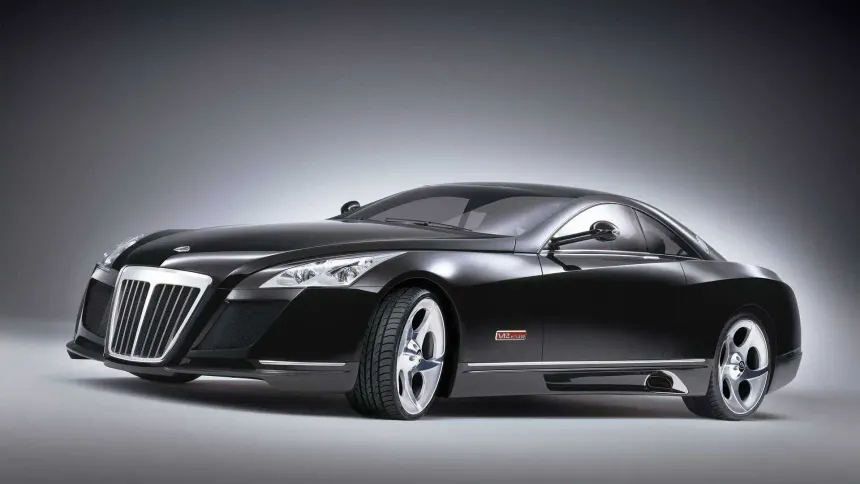
MAYBACH EXELERO: THE $8 MILLION CAR NOBODY KNOWS WHO OWNS
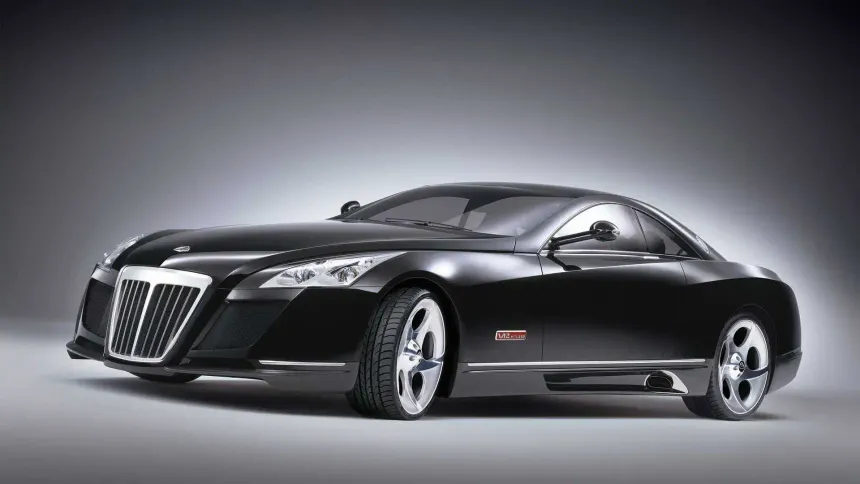
There are expensive cars. There are exclusive cars. There are one-of-a-kind cars. And then there’s the Maybach Exelero. A car of which only one exists on the entire planet, built to test tyres, appeared in a Jay-Z music video, was supposedly purchased for $8 million by a rapper who never paid, and whose real owner remains a mystery wrapped in black leather and carbon fibre.
If someone tells you they’ve seen it all in the automotive world, tell them the Exelero story. Because this story makes no sense. And that’s precisely why it’s perfect.
It all begins in 1938. And it begins with tyres.
Fulda, a German tyre manufacturer founded in 1906, needed a car to test its high-performance rubber. Not just any car. A heavy, powerful one, capable of sustaining speeds above 200 km/h over prolonged periods. So they commissioned the Frankfurt-based coachbuilders Dörr & Schreck to build a special vehicle. Dörr & Schreck chose to collaborate with Maybach Motorenbau and with aerodynamicist Baron Reinhard Koenig-Fachsenfeld.
The result was the Maybach SW 38 Stromlinienfahrzeug — an aerodynamic coupé with self-supporting bodywork based on the Maybach SW 38 chassis, with a six-cylinder engine producing 140 hp capable of exceeding 200 km/h. A dream machine for 1938. It was completed in July of that year.
But then World War II came. And the car disappeared physically. The actual vehicle has never been found. Only period photographs and documentary records of its existence survive. The car was most likely lost during the conflict, and no one has managed to trace it since.
Fast forward 65 years. It’s 2003. Fulda, now a German subsidiary of Goodyear, wants to repeat history. They have a new generation of ultra-high-performance tyres — the Fulda Carat Exelero — with diameters up to 23 inches. And they need a car to push them to their limits.
But the stakes are much higher than in 1938. This time, the car has to reach and sustain 350 km/h. Not 200. 350.
Fulda contacts Mercedes-Benz. Mercedes hands the project to its ultra-luxury division: Maybach. And so, in a Stuttgart office, an idea is born that shouldn’t work but ends up becoming one of the most impactful creations in automotive history.
The brief was clear: build a one-off car, based on the Maybach 57 platform, that pays homage to the original SW 38, is capable of exceeding 350 km/h, and serves as ambassador for Fulda’s new tyre range. No limits on imagination. No limits on budget.
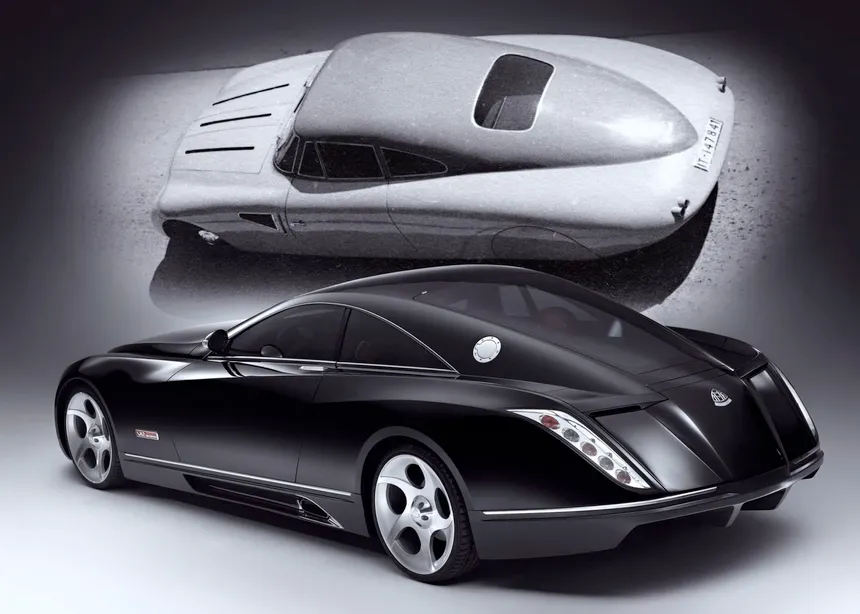
The design was entrusted to four students from the Transportation Design Department at Pforzheim University of Applied Sciences, under the direction of Professor Harald Leschke, working alongside DaimlerChrysler’s professional designers. It wasn’t the first time Fulda had collaborated with Pforzheim — in the 1990s they had designed a show truck together.
Nine months later, from among the proposals submitted, Fredrik Burchhardt’s design was chosen. He was a 24-year-old student. His sketch was exactly what Fulda wanted: a massive, menacing coupé, with lines echoing the original SW 38 but reinterpreted with an aggression that looked like it had escaped from a Batman film.
Construction was assigned to Stola, a company specialising in prototypes and vehicle studies based in Turin, Italy. Stola handled the chassis, bodywork and interior. The car was built in parallel: exterior, interior and mechanicals were developed simultaneously to meet a deadline of just 25 months from concept to delivery.
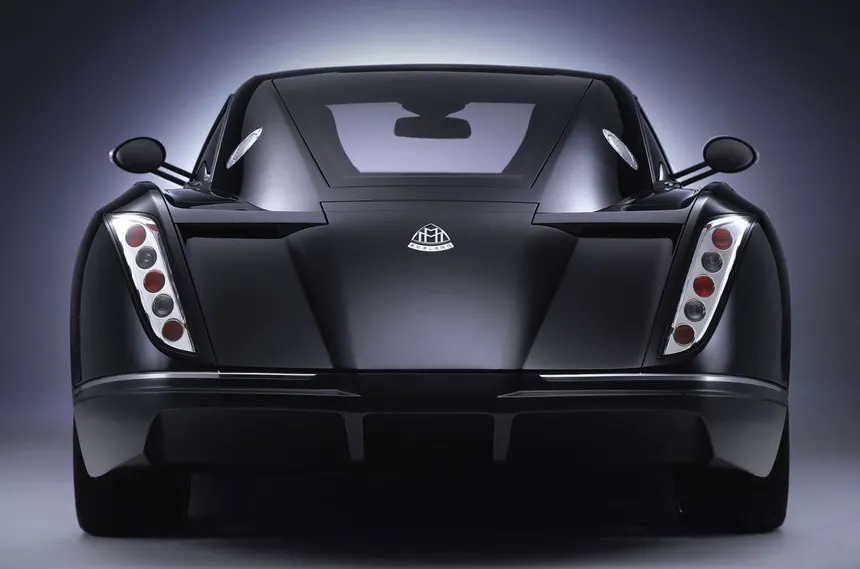
And let’s be clear about something: the Exelero is not pretty. Look at it from the front. The grille is enormous, the bonnet looks like a landing strip, and the roofline drops too soon for a car nearly six metres long. Some people worship it as a rolling sculpture. Others say it looks like an overweight Cadillac in a Batman costume. The Exelero’s aesthetics split every room in half. But that’s precisely what happens when you design a car to intimidate, not to charm. The Exelero doesn’t seek your approval. It demands it.
Now let’s talk about what sits beneath that matte black body.
The base is the Maybach 57 platform, but saying that is like saying the base of a great white shark is a fish. The Exelero shares the basic architecture, but everything else was transformed. The engine is Maybach’s twin-turbo V12 — the same base block fitted to the 57 and 62 — but the engineers at Untertürkheim took it to another level.
Displacement was increased from 5.6 to 5.9 litres. The turbochargers were optimised. The intercooler was enlarged. The radiator was improved. After more than 100 hours of continuous bench testing — equivalent to roughly 15,000 kilometres of real driving — the engine was ready. The numbers: 700 hp (515 kW) at 5,000 rpm and 1,020 Nm of torque at 2,500 rpm. That’s 150 hp more than the standard Maybach 57.
The transmission is a 5G-Tronic five-speed automatic — outdated even by 2005 standards, when the rest of the industry was already running six and seven-speed units. But it was the only gearbox in the Maybach family capable of digesting 1,020 Nm of torque without tearing itself apart every thousand kilometres. All power goes to the rear axle.
Consider the dimensions of this car. It’s longer than the Maybach 57 — over 5.9 metres in length, 2.1 metres wide. It weighs 2,660 kilograms. It’s a two-seater coupé with the dimensions of a small van. And it has to do 350 km/h.
The tyres — because ultimately it all revolves around the tyres — are Fulda Carat Exelero in size 315/25 ZR 23. 23-inch alloy wheels at all four corners. Brakes are ventilated discs with ABS.
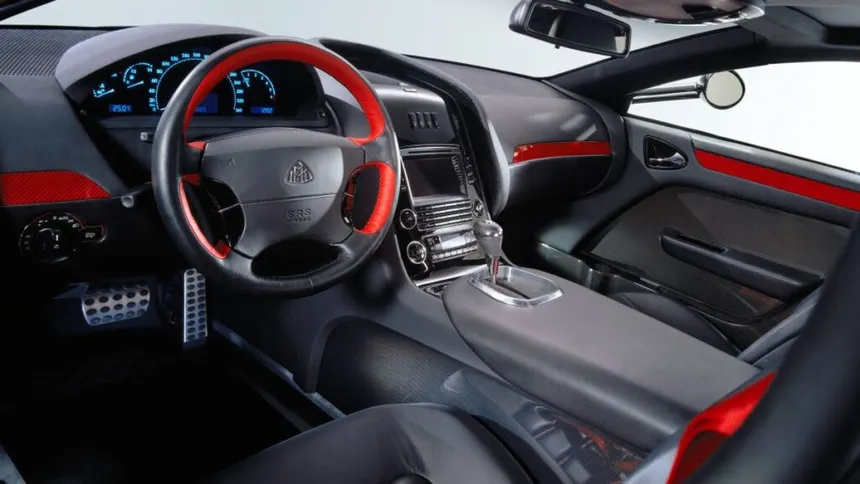
The interior is pure darkness. Black and red leather, neoprene, glossy black carbon fibre, aluminium accents. Sport seats with red harness-style seatbelts. None of the limousine opulence of a conventional Maybach. This car was designed to do one thing: go incredibly fast in a straight line while bearing brutal weight on four rubber tyres.
May 1, 2005. 5:45 in the morning. The high-speed circuit at Nardò, in southern Italy. A 12.5-kilometre oval. The Italian sky dawning radiantly blue.
Behind the wheel, Klaus Ludwig. Three-time DTM champion. Winner of the Le Mans 24 Hours and the Nürburgring 24 Hours. Not an amateur with connections. A real racing driver.
Ludwig waits for the start signal. The preceding weeks had been an endless sequence of tests: wind tunnel, roll-out in Turin in March, break-in at Sindelfingen in April, technical inspection on DaimlerChrysler’s test track at Papenburg. Different spoiler positions were tried. Everything adjustable was adjusted. The TÜV — Germany’s technical inspection authority — verified every safety component. Seats, belts, weight distribution. All approved.
At 7:09 in the morning, the signal sounds.
And the Exelero, with its 2,660 kilograms of steel, aluminium and carbon fibre on four 23-inch tyres, begins to accelerate on Nardò’s oval.
The result: 351.45 km/h.
World record for limousines on production tyres.
From 0 to 100 km/h in 4.4 seconds. In a car that weighs as much as two Volkswagen Golf Mk5s combined — 2,660 kg versus roughly 1,300 kg each.
Fast? Depends how you look at it. In 2005, a Ferrari Enzo did that sprint in 3.3 seconds. A Porsche Carrera GT in 3.5. A Bugatti Veyron in 2.5. But none of those weighed two and a half tonnes or rolled on 23-inch tyres. The Exelero isn’t quick off the line. It’s quick at endurance. Its merit isn’t the 0-100. It’s sustaining 350 km/h with the weight of a small tank on four strips of rubber.
Mission accomplished. The Fulda Carat Exelero tyres had proven they could withstand that weight, that speed and those forces over a sustained period. The car had justified its existence.
And here is where the Exelero story becomes something else entirely. Because after the record, the car had to go somewhere. And that “somewhere” became one of the most absurd mysteries in the automotive world.
Maybach put the Exelero up for sale at $5 million. The first buyer was André Action Diakité Jackson, a diamond industrialist. Jackson lent the car to Jay-Z for the “Lost One” music video in 2006. In the video, Jay-Z leaves a luxury apartment building, is handed the keys to the black Exelero, and spends the rest of the clip rolling through the streets in it. Some outlets reported that Jay-Z had bought the car. That wasn’t true. He only borrowed it.
Afterwards, the car passed to Arnaud Massartic, a European entrepreneur, for an undisclosed sum.
In 2011, Massartic put the Exelero on the market for $8 million. And this is where Birdman enters the picture.
Bryan Williams — Birdman — the American rapper, publicly announced he was buying the Exelero. He even said he’d respray it in bright red. The news spread like wildfire. Top Gear reported that Birdman had purchased it. Hip-hop media took it as fact. The $8 million figure was repeated everywhere.
But reality was different. Birdman didn’t pay. According to multiple sources, he couldn’t raise the funds. The car never changed colour. And the money transfer was never confirmed.
The Exelero ended up in the hands of Frank Rickert, founder of Mechatronik, a Mercedes-Benz specialist company based in Germany. When Supercar Blondie filmed a video with the car years later — being one of very few people ever to drive it — the Exelero was in Mechatronik’s care. Still black. Still intact. And nobody would give a clear answer about who the real owner was.
In 2023, the car appeared at the Nationales Automuseum The Loh Collection, in Dietzhölztal, Germany. A private collection of around 150 unique cars owned by businessman Friedhelm Loh. Whether the Exelero was purchased by Loh, donated, or is on semi-permanent loan is something nobody has publicly confirmed.
What is certain: a car built to test tyres, which has appeared in hip-hop music videos and episodes of German police dramas, now rests in a museum in a town in Hesse.
And a point of precision that almost nobody makes: no one has ever paid $8 million for the Exelero. That was Massartic’s asking price. Jackson originally bought it for $5 million. After that, the car changed hands for undisclosed sums. The “$8 million” exists in clickbait headlines and in Birdman’s mouth, but not on any confirmed receipt.
And a footnote that closes the circle in a way nobody expected: Stola, the Italian company that built the Exelero, was so impressed with their own work that they released their own version of the concept, the Stola Phalcon. The plan was to build 25 units. It never happened. Stola was absorbed by Blutec in 2014 — nine years after the Exelero — and years later fell victim to a corruption scandal that ended with the owner arrested and the company declared bankrupt in 2020. The car, meanwhile, remains untouched.
There’s something poetic about that. A car designed by students and built by a company that would eventually collapse under the weight of financial scandal, yet the car itself endures. Unblemished. Still wrapped in the same matte black skin it wore when Klaus Ludwig pushed it past 350 km/h on a May morning in southern Italy. Everything around it — the brand that commissioned it, the company that built it, the rappers who claimed to own it — has changed, crumbled, or been exposed as smoke. But the car remains.
That’s what happens when you build something for a single, clear purpose and execute it without compromise. The Exelero had no identity crisis. It wasn’t trying to be a luxury cruiser or a track weapon or a status symbol. It was a tyre-testing machine that happened to look like the villain’s car in a film that hasn’t been made yet. And because it had that clarity of purpose, it transcended its own brief.
Put it alongside the great one-offs — the Ferrari P4/5, the Lamborghini Egoista, the Rolls-Royce Sweptail — and the Exelero holds its own. Not because of its pedigree or its price, but because of the sheer improbability of its existence. No committee should have approved this car. No budget should have covered it. And yet here it sits, in a museum in rural Germany, proof that sometimes the automotive world produces something that defies every rule of common sense and comes out the other side as art.
The Maybach Exelero is not a supercar in the classical sense. It wasn’t designed for corners. It wasn’t designed for the track. It was designed to go in a straight line at the speed of a light aircraft on four rubber tyres, while carrying the weight of a small tank. And it accomplished that mission flawlessly.
But what makes it a legend isn’t the speed. It’s the absurdity of its existence. A car that cost millions to develop in order to test tyres. A car of which only one exists. A car that has passed through the hands of a diamond industrialist, a rapper, a tuning company and a museum. A car that Birdman swore to buy and never paid for. A car designed by a 24-year-old student. A car that pays homage to another car that vanished during World War II and whose whereabouts remain unknown.
The Exelero is proof that the greatest automotive stories aren’t in the record books. They’re in the margins. In the absurd projects that should never have existed but which, precisely because they were impossible, become immortal.
Check you’re still alive.