LAGONDA: THE BRAND THAT ALMOST MADE IT
Lagonda has been on the verge of greatness for 120 years. It has never arrived. They won Le Mans. The finest engine W.O. Bentley ever designed carried their name. David Brown bought them the same year he bought Aston Martin. And yet, if you stopped someone in the street and asked them what Lagonda is, you’d get a blank stare.
That’s the paradox. Lagonda has had more talent, more genius, and more flashes of brilliance than brands worth ten times more. But it has never found its place. Always almost. Always nearly. And here’s the most unsettling part: after 120 years without any sustained commercial success, it still isn’t dead. In the car industry, that is harder to explain than winning Le Mans.
And one of the rarest pieces of the entire Lagonda story — an Aston Martin Lagonda fitted with the Tickford sports kit, one of only five ever made — sits ninety minutes south of Valencia, at the Museo del Motor in Finestrat. But we’ll get to that at the end.
The opera singer who couldn’t stop building things
Wilbur Gunn was born in 1859 in Springfield, Ohio. Son of a Methodist minister. Near his hometown ran a creek the Shawnee people called Lagonda — a word meaning “trail of the imprints left by the deer.” Gunn trained as an engineer with the Singer Manufacturing Company, but what he really wanted was to sing. He was a tenor. In 1891, past thirty, he crossed the Atlantic for England, toured with the Carl Rosa Opera Company for three seasons, and performed at Kensington Town Hall in London. But opera in Victorian England didn’t pay enough. Or he wasn’t good enough. Either way, the outcome was the same.
By 1904, Gunn had abandoned music and settled in Staines, Middlesex. He built a steam yacht called the Giralda that became the fastest boat on the Thames. Then he started assembling motorcycles in the greenhouse of his house at 6 Thorpe Road. The factory that would later become Causeway Works literally grew outward from that greenhouse. In May 1904 he registered the Lagonda Motor Cycle Company Ltd. The bikes won medals: gold at the 1905 London–Edinburgh Trial, a British entry in the International Cup Races. But Gunn always wanted more than what he had. That was both his gift and his curse.
Russia, innovation, and a war that killed him slowly
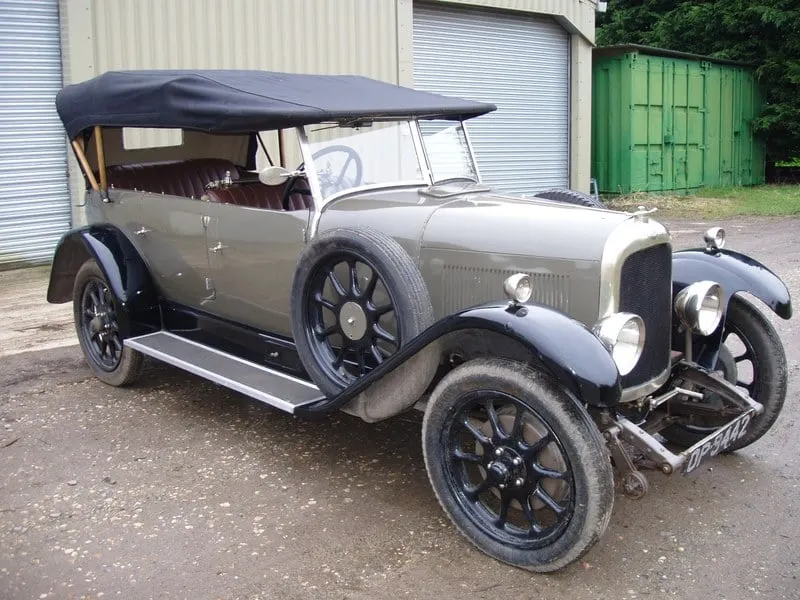
In 1907, the first car arrived: the Torpedo, a 20hp six-cylinder. Heavy, expensive, nearly indestructible. In 1910, Gunn got behind the wheel of a 16/18 and won the Moscow–St. Petersburg reliability trial — four hundred miles in 24 hours on roads that barely qualified as such. Russia wanted tough cars. Lagonda built them with reinforced chassis, heavier axles, and 20hp engines tuned for cold and mud. Those Russian exports kept the company alive until 1914.
But Gunn wasn’t just building brutes. The 11.1, a tiny four-cylinder with a mere 1,000cc, carried an anti-roll bar, a riveted monocoque body built from tinned steel sheet on an angle-section framework, and the first fly-off handbrake ever fitted to a production vehicle. Primitive unitary construction, decades before the idea had a name. By 1914, Lagonda had built approximately 200 cars. Every one hand-made. Every one engineered with an obsessiveness that larger manufacturers couldn’t match.
Then the war came. The Staines factory stopped making cars and started producing artillery shells — fifty thousand a week. Gunn worked punishing hours for four years straight. He never recovered. When peace came and the 11.1 returned to production, Gunn was a broken man. In May 1920, he drove in competition for the last time, at the London to Manchester Trial. He died in September. He was 61.
The opera singer who built steam yachts and motorcycles in a greenhouse was gone before he could see what his brand was about to achieve. Another “almost” in a story made entirely of them.
Le Mans 1935: the night Lagonda peaked — and it changed nothing
After Gunn’s death, three directors led by Colin Parbury took over. Lagonda turned seriously sporting. In 1925, the 14/60 with its twin-cam, hemispherical-head engine by Arthur Davidson from Lea-Francis. In 1927, the 2-litre Speed Model, supercharged from 1930. And at the 1933 Olympia Show, the machine that changed everything: the M45. A 4.5-litre Meadows straight-six. Over 100 mph in open form.
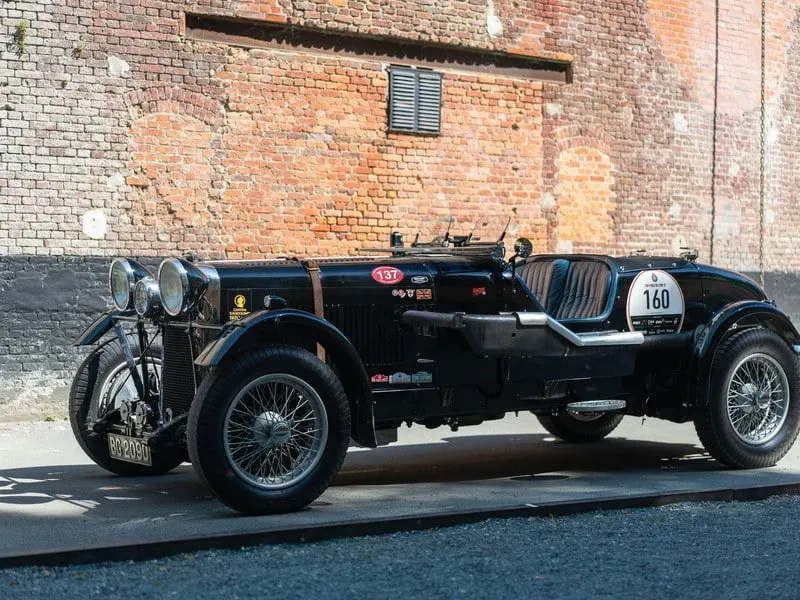
Le Mans. June 15–16, 1935. Alfa Romeo had won four straight years. Nobody expected that streak to break. The Fox & Nicholl team entered two Lagonda M45 Rapides: 4,451cc Meadows engines, 140 bhp. In car number 4: Johnny Hindmarsh, a Hawker Siddeley test pilot who looked twenty years older than he was, and Luis Fontés, a 21-year-old who’d inherited a fortune from his Brazilian shipping-magnate father and was spending it on racing cars and flying lessons. The night before the race, someone noticed every Alfa carried a tail fin. The Lagonda team fabricated one and bolted it on in a rush. It was slightly crooked. Every replica since carries a straight fin. The originals are identified by the wonky one.
Rain. Sommer’s Alfa led early until exhaustion and fuel problems ended him. The favourites fell one by one: Chinetti’s Alfa broke its rear axle, Howe’s holed a piston, Veyron’s Bugatti destroyed its back end. By dawn, only the Alfa of Pierre Louis-Dreyfus — racing as “Heldé” — remained to fight the Lagonda.
Final hour. The Lagonda started losing oil pressure. Fontés pitted again and again. At one point, the car died on track. Fontés walked back to the pits and announced retirement. A mechanic explained how to coax life from the gearbox. Fontés walked back to the car, locked it in top gear, and limped home. Louis-Dreyfus passed them. The Alfa pit crew celebrated, believing they’d taken the lead. They hadn’t. They’d only recovered the lap they’d been behind. The Lagonda crossed the line with a sump full of vapour: 3,006 kilometres, average 125.28 km/h, winning by 8.5 km. And against all British racing tradition, the car was red.
Fontés became the youngest Le Mans winner at that point. Four months later, driving drunk, he killed a motorcyclist in a head-on collision near Coleshill. Three years in prison. Ten-year driving ban. In 1940, at 27, he died when the Wellington bomber he was piloting crashed after takeoff from RAF Llandow. Louis-Dreyfus, the man who thought he’d won Le Mans, lived to 102.
Le Mans was the greatest night in Lagonda’s history. And it saved nothing. The company was already in the red. That is the pattern: Lagonda shines brightest just before it sinks.
Bentley’s masterpiece, built for someone else’s name
- The receivers came in. Alan P. Good bought the company at auction — outbidding Rolls-Royce. Think about that for a second. If Rolls had won, the entire map of British motoring would look different.
But what Good did next mattered even more. He persuaded W.O. Bentley to leave Rolls-Royce — the company that had taken the brand bearing his own surname away from him in 1931 — and join Lagonda as chief designer. Bentley accepted. He brought Stuart Tresillian, Charles Sewell, and design genius Frank Feeley. And in that primitive factory at Staines that he privately loathed, he designed the greatest engine of his career.
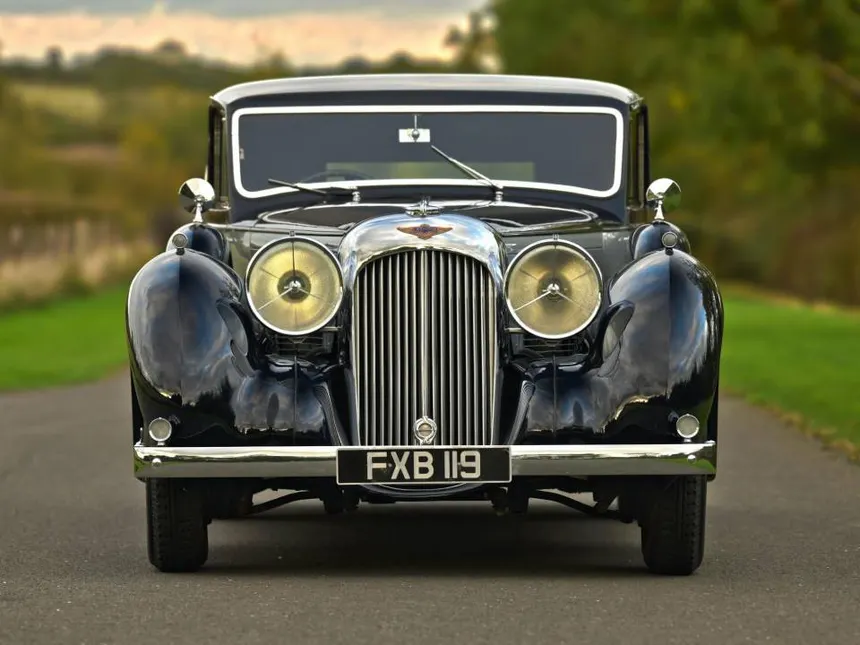
The Lagonda V12. 1937. 4,480cc. 180 bhp. It could pull from 7 to 105 mph without leaving top gear and rev to 5,000 rpm. The Rapide V12 appeared at the 1939 New York Motor Show as the most expensive car on the floor: $8,900. World War II killed it before anyone could properly drive it. The factory went back to shells. And flame-throwers: Lagonda developed the Crocodile and Wasp systems for armoured vehicles.
Here’s the question that defines Lagonda: what does it mean that the greatest engine W.O. Bentley ever designed didn’t carry his name, but someone else’s? It means Lagonda was where genius ended up when it had nowhere else to go. A refuge for brilliance without a market. That is what Lagonda has always been.
Swallowed whole: Aston Martin devours Lagonda
In 1947, David Brown bought Lagonda. A year earlier he’d bought Aston Martin. He merged them at Feltham, Middlesex. On paper, two brands. In reality, one consumed the other.
Bentley’s final prototype — a 2.6-litre twin-cam six — became the foundation for Aston Martin’s engines throughout the 1950s. Lagonda fed Aston Martin from inside, receiving no credit, no name on the marquee. The 1961 Rapide — four doors, aluminium body by Carrozzeria Touring of Milan, 55 units — was Lagonda’s last real attempt at existing as its own car before becoming what it truly was from 1947 onward: a name that Aston Martin pulled from a drawer when convenient and put back when it wasn’t.
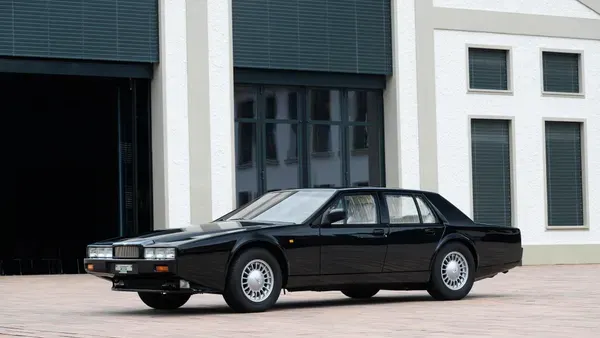
William Towns’ wedge in 1976 — 645 units. The Vignale concept in 1993. A handful of converted Virages in 1994. The SUV concept of 2009. The Taraf in 2015: 120 cars, 5.9-litre V12, one million dollars, the title of most expensive production saloon in the world, and demand that never materialized — they planned 200, built 120. The all-electric Vision Concept in 2018 promised autonomy, 400 miles of range, and a zero-emissions future. Cancelled. In 2024, Lawrence Stroll declared the Lagonda revival “completely dead.”
Seven attempted comebacks. Seven failures. And the name still exists. That isn’t a car brand. That is an idea that refuses to die.
What Lagonda actually means
A hundred and twenty years. No sustained commercial success. A Le Mans victory in a car running on fumes. The greatest engine Bentley ever built. An absorption that turned it into Aston Martin’s organ donor. Seven resurrections. Seven burials.
The easy take is that Lagonda is a failure. But defeats don’t last 120 years. Mistakes are forgotten. Lagonda has never been forgotten. Every decade, someone with power and money looks at that name and says: “This needs to come back.” And they try. And they fall short. And the name survives the attempt.
Lagonda is not a brand that collapsed. Lagonda is proof that surviving without success, in an industry that destroys everything that doesn’t sell, is harder than winning Le Mans with an empty sump.
Wilbur Gunn named it with a Shawnee word that nobody outside Ohio understood. Built it in a greenhouse. Funded it with motorcycle prizes and Russian export orders. And when he died, the brand continued. When the factory closed, the name continued. When Aston Martin swallowed it whole, the name continued. When every concept car was cancelled, the name continued.
And one of the rarest pieces of that entire story — an Aston Martin Lagonda with Tickford sports kit, one of only five ever made — sits ninety minutes from Valencia, at the Museo del Motor in Finestrat. But that’s another story.
Check you’re still alive.
2 thoughts on “LAGONDA”