
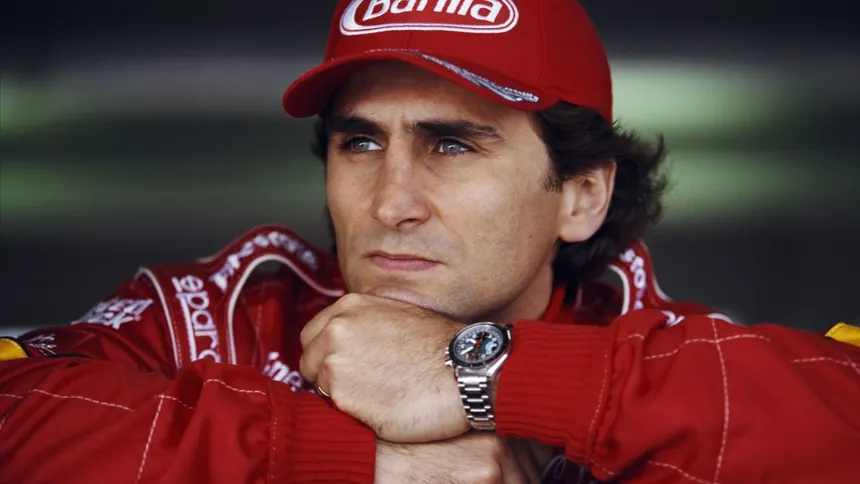
Alex Zanardi is gone. And we have nothing left to ask of him.
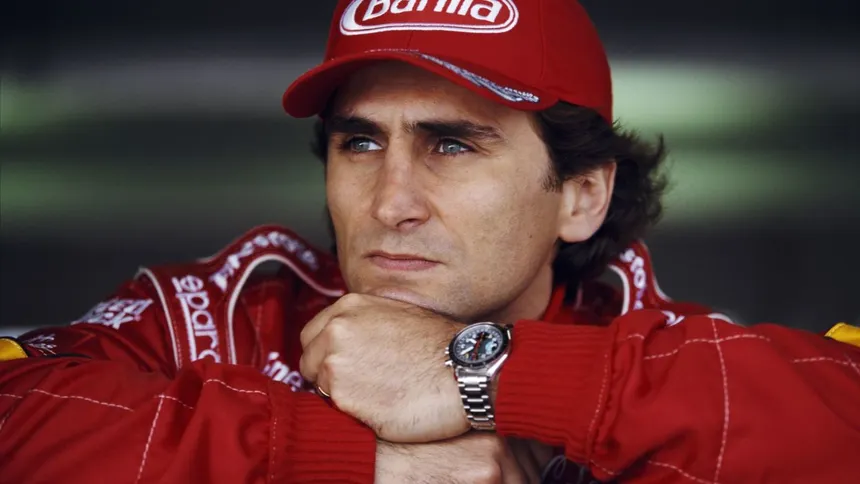
The man rebuilt himself twice. Three times if you count the kid in Castel Maggiore who built his first kart out of scrap metal because his parents wouldn’t sign off on what he wanted to do with his life. Alex Zanardi died on the night of May 1st, 2026. Fifty-nine years old. Surrounded by his family. The statement his wife Daniela and son Niccolo released on Saturday morning was short. Peaceful. No cause specified. Privacy requested. And the rest of us have been left staring at the screen trying to figure out how to write about a man who refused, every single time, to accept the version of himself the world handed him.
So let’s not pretend this is an obituary. Obituaries are for people who finished one thing. Zanardi finished about four.
The Bologna kid
Born in Bologna in 1966. Raised in Castel Maggiore, on the flat plain of Emilia-Romagna where Ferraris come from and where everyone’s uncle ran a workshop. His sister died young in a car accident. His parents wanted him as far away from racing as possible. He understood. Then he ignored them and built his own kart.
That, right there, is the entire Zanardi philosophy in one sentence. He understood your reasons. He just didn’t think they applied to him.
He climbed the European junior ladder fast and reached Formula 1 with Jordan in 1991, finishing ninth on debut at the Spanish Grand Prix and ninth again in Australia. Then Minardi. Then Lotus in 1993 and 1994, where his best F1 result came at the Brazilian Grand Prix — a sixth place that, in a Lotus 107C with engine money running out and the team weeks from financial collapse, was punching far above the car’s weight. Forty-one Grands Prix in total across his F1 career. Williams brought him back in 1999, paired him with Ralf Schumacher, and the partnership produced nothing the cold history books care to remember. He was dropped before the season ended. F1 was the chapter where the math never worked. The talent was there. The car wasn’t. Or the team wasn’t. Or the timing wasn’t. Pick your reason. None of it ended up mattering.
Because he had already found the country that understood him.
America, where the European with bad timing became a god
CART in the late 1990s was, to put it bluntly, more entertaining than Formula 1. Faster on most circuits. Closer racing. Drivers from every nation pushing each other in cars from Reynard, Lola and Penske, with Honda, Mercedes-Benz, Ford and Toyota engines beating each other into submission every race weekend. Zanardi arrived at Chip Ganassi’s Target operation in 1996 and immediately began driving in a way Americans hadn’t seen a European drive before — aggressive, late on the brakes, sliding the car into apexes that didn’t have room for him. He won twelve CART races over three seasons. Two championships back to back, 1997 and 1998. After every win, the donut. Burning the rear tyres on the start-finish straight. The crowd losing their minds. His signature.
And then the moment that defined him on track, before the moment that defined him as a human. Laguna Seca, 1996. Last lap. He’s chasing Bryan Herta for the win. The Corkscrew is a downhill double-apex left-right that no one passes anyone in. Zanardi sent his Reynard down the dirt on the inside, off the racing line, off the track in any reasonable definition of the word, and came out ahead. The pass became the most replayed overtake in CART history. It was technically illegal under modern rules. It was beautiful under any era’s rules. He laughed about it afterward.
He returned to Europe to drive for Williams in F1, the partnership failed, and in 2001 he did the only thing that made sense — went back to America.
September 15, 2001. Lausitzring.
That weekend the CART championship raced in Germany only because they were already there. The September 11 attacks four days earlier meant the series couldn’t immediately fly back to the United States, so they ran the German 500 with the world still in shock. Zanardi was leading the race with thirteen laps to go. He pitted, came out on cold tyres, lost the rear of the car at the pit exit, and slid sideways across the racing surface. Alex Tagliani, coming the other way at near top speed, hit him squarely. Zanardi’s car was cut in half. He lost both legs above the knee on the spot. He lost roughly five litres of blood before reaching the helicopter. He survived because the FIA medical team at the circuit happened to be one of the best in the world that year, and because he refused to die.
Recovery took the better part of two years. In 2003, he went back to the Lausitzring oval in a specially adapted Champ Car, completed the thirteen laps he’d never finished in 2001, and ran them at a pace that would have been competitive in a real race. He didn’t call it a tribute. He called it unfinished business. Different framing. Same act, different meaning. That was Zanardi.
What BMW Motorsport actually did
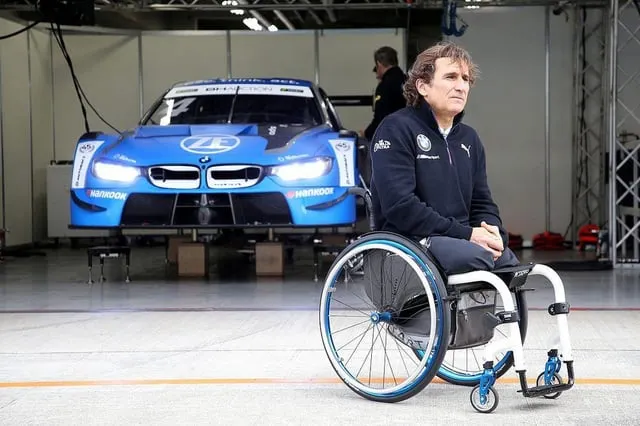
The BMW 320i E46 WTCC car that Zanardi raced from 2005 onwards was not a sympathy project. The engineers at BMW Motorsport spent years working with him on the adaptive controls. A throttle ring on the steering wheel, operated with the right thumb. A clutch button on the gear lever. A brake pedal modified so his prosthetic right leg could be physically attached to it, with the braking force coming from his hips driving the prosthetic downward. Manual sequential gearbox shifted with his right hand. Same chassis, same engine, same regulations as every other car on the grid. Just a different human-machine interface.
European Touring Car Championship in 2003 and 2004. Then the full World Touring Car Championship in 2005 with ROAL Motorsport / BMW Team Italy-Spain under Roberto Ravaglia. On August 28, 2005, at Oschersleben, Zanardi won his first FIA World Championship race. He beat Andy Priaulx and Jörg Müller — both able-bodied factory BMW drivers in identical machinery. Three more wins followed: Istanbul 2006, Brno 2008, Brno 2009. Four World Touring Car victories without legs. Over a hundred WTCC races between 2005 and 2009. He was a competitive World Championship driver, not a guest star.
In November 2006, BMW Sauber put him in their F1 car at the Circuit Ricardo Tormo in Cheste. He drove the laps. His times improved each run as he asked the engineers for more data. He became the first bilateral amputee to drive a Formula 1 car. He smiled through the press conference like he always did.
The handbike, and the second gold rush
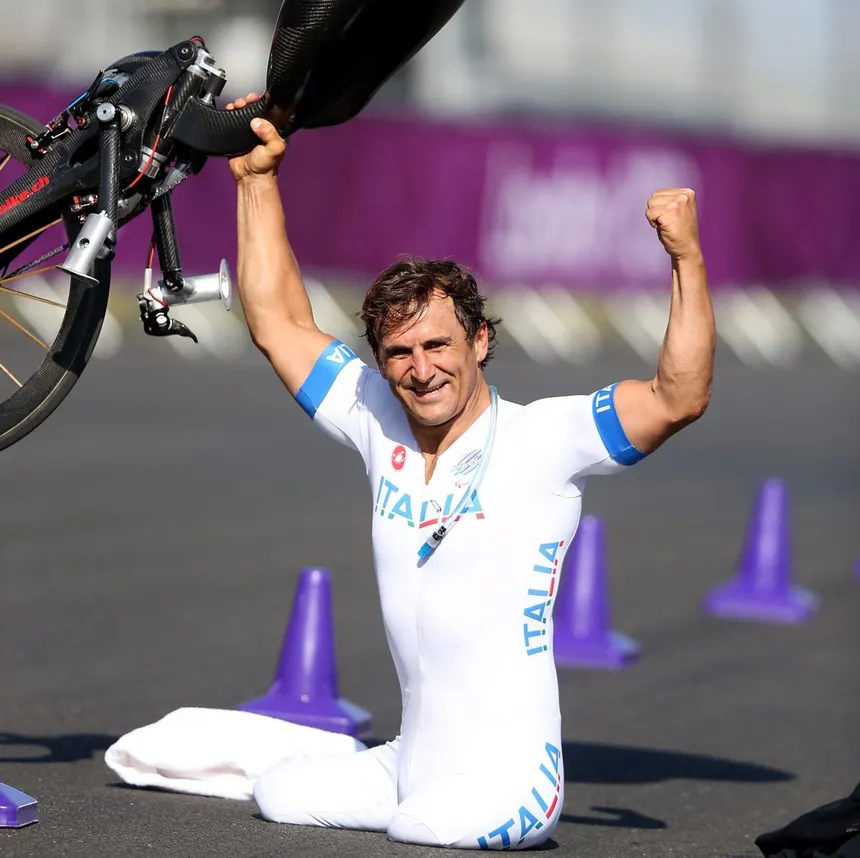
Parallel to all of this — while still racing in WTCC for BMW — Zanardi started training in handcycling. Hand-powered bicycle. Arms doing everything the legs would normally do. Brutal discipline, especially on descents, where the bike weighs roughly what the rider weighs and gravity doesn’t care about your training. London 2012 Paralympics: two golds and a silver. The decisive race ran at Brands Hatch — the same British circuit where he had raced single-seaters as a young driver. He crossed the line, sat down on the asphalt, and lifted the handbike one-handed above his head. The image has been printed on the inside of half the racing helmets in the world ever since.
Rio 2016: two more golds. Four Paralympic gold medals total, six medals overall. World championships in between. A Paralympic career that on its own would justify a Wikipedia page longer than most professional cyclists ever earn.
He designed his own prosthetics. Not metaphorically. Physically. Drew components, argued attachment points with technicians, modified handbike geometry the way an engineer modifies a race car’s suspension. People who visited his house described it as half workshop, half gym. Tools. Prototypes. Unfinished pieces. He treated his own body like a chassis to be optimised — because that’s what, to him, it was. The difference between Zanardi and most amputees was that he didn’t ask for things to be adapted to him. He adapted them himself.
In 2014 BMW signed him as a factory driver for the Blancpain Sprint Series, racing a Z4 GT3. In 2019 he came to Daytona for the 24 Hours, racing a BMW M8 GTE without his prosthetics on. In a paddock that included Fernando Alonso, the most photographed driver was Zanardi.
June 19, 2020. The corner that couldn’t be missed.
Charity handbike race in Tuscany. A descent. He lost the bike on the corner, crossed into the oncoming lane, and a truck hit him head-on. Severe craniofacial trauma. Multiple surgeries. Induced coma. His wife Daniela holding the family together in interviews while medical updates grew more cautious, then more sparse, then nearly nonexistent.
Almost six years. And tonight, May 1, 2026, the body finally stopped negotiating.
What we’re left with
There are racing drivers who leave behind lap times. Some leave behind championships. Zanardi leaves behind something more uncomfortable to file: an idea. The idea that when everything breaks, what’s left is whatever you decide is left. That a body is a machine and machines can be redesigned. That legs are not legs — they’re a way of pushing. And there are other ways.
He wasn’t a symbol. Symbols are static. He was a man with a quick smile making decisions almost no one else makes. Designing his own prosthetics. Arguing with BMW Motorsport engineers like an able-bodied factory driver. Winning World Championship races as a bilateral amputee. And when he had to start over, he didn’t request permission. He just started.
The Bimbingamba foundation he set up to help amputee children is the other side of all this. While he was competing at the top level with adaptive prosthetics, off the track he spent his time giving those kids what he’d had to find on his own — the conviction that the body doesn’t determine what you’ll do. It only determines how. The difference between those two sentences is the difference between giving up and starting over.
The CART donuts. The Oschersleben win. The thirteen laps finished three years late at the Lausitzring. The handbike held one-handed at Brands Hatch. The BMW Sauber laps in Cheste. The kids who learned, watching him, that the answer wasn’t no. All of it was the same thing. A man who understood that a race doesn’t end when the track spits you out. It ends when you decide to climb out of the car. And Alex Zanardi never climbed out.
Until tonight, May 1, 2026. And even now, in fairness, he’s not entirely out of the car. The donuts remain. The Oschersleben 320i remains. The foundation remains. The idea remains. And ideas are the last thing to break.
Goodbye, boss.
Check you’re still alive.