Patrice Banks: The Engineer Who Cracked a $200 Billion Market Failure with a Red Stiletto and a Crescent Wrench
The number you’ll hear is two hundred billion dollars a year. That’s the industry’s own estimate of how much women spend annually in the United States on vehicle purchases and repairs. It’s not an audited figure with decimal precision. It’s a sector-wide estimate, and Patrice Banks has always used it as such. But even if the real number were half that — a hundred billion — it would still be the most important and most ignored figure in the entire automotive industry.
Because the underlying problem doesn’t change with the decimal: women are the majority customer of the automotive sector, and for over a century the industry has built its shops, its language, its tools, and its culture as though that customer didn’t exist. That’s not a fact verifiable with a single data point — it’s an editorial conclusion based on the accumulation of evidence I’m going to put in front of you throughout this article. You decide whether you share it.
Less than 2% of working auto technicians in the US are women. Industry surveys — AAA, J.D. Power, and automotive consumer behavior studies — consistently place above 70% the share of female customers who report having felt dismissed, talked down to, or outright scammed at a repair shop or dealership. Tools are engineered for male grip circumferences. Uniforms are patterned for male body proportions. Technical language is routinely weaponized — sometimes intentionally, often not — with the net effect that the person walking through the shop door already feeling like she doesn’t belong is the same person who will pay the bill without question because she has no way to verify whether the charges make any sense.
An industry that is economically dependent on women and has spent the better part of a century making them feel like outsiders.
Until a DuPont materials engineer from Phoenixville, Pennsylvania decided she’d had enough.
The Numbers Behind the Woman
Patrice Banks didn’t start in a shop. She started exactly where the auto industry wanted every woman to be: behind the wheel, behind a checkbook, and behind on knowledge.
She grew up poor in Phoenixville, PA. Biracial. Daughter of a single mother. Childhood shaped by domestic violence — the kind of starting point that TED talks turn into redemption arcs and real life turns into dead weight. She worked three jobs before turning sixteen. Bought her first car with that money. Not as a teenage status symbol. As an escape route. A literal, physical way to put distance between herself and a household she couldn’t control. Her grandfather taught her to drive. The car gave her the one thing nothing else had: the ability to leave.
That context matters for everything that follows. For Patrice Banks, a car was never a mechanical fetish. It was a freedom tool. And that framing — car as instrument of personal autonomy, not as object of technical worship — is what I believe the auto industry has failed to understand about its primary customer for over a hundred years. You can disagree. The data that follows will make it hard.
She was an honors student at Phoenixville High School. Excelled in math and science. Her mother nudged her toward engineering. She became the first person in her family to graduate from high school. The first to attend college. She earned a scholarship to Lehigh University, where she graduated in 2002 with a BS in Materials Engineering — and where she also competed as a varsity rower. Not a student who clocked in and went home. A Division I athlete who stacked physical discipline on top of academic performance while funding her education through scholarships that nobody in her family had taught her how to find.
She joined DuPont. Over twelve years as an engineer, manager, and team leader at one of the world’s largest science and technology corporations. Six-figure salary. Air-conditioned office. High heels. The version of success that’s supposed to be enough.
It wasn’t.
The Search That Changed Everything
Here’s what Patrice Banks had in common with tens of millions of American women: every trip to the mechanic erased her. A person capable of solving complex materials engineering problems became — in her own words, blunt and unsparing — an “auto airhead.” Not because she lacked the intellect. Because the entire system was designed to make her feel exactly that way.
The mechanic who talked past her. The estimate that explained nothing. The repair she didn’t understand and paid for anyway because she had no way to know whether it was legitimate. As she’s recounted in interviews, a dealer once prescribed a full transmission job on a two-year-old SUV. Two years old.
One day she decided to look for what seemed like an obvious solution: a female mechanic. Someone who might understand the experience. Someone she wouldn’t have to convince that she deserved to be taken seriously.
She searched the entire Philadelphia metropolitan area. Six million people.
Zero female mechanics.
Most people would process that information as personal frustration. Patrice Banks processed it as a market failure. Women hold more driver’s licenses than men in the US. They spend more time on the road. They account for the majority of repair and maintenance spending. And across the entire Philly metro there wasn’t a single female mechanic. Not because women couldn’t do the job. Because no training pipeline, no hiring structure, and no shop culture had ever included them in the equation.
The Bet Nobody Understood
In 2013, Patrice Banks founded Girls Auto Clinic as a concept. But before that, she did something that needs to be understood in full to grasp the scale of what came after: she enrolled in night classes at Delaware Technical Community College to earn an automotive technology diploma.
She was the only woman in the program. Over a decade older than her classmates. She walked up to her instructor on day one and told him exactly what she planned to do: learn everything, then build a shop for women.
After graduating, she learned how to run a repair shop by working for free at a small garage in Philadelphia. For free. A six-figure engineer sweeping floors and changing oil without a paycheck because she needed the firsthand operational knowledge of how a shop actually works from the inside. She moved to a larger shop. A job offer from that second shop was what finally pushed her to leave DuPont in 2014.
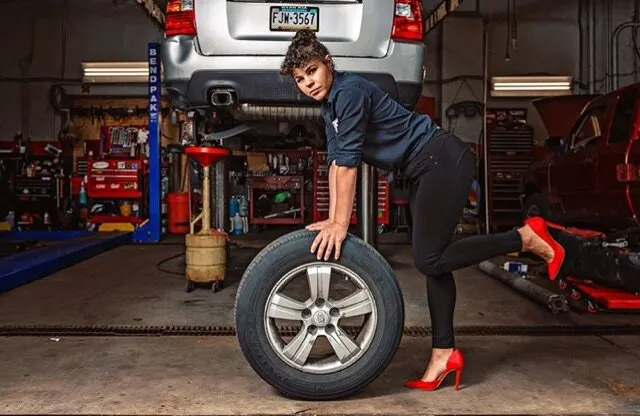
She traded heels for work boots. Climate-controlled offices for grease-covered hands. A secure salary for total uncertainty.
Building What Didn’t Exist
While studying, she started running free car care workshops for women across the Philadelphia area. No venue. No investors. No infrastructure. Just Patrice Banks in a borrowed space teaching women what it means when the oil light comes on — without treating them like they had the comprehension capacity of a ten-year-old.
In 2015, she delivered a TEDx talk at Wilmington University titled “How I Plan to Disrupt the Automotive Industry in Red Heels.” That same year, she published a Washington Post op-ed laying out the numbers.
In January 2017, she opened the physical shop: Girls Auto Clinic Repair Center, Upper Darby, Pennsylvania. And inside, in what used to be a parts storage room, she built the Clutch Beauty Bar — a salon offering manicures, pedicures, and blowouts for customers while their cars get serviced.
This is where most first-time readers fall into the trap of reading it as a gendered marketing gimmick. I think it’s the opposite — and I’ll explain why, but I want to be clear: this is my editorial reading, not a provable fact.
The idea came from direct behavioral observation. Patrice used to go to a Jiffy Lube that happened to be next to a nail salon. She’d watch women leave one and walk into the other. Two trips that could be one. Dead time that could be productive time. The question formed itself: why not under the same roof?
To me, that’s process engineering applied to customer behavior. You could argue it’s still a marketing strategy aimed at a demographic segment — and you’d be right that the line between the two is thin. But there’s a difference between putting a beauty bar in a garage as an aesthetic lure and putting one there because you’ve observed how your actual customer uses her time and removed friction. That difference exists, and I believe Patrice is on the right side of it.
The Mechanics Who Found Her
When word got out that Patrice Banks was opening a shop, something happened that nobody planned. Female mechanics already working in the area — scattered, invisible, operating in environments where being a woman was an anomaly they had to justify every day — started reaching out. One by one. She didn’t recruit them. They found her.
Within a year, she had five women mechanics on staff. Every single one had come to her on their own initiative.
Rich Carney’s story illustrates the culture Patrice created. Carney was a mechanic at the Midas directly across the street. He quit, rolled his tools across the road, and asked to join Girls Auto Clinic. Raised by a single mother, Carney valued a collaborative environment where the competition was against the problem, not against each other.
Seventy-five percent of the clientele are women. Not because the shop turns men away — it serves everyone — but because they’ve built a space where getting your car serviced doesn’t include having to prove you deserve to be treated with respect. Where the mechanic explains what they’re doing, why, and how much it costs. Before doing it.
According to features in TIME and The Philadelphia Citizen, on Friday nights, when the day’s work is done, the crew hops onto an empty car lift and dances together. It’s a powerful image. It says something about what happens when people who’ve spent years working in spaces where they didn’t fit finally find one of their own.
The Girls Auto Clinic logo is a red stiletto with a crescent wrench for a heel. Not an aesthetic choice. A declaration of identity.
The Book, the TV Pilot, the Ford CEO, and an Italian Shoe
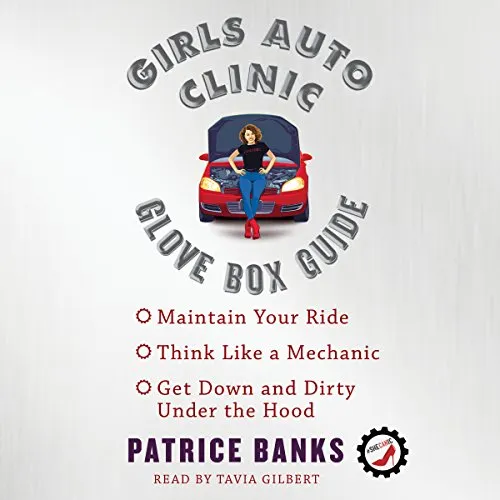
In September 2017, Simon & Schuster published the Girls Auto Clinic Glove Box Guide. Three hundred pages on car maintenance, roadside emergencies, and how not to get ripped off at the shop. She wrote it for the version of herself that existed ten years prior. The New York Times ran a favorable review.
What followed speaks for itself:
NPR’s Fresh Air with Terry Gross. A full-length TIME magazine feature on the shop. Good Morning America. CBS This Morning. Profiles in The Washington Post, O Magazine, Glamour, Car & Driver. The cover of People Magazine — photographed wearing a red shoe crafted specifically for her by Italian luxury firm Barollo, with a heel designed to echo the Girls Auto Clinic logo.
National commercials for Lean Cuisine and Ford. Partnerships with Dell, Honda, and the Girl Scouts of the USA. Ford CEO Jim Farley invited her on his personal Spotify podcast DRIVE. According to Banks in interviews with Forbes, Inc. and other outlets, what was supposed to be a casual coffee at Ford headquarters in Detroit turned into a ninety-minute strategy session with senior executives. I don’t have access to a direct Ford source confirming the details of that meeting, but Banks has recounted it consistently across multiple appearances. Ford featured her in their “Car Girls” campaign for International Women’s Day.
In January 2019, Fox ordered a comedy pilot titled “Patty’s Auto,” inspired by Girls Auto Clinic. Written by Darlene Hunt, creator of Showtime’s The Big C. Produced by Elizabeth Banks and Max Handelman’s Brownstone Productions alongside Warner Bros. Television. Patrice served as consulting producer. Fox didn’t pick the pilot up to series — but the fact that Hollywood came knocking on the door of a repair shop in Upper Darby, PA tells you everything about the reach of what she’d built.
That same year, she got married. Not at a hotel. Not at a country club. At Girls Auto Clinic — in the building she’d bought with her own money two years before. The same floor where she changes oil and inspects brakes.
WOCAN, the SheCANic Foundation, and the Hall of Fame
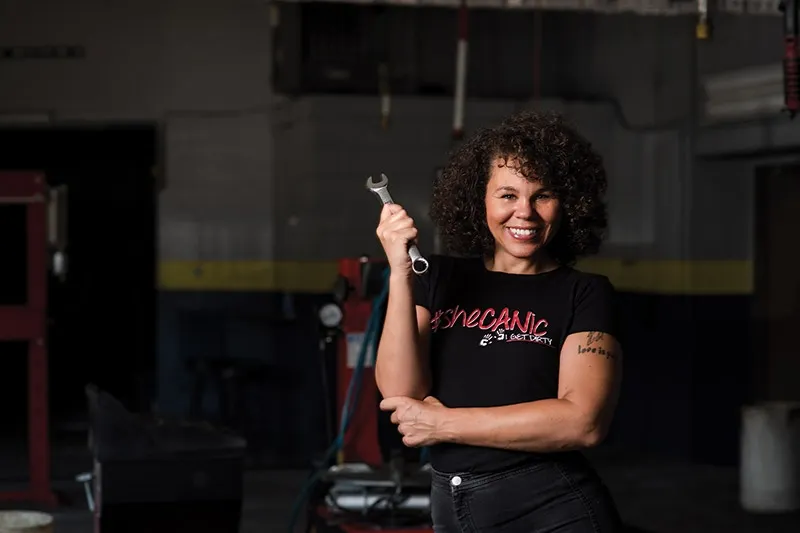
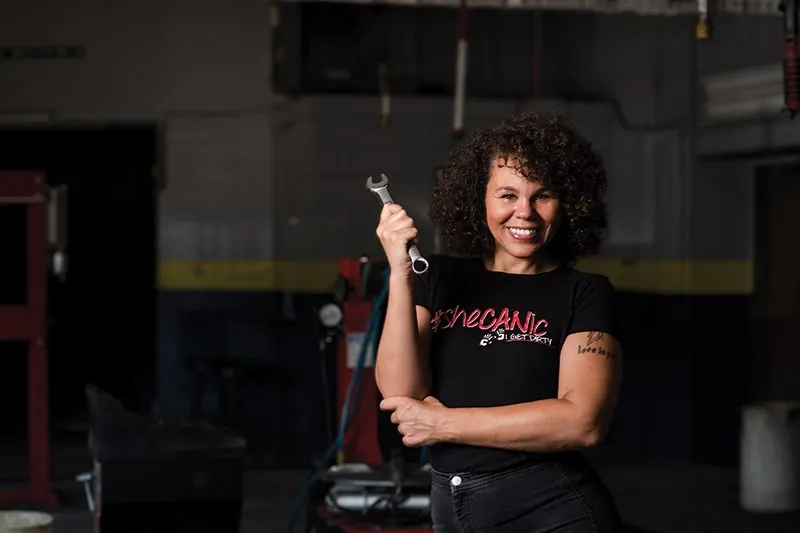
Patrice trademarked the term SheCANic®. Her definition: “a female of any age who has mastered the mechanics of ‘yes I can’ and uses them to get to ‘yes I did.'” The Facebook community grew to over 20,000 members.
In 2019, Lehigh University’s Alumni Association awarded her Outstanding Entrepreneur of the Year.
In 2020, during the pandemic, she co-founded the Women of Color Automotive Network (WOCAN) alongside Amanda Gordon (first Black woman to own a car dealership in Colorado), Kerri Wise (communications executive at TrueCar and AutoFi), and Erikka Wells (sales management at Audi and Nissan). Four women of color who had each succeeded independently across different automotive sectors and decided to build the community that none of them had found when they needed it. Only 6% of automotive jobs are held by women of color — WOCAN exists to change that number. In 2022, it received the Lighthouse Award from the AWA Awards.
In July 2024, Patrice was inducted as an honorary member of Zeta Phi Beta Sorority, Inc., at the Grand Boule in Indianapolis.
In February 2025, she was inducted into the African American Automotive Association Hall of Fame.
What Nobody Usually Says
There’s a conversation that almost nobody has about Patrice Banks. NEC isn’t going to be the one to skip it.
Girls Auto Clinic is still a local shop in Upper Darby, Pennsylvania. A small operation. The media coverage it has received — TIME, NPR, People, Ford, Fox, Hollywood — is disproportionately large compared to the actual scale of the business. There is no chain of Girls Auto Clinic locations. No franchises. No structural disruption of the repair market. There is one shop, one book, one foundation, and an online community.
That doesn’t invalidate anything Patrice Banks has built. But it needs to be said, because the gap between what she has achieved as a symbol, as a role model, and as a voice for a real problem, and what she has achieved as a measurable force of industrial transformation, is significant. The market failure she identified remains largely intact. The 2% of female mechanics is still 2%. The experience of the average female customer at the average American repair shop hasn’t structurally changed.
What she has done is prove that the demand exists, that the model works when someone executes it with competence, and that the market responds when treated with respect. That is the real contribution. It isn’t small. But it’s not the industrial revolution that media coverage sometimes suggests.
My opinion — and it is opinion, not data — is that what Patrice Banks has built matters more as a diagnosis than as a solution. The diagnosis is impeccable: a market of enormous proportions, systematically underserved, that responds immediately when someone addresses it with real competence. The solution, so far, has been local and personal. The real question isn’t whether Patrice Banks was right — she was right. The question is who’s going to scale that diagnosis to an industrial level. And that question remains unanswered.
What This Looks Like from a Train Factory in Spain
I’m writing this from Valencia, Spain. I assemble train doors at a Stadler Rail factory. Before that, I spent decades in automotive workshops and industrial automation. My hands know what a 14-hour day with a torque wrench feels like. I’ve seen from the inside how these environments operate, who feels welcome, and who doesn’t.
And I can tell you — as personal testimony, not as a statistical data point — that the experience Patrice Banks described in Philadelphia in 2013 happens in exactly the same way in Valencia, in Madrid, in Barcelona, and in every major city in Spain where there’s a repair shop. The condescension. The technical jargon as a weapon. The feeling that you’re being charged for something you can’t verify. This is not an American problem. It’s an industry problem.
In Spain, women hold 47% of all driver’s licenses. The vehicle repair and maintenance market exceeds 9 billion euros annually. The percentage of female mechanics is so low that the data isn’t even properly documented.
It’s not universal bad faith. It’s installed culture. A sector that has never had to think about itself from the perspective of its primary customer because that customer never had the voice, the resources, or the role models to demand something different.
I reached out to Patrice Banks on LinkedIn. I told her who I am, where I write from, and why her story deserves to cross the Atlantic. She accepted the connection.
What I want her to find if she reads this isn’t another profile of distant admiration. It’s the analysis of someone who has spent thirty years inside the same industry she diagnosed, written from the other side of the world, with verified data where data exists, caveats where the data isn’t solid, and opinions clearly marked as opinions.
Patrice Banks’ story isn’t an inspirational poster. It’s the most precise diagnosis ever made of the biggest market failure in the automotive industry. A diagnosis made with a materials engineer’s mind, built with her own hands, and scaled without asking anyone’s permission.
That the industry took a century to listen says nothing about her. It says everything about the industry.
Check you’re still alive.
— Toni, Not Enough Cylinders