Ferrari 250 GT Breadvan: The Ferrari Ferrari Refused To Acknowledge
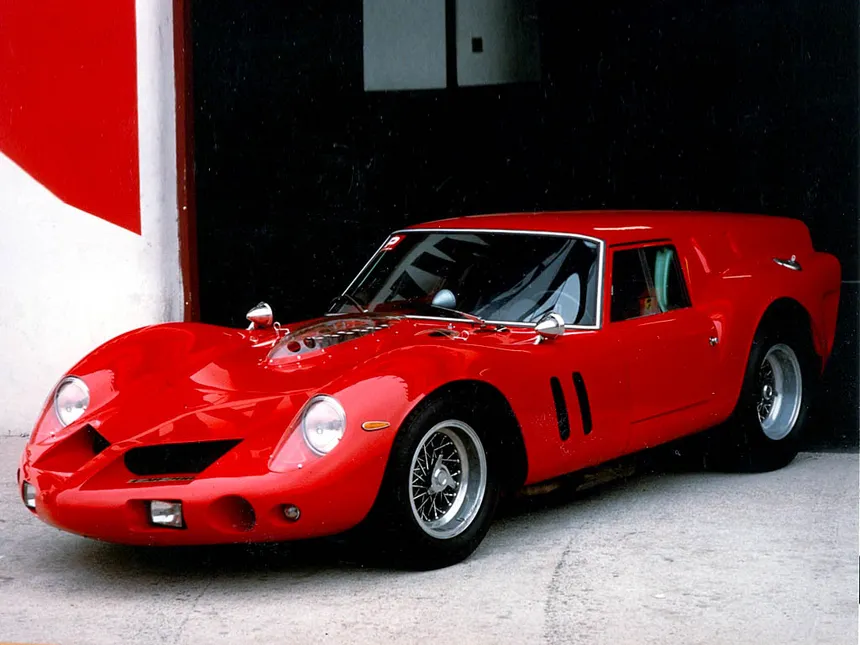
There exists a Ferrari built to destroy Ferrari.
Read that again, slowly, because it isn’t a metaphor.
A car with a Colombo V12, a 250 GT SWB chassis, a body designed by Giotto Bizzarrini, built by coachbuilder Piero Drogo in Modena in roughly two weeks, financed by a Venetian count, and raced at Le Mans 1962 with one single objective: humiliating the man who had thrown its creators onto the street the year before.
It almost pulled it off.
In the early hours of the race, the Breadvan was beating the works Ferrari 250 GTOs. On the Mulsanne straight it was faster than they were. Bizzarrini said so himself in his memoirs: seven kilometres per hour faster than the works GTOs on the most legendary straight in motorsport. All of that with a car a hundred kilos lighter, built in two weeks, on pocket money, by the men Enzo Ferrari had just sacked.
Only one Breadvan exists on the planet.
This is the story Ferrari would rather you didn’t tell.
October 1961: The Day Maranello Cracked From the Inside
To understand the Breadvan, you have to understand what happened inside Maranello in October 1961.
Ferrari had just enjoyed its strongest season to date. Phil Hill had won the Formula 1 World Championship. The 250 SWB was crushing the GT field. The 250 TR was dominating sportscars. The cash registers were singing. The trophies were stacking up. And Enzo Ferrari, at the peak of his power, was receiving regular visits from his wife Laura.
Laura Ferrari wasn’t decorative. She was a partner in the business, a shareholder, a real voice in internal decisions. And that season Laura had begun showing up at the factory with a frequency and an authority the technical staff couldn’t tolerate. Race-by-race calls, hires, firings, budgets — Laura wanted in on everything. Enzo wasn’t pushing back. And the engineers who’d spent years building that house started talking among themselves.
On 30 October 1961, it all went up. In what motorsport history remembers as the palace revolt, eight key Ferrari executives wrote a letter to Enzo demanding management changes. They wanted Laura to stop interfering in operations. It was a red line.
Enzo read the letter.
Then he fired all of them.
Every single one.
Carlo Chiti, head of engineering, the early architect of the 250 GTO project. Out. Giotto Bizzarrini, sporting development engineer, the man behind the most radical technical solutions on the Ferrari race cars. Out. Romolo Tavoni, sporting director, the public face of the team at the circuits. Out. Girolamo Gardini, commercial director. Out. And four more names with less public profile but the same daily centrality at the factory.
Phil Hill, freshly minted World Champion, saw the blood in the water and walked out at the end of the season under his own steam.
In forty-eight hours, Maranello had lost half its technical and sporting brain.
The Count Who Funded the Revenge
Enzo cared less than he should have. He was a man who believed people were interchangeable, and that only Ferrari, the brand, was irreplaceable. He fired eight men and kept moving with Mauro Forghieri, a young engineer who had the house’s full confidence but none of the experience the dismissed men had carried with them.
What Enzo failed to calculate was that those eight men had a way out.
It was called ATS — Automobili Turismo Sport. A new Italian sportscar and Formula 1 brand that was going to compete head-on with Ferrari. The principal financier? Count Giovanni Volpi di Misurata, Venetian aristocrat, son of one of the wealthiest men in Italy, owner of Scuderia Serenissima, a private racing team that until then had been racing Ferrari customer cars. Volpi was a personal friend of both Bizzarrini and Chiti. When they were sacked, Volpi put up the money so they could set up their own operation.
Enzo found out fast.
And he made a decision that would change the history of Ferrari competition cars.
Count Volpi had two Ferrari 250 GTOs on order from Ferrari for the 1962 season — the cars every privateer team wanted to have for GT racing. They were Volpi’s ticket to the season. Without GTOs, no realistic shot at winning anything.
The moment Enzo learned Volpi was bankrolling his ex-employees, he picked up the phone and cancelled both orders.
No further explanation.
No clean refund process.
No alternatives.
Volpi was left without cars for the season and with his Venetian pride bleeding out. What Enzo failed to gauge is what kind of people do when you step on that kind of pride.
The Phone Call That Changed Le Mans 1962
Legend has it Volpi called Bizzarrini and asked him a simple question.
“Giotto, can you build a car that’s better than the 250 GTO?”
Bizzarrini, two months into unemployment and itching to prove Ferrari had made a mistake firing him, gave the answer that defines this whole story.
“Count, I know exactly how to build a better GTO. Because I designed the GTO.”
And he wasn’t lying.
Bizzarrini had been the lead engineer on the 250 GTO project during its aerodynamic development phase. He knew every concession that had been made, every solution that had been ruled out for budget reasons, every millimetre the works GTO was leaving on the table. Now, free of Maranello’s corporate chains, he could build the GTO he would have built if anyone had let him.
Volpi gave him two things: the money, and a Ferrari 250 GT SWB Berlinetta Competizione, chassis number 2819GT, first registered in Modena on 9 September 1961 under the name of coachbuilder Carlo Scaglietti. The first owner had been Belgian aristocrat Olivier Gendebien, multiple Le Mans winner. Volpi had bought the car off Gendebien to race it himself, and now he handed it over to Bizzarrini to do whatever he pleased with it.
Bizzarrini took the car, called Piero Drogo — a Modena coachbuilder who specialised in fast, cheap competition builds — and told him they had two weeks.
Two weeks to build a car that could race at Le Mans.
And beat the works GTO.
What They Pulled Off In Two Weeks
The first thing Bizzarrini did was move the engine.
The 2,953 cubic centimetre Colombo V12 in the 250 GT SWB sat in conventional front position. Bizzarrini shifted it twelve centimetres rearwards within the chassis. A small change on paper, but one that completely rebalances the car’s weight distribution and lowers the longitudinal centre of gravity towards the axle. The result: better front-rear balance, sharper turn-in, less understeer.
He then added a dry sump to the engine. The road-going SWB didn’t have one. A dry sump lets you drop the engine even lower in the chassis, eliminates oil starvation in long high-speed corners and lets you push power figures with more consistency. Output went from the SWB road car’s roughly 240 horsepower to around 280, with a cleaner top end and far less thermal volatility.
But the real revolution was the body.
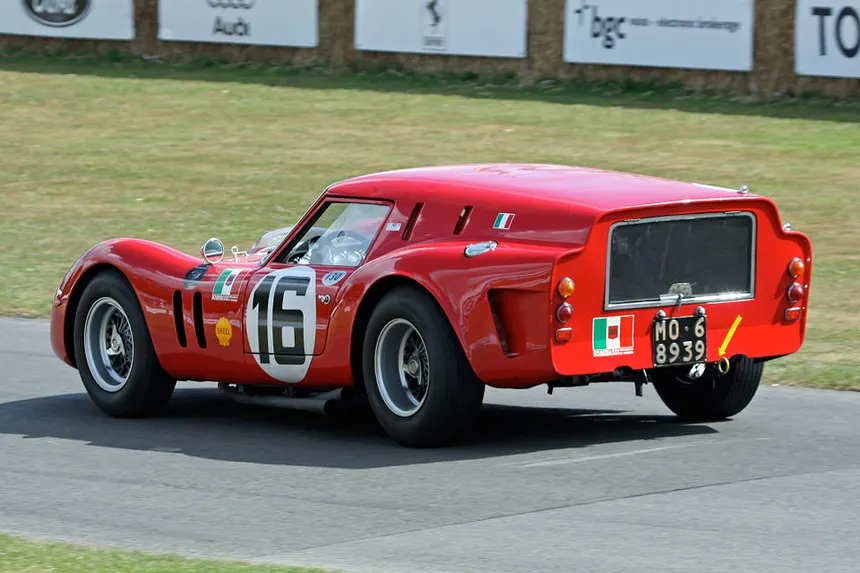
Bizzarrini had been obsessed for years with the Kamm tail aerodynamic principle. The idea, formulated by German engineer Wunibald Kamm in the 1930s, says a car is more aerodynamically efficient if the tail is cut off cleanly and vertically rather than tapering off in a long descending surface. Cutting the tail reduces wake turbulence and improves top speed without needing wings or other auxiliary devices.
The works 250 GTO used a conventional, tapered tail. Pretty but less efficient.
For chassis 2819GT, Bizzarrini designed a radical Kamm tail: vertical, cleanly cut, no conventional diffuser. The roofline extended rearwards like a delivery van and ended in a flat truncation. Drogo built the body in aluminium in his Modena workshop, working double shifts, against the clock.
When the Scuderia Serenissima mechanics saw the finished car, somebody named it after the shape of the tail.
Breadvan. A delivery truck for bread. In French, camionette. The name stuck.
What didn’t stick was public opinion on what the car actually was. While purists were laughing at the rectangular, anything-but-Italian appearance of the Breadvan, Bizzarrini was finishing the final calculations: the car was a hundred kilos lighter than a works 250 GTO, more aerodynamically efficient, and made the same horsepower.
A hundred kilos.
Same power.
Cleaner through the air.
In motorsport terms, that’s the difference between winning and watching other people win.
Le Mans 1962: The Early Hours
Saturday 23 June 1962. Le Mans. The works Ferrari 250 GTOs in the GT class. The Breadvan, thanks to a political decision that deserves its own paragraph, outside the GT class.
When Ferrari heard the Breadvan was going to compete, the factory leaned on the ACO (Automobile Club de l’Ouest) to make sure Volpi’s car wouldn’t run in GT. The formal reasons were technical — non-homologated aerodynamic modifications, non-standard dry-sump engine. The real reasons were something else. If the Breadvan ran in GT and beat the works GTOs, the scandal would have been planet-sized.
The ACO caved. The Breadvan ran in Prototype class. Alone.
Drivers: Carlo Maria Abate, Italian, one of the fastest privateer drivers of the era, and Colin Davis, British, son of two-time Le Mans winner S.C.H. Davis. Team: Count Volpi’s Scuderia Serenissima.
Before the story moves into what happened on the circuit, you need to know who else was on the grid. Le Mans 1962 wasn’t a walkover. The Aston Martin DB4 GT Zagatos were fighting for the GT class. Briggs Cunningham had brought the brand-new Jaguar E-Type Lightweights with the best American privateers behind the wheel. Stuttgart was defending its colours with the Porsche 718 RS 61 in prototype class. Lucky Casner was driving a four-litre V8 Maserati Tipo 151 monster. Below them, the Porsche 356 Carrera Abarths and the customer Jaguar E-Types were fighting over scraps. Le Mans 1962 had one of the densest technical grids of the decade. The Ferrari 1-2-3 wasn’t won against thin air. It was won against everything Europe could put on track that season.
What happened in the early hours has become one of the most talked-about moments in Le Mans history.
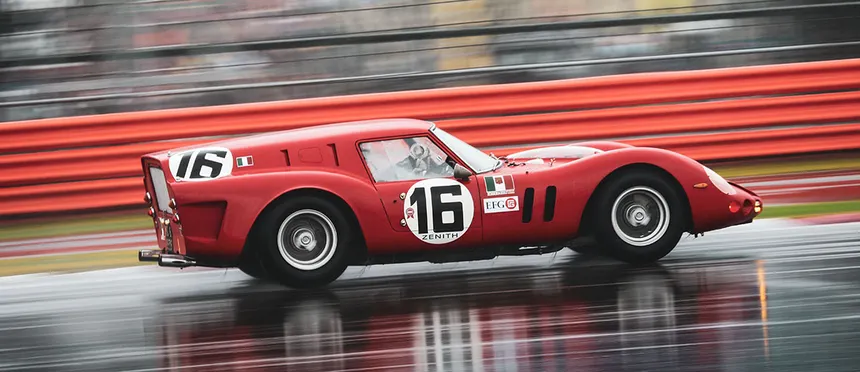
The Breadvan overtook every single works Ferrari 250 GTO on track. Bizzarrini described it years later: on the Mulsanne straight, more than five kilometres without chicanes back then, the Breadvan was seven kilometres per hour faster than the works GTOs. The Kamm tail was doing exactly what Bizzarrini had promised. The hundred-kilo deficit on the works cars was doing the rest.
Picture the faces of Maranello’s engineers in their pit. Picture Mauro Forghieri, freshly promoted to technical director after the firings, watching a car built by his predecessor in two weeks pinning back his GTOs. Picture Enzo Ferrari, reading race bulletins by teleprinter from his Maranello office.
Now step back with me for a moment, because there’s something I haven’t told you yet, and it matters for what comes next.
The works 250 GTO ran a five-speed gearbox. Bizzarrini had neither the time nor the money to build one. The Breadvan rolled into Le Mans 1962 with the four-speed gearbox of the original SWB, unmodified.
For a 24-hour race on a circuit that combines the longest straight on the calendar with a technical corner sector, four ratios was a serious limitation. It meant the engine spun too high in some sections, too low in others. It meant more mechanical stress on every gear. It meant the transmission was going to suffer.
Bizzarrini knew it. He took the gamble. The alternative was not showing up.
The dream lasted four hours.
In the fourth hour the Breadvan broke. The transmission gave out. Some sources point to the driveshaft, others to the gearbox itself. The result was the same: end of race. Abate and Davis, out. Count Volpi’s dream, out. And on track, the works GTOs cruising to a 1-2-3 the history books remember as Ferrari’s absolute domination of Le Mans 1962.
The real cause of the failure? Bizzarrini owned it later, no filter. The four-speed gearbox, hammered by a top speed higher than originally planned, didn’t hold up. Two more weeks to build a five-speed and the Breadvan would probably have finished the race. Probably would have won outright on its debut. Italian motorsport history would read differently.
They didn’t have those two weeks.
The Wins Nobody Talks About
The official story remembers Le Mans 1962 as a Ferrari rout. What hardly anyone tells you is what happened to the Breadvan after.
Brands Hatch, August 1962. The Breadvan races again, this time in GT class, with no Ferrari leaning on the organisers. Result: class win.
Paris 1000 km, October 1962, at Montlhéry. The Breadvan finishes third overall, behind two works 250 GTOs run by teams with infinitely bigger budgets. The car built in two weeks at Drogo’s workshop had reached the podium of one of the toughest races on the European calendar.
And in a smaller meeting that same season, the Breadvan set a class lap record — a stat that defines the car better than any other when it was actually running.
The Breadvan didn’t win at Le Mans. But it left no doubt for anyone willing to look two centimetres past the official headline that the 250 GTO was not the best car you could build on the SWB platform. It was simply the best car Ferrari had decided to build.
The Afterlife of the Only Breadvan in Existence
When Scuderia Serenissima dissolved in 1963, the Breadvan became Count Volpi’s personal car. He drove it on the roads of the Veneto. He kept it in his private garage. It was his personal trophy.
In the 1970s it changed hands several times and ended up as a road car owned by an American collector named Monte Shalett, who registered it with plates and drove it on California roads. Picture the Breadvan, the car built to humiliate Enzo Ferrari, stuck in Tuesday afternoon traffic in Los Angeles.
In the 1980s and 1990s it returned to Europe and re-entered vintage racing in the hands of British driver John Harper, who took it to several historic class wins. Fifty years after it was built, the car was still competitive in its category.
In 2005, at Christie’s Monterey, it went to auction with an estimate of three and a half to five million dollars.
It didn’t sell.
The reserve was never met.
It was later bought by Klaus Werner, a German collector who commissioned a full restoration. During that work, the car’s original nose was reconstructed, recovering the precise 1962 line. The bodywork was done by Hietbrink Coachbuilding in the Netherlands, specialists in 1960s Ferrari competition restorations.
Today chassis 2819GT exists, is documented, has been restored to original Le Mans 1962 specification, and forms part of the Werner collection. It surfaces every so often at events like Goodwood Revival and Le Mans Classic, where the audience that knows what it’s looking at goes quiet when it passes.
There is one Breadvan.
Another one was never built.
What Ferrari Did Next
What happened to Bizzarrini, to Chiti, to Count Volpi?
ATS, the brand they were going to set up to compete with Ferrari, failed commercially within a few years. The project was ambitious and Volpi’s money wasn’t infinite. Bizzarrini went solo, founding his own brand, Bizzarrini SpA, which produced cars like the iconic Bizzarrini 5300 GT Strada — a car that technically shared a great deal with the spirit of the Breadvan: light, aggressive, no concessions. Chiti ended up running Alfa Romeo’s racing department, where he built the Tipo 33 cars that won Le Mans in sport class in the 1970s.
Mauro Forghieri, the engineer Enzo had promoted after the firings, turned out to be a genuine hit. Under his leadership Ferrari won Formula 1 World Championships, dominated sportscar racing and built the 312 PB that took 10 of 11 races in the 1972 World Sportscar Championship. Official history is fair to Forghieri.
What official history doesn’t mention quite as often is that Forghieri, in several later interviews, admitted he learned a great deal by studying what his predecessors had done — and a great deal of what Bizzarrini specifically had done. The palace revolt, seen from the inside, wasn’t a clean break. It was a transfer of knowledge Ferrari has never fully wanted to acknowledge in its official communications.
Why The Breadvan Matters More Now Than Ever
There are technical reasons for the Breadvan to matter. The Kamm tail applied to a 1960s Italian competition car is an aerodynamic milestone. Adding a dry sump to a privateer SWB is serious engineering. Moving the engine twelve centimetres to rebalance weights is engineer thinking, not coachbuilder thinking.
But the technical reasons aren’t what make the Breadvan eternal.
What’s eternal is the story. What’s eternal is that a group of engineers fired out of pride, in two weeks, on zero budget, were able to build a car better than the works GTO. Better on paper. Better aerodynamically. Better balanced. They only lost at Le Mans because they ran out of time to build a five-speed gearbox.
What’s eternal is that Ferrari, the biggest racing brand in the world, had to lean on the Le Mans organisers to keep the Breadvan out of its own class. That isn’t what you do when you’re sure your car is better. That’s what you do when you know it isn’t.
What’s eternal is that there exists one single Breadvan on this planet. Another one was never built. Another one will never be built. And the car that came within a transmission failure of changing the history of Ferrari competition is still there, restored, waiting for someone with money and no scruples to pull it out of the Werner collection and take it back to Le Mans Classic, where it belongs.
The Breadvan isn’t a car among the ones that won.
It’s a car among the ones that should have won.
In motorsport language, that’s the only category that matters.
Check you’re still alive.