
Hot Vapor: The Engine a Mechanic With No Degree Built in 1984 Was the HCCI Mazda Spent 35 More Years Trying to Mass-Produce
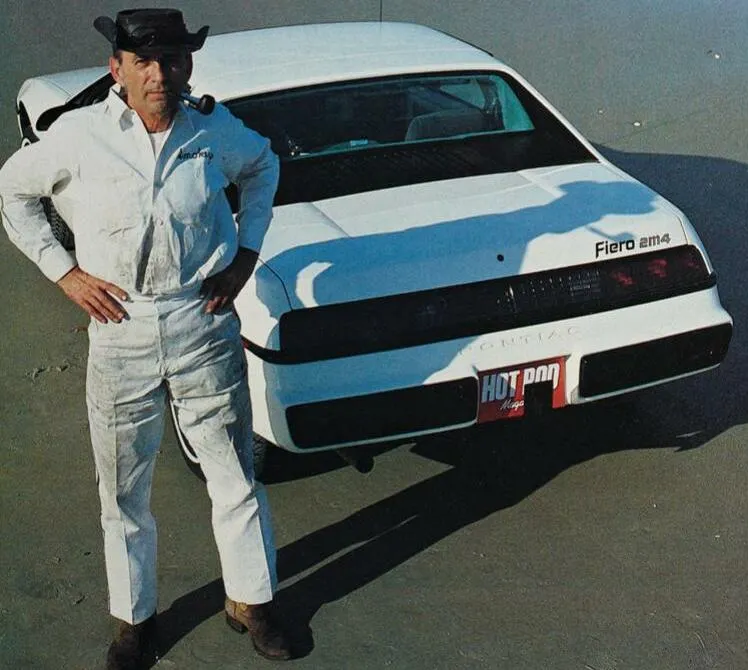
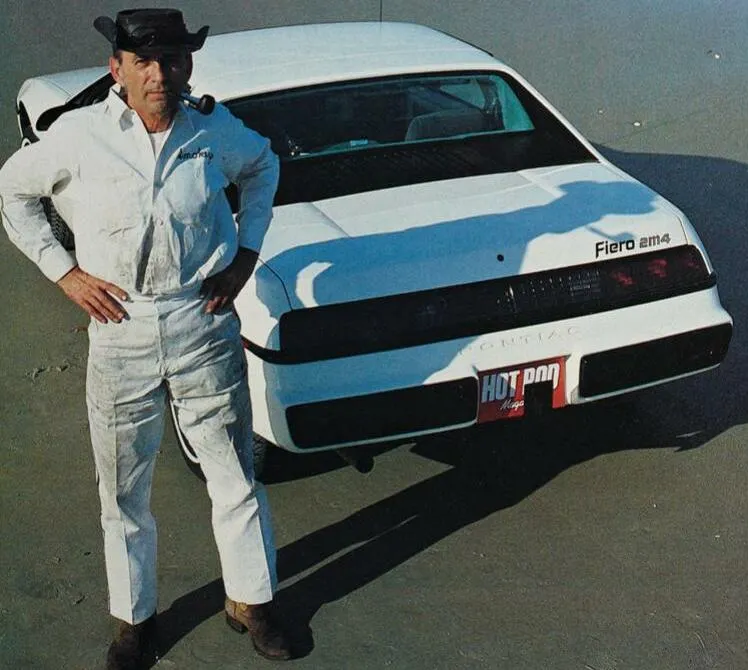
Daytona Beach, Florida. 1984. Behind the back door of the workshop Smokey Yunick called The Best Damn Garage in Town, a Pontiac Fiero sits up on jack stands. Under the engine cover there is no Iron Duke from the factory. There is no GM optional V6 either. There is a block that still looks like GM hardware on the outside, but inside it is a different machine. A different thermal architecture. A different way of thinking about combustion.
On the dyno, the engine produces two hundred and fifty horsepower. The original Iron Duke produced ninety-two. On the road, the Fiero accelerates from zero to sixty in under six seconds and returns fifty-one miles per gallon. The man whose name appears on those numbers is not a team of engineers with thermodynamics PhDs. He is a sixty-one-year-old mechanic with no university degree, no high school diploma, and thirty years of obsession with a single idea, working alongside a Swedish-American collaborator named Ralph Johnson.
The engine is called Hot Vapor. The global automotive industry came to see it, drove it, offered twenty million dollars for the patent, and then buried it.
Forty-two years later, Mazda is the only manufacturer on the planet capable of putting into commercial production a gasoline engine that operates on the principle Smokey found in a Florida workshop without even knowing the technical name Stanford academics would later assign to it.
This is the engine the industry refused to build. The question is why.
The principle: putting heat back where everyone else throws it away
To understand the Hot Vapor, you need to accept a heresy first. A conventional internal combustion engine wastes, by its own architecture, around seventy-five percent of the chemical energy in its fuel. That energy doesn’t disappear — the first law of thermodynamics doesn’t allow that. It leaves through two channels: the cooling system, where water absorbs heat from the block and dumps it into the atmosphere through the radiator, and the exhaust, where gases at more than six hundred degrees Celsius are blown out into the open air. For every four liters of gasoline you put in your tank, three of them go into heating the ambient air. Only one moves the car.
That is what Smokey had been trying to recapture for thirty years.
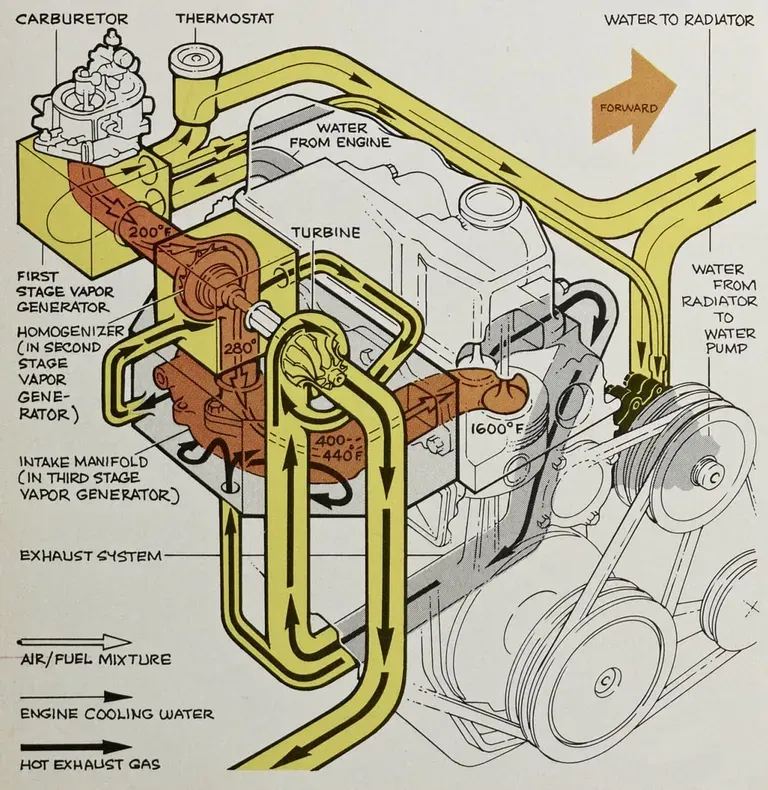
His idea, simplified, went like this. If the largest single energy loss is exhaust heat, recover that heat before it leaves and use it to preheat and fully vaporize the air-fuel mixture before it enters the cylinder. A conventional engine injects liquid gasoline that atomizes into microscopic droplets, and many of those droplets do not fully burn during the cycle. If you enter the cylinder with the fuel already in vapor state — that is, with every gasoline molecule surrounded by air molecules instead of clumped into droplets — combustion becomes complete, instantaneous, and homogeneous. More efficient. Cleaner. More powerful.
The technical architecture Smokey described in his patents, now in the public domain since 2003, had three stages. The air-fuel mixture left the carburetor at ambient temperature. It passed through a first heat exchanger where the engine cooling water raised it to ninety degrees Celsius. From there it entered a special turbocharger — not a conventional one — that served simultaneously as pump and atomizer, raising the temperature to one hundred and forty. Then it crossed a second exchanger, this one heated by exhaust gases, where it reached two hundred and thirty degrees. At that point the fuel was completely vaporized. The mixture entered the cylinder at two hundred and thirty degrees, where compression raised it above eight hundred before spark ignition. Afterwards, exhaust gases passed first through the second exchanger to give up heat to the next incoming charge, and then through the expansion side of the turbo. The system recycled almost all available heat.
The result of all this, according to data published by Hot Rod Magazine in its June 1984 issue, was an air-fuel ratio of more than twenty-two to one. To put that in perspective, the ideal stoichiometric ratio for a conventional gasoline engine is fourteen point seven to one. A conventional gasoline engine simply cannot run at twenty-two to one. The mixture is too lean. The spark cannot propagate a flame. The engine stalls.
The Hot Vapor could. And nobody could fully explain why.
What Smokey had built without knowing
In 1984, the physical principle that makes burning gasoline at air-fuel ratios above twenty-two to one possible did not yet have a commercial name. Academics at Stanford and at Lawrence Livermore National Laboratory had begun publishing papers on something they called Homogeneous Charge Compression Ignition. HCCI. The theory was simple. If you can make an air-fuel mixture distribute perfectly homogeneously throughout a combustion chamber, and compress it to a sufficient temperature and pressure, the mixture self-ignites simultaneously across the entire cylinder, with no need for a spark to propagate a flame from a single origin. Combustion becomes instantaneous, complete, and runs at lower temperatures than conventional combustion. That means fewer nitrogen oxides. Fewer particulates. Higher efficiency.
It is, fundamentally, making a gasoline engine behave like a diesel. Without a spark.
The problem with HCCI is that it is fiendishly hard to control. The operating window is narrow — only low load, only mid-range rpm, only at stable temperatures. The moment you push harder on the throttle or the air cools, combustion either runs away into knock or extinguishes entirely. Honda flirted with it in the seventies with their CVCC engine, brushing the principle without naming it. Lotus Engineering built a prototype in 2001 using recirculated exhaust gases to induce auto-ignition. VW published a Gasoline Compression Ignition unit based on their FSI architecture in 2007. Mercedes-Benz, Ford, GM, Nissan, Hyundai, Ricardo — everyone built prototypes. Everyone shelved them. Too unstable. Too expensive to control. Too far from the actual operating windows a real car sees between cold-starting and climbing a mountain pass in August.
In 2017 Mazda announced the Skyactiv-X. They launched it commercially in 2019. As of today, it remains the only HCCI gasoline engine in mass production anywhere on the planet. And to get it there, Mazda had to add a spark plug. Compression alone wasn’t enough to control auto-ignition timing across the operating range a real car requires. Mazda injects a small rich charge of fuel near the spark plug, ignites it conventionally, and uses the small flame front to push the main lean homogeneous charge — already on the brink of auto-ignition — over the threshold. They called it Spark Controlled Compression Ignition. SPCCI. Trademarked.
Smokey Yunick, in 1984, had already solved the problem. He had solved it backwards. Instead of fighting HCCI’s instability with software and a control spark, he eliminated the instability by changing the mixture itself before it entered the cylinder. If you arrive at the intake valve with a mixture preheated to two hundred and thirty degrees and fully vaporized, the thermodynamics inside the cylinder become predictable. No droplets that need to evaporate during compression. No heterogeneities. No hot spots, no cold spots. Compression and exhaust waste heat raise the final temperature in the most stable manner possible. And then yes — a conventional spark plug can initiate combustion in a mixture that is already at the auto-ignition threshold across the entire chamber simultaneously. The difference between Mazda and Smokey isn’t principle. It’s engineering route.
Mazda controls HCCI with software, in-cylinder pressure sensors, twin direct injection, a variable supercharger, and a spark. Smokey controlled it with two heat exchangers, a modified turbo, and thirty years of testing in his shop. Mazda has spent thirty-five years arriving at the other route, the one with electronics Smokey never trusted. Smokey didn’t believe in EFI and preferred his system to function mechanically. That stubbornness was his limitation and his greatness at the same time.
DeLorean’s office
The story of why the Hot Vapor never reached production has several layers, and none of them quite stand up alone.
In 1984, John DeLorean offered twenty million dollars for the patent, with financial backing from Texas oil magnate H.L. Hunt. The deal was effectively closed. DeLorean had been arrested in an FBI sting operation on suspicion of cocaine trafficking on October 19, 1982 — he was acquitted in 1984 — but the shadow of the trial destroyed his ability to lead any serious investment. The twenty million evaporated with the proceedings. That fact is confirmed by Smokey in his autobiography and by Yunick family interviews in Hot Rod.
But DeLorean wasn’t the only suitor. Ford, General Motors, Chrysler, BMW, Volvo and Volkswagen all came through Beach Street to see the engine in person. Smokey had installed it, beyond the original Fiero, in experimental versions of a Plymouth Horizon four-cylinder, a Ford Fiesta single-cylinder, a Volkswagen two-cylinder, a Chrysler four-cylinder, and a Buick Skylark three-cylinder. Each one showed the same pattern: it doubled the original engine’s power output while cutting fuel consumption in half. The figures documented in Popular Science on two of those prototypes make it concrete. The stock Plymouth Horizon returned twenty-three miles per gallon. The Hot Vapor version exceeded fifty-four. The stock Pontiac Fiero managed twenty-two. The Hot Vapor version reached fifty-one. More than twice the range from the same tank. The engineers from each manufacturer drove the cars on the road. They went back to their offices with notebooks full of data. None of them bought the patent.
GM came closest. They went as far as studying a Crane Cams retrofit kit for commercial vehicles — specifically the Chevrolet S-10 pickup — designed as an aftermarket product for fleet operators. The kit never reached market. The reasons documented in internal correspondence are three: durability, cost, and materials.
Durability was the biggest problem. The original Hot Vapor used forged pistons, special rings, Carrillo connecting rods, ceramic coatings on piston crowns and valves. Without those components, the engine self-destructed. The internal temperatures the Hot Vapor managed would have melted a conventional engine. Smokey controlled them because he hand-built every motor to tolerances GM couldn’t replicate on a production line for a four-thousand-dollar Fiero. To make it last a hundred thousand miles in the hands of an average buyer, you had to multiply material costs by a factor the income statement wouldn’t accept.
The second factor was ideological. In 1984, the American industry was betting all its R&D resources on electronic fuel injection and three-way catalytic converters. Those two systems solved the emissions problem under post-oil-crisis CAFE regulations and were controllable, predictable, scalable. Detroit engineers didn’t want to commit to a thermodynamic architecture that depended on custom turbos, hand-designed heat exchangers, and a sixty-year-old mechanic in Florida who wouldn’t share all his secrets because he was reserving some of them to protect against industrial theft. Smokey distrusted big corporations — with historical justification, given his NASCAR experience. When GM engineers asked him about final tuning details, he replied with lines like “I’ll teach you that part when you sign the check.” That stance, perfectly legitimate from his side, made knowledge transfer impossible.
The third factor, the dirtiest one, is the one that never appears in documents but lives in every private letter from that period. The American industry didn’t want a gasoline engine that doubled the efficiency of a conventional motor. Not in 1984. Not after having built an entire production and marketing infrastructure around large-displacement engines and high consumption. Not with the internal civil war between the catalyst lobby, the EFI lobby, the forged-piston suppliers, the Flint and Detroit unions. An engine that halved the fuel consumption of a Fiero threatened half the supplier chain. Smokey’s daughter Trish put it less euphemistically years later: “A patent application is a balance between revealing enough to protect it and not revealing so much that anyone can reverse-engineer it. Smokey is gone, and some of the secrets went with him.”
The Smithsonian Fiero
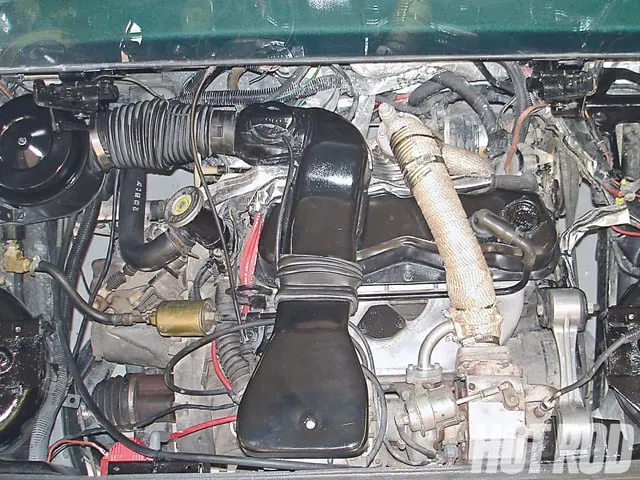
The original Fiero tested in 1984 was returned to Pontiac and crushed in a scrapyard. GM had loaned the car to Smokey on a long-term basis, and when the project was cancelled they demanded it back. Smokey returned the car. He just removed the entire drivetrain first. Tony Allers, a longtime friend and customer, later built an identical Fiero in 2006 using the original Hot Vapor drivetrain Smokey had salvaged. That car exists. It runs. It passes Tennessee emissions inspection. It returns forty miles per gallon when Allers drives it sensibly, and fifty-one when he focuses on economy. It smokes the rear tires at sixty miles per hour and fired up on the first turn of the key after twenty-two years sitting in storage.
Trish Yunick keeps four other prototypes in long-term storage. One of the original Hot Vapor units is, according to unconfirmed reports, in the custody of the Smithsonian Institution. The patents entered the public domain in 2003, two years after Smokey’s death. Anyone who wants can download them today from the USPTO database. The main patent, US 4862859 from September 1989, describes the vaporization system in sufficient detail to reproduce it. The secret Smokey took to his grave wasn’t the principle. It was the exact calibration. The operating range. The final tuning that made the engine work in real-world conditions instead of melting after a thousand kilometers.
Meanwhile, GM has received federal stimulus funding over the last fifteen years to research hot-vapor technologies. Parker Hannifin reportedly has confidential projects in the area. In Sweden, according to industrial sources, teams are working on similar architectures. Mazda already has its Skyactiv-X on dealer lots. The industry that buried the Hot Vapor in 1984 is now reconstructing it from scratch in 2026 with federal budgets running into hundreds of millions, software, sensors, and simulation tools Smokey never had access to.
The question isn’t why Smokey didn’t succeed. The question is how much fuel and how much pollution the planet would have saved if Detroit had bought DeLorean’s twenty million in 1984.
Check you’re still alive.
1 thought on “HOT VAPOR ENGINE”