Jaguar Burned the Ships Before Learning to Swim: An EV Bet at the Worst Possible Moment
Clarkson once said, with that lazy contempt only he could pull off, that Jaguar had spent decades being the brand that posh men bought because they couldn’t quite stretch to a Rolls. Cruel, accurate, and missing the point. Jaguar was never about reaching for the top. It was about offering something different at the level just below: the E-Type next to a Ferrari 250 GT for half the money, the XJ6 next to a Mercedes S-Class with more soul and less Teutonic seriousness, the F-Type next to a 911 with a louder voice and a worse warranty.
That brand — flawed, charming, mismanaged, beloved — sold 49 cars in April 2025. Worldwide. Not 49,000. Forty-nine. The number was reported by DesignRush and matches the registration data anyone willing to dig can verify. By December 2025, the last F-Pace SVR — a black one — rolled off the Solihull line on the 19th and went straight to the Jaguar Daimler Heritage Trust in Gaydon, never sold to anyone. The Jaguar Drivers’ Club confirmed 2024 production fell to 59,300 units. In 2018 the brand made over 180,000. A two-thirds collapse in six years.
This isn’t a downturn. It’s a wake with the flowers still fresh.
How a Brand Talks Itself Off a Cliff
Here’s the timeline, no filter.
In 2021, under then-CEO Thierry Bolloré, Jaguar committed to becoming 100% electric by 2025. Current Managing Director Rawdon Glover confirmed to Carbuzz that the plan to reinvent Jaguar as a high-end EV brand only materialised in 2021 — it wasn’t a long-running strategy, it was a pivot taken under pressure.
What followed was a managed demolition. In March 2024 Jaguar announced production end for the XE, XF and F-Type. By June 2024 the lines stopped. The I-Pace and E-Pace, built in Graz by Magna Steyr, were wound down in December 2024. The F-Pace held on, mostly because dealers in the US and China needed something to sell, but its last unit left Solihull on 19 December 2025.
Then, in August 2025, a cyberattack hit Jaguar Land Rover. Solihull, Halewood and Wolverhampton stopped for weeks. The UK’s Centre for Monitoring Cybersecurity estimated a £1.9 billion hit to the British economy. IT collapsed, supplier chains seized up, dealer orders fell into a black hole.
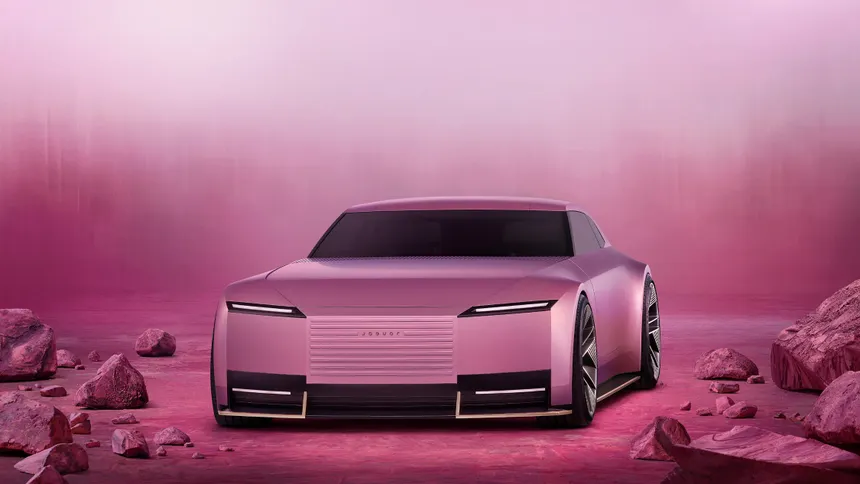
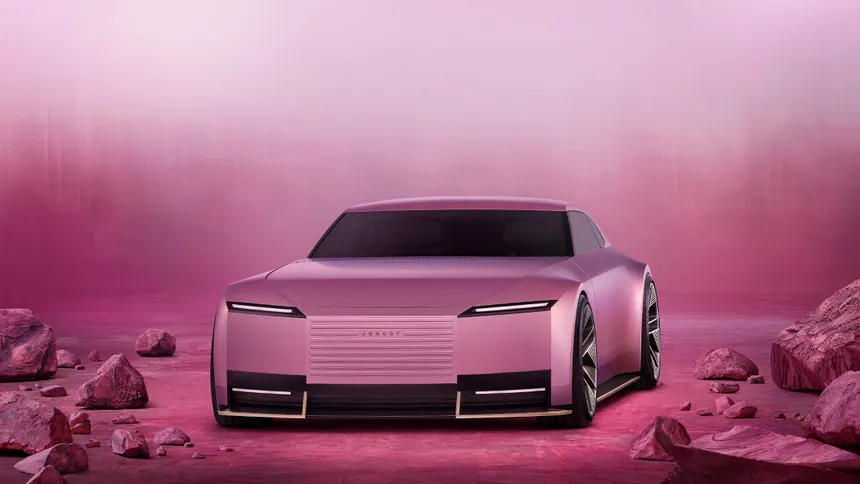
And the Type 00 — that polarising four-door concept Jaguar unveiled at Art Basel Miami in December 2024, the one that was supposed to anchor the new electric era — has been delayed. The brand has since confirmed the production car will be called Type 01. Glover told ABC News, reported by Automotive World, that the production reveal moves to 2026. Speaking later to Auto Express, he admitted deliveries in earnest won’t happen until 2027. Starting price: around USD 130,000.
So here’s the picture: Jaguar killed its entire combustion lineup before it had a single replacement ready. Empty showrooms. Zero revenue from new cars. And then a cyberattack stole what little operational stability remained.
Wrong Bet, Wrong Decade
The thing that makes this whole story painful isn’t that Jaguar went electric. It’s that Jaguar went all electric at the precise moment the rest of the industry started realising that pure EV wasn’t the universal answer it was sold as.
Look at what was happening around them.
Volvo, which announced in 2021 it would go fully electric by 2030, walked it back. Its US EV sales fell 32% in the first half of 2025 according to InsideEVs. Volvo is still selling EVs, but it has reinvested in combustion engines and mild hybrids to protect revenue.
Mercedes-Benz admitted in 2024 it wouldn’t hit its all-electric target by 2030. US EV sales collapsed 54% year over year in 2025. The EQE and EQS have been paused for the American market. Mercedes itself, in InsideEVs’ assessment, treats the EQ cars as “compromised and middling”.
Ford pushed back billions in EV investment and pivoted hard to hybrids and extended-range vehicles. Jim Farley told reporters in December 2025 that the hybrid F-150 is now 30% of F-150 sales, up sharply. Ford’s pure EV sales fell roughly 40% in November 2025 after federal tax credits expired.
GM, via Mary Barra at the New York Times DealBook conference in December 2025, also backed off its commitment to 100% EV by 2035 across several brands.
Porsche softened its 80%-EV-by-2030 target to “depending on market demand”. Lamborghini delayed the Lanzador from 2028 to 2029. Aston Martin and Bentley delayed their first EVs. Honda and Nissan cancelled or scaled back. Even Stellantis took a USD 26.5 billion writedown linked to its EV retreat, according to Automotive World in early 2026.
And what was the market actually doing? The ICCT’s February 2026 European Car Market Monitor reports BEVs at 19% of registrations across Europe. Plug-in hybrids at 10%. Full hybrids at 14%. Mild hybrids at 26%. Conventional combustion engines at 31%. Spain came in at 9% BEV, Italy at 7%. The transition is real but slow, plural, and absolutely not all-electric in 2025–2026.
Toyota — endlessly mocked by automotive journalists for refusing to drop combustion — turned out to be reading the map correctly. Multipowertrain strategy. Hybrids first, EVs alongside, combustion still earning revenue, hydrogen as a longer-term option. Boring, but solvent.
Jaguar read the same map upside down.
The Statement That Tells You Everything
There’s a line from Rawdon Glover, reported by Auto Express and reproduced by DesignRush, that should probably haunt every business school discussion of brand strategy for the next decade. Asked about customer retention through the EV transition, Glover estimated only 15% of current Jaguar buyers would return after the rebrand. And he said the company is fine with that. They’re targeting a different audience.
Read it again. Eighty-five percent of your existing customer base is gone, and you’re fine with that.
This isn’t strategy. This is a managing director publicly accepting that the brand he runs will lose almost all its existing customers and hoping a different demographic will appear at the showroom door. Any independent garage owner can tell you what happens when you lose 85% of regulars and have nothing on the forecourt: you don’t open Monday. Jaguar isn’t an independent garage. It’s a 103-year-old marque that has decided the buyers who paid for XJ after XJ, who kept Land Rover afloat in the lean years through brand prestige, who treated the F-Type as the sensible Brit alternative to a 911 — that those people no longer matter.
This from a managing director who took the role in 2020, working from a plan written in 2021 by a CEO — Bolloré — who left the company in 2022. Strategic continuity isn’t the strong suit here.
What Porsche Did Right (And What BMW Keeps Doing)
Porsche is the textbook case. The Taycan arrived in 2019, it sold, it worked. Meanwhile the 911 carried on with its naturally aspirated and turbocharged flat-sixes. The Cayenne added plug-in hybrid versions. The Macan EV launched alongside the petrol Macan, and the petrol Macan was kept on sale until the EV had time to prove itself. When the EV market cooled in 2024–2025, Porsche could absorb it because both lanes were open. Sales shifted, but the company didn’t bleed.
BMW is even cleaner. The i4, i5, i7 and iX sell alongside the M3, the M5, the X5 plug-in hybrid and the X3 petrol. The i5 didn’t kill the 5 Series. They coexist. According to the ICCT’s January–February 2026 data, the BMW Group recorded the highest BEV share among major European manufacturers at 24%. That’s transition done properly — slow enough that revenue holds, fast enough that compliance targets are met.
Volvo retreated but stayed in the game. EX30, EX40, EX90 all on sale, combustion and hybrids still in the lineup. When EVs stalled, Volvo leaned the other way and kept the cash flow.
Mercedes is mid-pivot to the new CLA on an 800-volt architecture, with some quality wobbles, but the C-Class, E-Class and GLE keep the lights on while the EV ranges are reorganised.
Jaguar has none of that runway. The I-Pace dates to 2018 and nobody buys them anymore. The Type 01 arrives in 2026, with deliveries in 2027, at USD 130,000, into a segment that already includes the Porsche Taycan, the Tesla Model S Plaid, the Lucid Air, the Mercedes EQS, the BMW i7 and the Audi e-tron GT. Late and expensive into a saturated room where everyone else has been learning for half a decade.
Walking Into Tesla’s Knife Fight With the Chinese
The premium EV segment is brutal. Tesla still holds about 41% of the US EV market according to data published in late 2025. BYD, the global EV leader, actually sold more plug-in hybrids than pure EVs in November 2025 — even China is hedging. The Chinese assault, with BYD, Nio, Xpeng, Zeekr, MG and now Xiaomi, isn’t slowing down. Xiaomi grew over 90% in China in November 2025. UBS’s Paul Gong, quoted by CNBC, expects the Chinese price war to drag on for years.
Walking into that ring as a newcomer, without volume, without your own charging network, without industrial scale, without battery cost advantages, without brand association with EVs — that’s not strategy. That’s turning up to a knife fight with a butter knife.
The only viable lane for Jaguar was always low-volume ultra-luxury. The Polestar, Lotus, Rolls-Royce Spectre kind of space. Bentley electrifying carefully. Aston Martin moving at its own pace. Lucid trying to survive. That lane is narrow, and Jaguar is arriving with a car the public still hasn’t decided whether to look at.
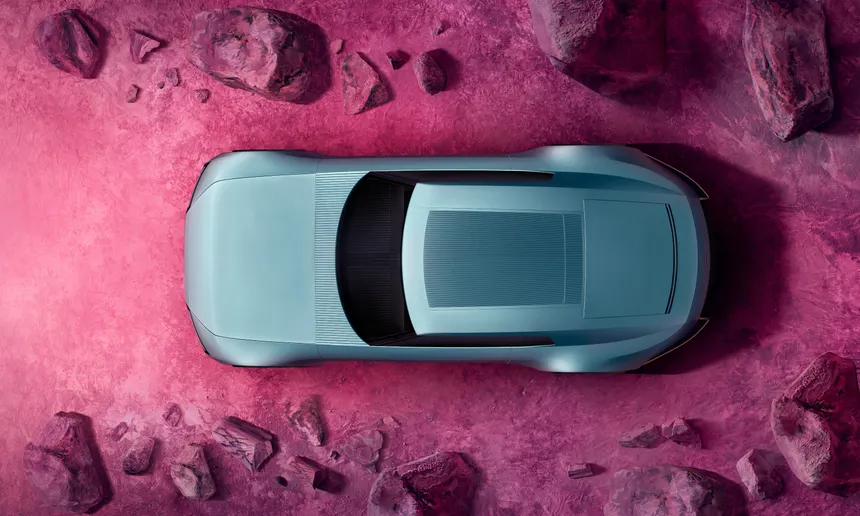
The Type 00, That Design, and Musk’s Question
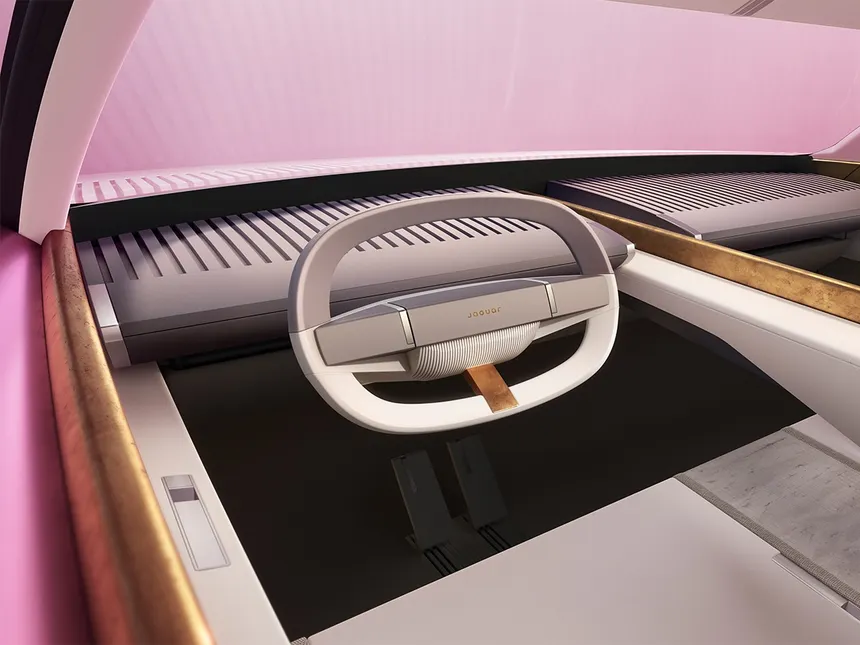
The Type 00 — the concept the production car, now officially badged Type 01, has to inherit — is a four-door with an exaggerated long bonnet, a clean grille-less front, and proportions read by some as a reborn E-Type and by others as a spaceship that took a wrong turn over Coventry.
From the workshop floor, thirty years of fitting metal in hand, my read is that a designer got a blank canvas and a remit to ignore everyone else. Some things are genuinely well executed — surface purity, brave proportions — and others feel like an odd evening at the design centre. The launch campaign, with pink runways, no car visible, diverse models and the slogan “Copy nothing”, was so badly received that Jaguar fired the agency, per Carbuzz. Elon Musk’s reply on X was a single line: “Do you sell cars?” That question summed it up. Jaguar had no answer, because at that moment it effectively didn’t.
Glover defended the design by citing fashion and architecture — great design polarises. Fair in principle. Less fair when monthly sales are 49 units and survival depends on the “yes” side of the polarised public being big enough.
The E-Type polarised too in 1961. But underneath the sculpture was 150 mph, four-wheel disc brakes, independent rear suspension before the Corvette, a stressed-steel semi-monocoque, and a price half that of a Ferrari 250 GT. Enzo Ferrari’s famous compliment is secondhand — Norman Dewis and a 1988 Gino Rancati biography, never recorded — but the technical bomb underneath was real.
The Type 01 still has to prove the substance underneath. And it has to prove it on a JEA platform that has yet to see the road in a production vehicle.
A Legacy Falling Off the Mantelpiece
Jaguar has a back catalogue most marques would kill for. The XK120 from 1948, with a twin-cam straight-six that rewrote postwar sports car expectations. C-Type and D-Type winning Le Mans in the 1950s. The E-Type in 1961. The XJ6 in 1968, a saloon that for 25 years was the international benchmark for refinement, smoothness and silence. The XJ220. The XJR-15. The XJR racers. Then the Ford and Tata years — uneven but with bright moments: the F-Type, the first-generation XE, the XKR.
What of all that is on sale today? Nothing. Zero cars in production during the transition. A brand that has set fire to its inheritance without making sure the future was written down.
The Numbers That Settle the Argument
We could have written all of this from the perspective of cars alone. But the books close the case. JLR published its full-year FY26 results — fiscal year ending 31 March 2026 — only days ago, and they read like a diagnosis.
Annual revenue came in at £22.9 billion, down 20.9% year-on-year. Profit before tax and exceptional items collapsed from £2.5 billion in FY25 to £14 million in FY26. Fourteen million. Adjusted EBIT margin of 0.7%, against 8.5% the year before. Consolidated net loss, according to Whalesbook and the company itself, came to £244 million — the worst result in nearly five years.
Q3 alone, the quarter of the cyberattack, was a bloodbath: revenue £4.5 billion (-39%), operating loss of £310 million, EBIT margin of -6.8%. Free cash flow for the year was negative £2.2 billion. The UK government had to step in with £1.5 billion of financial support to JLR and its supply chain during the cyber crisis.
And here’s the figure that tells you who’s actually keeping the lights on: in Q4 FY26, the Range Rover, Range Rover Sport and Defender accounted for 77.1% of total wholesale volumes. Three Land Rover products carry nearly four out of every five cars JLR sells.
Without Land Rover, there is no company. That’s not opinion. That’s the income statement read with a calm voice.
And What Does Tata Say?
Tata Motors bought Jaguar Land Rover from Ford in 2008 for USD 2.3 billion. The deal was widely criticised at the time — peak global financial crisis — and proceeded to become Tata’s main profit engine for over a decade. As recently as FY25, JLR delivered a record £2.5 billion in profit before tax to the group.
The year that just closed changes everything. So the question becomes: what is the owner saying?
So far, the owner is holding. N. Chandrasekaran, Chairman of Tata Sons, continues to back the Reimagine plan publicly. Committed investment stands at £18 billion over five years (FY24-28), with £3.6 billion earmarked for the current year for new platforms and electric powertrain development. Tata is building JLR electric vehicles in India — at the Sanand plant, the old Ford facility, and a joint Tata Motors/JLR project in Tamil Nadu — to inject volume and “subsidise” the operation with Indian cost structure. Chandrasekaran explained it to Autocar: “We can bring the cost attitude of Tata Motors with the design and sophistication of JLR.”
Translation: Tata isn’t walking away, but Tata also isn’t going to keep Jaguar as a loss-making European subsidiary at European prices forever. The declared philosophy is “cash over volume” — and FY27 guidance is for an EBIT margin of 0–2%, with a medium-term target of 5–7% and a long-term aspiration of 15%. Per ICICI Direct, citing the June 2025 Investor Day.
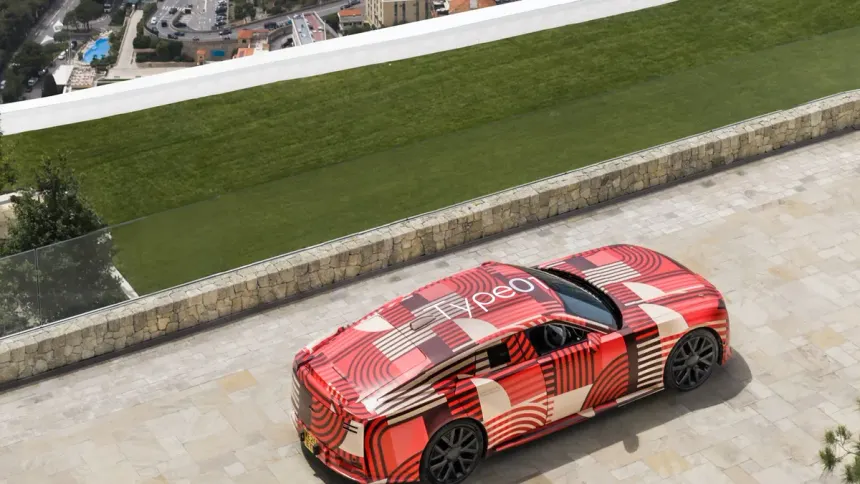
P.B. Balaji, JLR’s current CEO, has stated in the results presentation that the group is “focused on reducing break-even volumes” while launching the Range Rover Electric, the first EMA platform products, and “the new Jaguar”. The electric car meant to justify all this carnage now has its official name: Type 01. The brand confirmed it this week, per GBNews.
What Tata is not doing, at least visibly, is looking for a buyer. No sale rumours. No public Jaguar spin-off plans. But Tata Motors did, in October 2025, demerge its commercial vehicle business from its passenger business so each could pursue its own trajectory. And Indian analysts — Motilal Oswal, HDFC Securities, Elara Capital — are on “Sell” or “Reduce” on the stock, citing JLR concerns specifically.
The summary: Tata isn’t leaving, but Tata is no longer treating JLR as the holy cow it once was. The day the Type 01 fails to land, the questions in Mumbai will get very serious very quickly.
The Lesson Nobody Will Take
The lesson Jaguar leaves the rest of the industry isn’t that EVs failed. EVs haven’t failed. BEV share keeps climbing slowly, prices keep dropping, ranges keep growing, charging keeps expanding. The lesson is something else.
The lesson is that in an industry running on long cycles, going all-in on one technology at the peak of enthusiasm is the most reliable way to end up stranded when the cycle turns. And cycles always turn. Anyone who has spent thirty years putting parts together knows that when everyone tells you the future is here and the past is dead, the prudent move is to keep a foot in both rooms until the floor stops shaking.
Jaguar didn’t keep a foot in both rooms. It put both feet in one boat and burned the other before checking if its boat could float. Now it’s realised the other boat — the one with hybrid coexistence, gradual transition, multipowertrain pragmatism — is sailing perfectly well, and its own boat is taking on water while we write this.
Can it be saved? Maybe. If the Type 01 lands, if the second and third models arrive on schedule, if the JEA platform holds together, if a niche of ultra-luxury electric buyers exists that isn’t already pre-booked elsewhere, if Tata keeps writing cheques, if Land Rover keeps subsidising the recovery through earnings. A lot of ifs for a brand that closed FY26 with £14 million in pre-exceptional profit across the entire group.
What won’t recover is the trust of the people who were already there. That 85% of customers Glover says he’s fine losing won’t come back because a USD 130,000 electric GT arrives in 2027. They’ve walked into a BMW, a Mercedes, a Porsche, a Volvo dealership. They’ve signed. Coming back to Jaguar requires Jaguar to give them a reason. So far, all it’s given is a polarising concept and a pink runway ad.
The Jaguar ship turned. The problem is it turned towards the iceberg, not around it.
Check you’re still alive.