
BOVENSIEPEN ZAGATO: WHEN BMW BOUGHT ALPINA, THE FAMILY STAYED IN THE WORKSHOP
BOVENSIEPEN ZAGATO: WHEN BMW BOUGHT ALPINA, THE FAMILY STAYED IN THE WORKSHOP
Ask anyone who watched Chris Harris drive an ALPINA B7 down a wet B-road back in the day. He came back out of the car with that grin he only gets when something has surprised him. ALPINA were never the loudest, never the fastest on a spec sheet, never the ones in the magazine covers. But on the road, on a real road, with a real driver, they did something most marques never managed: they made BMWs better than BMW could.
That story, the one that started in a small town called Buchloe in January 1965, ended in March 2022. BMW announced they were buying ALPINA. The cars kept coming until the end of 2025. And then the badges stopped. But the family didn’t.
The first chapter of what they did next is called the Bovensiepen Zagato. And it tells you everything you need to know about the people who built ALPINA in the first place.
A name worth knowing
Burkard Bovensiepen started ALPINA in 1965 with a carburettor kit for the BMW 1500. He built one of the most respected marques in European motoring, ran the company for nearly six decades, and passed away in 2023. His sons, Andreas and Florian, ran ALPINA in the modern era and sold it to BMW. They could have walked away. They didn’t. They kept the Buchloe factory, kept the craftsmen, kept the parts business and the wine importing arm, and quietly started building something else under the family name.
That something else turns out to be a coachbuilt grand tourer with Zagato bodywork on a BMW M4 platform. Read that sentence again. It’s the kind of project that should have happened in 1972 with Aldo Brovarone or Marcello Gandini, not in 2025 with two German brothers and an Italian design house. And yet here it is.
Why Zagato, why now
There’s a fork in the road every time a small marque tries to enter the coachbuilt world. One path leads to an in-house design studio, a digital renderer, a moody black photoshoot and a press release with the word “iconic” in the first paragraph. The other path leads to Milan, to a family-run design house that’s been cutting metal and shaping cars since 1919, and saying the words: we want you to dress this car.
The Bovensiepen brothers chose Milan. They chose Andrea Zagato. They chose the company that put bodywork on Aston Martins, on Lancias, on Alfa Romeos, on the kind of cars Jeremy Clarkson used to call “the proper sort.” It wasn’t a marketing decision. It was a craftsmanship decision. The kind a workshop owner makes when he’s paying for the work himself.
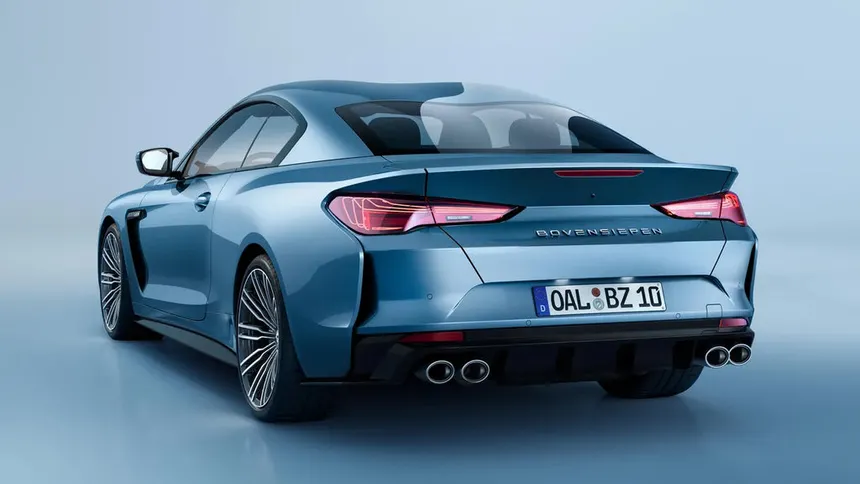
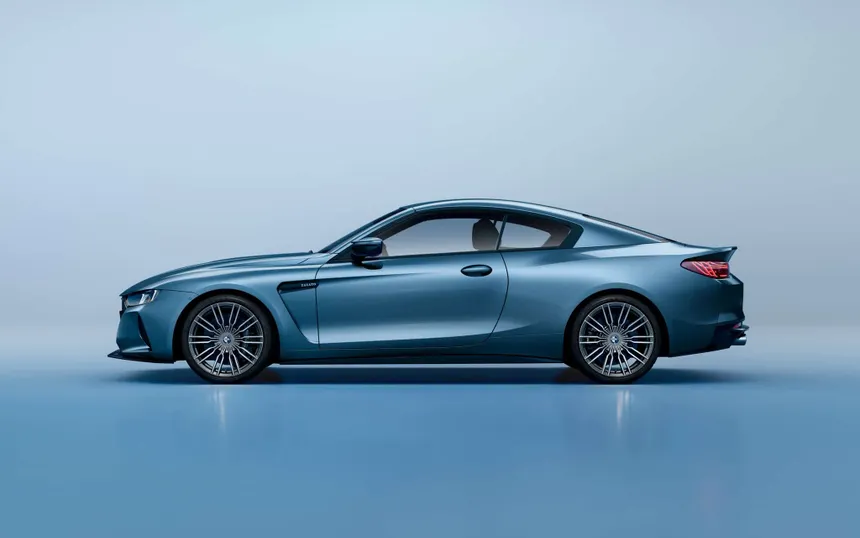
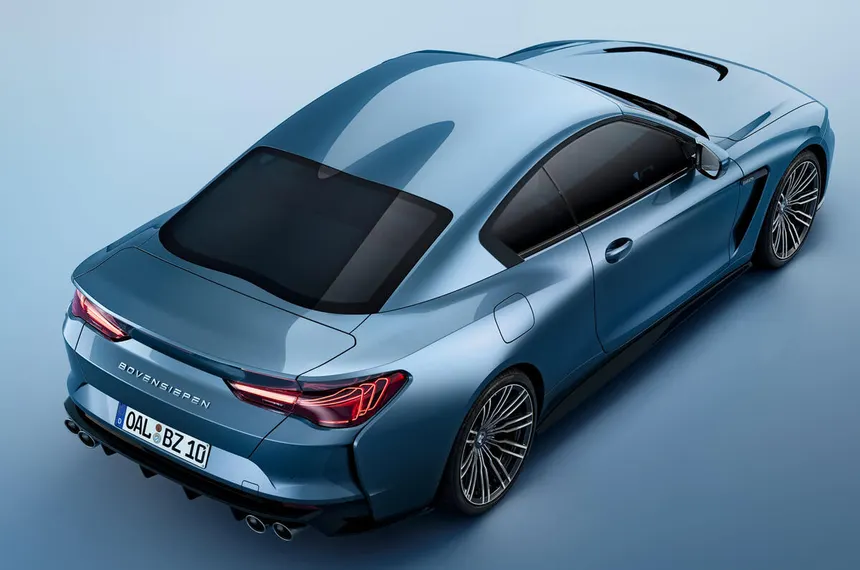
The result wears the most famous Zagato signature on the planet: the double-bubble roof. Originally a trick to give racing drivers room for their helmets without raising the overall height of the car, the double bubble survives today as a design language. Walk around the Bovensiepen Zagato and you’ll see the roof flow into two slight bumps over the seats. It’s a quote, a reference, a wink at anyone who knows their Aston Martin DB4 GT Zagato or their Alfa Romeo TZ. The people who matter will see it.
The decision under the skin
Here’s the part that most reviews miss. The Bovensiepen Zagato is not based on the BMW M4 Coupé. It’s based on the M4 Convertible, the G83 droptop. Why does that matter? Because a convertible has no B-pillar. And the brothers wanted a coupé without a B-pillar. The pillarless hardtop, the kind of coupé you saw on a 1965 Buick Riviera or a 1971 Mercedes-Benz 280 SE 3.5, the kind where rolling down the windows leaves a clean uninterrupted line from front to back. That’s the look they wanted.
To get there, they took the convertible, kept its reinforced chassis, and put a fixed carbon fibre roof on top of it. The whole body is new. The silhouette of the M4 is still there if you squint, but every panel has been remade. That isn’t a job a marketing department dreams up. That’s a job that comes from someone who’s spent his life under cars with a torch, thinking about geometry.
What makes it move
The engine is BMW’s S58 inline-six. Three litres, twin-turbocharged, the same block you find in the M3 and M4 Competition. Bovensiepen have reworked the intake, the exhaust and fitted new turbos. Power output is 611 hp and 700 Nm of torque. That’s a gain of 79 hp and 50 Nm over the standard M4 Convertible. The numbers translate to 0-100 km/h in 3.3 seconds. Four-tenths quicker than the donor. A tenth quicker than the M4 CS, which is the sharpest M4 BMW currently sells. Top speed is over 300 km/h.
Some people will read “3.0 inline-six” and shrug. They’ll point at a Ferrari Amalfi with its V8 and ask why a six-cylinder car costs nearly four times the price of the M4 it’s based on. They’re missing the point entirely. The S58 is one of the finest inline-six engines ever built for the road. It has torque from idle, it climbs the rev range with proper intent, and crucially it sounds like an engine, not a synthesiser. Akrapovič built the titanium exhaust system: 22 kg in total, 40 percent lighter than BMW’s own, with reduced back pressure and twin twin tailpipes. Andreas Bovensiepen describes the note as “throaty” — full-bodied from low revs, opening up with intent under load, none of the artificial drama you hear when a four-cylinder pretends to be a V8. It’s a proper German straight-six speaking through a properly engineered Slovenian titanium system (Akrapovič is from Ivančna Gorica, not Italy, a detail most reviews get wrong). When the right foot goes down, the car talks. The Top Gear test track or a Welsh B-road in late September are where you’d want to find out how well.
The gearbox is the BMW eight-speed automatic. The drivetrain is all-wheel-drive. Both inherited from the M4 Convertible base, neither optional. For some readers this will be a disappointment. I understand why. But the Bovensiepen Zagato isn’t trying to be a Porsche GT3 RS or a Lotus Emira manual. It’s a grand tourer in the proper sense of the term: a car you can take from Munich to Lake Como, from London to Le Touquet, without arriving with sore shoulders and a strained jaw. For that brief, AWD and an automatic are allies, not enemies. The buyer who wants a manual gearbox and rear-drive purity already has options. The buyer who wants something that drives itself when it should, and wakes up when you press the pedal, will find exactly that.
A word about weight. The Bovensiepen Zagato tips the scales at 1,895 kg. That’s roughly 120 kg more than the standard M4 Convertible. The carbon body helps keep the figure in check, but converting a convertible chassis into a fixed-roof coupé, adding structural reinforcement, fitting 400 bespoke parts and trimming the interior in hand-stitched leather costs kilos. That’s the weight it has to be. For context, the Bovensiepen is roughly half a tonne lighter than a Bentley Continental GT, the proper benchmark for this category. The point isn’t to chase a stopwatch around a circuit. The point is to cover ground beautifully, and 1,895 kg with a 611 hp twin-turbo straight-six is exactly the right tool for that job.
The suspension is by Bilstein, but read the small print. It isn’t the M4 Convertible setup with a tweaked firmware map. It’s a bespoke development, designed and tuned in Buchloe by the Bovensiepen chassis team in partnership with Bilstein, signed off after thousands of test kilometres. The Damptronic dampers and their three modes — Comfort, Sport, Sport Plus — were specified for what Andreas Bovensiepen calls “Fine Driving.” His words, on the public record, leave little room for interpretation: “It’s designed so you can have great fun from Munich to Como or Milano, drive for several hours, and still feel comfortable.” That’s the brief. Not Nürburgring lap times. Long days on real roads, including the bad ones. Once you read that into the rest of the spec, the car makes sense. Forged 20-inch wheels in a unique design, with three patterns to choose from. Brake calipers in any colour the buyer wants, with the Bovensiepen lettering machined into the metal, not stickered on.
Four hundred bespoke parts and 250 hours per car
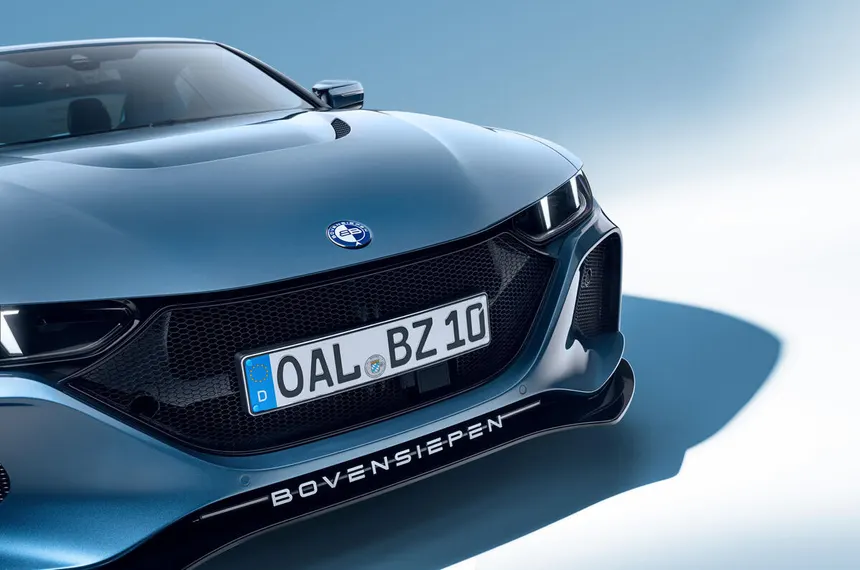
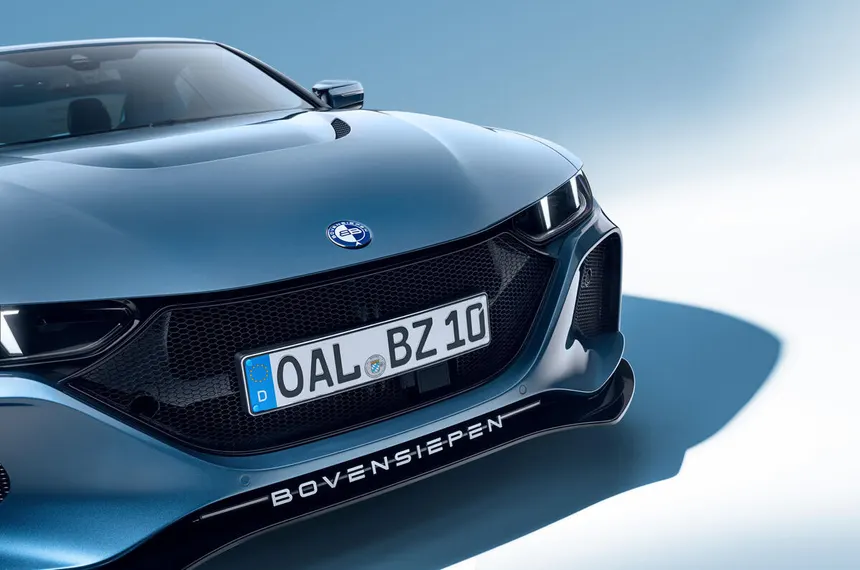
This is where the line between tuner and coachbuilder gets drawn. A classic ALPINA had roughly 100 bespoke parts compared to the BMW it was based on. A Bovensiepen Zagato has more than 400. Almost the entire exterior is new. Almost all of it is carbon fibre. The front grille is no longer the BMW kidney; it’s a black stainless-steel mesh with the marque’s lettering set beneath. The bonnet is longer and lower than the M4’s, giving the car proper GT proportions. The flanks carry three pressed creases that pull the metal towards the muscular rear arches. The rear ends in a body-integrated spoiler, an aggressive diffuser, and four titanium tailpipes. The taillight signature is a thin horizontal stripe that, if you stare at it long enough, looks like a respectful nod to the old ALPINA livery. Not a copy. A nod.
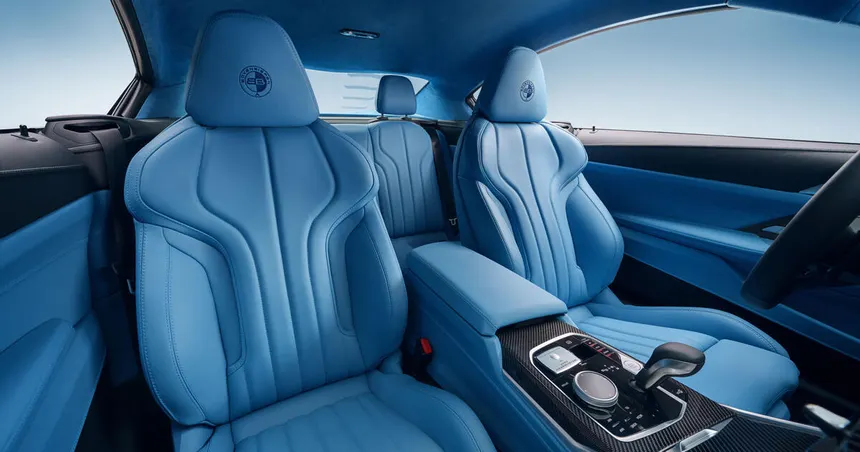
Every car takes more than 250 hours to build. Over 400 individual hand-finished components. The interior is Lavalina leather as standard, with a bi-colour option that requires more than 130 hours of upholstery work on its own. More than 390 leather panels per car. More than 1,800 metres of stitching thread. This is not series production. This is the old definition of coachbuilding: a small team of people who have done this for decades, sitting at a bench, making things by hand.
But the leather is only half the story. Climbing into a Bovensiepen Zagato isn’t the same as climbing into an M4 with expensive trim. The dashboard inherits the M4’s underlying architecture (paddle-shift wheel, curved twin-screen display, driving position), but every surface you can see and every surface you touch has been replaced. Lavalina leather sourced from the same supplier Rolls-Royce uses, in 16 standard colours plus an unlimited Bespoke programme. Alcantara in 45 additional shades to combine with the leather, or a full Alcantara headliner in any colour if you want to seal the deal. An optional thin-rimmed Lavalina steering wheel, much slimmer than the chunky M4 Competition rim. The wheel boss carries the Bovensiepen logo — two Bs back-to-back — not the BMW roundel. The boot lining can be specified in full Alcantara, which is the kind of touch that only makes sense once you realise the people commissioning these cars actually care that their luggage is rattling around inside something nicer than the neighbour’s interior. There is no ALPINA reference anywhere in the cabin. No badge, no signature, no nod. The team has consciously erased the previous marque from the inside of the car. This isn’t ALPINA. It’s the next chapter, and they want you to register that from the first button you press.
One last detail before we step out of the cabin, because it tells you who’s running the workshop. The strut tower bar in the engine bay, available through the personalisation programme, comes with an exposed carbon cover and a milled Bovensiepen crest. You only see it if you open the bonnet. Which means the only people who’ll appreciate it are the ones who know.
The number that matters
The starting price in Germany is €369,495, VAT included. Production is capped at 99 units worldwide. The configurator opened in April 2026. First deliveries are scheduled for Q3 2026.
Some context. The BMW M4 Convertible starts at around €112,700 in the same market. The Bovensiepen Zagato is roughly three and a half times that figure. It enters the same price territory as the Ferrari Amalfi, the Aston Martin Vanquish and the Bentley Continental GT. All three of those have larger, more cylinders, and more grand-tourer heritage. So on paper, the Bovensiepen looks expensive for what it offers.
But that calculation only works if you treat this as a transport device. As a buyer-experience proposition, the maths is different. You’re buying one of 99 cars. You’re buying the first product of a family that built one of the most respected marques in German motoring. You’re buying 250 hours of handwork and a Zagato body. And, perhaps most importantly, you’re buying a story with an ending nobody has written yet. That kind of value doesn’t show up in a spec table.
What it actually means
Here’s what I see when I look at this car. ALPINA, as an independent marque, is gone. Whatever BMW does with the name next will be its own thing, and we’ll judge it on its own terms when it arrives. But the people who actually built ALPINA, the craftsmen and the family, are still in Buchloe. They have a new name on the building. They have a new logo with two Bs back-to-back. And they have a Zagato body waiting to go on a BMW M4 Convertible chassis with the B-pillar removed.
The figure worth knowing is this. ALPINA peaked at around 292 employees in 2021, the year it built over 2,000 cars. When BMW announced the brand acquisition in March 2022, it was clear that not all of those jobs could continue at Buchloe in the same form. Bovensiepen has publicly confirmed that workforce changes were handled mainly through natural turnover, expiring fixed-term contracts, retirement agreements, and limited transitional arrangements for around 60 employees, with BMW absorbing some of the affected staff into its own organisation. I don’t have the exact head-count of who stayed in Bovensiepen, but I do know the Buchloe factory is still open, the new structure has five business lines (Bovensiepen Automobile, Engineering, an authorised BMW Service centre, Certified Cars, and parts supply for the existing ALPINA fleet), and the people who know how to hand-assemble a car like this are still in the building. In the context of a brand sale, that’s about as soft a landing as anyone could reasonably hope for.
That isn’t a press release. That’s a decision. A decision to keep going when the easy thing was to retire. A decision to start with the hardest possible first car, a coachbuilt grand tourer, rather than the safe choice. A decision to choose Zagato over an in-house studio. A decision to use the convertible chassis to build a pillarless coupé, because a pillarless coupé is what a proper GT should be.
These are workshop decisions, not boardroom ones. And in a world where almost every new car is designed by a committee that has never held a torque wrench, that distinction matters more than ever.
The Bovensiepen Zagato won’t change the world. Ninety-nine cars never do. But it will sit in 99 garages around the planet as proof that the kind of car-building that used to happen, with two families on two sides of the Alps making something beautiful together, still happens in 2026. That’s worth more than the spec sheet says.
Check you’re still alive.