
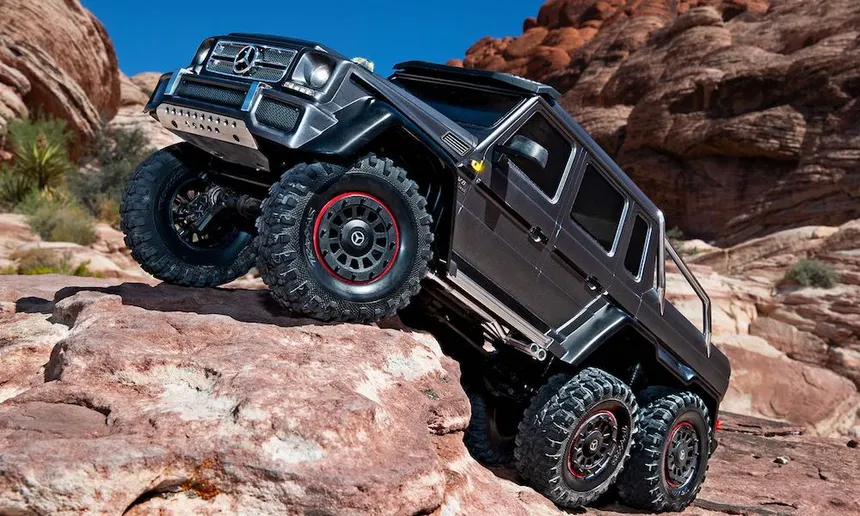
MERCEDES-AMG G63 6X6: How a truck for the Australian army got an AMG makeover
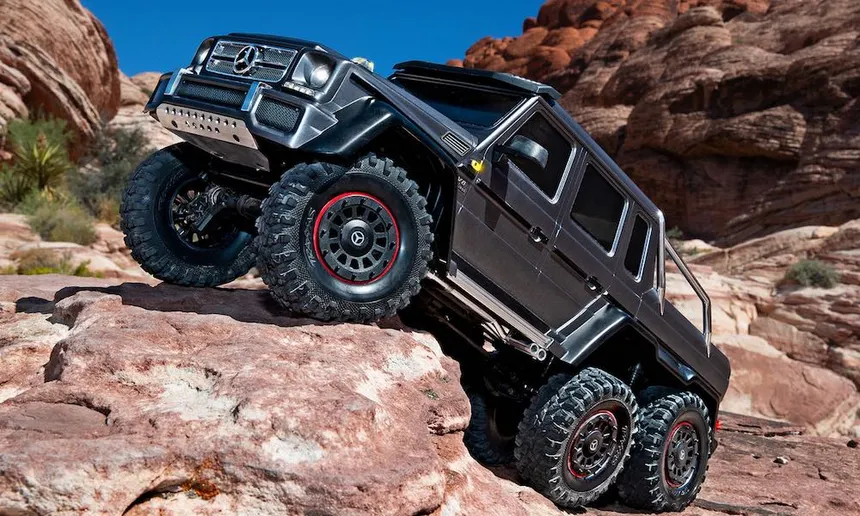
The Mercedes G63 6×6, the precise moment a premium brand decided to spend with no limits
Some cars only exist because, at a specific moment, a manufacturer decided money was no object. They’re not the cars that sell in volume. They’re not the cars that justify themselves on a spreadsheet. They’re the cars that exist because someone in a boardroom said “if we can build it, we will, and we’ll worry about costs afterwards”. The Mercedes-Benz G63 AMG 6×6 is one of those cars. Four tonnes, six driven wheels, a twin-turbo 5.5-litre V8, portal axles lifted from the Unimog, and a launch price in 2013 of around USD 510,000.
And the best part: it isn’t a marketing toy invented in a meeting room. It is a Mercedes military vehicle that had been running through the Australian outback for two years before AMG laid hands on it. The G63 6×6’s story begins, as all good modern car stories do, with an army that needed a serious vehicle and a German manufacturer willing to build it.
Land 121 Overlander
In October 2007, Australia’s Department of Defence opened a public tender to replace the Australian Defence Force’s ageing fleet of Land Rover Perentie vehicles. The project was named Land 121 Overlander. Its scope was considerable: a multi-role off-road vehicle capable of operating in the Australian outback, in Middle Eastern and Asian deployments, with variants for cargo, troop transport, communications, ambulance and reconnaissance. They wanted both 4×4 and 6×6 vehicles built on the same platform.
And something curious happened. Land Rover, which had supplied the Perentie to the Australian army for three decades, did not bid. Toyota, with the Land Cruiser 70, did not bid. Mercedes-Benz was the only serious tenderer. In October 2008, the ADF signed an initial contract for 1,200 vehicles. The final figure, extended through subsequent options, reached 2,268 units across ten distinct configurations, valued at close to AUD 350 million.
Among those configurations was one Mercedes had never produced as a series model: a G-Wagen 6×6.
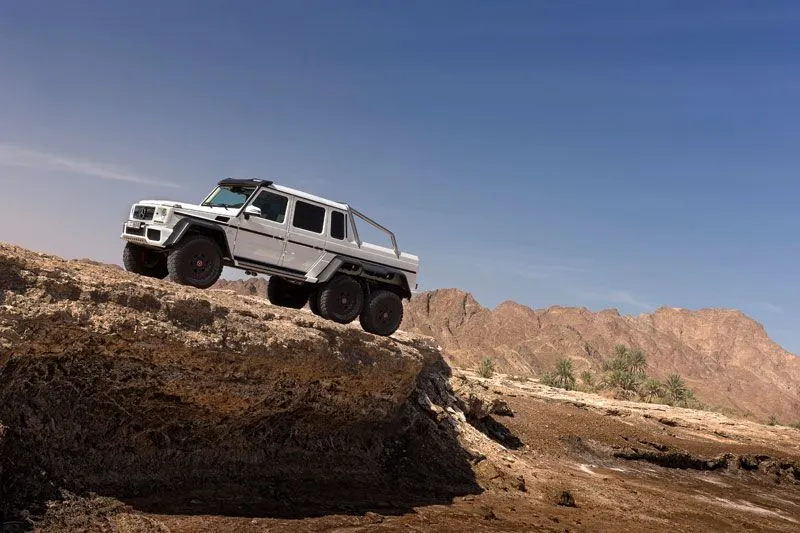
The military 6×6
It was built at the Magna Steyr plant in Graz, Austria. The same plant that has assembled the G-Class since 1979. Mercedes designs, Magna Steyr assembles, under an agreement the two companies signed in the 1970s when they jointly created the platform. The military 6×6 started from the standard W463 G-Class chassis and added a third axle at the rear, retaining coil spring suspension but with two rear axles and no load-sharing mechanism between them. Weight distribution settled at 60/40 between the two rear axles (the front carried the rest, with reinforced springs lifted from the armoured G-Class to handle the load).
The donor engine was the 3.0-litre V6 turbo-diesel from the G320 CDI, producing around 224 hp. Enough to move a loaded military platform at patrol speeds. Automatic transmission, transfer case with low range, five lockable differentials, 37-inch tyres mounted on beadlock wheels (where the rubber is mechanically clamped to the rim and cannot escape even at zero pressure). And the headline: portal axles.
Portal axles deserve explanation. In a conventional axle, the half-shaft exits the differential and enters the wheel hub at its geometric centre. In a portal axle, the half-shaft does not enter the centre; it enters the top, where a gearbox transmits drive downward through a pinion and crown gear to the wheel centre via a vertically offset shaft. The result is that the entire axle line sits physically higher than the wheel centre. Without lifting the suspension, without fitting larger tyres, without changing geometry, you gain centimetres of ground clearance. It is technology Mercedes has used on its Unimog trucks since the 1950s, where ground clearance is the difference between a truck that crosses a muddy field and a truck that gets stranded in it.
The Australian military 6×6 entered active service in 2011. It met its objectives. The ADF reported satisfaction. And within Mercedes, someone started doing different arithmetic.
The civilian idea
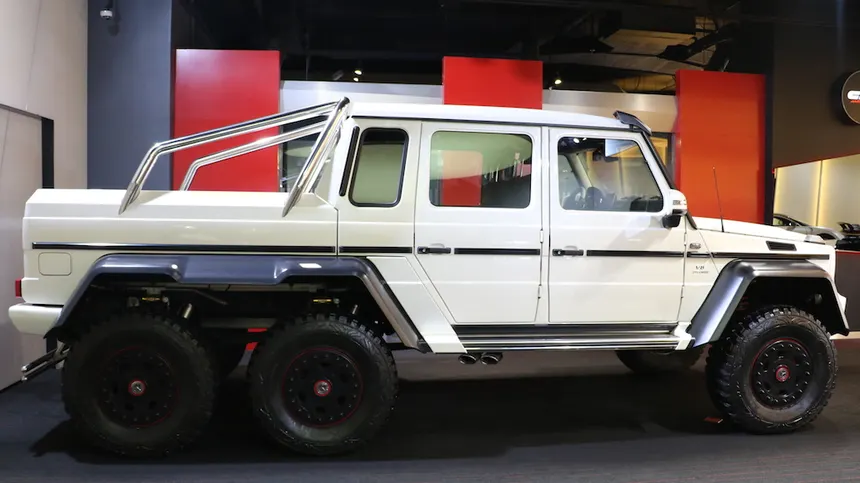
Axel Harries was the G-Class’s head of development at the time. His team, working with AMG’s engineers, looked at the military 6×6 and asked the obvious question: what would happen if we dropped the standard G63’s biturbo V8 into it? The answer, on paper, was an exciting kind of madness. In practice, it required redesigning several things, but nothing impossible. The chassis, suspension, axles and transmission were already proven. They needed to adapt the powertrain, extend the wheelbase to 4,196 mm (300 mm longer than the standard G63), add a four-seat cabin with individual seats and an open cargo bed at the rear, and dress it in AMG livery.
The civilian prototype was unveiled in February 2013, in Dubai, ahead of the Geneva Motor Show. The technical name was Mercedes-Benz G63 AMG 6×6. The marketing name was “the last word in desert capability.” Production began in late 2013 at the same Magna Steyr plant in Graz that was producing the Australian military vehicles. The difference: the civilian cars wore leather interiors, polished bamboo cargo beds, and a 5.5-litre twin-turbo V8 under the bonnet.
The civilian hardware
The engine is the M157, the 5,461 cc V8 with two turbochargers that AMG mounted in the standard G63 and across the entire AMG range of the era: E63, CLS63, ML63 and so on. In the 6×6 it produces 544 hp (400 kW) at 5,500 rpm and 760 Nm of torque from 2,000 rpm. It was the most-fitted engine in AMG’s catalogue of the decade, hand-assembled in Affalterbach with the signing technician’s plaque (“one man, one engine”) fixed to the block. Here it is paired with the 7G-Tronic seven-speed automatic, recalibrated slightly to handle drive distribution across three axles rather than two.
The transmission is where things get interesting. Transfer case with two ratios: 0.87:1 for road use and 2.16:1 for low range. Five electronically locking differentials. When the driver hits the three dashboard switches, full lockup engages and the car distributes drive 30% front axle, 40% centre axle, 30% rear axle. All six wheels rotate at the same speed by mechanical necessity. If one wheel loses ground contact, the other five keep pushing. If three wheels lose contact, the remaining three keep pushing.
Suspension is solid axle at all three positions, with coil springs and Öhlins gas dampers adapted specifically. The front uses the reinforced springs from the armoured G-Class. The rears use different spring rates between the first rear axle (stiffer) and the second (softer), to optimise load transfer. Tyres are 37-inch, mounted on 18-inch beadlock rims. The whole system integrates an air compressor connected to four 20-litre reservoirs, allowing on-the-move pressure adjustment for all six tyres. From 0.5 bar for sand to 2.0 bar for tarmac, in under twenty seconds. Without getting out of the car.
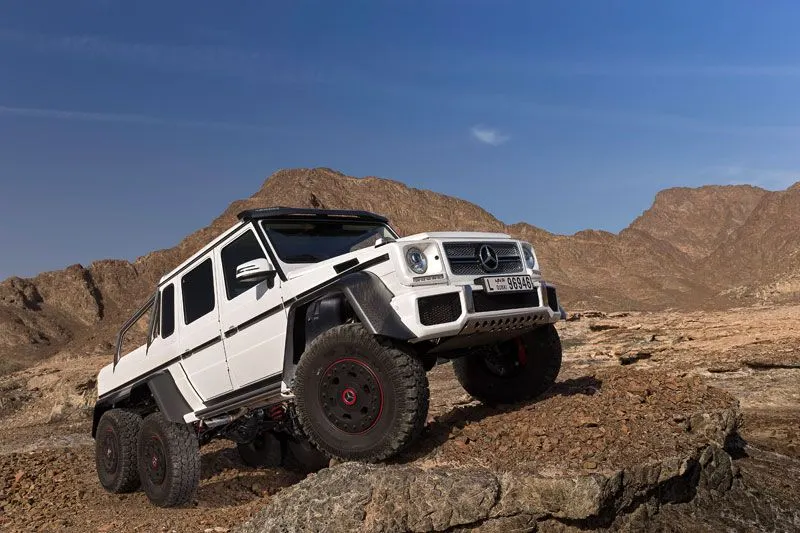
The figures
The 6×6 weighs 4,083 kg empty. Just over four tonnes. It is the heaviest vehicle Mercedes-Benz has ever sold as a road-going production model. It measures 5,875 mm long, 2,110 mm wide, 2,210 mm tall. Ground clearance, courtesy of the portal axles, is 460 mm. Fording depth, one full metre. Wheelbase between the front axle and rear-most axle is 4,196 mm, comparable to a three-axle Sprinter van. Ground clearance under the portal axles is so generous that you can walk underneath the car without bending much.
In spite of all that, 0-100 km/h takes 7.8 seconds according to official figures (Auto Express and Autocar recorded slightly faster times in their Dubai tests, dipping below six seconds). Top speed is electronically limited to 160 km/h, not because the engine can’t deliver more but because the tyres aren’t certified for higher speeds. Real-world fuel consumption sits between 25 and 30 litres per 100 km. The fuel system uses two separate tanks totalling 159 litres. Real-world range, roughly 500 km.
How it drives
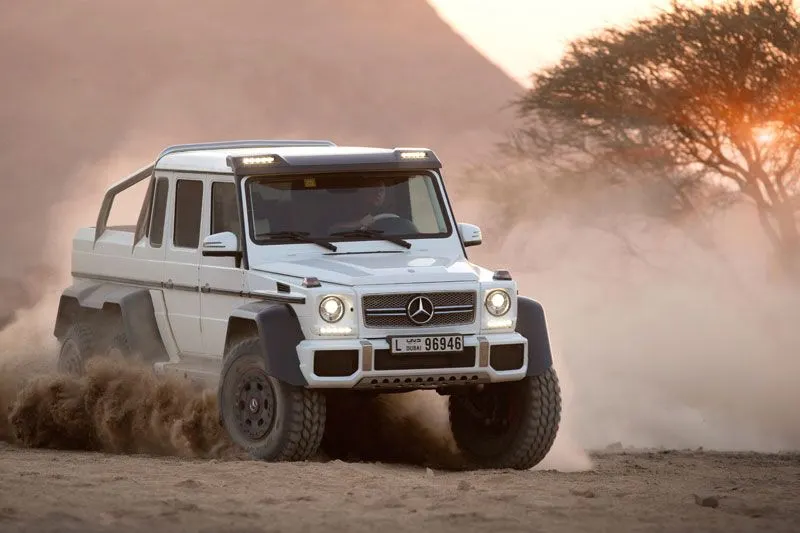
This is what distinguishes the 6×6 from any other extreme road car in history. The verdict is consistent across the road testers who got behind the wheel in the Dubai dunes during the 2013 and 2014 launches: the car is extraordinarily easy to drive. Once you’ve climbed in (you need the side step because the floor is over half a metre off the ground), everything you see from the cabin is the same as the standard G63. The instrument cluster, the steering wheel, the front seats, all identical. The steering column is vertical, the windows are flat, the mirrors are the same. If it weren’t for the three extra dashboard switches for the differential locks, you might think you were in a G63 with a taller cabin.
Then you press the accelerator. Four tonnes set themselves in motion without protest. The biturbo V8 has more than enough strength to move that mass, and the response is surprisingly quick for a machine of this scale. The automatic shifts smoothly. The steering, while heavy, has an honest feel to it. And the extra-long wheelbase, rather than producing an awkward ride, delivers a longitudinal stability the standard G63 doesn’t have. On the motorway, the 6×6 cruises at 120 km/h with less body roll and less pitch than the regular G63. The dead weight of the third axle stabilises the whole package.
In the desert, where it was conceived and where every unit was tested before leaving the factory, the experience moves to another level. British road tester, during the Al Maha dune launch in Dubai: “no incline too steep, no dune too deep, and after 45 minutes of the most aggressive desert bashing I’ve ever encountered, this thing isn’t even making the slightest of squeaks.” The six tyres working with the five differential locks engaged produce a traction capability so absolute that the car physically refuses to get stuck. When one wheel loses contact, which happens constantly while jumping between dunes, there are five others still pushing. When several lose contact at once, the remaining ones do the work. The 6×6 doesn’t get stuck because it cannot. It is a geometric property as much as a mechanical one.
The only thing that fails in that desert is the driver’s common sense. The sense of invincibility the car generates leads you to attempt things that would be suicidal in any other vehicle: vertical descents down dune faces, reverse climbs, one-metre water fords at 60 km/h. The 6×6 does them all without hesitation. The Top Gear review, which awarded it 9/10 in its initial test, summed it up as “the best big boy’s toy ever invented.”
Why it never reached the United States
Despite the success in the Middle East and the global waiting list, the 6×6 was never officially sold in the United States. The reason is the same as for so many extreme European cars of the era: the NHTSA and the EPA refused homologation. Real-world fuel consumption (25-30 l/100 km) excluded it from CAFE regulations, the 37-inch tyres didn’t comply with pedestrian protection rules, headlight heights were outside the legal US range. Mercedes calculated the adaptation cost and decided it wasn’t worth it for such a limited production. American buyers had to wait for the 25-year import rule or work through grey-market channels.
The real market was the Middle East. Dubai, Abu Dhabi, Riyadh, Doha. Royal families, sheikhs, oil magnates. Mercedes sold its planned units in a matter of months. There were also individual European buyers (a handful in Switzerland and Monaco), a special run of 15 right-hand-drive units for Malaysia (the only official RHD production of the 6×6, built for the Naza World conglomerate at a price of 3.2 million ringgit each, around 700,000 euros), and a separate order of ten RHD-converted units for a South African magnate. The United States remained off the official list.
Brabus, the tuners, the prices
Like every G in history, the 6×6 attracted the tuner community from day one. Brabus, in particular, produced several of its own series using the 6×6 as a base. The most famous is the Brabus B63S 700 6×6, with the engine taken to 700 hp through larger turbos, new intercoolers, sport exhausts and remapped ECUs. Brabus built a limited series and sold most of them in the Middle East.
Current market figures are what you’d expect from a limited-production car aimed at a specific buyer. The original Mercedes price was USD 510,000 at launch. Today, clean-condition examples trade between USD 800,000 and 1.5 million depending on specification, mileage and provenance. Brabus units, especially early series cars, have crossed the million-dollar mark at auction. Bring A Trailer recorded a Brabus 700 6×6 sale in 2023 for USD 1.3 million.
The end and the successor that isn’t
Production stopped in May 2015. The final unit left Graz that month. Mercedes had officially declared the model sold out in early 2015 to preserve exclusivity, though they had built more units than initially planned. The final figure exceeds 100 civilian cars, counting official variants and the Malaysian series.
In 2022, Mercedes launched the G63 4×4 Squared (4×4²) on the new W464 platform. It is a G63 with portal axles but only four driven wheels, not six. It offers the ground clearance and presence of the 6×6 without the third axle. It is a more affordable version, more manageable, technically less extreme. It is not a replacement for the 6×6. It is a compromise. And precisely for that reason, the original 6×6 has come to occupy a special place in Mercedes’s historical catalogue: the last civilian car the brand built with no compromises.
What the car means
Some people say the 6×6 is vanity. That it is a car with no practical purpose, that only sheikhs with too much money bought it, that it is a symbol of industrial excess in an era that was already starting to talk about electrification and efficiency. All of that is true. But the other thing is also true: the 6×6 is the precise moment when military ingenuity and civilian luxury intersected in a single car, and nobody in the decision chain put the brakes on the project.
The suspension comes from the armoured G-Class. The portal axles come from the Unimog. The engine comes from the E63 saloon. The cabin comes from the standard G63. The cargo bed is new, lined in polished bamboo, with a stainless-steel rollover bar. The pneumatic compressor is a system designed specifically for the car. The tyres are a one-off size in the civilian market. This is a vehicle that takes parts from five different military and performance products, combines them with judgement, and produces something that didn’t exist before.
That’s why it works. Because it isn’t a marketing gimmick. It is an engineers’ gimmick: people who decided, at a specific moment, that they wanted to find out how far they could push a G-Class before something broke. The answer turned out to be: a lot further than it looked. The 6×6 doesn’t break. After-sales service data, accessible through the Mercedes-Benz Classic network, shows extraordinarily low mechanical incident rates for a car of such complexity. The reason is simple: every individual component in the 6×6 is already validated in military applications or in AMG applications. There is nothing new in the car. There are only known parts, combined in a new way.
The last of its kind
When Mercedes presented the G63 6×6 in 2013, the brand was at a specific moment in its history. The G-Class was about to turn 35 years in production, had been rumoured as endangered several times (especially in 2005, when Dieter Zetsche had to publicly confirm the car would continue), and AMG was looking to demonstrate it could deliver excess at a level no competitor could match. The 6×6 served both missions: it gave the G-Class a defining chapter in its mythology, and it positioned AMG as the only premium brand capable of turning a military vehicle into an object of extreme luxury.
Today, viewed in perspective, the 6×6 is probably the last civilian car of the pre-electrification era that was built without thinking about fuel consumption, emissions or efficiency. It is a 5.5-litre twin-turbo V8 moving four tonnes through six driven wheels and consuming exactly what it consumes. In 2030, when the electric car has wiped this kind of machine off the catalogue, the 6×6 will still be what it is: Mercedes-Benz’s last great industrial folly, hand-built in an Austrian factory by the same people who build G-Wagens for the world’s militaries.
Only just over 100 people worldwide own one. The rest of us can only tell the story. And while we tell it, we remember that all of it began in an Australian Ministry of Defence office in 2007, with a civil servant opening a tender to replace old Land Rovers. Without that tender, no military 6×6. Without the military 6×6, no civilian 6×6. Without the civilian 6×6, AMG has no proof of how far it can go. And without that proof, the G-Class might well have disappeared in 2018, when the second generation entered production. The 6×6 saved the G-Class from the cancelled-models list. And the G-Class repaid the debt many times over.