VAMTAC: The Galician Tactical Vehicle That Out-Engineered The Humvee
The image you’ve probably seen
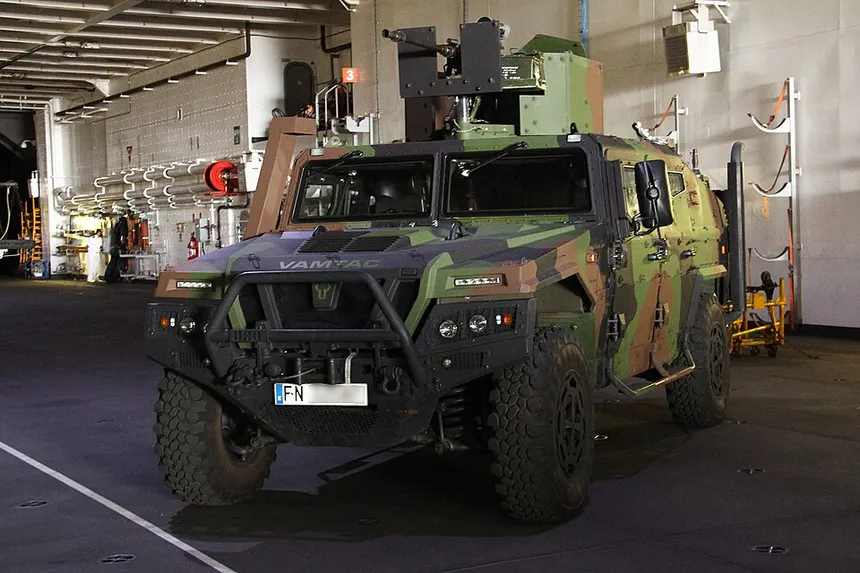
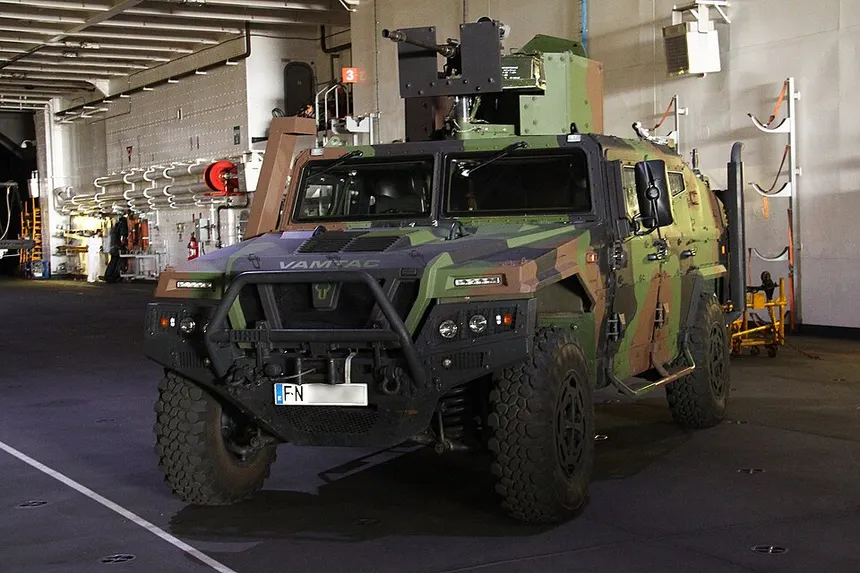
If you scroll military hardware accounts on social media, you might have caught the footage. May 2026. Casas de Uceda training ground, central Spain. The rear ramp of an Airbus A400M of the Spanish Air and Space Force opens at around 300 metres altitude. A VAMTAC ST5, valued at roughly 600,000 euros, drops cleanly out the back. The parachute deployment starts. Then something in the rigging fails. The straps part. The vehicle goes into free fall.
It hits the ground at terminal velocity. The footage, shot by the Brigada Almogávares VI paratroopers on the drop zone, was on X within hours. The VAMTAC was reduced to a sheet of aluminium foil scrunched up in the middle of a Castilian field.
The obvious read is: a 600,000-euro vehicle just got destroyed. The interesting read is the reverse. The VAMTAC was engineered to withstand 8-kg anti-tank mines under any wheel, 7.62 mm armour-piercing rounds at 30 metres, unprepared fording up to 1.5 metres, gradients with 100% surface adhesion, and temperatures from minus 20 to plus 50 degrees Celsius.
It was not engineered to fall out of the sky without a parachute. And yet somebody at the Ministry of Defence considered it a calculated risk to airdrop one, because most of the time the parachute opens, the vehicle lands, the paratroopers behind it climb in, and the operation continues.
That is what we are talking about. A vehicle built to take almost anything short of the physically impossible. Designed, welded, and assembled in a 40,000-square-metre plant in Galicia.
The brief: build a Humvee, but build it properly
By the mid-1990s, the Spanish Army had the same problem most NATO armies were quietly working out. The American HMMWV, the Humvee, had become the default tactical 4×4 of half the world after the Gulf War. Top Gear had made it pop culture. Hollywood had put it in everything from Black Hawk Down to The Hurt Locker. The vehicle was iconic.
It was also fifteen years old by then, and the cracks were visible. Heavy. Slow. Lousy visibility. Inadequate ballistic protection. Armour upgrades bolted onto a chassis that had never been engineered to carry them, with predictable consequences in Mogadishu and later in Iraq. And there was the strategic dimension nobody really discussed in public: the Humvee was an American answer, with American service support, American spares, and American political dependency baked in.
In 1995, the Spanish Ministry of Defence framed the requirement. The Army wanted a tactical high-mobility vehicle that matched the operational role of the Humvee but was built from scratch with newer technology, manufactured in Spain, with a domestic supply chain. Not a clone. The next step.
UROVESA, already a Ministry of Defence supplier since 1984 with eleven years of direct industrial experience producing the TT URO truck for the Army, was the natural candidate. José Sierra and his engineering team took on the development. Three years of work. Three years of prototypes. Three years of evaluation under conditions that would have rattled most engineering teams who hadn’t already spent a career delivering for clients who deliberately break things.
The first VAMTAC, internally known as the Rebeco, entered serial production in 1998. Fifteen years after the Humvee had been launched in 1983. That fifteen-year gap, which sounds like a footnote, is the whole story. It is the reason the VAMTAC is not another Humvee. It is what comes after the Humvee.
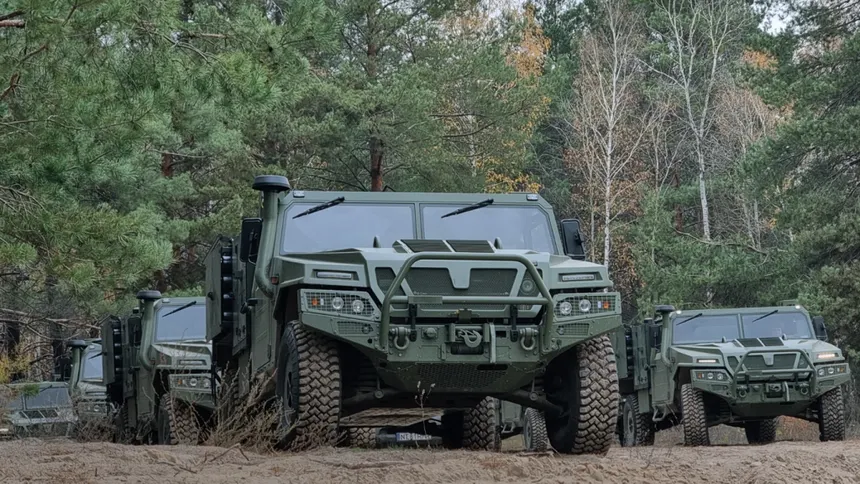
What’s actually under the bodywork
Before the comparison, the mechanical details. Because when you’ve spent three decades with your hands inside engine bays, the first thing you look at on a vehicle is not the paint and not the badge. It is what sits beneath.
The heart of the current VAMTAC ST5 is a Steyr M16 diesel: inline six-cylinder, 3.2 litres, turbocharged with intercooler, direct injection. Block and cylinder head machined as a single monobloc casting. That is not a cosmetic engineering choice; it eliminates two of the chronic failure modes of any diesel under sustained thermal stress: head warping and head gasket failure. For anyone who has spent August nights replacing blown gaskets on industrial diesels, that single design decision is worth the cover charge.
Power output varies from 188 to 272 horsepower depending on variant, with 410 Nm of torque in the S3 spec and higher in the upgraded variants. NATO standard fuel compatibility. That is not a marketing line: it means the engine runs on JP-8 jet fuel pulled from an aircraft, on tanker-grade diesel, or on whatever else is available in a theatre of operations. First rule of any military engine: it must eat whatever is in the can.
Transmission is Allison automatic with torque converter, five or six forward gears depending on version, one reverse. Proprietary URO URM-15 transfer case with two ranges plus neutral. Permanent 4WD with inter-axle differential.
Here is the line that separates the VAMTAC from the Humvee in the real-world mud: three fully lockable differentials. Front, centre, rear, 100% lock. Translation, in workshop English: you can have three wheels spinning in the air and one wheel braced on a rock, and the vehicle still moves forward. The Humvee locks the centre differential. The VAMTAC locks all three. The difference on mud, snow, rock, or soft surfaces is the difference between making the mission and waiting for recovery.
Suspension is independent on all four corners, double wishbones, helical springs, telescopic dampers. No solid axles. No compromise. The wheels articulate independently, which lets the VAMTAC follow tank track ruts when it leaves the road. The Humvee, with its older geometry, famously could not do this without ending up with one wheel airborne in the bottom of a Russian tank rut, a sequence YouTube has documented extensively.
Hydraulic disc brakes, dual circuit, ventilated discs on all four wheels. Power-assisted steering. Military-spec tyres in 37×12.5 R16.5 or R17.5 with Central Tyre Inflation System, adjustable from the cabin: high pressure for tarmac, low for sand, mid for mud.
Unprepared fording capacity: up to 1.5 metres. The Marines variants get a snorkel and waterproof seals to push that deeper without drowning the intake. Maximum range: up to 1,000 km on extended-tank variants. Top speed: 135 km/h at full load.
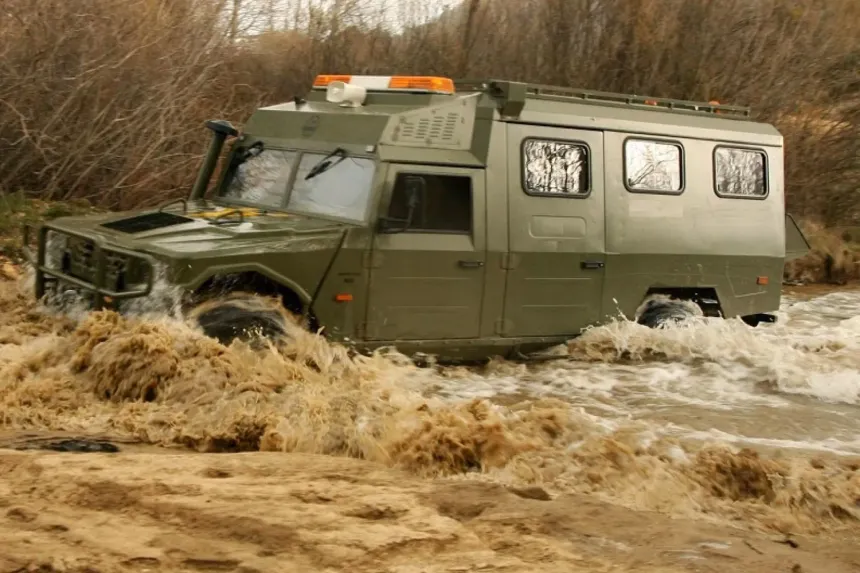
The terrain figures
This is where the VAMTAC starts to make a real argument. Approach angle: 74 degrees, with or without the integrated winch. Seventy-four. There are road cars whose approach angle sits around fifteen degrees. The VAMTAC nearly quadruples that. Departure angle: 54 degrees. Maximum frontal gradient: 100% with sufficient adhesion, which is a 45-degree wall. Maximum side slope: 50%.
These are not brochure numbers. They are the figures confirmed by six months of official Spanish Ministry of Defence evaluation on VAMTAC prototypes. High-altitude trials in Jaca at minus 20 degrees. Desert trials in the Álvarez de Sotomayor range in Almería at plus 50 degrees. Beach trials at the Retín live-fire range in Cádiz. Airdrop trials from C-130 Hercules transports. Sling-load trials under CH-47 Chinook helicopters.
Six months. Every climatic and operational extreme a military vehicle could realistically meet, reproduced on Spanish soil, with Defence engineers logging every torque value, every component temperature, every operating hour.
That kind of validation does not come from glossy brochures. It is earned on dirt. The VAMTAC earned it in 1998 and has been re-earning it ever since.
VAMTAC versus Humvee: the real fight
This is the argument that has run for two decades on military forums, YouTube comparison videos, and Top Gear bar conversations. Is the VAMTAC actually better than the Humvee? The honest answer, with no national flag-waving, is that the VAMTAC is better at almost everything that matters in a modern military operation. Not because of patriotism. Because it was designed fifteen years later, with the explicit objective of beating the Humvee on its own terms.
Traction. Humvee: centre differential lock. VAMTAC: front, centre, and rear 100% locks. Point VAMTAC.
Suspension. Humvee: independent, but with 1980s geometry. VAMTAC: independent double-wishbone, geometry designed to track tank ruts. Point VAMTAC.
Engine. Humvee: General Motors 6.2-litre V8 diesel, 155 hp, 350 Nm, traditional cast block with separate head. VAMTAC ST5: Steyr 3.2-litre inline six, up to 272 hp, monobloc construction. More power, less displacement, fewer points of failure. Point VAMTAC.
Visibility. Humvee: notoriously poor, wide cab, long bonnet, thick pillars. VAMTAC: better seating height, better windscreen, better peripheral vision. Point VAMTAC.
Handling. Humvee: heavy, truck-like steering, requires a Class C licence for civilian use in Spain. VAMTAC: more agile, more controllable at speed across rough terrain, better power-to-weight (46.6 hp/tonne unladen). Point VAMTAC.
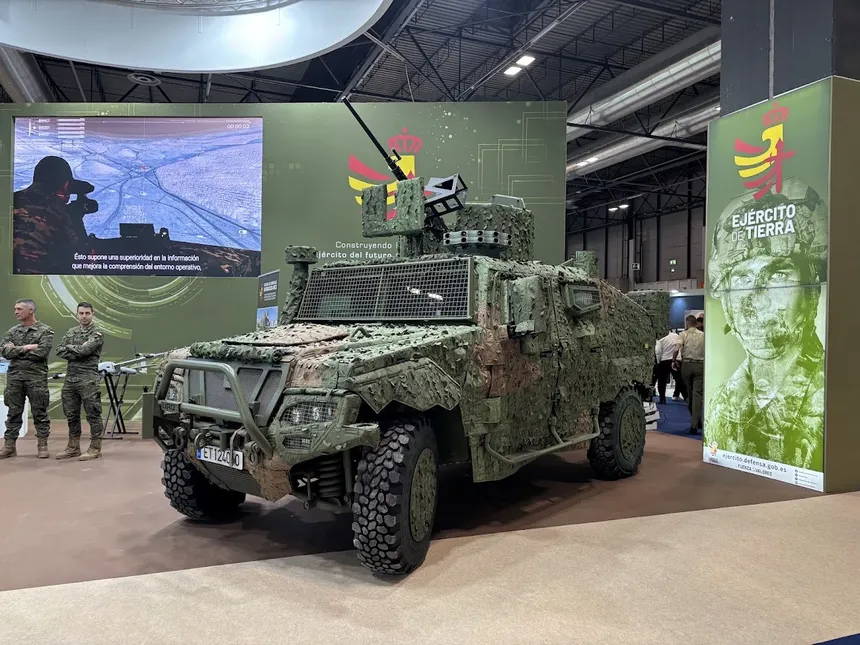
Armour. Original Humvee: essentially none. The armoured uparmoured variants that followed Iraq are field-applied add-ons on a chassis that was never designed to carry them. VAMTAC ST5 SK and derivatives: structural armour up to NATO STANAG 4569 Level 3, modular survival capsule, V-shaped blast deflector, anti-blast seating with head and foot restraints, run-flat tyres. Designed from the start to mount armour structurally, not to bolt it on. Point VAMTAC.
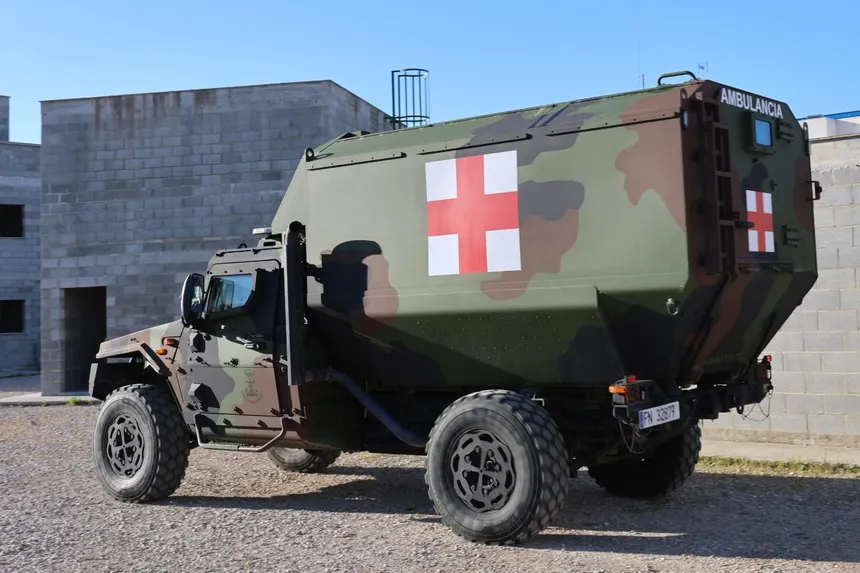
Modularity. Humvee: a limited official set of variants. VAMTAC: around twenty body configurations and seventy-five distinct applications on the same platform. Same chassis, same powertrain, fitted as armoured ambulance, as Alakrán 120 mm mortar carrier, as Starstreak air defence platform, as command and control, as Pitón NBC reconnaissance, as anti-drone system. Point VAMTAC.
What does the Humvee win on? Mass production. Cultural footprint. The fact that half of American cinema has one parked outside the barracks. And legacy: the Humvee was first, it opened the segment, and that counts for something. But as a vehicle in 2026, the VAMTAC outperforms it on virtually every operational metric that matters in combat.
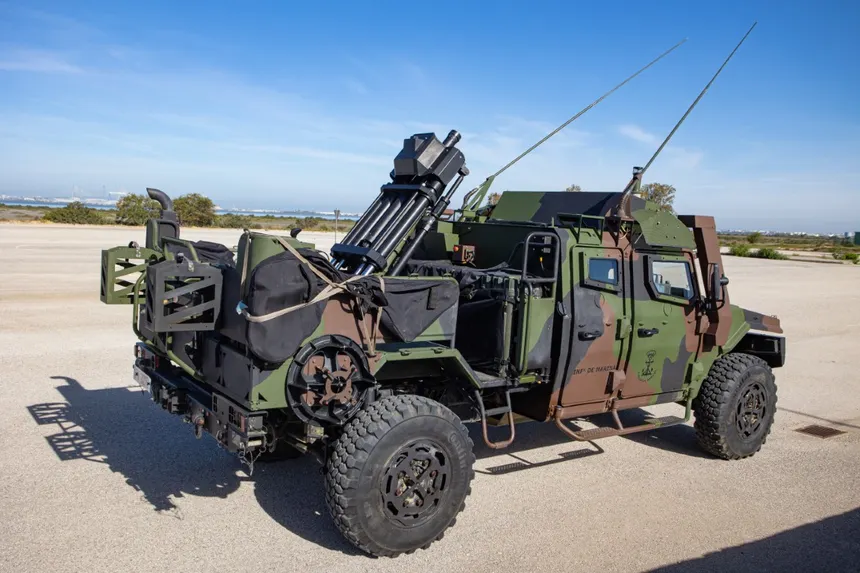
The real proof: the Ukrainian frontline
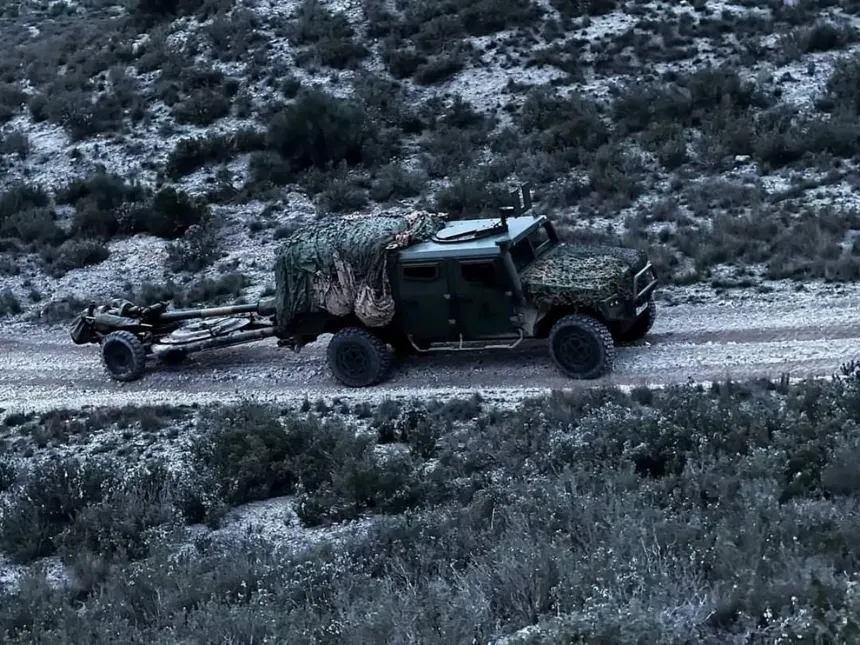
If the comparison still sounds like marketing copy, here is the test that does not lie. Since early 2024, the VAMTAC has been operating in Ukraine. Spain has transferred an undisclosed number of units in multiple configurations, including several VAMTAC ST5 Alakrán: the mortar-carrier variant that combines the ST5 chassis with a 120 mm Thales tube on an electromechanically deployed NTGS Alakrán mount. The mortar deploys from the rear compartment, sets onto its dual base plate stabiliser on the ground, and fires at full charge without transmitting recoil load into the vehicle.
Onboard ammunition capacity: up to 48 rounds of 120 mm mortar. Time from movement to firing position: seconds. Time from firing to moving again: seconds. In a war dominated by Russian counter-battery radar that can backtrack a fire point in minutes, that exit time is the line between continuing to fight tomorrow and being a crater tonight.
Ukraine’s 210th Independent Assault Regiment, based out of Kyiv, has been operating VAMTAC ST5 Alakrán units since November 2024. The first public images showed six lined up on a live-fire training session. The UROVESA logo on the front grille had been pixelated, for obvious operational reasons. What could not be hidden was the dark olive paint matching the Spanish Army’s livery, the silhouette, the unmistakable geometry.
In April 2026, during Defence Minister Margarita Robles’s visit to Kyiv, Spain confirmed the delivery of 100 additional VAMTAC vehicles to Ukraine as part of the bilateral security agreement signed with Zelensky, valued at 1.129 billion euros over ten years. The first batch began leaving Valga in early May 2026. Specific recipient: the Ukrainian Border Guard, a service that has shot down more than 4,000 drones in the first part of 2026 alone, nearly triple the entire previous year. The frontline is no longer just trenches at ground level. It is in the sky. And a fast, modular, armoured platform that can mount different weapon systems is precisely what that scenario demands.
Then there is the United Kingdom. In 2025, the British selected the VAMTAC ST5 as the platform to mount the Thales Rapid Ranger air defence system, also destined for Ukraine. The stated reason was unusually blunt: no domestic alternative met the mobility and payload requirements. The British Army, with its entire defence industrial base behind it, chose a Galician vehicle because there was nothing equivalent at home.
The global map
The VAMTAC operator list started in Spain and now covers five continents. Morocco: more than 1,600 vehicles. Portugal: 139 ST5 units delivered 2019-2020. Iraq: 225 EOD-specialist variants. Malaysia: 109 units. Romania: 24-unit contract signed in 2024, deliveries 2025. New Zealand: 60 vehicles contracted in November 2024, comprising 40 CK3 personnel carriers and 20 ST5 operational units, with deliveries running to 2027. Singapore: an additional 100-unit order on top of the existing fleet. Dominican Republic, Saudi Arabia, Indonesia (where they carry the Starstreak missile system), Paraguay, Latvia.
Thirty countries. Over 6,000 units delivered since 1998. Every single one assembled in Valga.
The interesting question is not why so many countries buy the VAMTAC. The interesting question is how a family-owned Galician manufacturer, with 330 direct employees and no sovereign-fund defence backing on the scale of Krauss-Maffei or General Dynamics, has been able to stand up to the multinationals in this segment. Justo Sierra has given the answer in interviews: product, reliability, after-sales support, ability to adapt to client requirements. Four things. All four are controlled by UROVESA, in Galicia.
What it takes and what it doesn’t
Back to where we started. May 2026. Casas de Uceda. The VAMTAC turned into foil.
What the VAMTAC takes: 8-kg anti-tank mines under any wheel. 7.62 mm armour-piercing rounds at 30 metres. 1.5 metres of fording without preparation. Vertical gradients with grip. Extreme temperatures from minus 20 to plus 50 Celsius. Airdrops from C-130 Hercules and A400M transports, when the parachutes do their job. Over twenty years of continuous front-line service, demonstrated by fleets still operational from 1998.
What the VAMTAC does not take: 300-metre free fall without a parachute. But nothing does. Not a Russian T-90, not a 15-tonne American MRAP, not a German Leopard. The VAMTAC is a high-mobility tactical vehicle, not a meteorite. And yet it is engineered to survive almost everything else a modern theatre of operations can throw at it.
When you look at it from the workshop, after thirty years of putting your hands inside chassis and engines and suspensions, what you see in the VAMTAC is a series of correctly made engineering decisions. The Steyr monobloc is a correct decision. The three diff locks are a correct decision. Structural rather than bolted-on armour is a correct decision. NATO fuel compatibility is a correct decision. Cabin-adjustable CTIS is a correct decision. Independent suspension geometry calculated to follow tank ruts is a correct decision.
And all of them, decision by decision, welded, integrated, finished in a Galician factory that most Spaniards could not point to on a map.
The VAMTAC is not a Humvee clone. It is what the Humvee should have evolved into if AM General had kept investing in it. And it is built in Valga.
Check you’re still alive.