The 2CV Wasn’t a Car. It Was a Spec Sheet Turned to Steel.
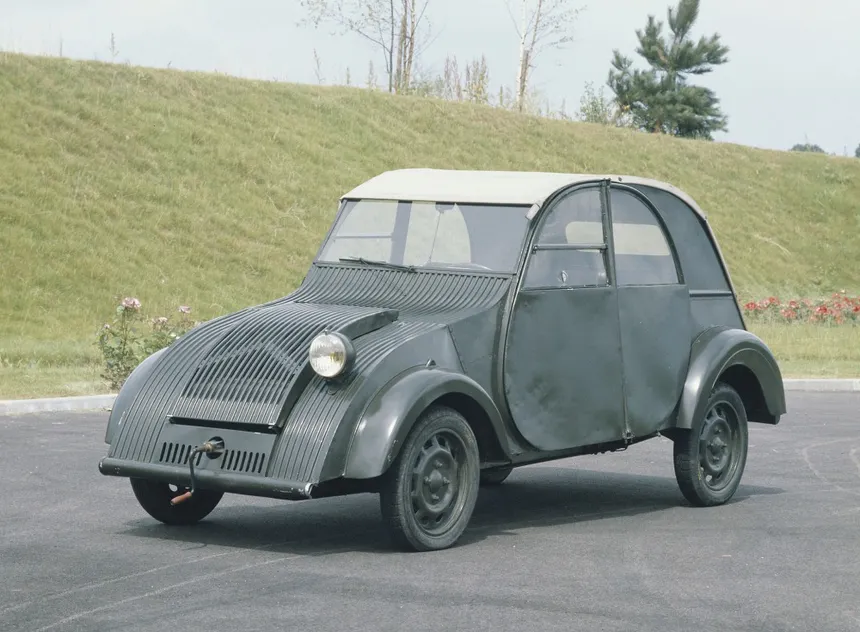
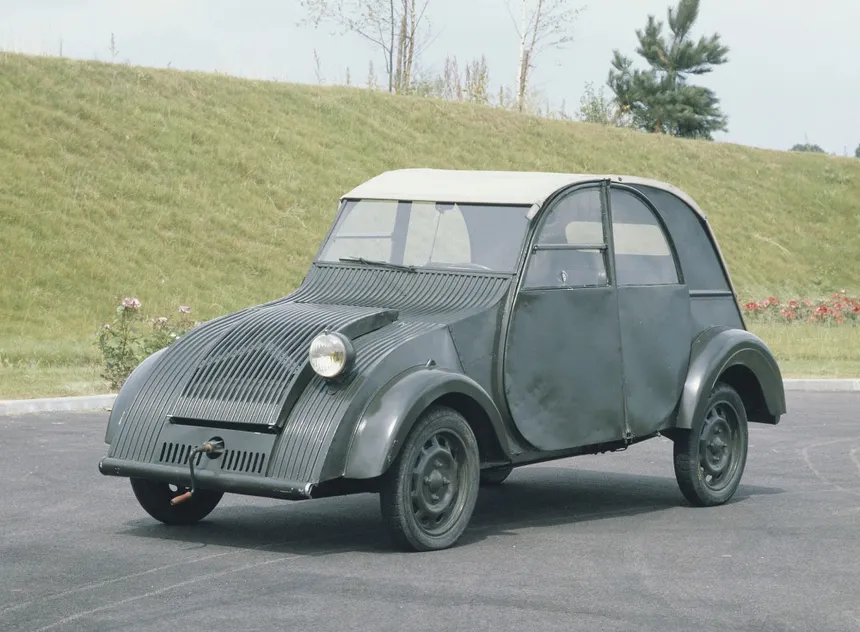
Citroën 2CV and AK400: how Boulanger’s design brief wrote the car before anyone picked up a pencil
You’re going to read it a thousand times. The 2CV was “four wheels under an umbrella.” It’s a lovely slogan and it sells itself, but it’s marketing, not engineering. The line was actually invented in the 1960s, more than a decade after the car had been on the road. The real story, the one nobody bothers to tell in English, is a lot more interesting. And a lot less folksy.
The 2CV is what happens when an executive sits down and, instead of asking for a car, writes down a problem. Then leaves his engineers to solve it.
That piece of paper is called a cahier des charges — a design brief. And Boulanger’s is probably the cleanest piece of requirements engineering ever written in the auto industry. A masterclass in something we’d today call user-centered design or design thinking, but without the PowerPoint deck and the consultancy fee.
Let’s get under the bonnet.
Boulanger’s brief, word for word
- Pierre-Jules Boulanger has been running Citroën for a year, installed by Michelin after they forced André Citroën out in 1935. The company is financially shattered. The Traction Avant is a masterpiece, but it’s a middle-class car, and Boulanger notices something the rest of Quai de Javel had missed: most of France doesn’t own a car. Farmers, small shopkeepers, tradesmen. People still going to market by horse-drawn cart or bicycle. A virgin market the size of an entire country.
Boulanger hands the team led by André Lefebvre (the same engineer who’d signed off the Traction Avant) a new internal project, TPV: Toute Petite Voiture — Very Small Car. The brief reads, in part:
“Have your services study a vehicle capable of carrying two farmers in clogs, fifty kilos of potatoes or a small barrel, at a maximum speed of 60 km/h, for a fuel consumption of three litres per hundred kilometres.”
That’s the famous part. But the full brief went much further:
- Four real seats. Four actual humans, not four catalog seats where the rear row is for children.
- Front-wheel drive.
- Two French tax horsepower (which is where the commercial name came from).
- Three-speed gearbox.
- Suspension capable of carrying a basket of eggs across a ploughed field without cracking a single one.
- Driveable by a woman or a beginner (yes, that’s how it was written — period chauvinism asking permission from period chauvinism).
- Minimum maintenance cost: 50,000 km without touching anything mechanical.
- And the line Boulanger said out loud when someone asked about styling: “I don’t want to hear about aesthetics.”
That last line is the key. Boulanger didn’t want a beautiful car. He wanted a correct car. The gap between those two words is the gap between Detroit and Citroën.
The problem, translated into engineering
If you sit at a desk and translate that brief into actual technical specifications, you end up with a list that, in 1936, would have read as openly offensive:
- Mass: as low as humanly possible. Every kilo costs fuel and costs payload. If you want 3 L/100 km from a small engine, you have to weigh roughly what a sidecar weighs.
- Suspension: soft enough not to break eggs over a ploughed field. That kills any conventional semi-elliptic leaf spring. It also kills any rigid suspension.
- Four real seats: you need a generous wheelbase.
- Engine: small, light, cheap to maintain, dead reliable at full chat for 100 hours straight if it has to be.
- Front-wheel drive: engine, clutch, gearbox and differential all crammed up front, which makes packaging brutally hard.
- Manufacturing cost: ridiculous. Citroën is broke.
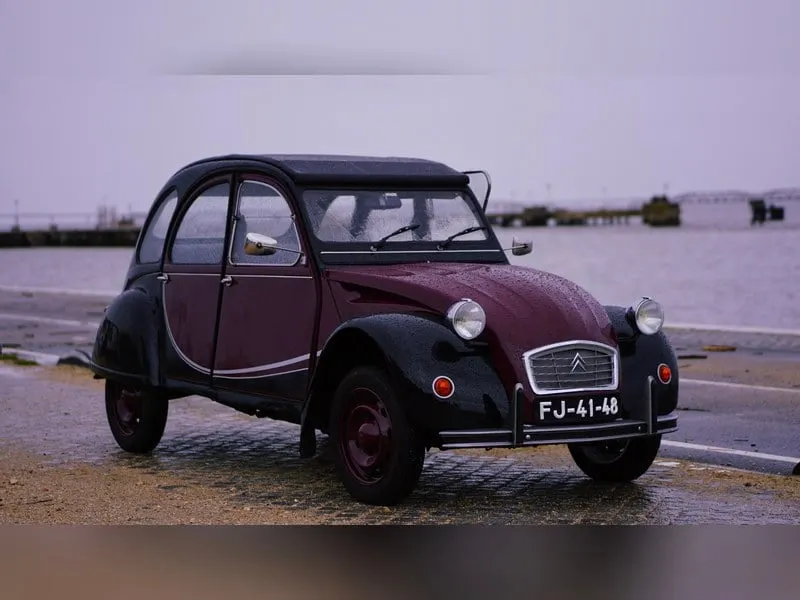
To that list you add a detail that circulates throughout the 2CV literature but doesn’t appear in the original brief: legend has it that Boulanger, a tall man, demanded that he be able to drive the car with his hat on. The anecdote is probably apocryphal (no period documentation supports it), but it must contain a grain of truth in somebody’s head, because the finished 2CV stands 1.60 m tall, ludicrous for a vehicle that weighs 510 kg in running order. That odd, tall, narrow proportion came from somewhere.
How Lefebvre solves the problem
André Lefebvre had the Traction Avant on his CV. He knew perfectly well a brief like this couldn’t be solved with compromises. It had to be solved by reinventing every subsystem from scratch. So that’s what he did.
Chassis: a flat stamped-steel platform instead of a traditional ladder frame. On top of that, a thin self-supporting steel bodyshell bolted to the platform. It isn’t a pure unibody like the Type H will become in 1947, but it isn’t body-on-frame either. It’s a hybrid designed so the platform carries the structural loads and the body can be unbolted for repair without touching the chassis. Pure cleverness.
Front-rear interconnected suspension: this is where Lefebvre does something nobody had attempted. Each wheel has a leading arm (front) or trailing arm (rear) connected to a horizontal cylinder mounted longitudinally on the chassis. Inside the cylinder is a helical spring. But the cylinder itself is not rigidly bolted to the bodywork: it sits on secondary springs called volute springs (steel volutes at first, rubber later).
What does that do? When the front wheel hits a bump and rises, the front pull rod compresses the spring inside the cylinder. At the same time, that compression pulls the entire cylinder forward via the volute spring. And that motion drops the rear wheel on the same side, anticipating that in half a second that same rear wheel will hit the same bump.
It’s fore-aft interconnected suspension. The rear wheel knows what’s coming before it gets there, because the front has already told it through the volute springs. Pitch is dramatically reduced. The basket of eggs survives the field. The brief is met at the cost of a mechanism the customer will never understand but will benefit from every time he loads something fragile in the back.
Add to that almost non-existent anti-roll bars, body roll that can reach 30 degrees in corners (the 2CV leans like a motorcycle but doesn’t tip over because the suspension geometry keeps the wheels parallel to the ground), thin tyres at low pressures, and primitive but effective friction dampers — and you have a system that looks ridiculous on paper and works like a Swiss watch in practice.
Engine: this is the other milestone. The initial project tried BMW motorcycle engines (a 500 cc flat-twin), water-cooled engines from Maurice Sainturat, all sorts of approaches. But the final decision, taken in 1948 with the war over, was to commission Walter Becchia (formerly chief engineer at Talbot-Lago) to design a completely new engine.
Becchia, according to Citroën oral tradition, took apart the engine of Flaminio Bertoni’s BMW motorcycle (Bertoni was the car’s designer, the Italian with the “golden fingers”) and from that exercise drew the 2CV flat-twin. Company lore says he did it in three days; it’s a piece of folklore repeated for decades but without a verifiable primary source. What is documented is the architecture: forced air cooling with a crankshaft-driven fan, four-stroke, OHV valves operated by pushrods and rockers, hemispherical combustion chambers, one-piece connecting rods with plain bearings fitted to a pre-shrunk crankshaft during assembly.
Result? An engine that could run flat out for 100 hours without damage. First version: 375 cc, 9 hp. For moving 510 kg in 1948 that was exactly what the brief demanded — no more, no less. The family then grew: 425 cc in 1955, 435 cc and 602 cc in 1970, and the 602 cc in its final form delivered 33 hp. Forty-two years of production from the same basic architecture. Becchia drew an engine in 1948 that was still being sold in 1990 without ever changing its fundamental design philosophy.
Four gears, not three: the brief asked for three speeds, but the engineers fitted four. The most-repeated version of the story (told by the French Wikipedia without a primary source, so treat it as workshop lore rather than notarised fact) has Boulanger testing the prototype, noticing it ran suspiciously well, and being told by the engineers that it was a three-speed gearbox plus an overdrive ratio. Boulanger, an engineer but a trusting one, accepted it. Whether the verbal pirouette actually happened or not, what is documented is that the production gearbox had four gears.
September 1939: the 2CV doesn’t launch
The TPV is ready in August 1939. Boulanger has 250 pre-series cars built and slated for the Paris Motor Show in October. On September 1st, Germany invades Poland. On September 3rd, France declares war. The Paris show is cancelled.
Boulanger, watching German tanks roll into the Low Countries, makes a decision that defines Citroën for the next century: he orders the prototypes dispersed and hidden. Some of the 250 pre-series cars are dismantled to keep the TPV out of Nazi hands; others are concealed whole in barns and attics across rural France; others are sacrificed in the rush. It wasn’t a blanket order to destroy them, but a concealment operation with all the messy edge cases an occupied firm produces. Throughout the entire war, Boulanger deliberately sabotages Citroën production to avoid helping the enemy. Some prototypes continued to be developed in secret, with parts modified so the car would eventually use flat steel panels rather than duralumin (the Germans had already tried to steal Citroën’s press tools).
In 1968, thirty years later, the first TPV prototype was rediscovered in a barn. In 1994, three more turned up in another. Both finds are documented by the Conservatoire Citroën HERITAGE and rank among the most extraordinary automotive archaeology stories on record.
October 1948: the 2CV finally arrives
Paris Motor Show, 7 October 1948. Citroën stand. The production 2CV is unveiled. The press, en bloc, treats it as a joke. “They’ve built a car with a canvas roof!”. “Four wheels under an umbrella!”. The British press calls it the Tin Snail. Charles Faroux writes that the model on display “has no engine” (one of the few outright falsehoods — it did).
But the farmers weren’t reading Faroux. The farmers walked into Citroën dealerships, looked at the price (228,000 francs, a pittance compared to any decent passenger car of the period), climbed in with their hats on, confirmed that four people fit, opened the canvas roof, listened to the salesman explain that it drank 3 L/100 km and could be driven with two fingers, and bought.
Waiting lists, depending on the market and the moment, stretched to three years. Citroën couldn’t keep up. The 2CV became, almost by accident, the most subversive car in Europe: so cheap and so efficient it made every conventional rival look obsolete.
The 2CV Fourgonnette: the brief, scaled to commerce
And here’s the other half of the article: the Fourgonnette family.
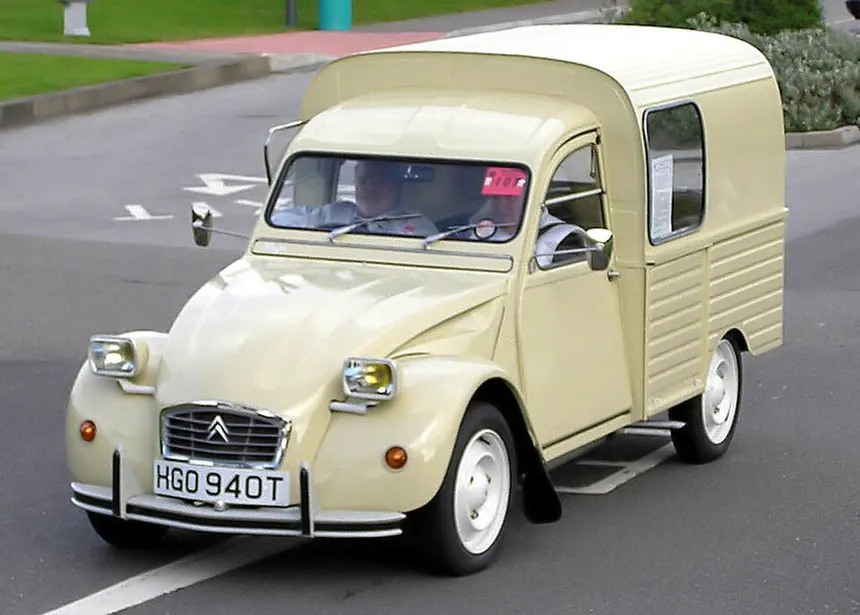
In September 1951, Citroën launches the AU, the first 2CV-based van. 375 cc engine, 9 hp, 250 kg payload. What they’re doing is something that feels obvious in 2026 but was radical in 1951: deriving a commercial van directly from the road car, sharing platform, engine, suspension and costs. Everybody does it today (Caddy on Golf, Berlingo on C4, and so on). In 1951, Citroën invented it.
In September 1954 the AZU arrives, with the 425 cc engine. It stays in the catalogue until the end of 1977 with successive upgrades (in March 1963 it climbs from 12 to 18 hp; in August 1967 it reaches 21 hp SAE). When Renault launched the 4 Fourgonnette in 1961 (seven years after the AZU, not before), Citroën already owned the segment, but the French market needed an upgrade so its van didn’t fall behind. In May 1963 the AK350 appears: 20 cm longer rear overhang, 602 cc engine from the Ami 6 (22 hp), payload up to 350 kg. It isn’t exactly a response to the R4, because the AZU got there first; it’s a move upward to cover the slice Renault was trying to occupy with the F4.
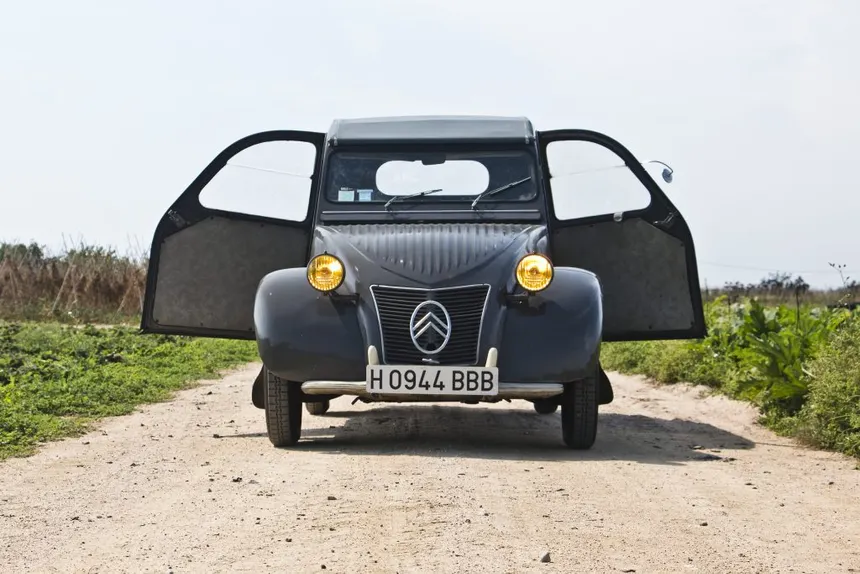
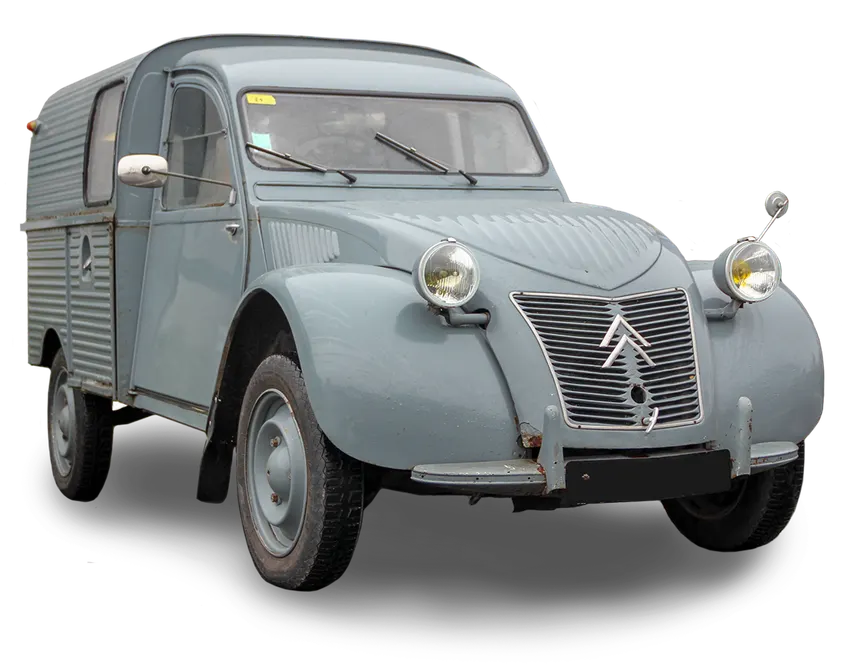
And in July 1970 the piece we came here for arrives: the AK400, factory designation AKS400 (the S stands for Surélevé, “raised”). It’s the family’s evolutionary endpoint. The loading box is raised by a further 20 cm, the 602 cc engine in Ami 8 spec delivers 35 hp SAE (later 33 hp under revised classification), the indicators are integrated into the front wings instead of the old angular bat-style units, the side ribs are flattened, the rear doors are larger, and the declared payload rises to 400 kg (actually 475 kg less the driver’s weight).
Realistic top speed: 95-100 km/h with a tailwind. Usable volume: over 2 m³. AK400 production: from July 1970 to May 1978. Cumulative total for the entire Fourgonnette family (AU + AZU + AK350 + AK400): more than 1,250,000 units.
That million-and-a-quarter vans has a meaning. The 2CV platform, designed in 1936 to carry two farmers in clogs and a sack of potatoes, sustained forty-two years of commercial derivatives without ever needing the mechanicals to be redesigned. Becchia flat-twin, Lefebvre interconnected suspension, Lefebvre flat platform. Three surnames and a thinking head above them (Boulanger). In 2026, that would be a PhD thesis in product engineering.
The Acadiane: a dignified exit
In May 1978, Citroën retires the AK400. It’s replaced by the Acadiane, a van derived from the Dyane (not from the 2CV directly, though the Dyane is itself a 2CV derivative) and mounting the same 602 cc flat-twin. The Acadiane remains in the catalogue until 1987.
The 2CV Sahara: the brief, taken off-road
If the Fourgonnette proves the platform could carry commercial derivatives, the 2CV Sahara proves it could carry something nobody had asked for: a trip to the desert. By the late fifties France still had colonies in North Africa. The terrain there was murderous for a front-wheel-drive 2CV. Citroën could have engineered a conventional 4×4 setup with a propshaft to the rear axle. They didn’t.
What they did was bolt a second engine, identical to the front one, into the boot, driving the rear axle through its own gearbox. Two 425 cc flat-twins in parallel (later modified to deliver around 28 hp combined), two 15-litre fuel tanks under the front seats (filled through the doors), a spare wheel on the bonnet (because the boot was occupied by the rear engine), and two separate ignition keys on the dashboard. Top speed on one engine alone: about 65 km/h. With both running: around 100 km/h.
What that layout offered wasn’t exactly 4WD. It was front-drive, rear-drive and all-wheel-drive on demand. You could start the rear engine on its own if the front one failed. You could use just the front for road work to save fuel. You could engage both when terrain got serious. And with near-50/50 weight distribution, it was a monster in sand, mud and loose rock.
The first prototypes were shown in 1958. Series production started in December 1960. In 1962, following Algerian independence, Citroën dropped the “Sahara” name and the car became simply the 2CV 4×4. Production ended in 1966. Total built: 694 units according to the Conservatoire Citroën records. It’s one of the rarest cars in the brand’s history, and arguably the only production passenger car in the world ever built with two engines and two gearboxes synchronised through a single clutch pedal.
The Sahara is the final piece of evidence that Boulanger’s brief was over-engineered for its original purpose. When you asked the 2CV platform to cross the Sahara, it crossed the Sahara.
Mangualde: the Portuguese farewell
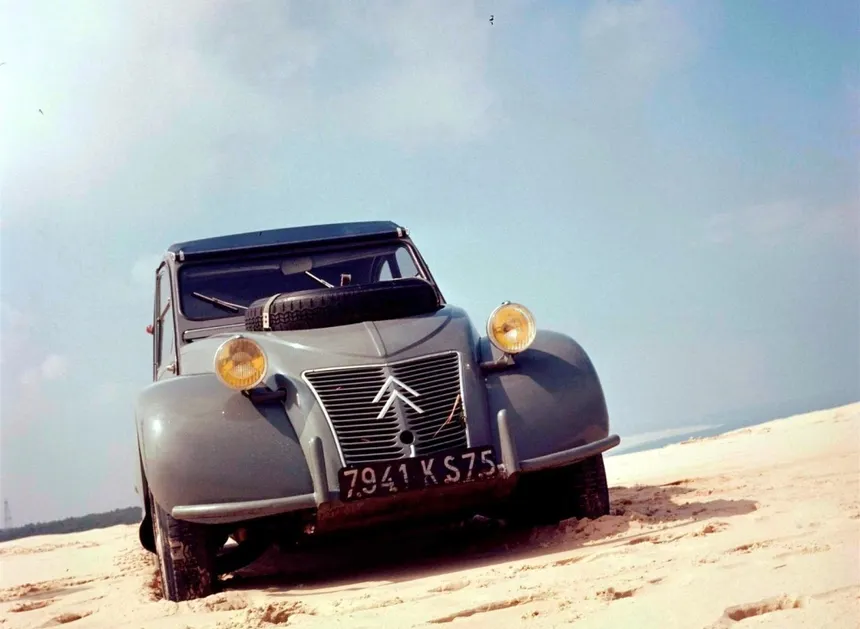
2CV production at the French Levallois-Perret plant ended on 25 February 1988. But the car didn’t die there. Citroën had opened a factory at Mangualde, in Portugal, back in 1961, and that’s where 2CV production was concentrated for the final years. The last 2CV ever made rolled off the Mangualde line on 27 July 1990. Forty-two years after the 1948 Paris Motor Show, with Becchia’s engine block essentially unchanged in philosophy, with Lefebvre’s platform intact, and with Boulanger’s brief still steering the product from beyond the grave.
Mangualde isn’t a footnote. It’s the plant where Citroën, by then absorbed into the PSA group, decided to keep the 2CV alive when building it on French soil no longer made commercial sense. If you look at the last-generation 2CVs on any used market today, the soundest examples tend to be the Mangualde cars: late production, more modern quality control, better-protected steel.
What Boulanger’s brief still teaches
Lay the TPV’s cahier des charges alongside the typical requirements document of any modern industrial project, and something uncomfortable becomes obvious: Boulanger’s was better written.
It’s specific (50 kg of potatoes, 60 km/h, 3 L/100 km, intact eggs). It’s measurable (every criterion verifiable empirically). It’s prioritised (the line “I don’t want to hear about aesthetics” is the cleanest piece of scope management on record). It’s grounded in the real user (farmers in clogs, not hypothetical consumer personas). And it leaves the engineering team total freedom on the how.
Modern automotive requirements, by contrast, tend to read like political compromises: “competitive in segment”, “aligned with trends”, “positive emotional profile”, “validated market potential”. Words that mean nothing and, crucially, can’t be verified against a ploughed field.
The 2CV exists because someone in 1936 knew how to write down a problem in simple language. And because someone else, two years later, knew how to translate that problem into a technical platform that would last until 1990. Forty-two years of production isn’t luck. It’s what happens when the brief is right from the start.
The AK400 — that raised-roof van with dubious payload figures and side windows that came and went with the tax winds — is the proof that the platform was over-engineered for its original purpose. What Boulanger asked for to take two farmers to market ended up moving the entire commerce of France for four decades. That’s the mark of good requirements engineering: when the system endures far beyond what was asked, and keeps working.
And still today, on any French B-road, you’ll see a 2CV roll past with a kid behind the wheel waving like he’s driving a Ferrari. It isn’t nostalgia. It’s that the car, quite simply, still meets the brief. Four seats, low consumption, maintenance any hand can manage, suspension that doesn’t break eggs. The 1936 promise still stands.
The auto industry of the 21st century has spent years arguing about how to build cars that are once again simple, affordable and useful. Nobody seems to spot the obvious: the manual was written ninety years ago. Somebody just needs to read it again.
Check you’re still alive.
1 thought on “CITROËN 2CV + AK400”