
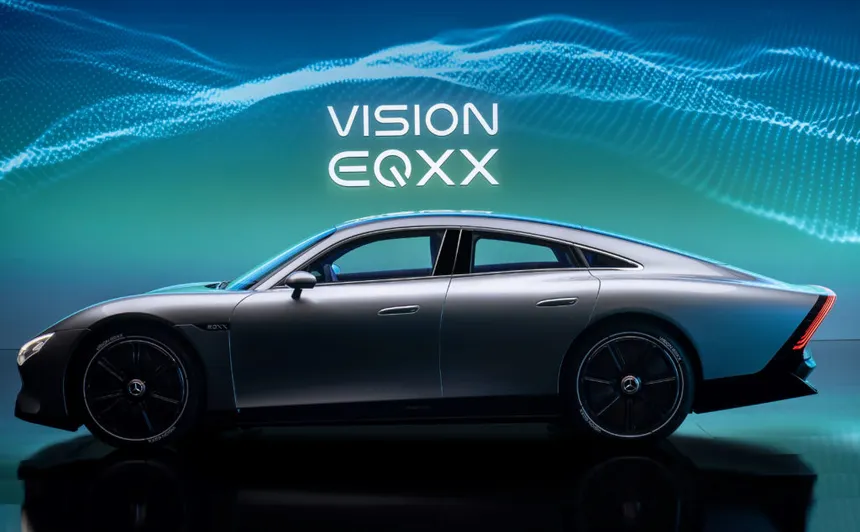
Vision EQXX: Everyone bragged about horsepower. Mercedes drove 750 miles on 201 and won
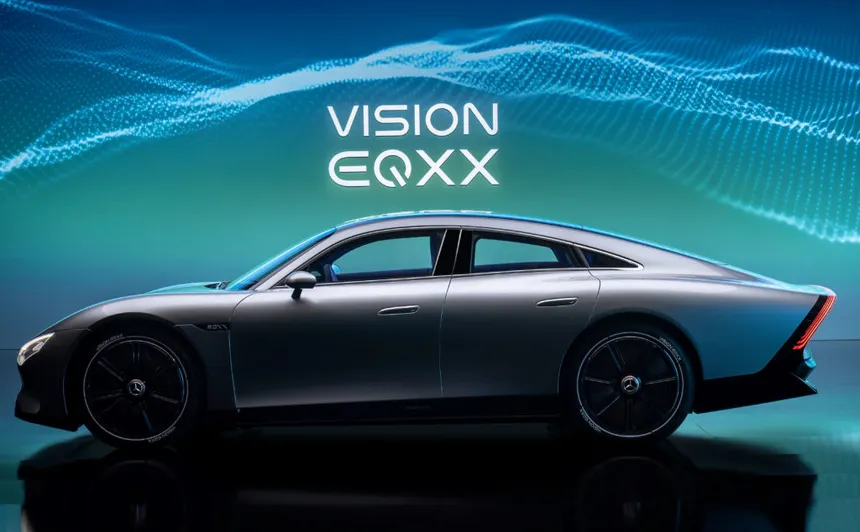
There are two ways to impress someone with a car. The easy way and the hard way.
The easy way is big numbers. A thousand horsepower, two thousand, nought to sixty in under two seconds — figures that fit in a headline and that anyone grasps in half a second. It’s the road half the electric-car world has taken: because the battery hands you instant torque and cheap power, everyone piled into the horsepower war as if more were the same thing as better. The Cadillac Celestiq packs 655. Any mid-table electric SUV promises 600 without breaking a sweat. Power has become free, which is exactly why it stopped meaning anything. Even Top Gear ran out of ways to be impressed by it.
Then there’s the hard way. The one that doesn’t fit in a headline. The one where you take 201 horsepower — the same as a fifteen-year-old hot hatch — and use it to cover 750 miles without plugging the car in once. That’s the way Mercedes chose with the Vision EQXX. And it is, by a distance, the smartest move anyone in the EV industry has made in a decade.
We’re not going to talk about a car you can buy, because you can’t. We’re going to talk about why this prototype — one Mercedes never intended to sell — says more about the future of the motor car than the other two ludicrously expensive flagships put together.
What this thing actually is
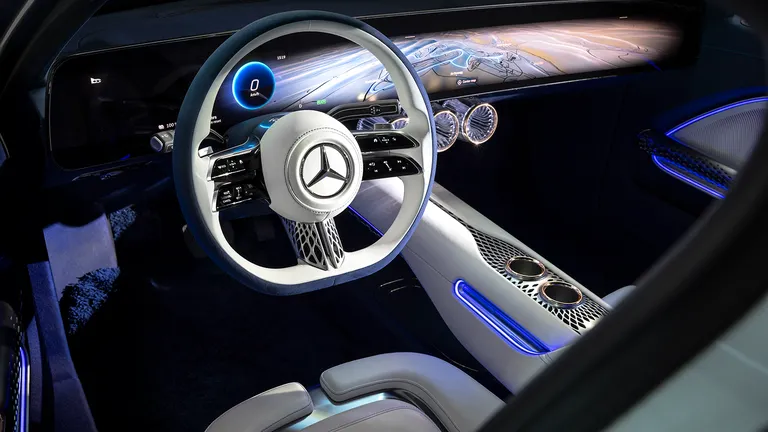
The Vision EQXX broke cover at CES in Las Vegas in 2022. It’s not a motor-show concept of the kind that spins on a turntable and never starts. It’s a working, running prototype, which Mercedes described with a candour rare in this business: production-viable, but not production-intended. Translation: we could build it, but we won’t. It’s a laboratory on wheels. A statement of intent with headlights bolted on.
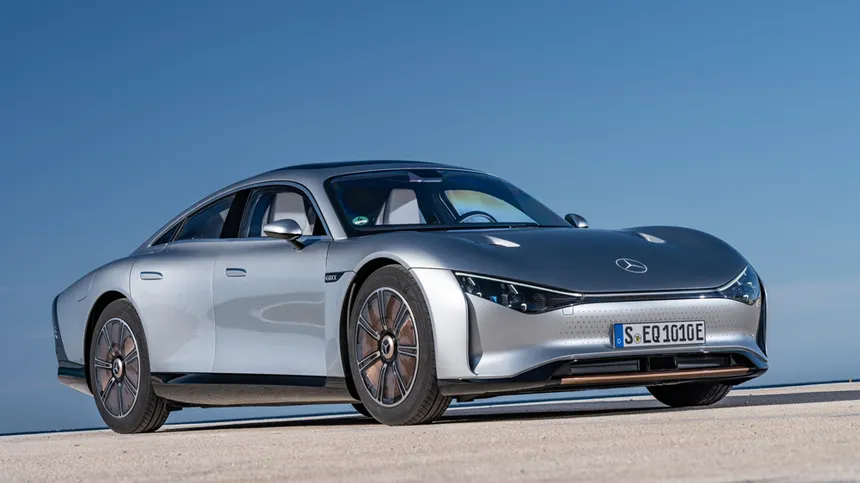
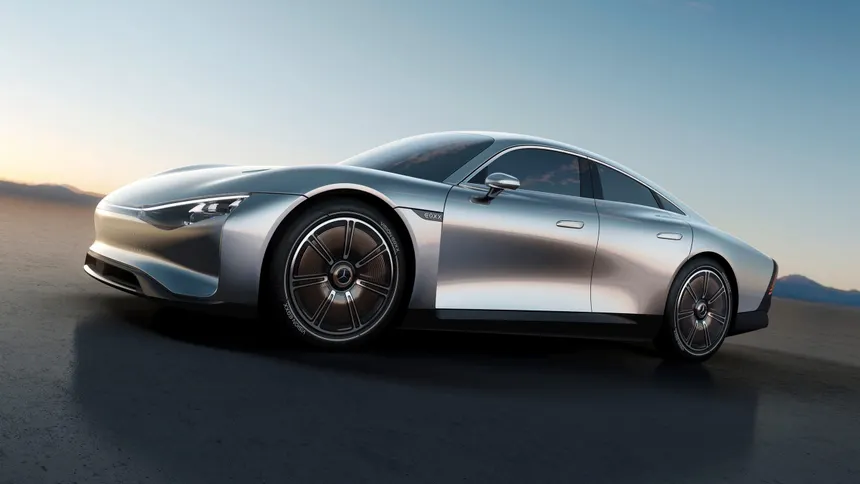
The numbers that matter aren’t the power figures. A single motor, 201 hp, rear-wheel drive. Top speed limited to 87 mph. On a dealership spec sheet, that’s a dull car. But the real numbers live elsewhere: a drag coefficient of 0.17, the lowest of any car ever to touch tarmac, below Mercedes’ own EQS (0.20), the Tesla Model S (0.208) and the Lucid Air (0.21). Consumption of 8.7 kWh per 100 km, less than half what a normal EV drinks. A 100-kWh battery weighing just 450 kg, when a conventional pack of that size weighs double. And solar cells on the roof adding up to 25 km of range a day just sitting in the sun.
Then, so nobody could dismiss it as laboratory arithmetic, they put it on the road. From Sindelfingen in Germany, across the Swiss Alps and northern Italy, to Cassis on the French Riviera: over 1,000 km in one shot, in real traffic, rain, cold, and motorway stretches at 87 mph. It arrived with 15 percent still in the tank. Weeks later it did it again and reached 1,202 km on a single charge. Seven hundred and forty-seven miles. On 201 horsepower. That, not the power figure, is the record.
Why this is the most NEC car of the three
If you’ve read this place for a while, you know we have an obsession, and it’s a fair one: weight is the enemy. Weight punishes the brakes, the tyres, the handling, the road surface, and in an EV it punishes the very range you were chasing, in one of those infuriating vicious circles. The more battery you cram in to go further, the heavier the car, the more energy it needs to move, the less each kilowatt achieves. It’s the dog chasing its own tail, and it’s the central, unsolved problem of the modern electric car.
The whole industry has decided to solve that problem by brute force: ever bigger batteries, ever heavier cars, two and three tonnes of mass hauling the sofa along at 130 mph. The Celestiq weighs 3,100 kg. The Spectre nearly 3,000. Most of the industry’s answer to the weight problem is… add more weight.
Mercedes did the opposite, which is why the EQXX is the car that most resembles what we argue for here. Instead of fighting physics with a hammer, they studied it. Obsessive aerodynamics so the air doesn’t brake the car. Lightweight materials drawn from bionic design, copying how nature builds strong structures with minimal material. A battery with brutal energy density to carry more kilowatts in fewer kilos. Tyres with minimal rolling resistance. A drivetrain running at 95 percent efficiency, meaning almost all the battery’s energy ends up moving the car rather than bleeding away as heat. Every gram argued over. Every watt fought for. The car isn’t fast because fast was easy and boring. It’s efficient, which was the hard part.
This is real engineering. The kind you don’t see, the kind that doesn’t make the headline, the kind that separates those who know from those who merely have a budget. Anyone with money can buy a thousand horsepower. Covering 750 miles on 201 takes a brain. Chris Harris could tell you which one is the harder trick.
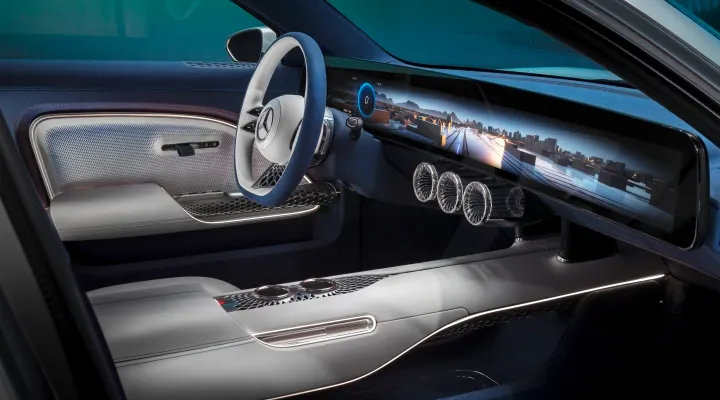
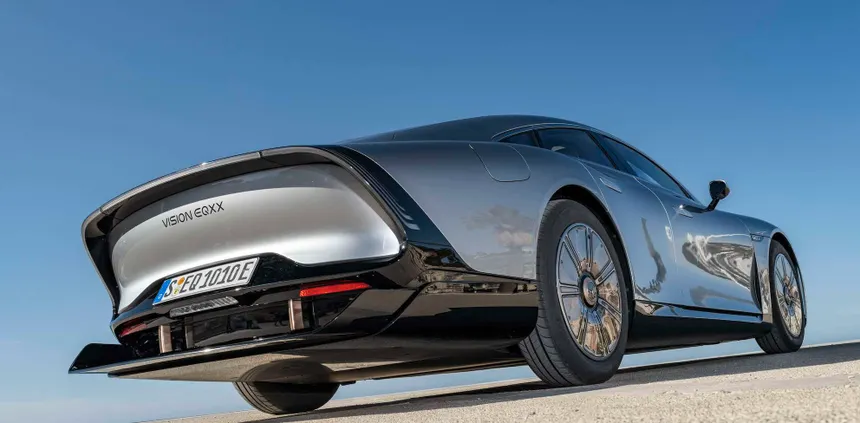
And it’s worth saying why the horsepower war is a dead end, not just a tasteless one. Power in an EV costs almost nothing to add — bolt on a bigger motor, draw more current, done. But you can’t use it. There’s no road where 1,000 hp does anything a sane person needs, and on a track the weight that comes with the giant battery murders the handling anyway. So the industry sells a number that exists purely to exist, a stat for the spec-sheet pissing contest, with no bearing on how the car actually lives. Efficiency is the opposite. Every watt the EQXX saves is a watt you feel, in range, in cost, in not standing at a charger. One number flatters the buyer’s ego; the other improves the buyer’s life. Guess which one the whole industry chose to chase. The look-at-me detailing reaches absurd lengths in the EQXX’s favour: 117 roof-mounted solar cells that hand the car up to 25 km a day for free, a rear diffuser that deploys only at speed to tidy the air behind the car, a drivetrain so efficient it barely needs cooling, which then saves the weight of the radiators it didn’t fit. Everything connected to everything. That’s thinking of a car as a system, not a pile of expensive parts.
Efficiency as a form of luxury
And here’s the turn that connects this car to the other two we’ve discussed.
The Cadillac sells luxury through muscle and craft: 655 hp, hand-built, three tonnes of American presence. The Rolls sells luxury through aura and mythology: the name on the bonnet, 120 years of history, the presence you can’t buy anywhere else. Both understand luxury as something you add. More power, more material, more history, more weight, more of everything.
Mercedes, with the EQXX, proposes a radically different and far more modern idea: the luxury of the future isn’t having more, it’s needing less. It’s the elegance of the efficient solution over the brute force of excess. It’s the difference between the man who walks into a room shouting and the man who walks in and doesn’t need to raise his voice because everyone already knows he’s the cleverest one there. Efficiency is discreet, it’s intelligent, and in a world growing tired of waste, it’s infinitely more sophisticated than a speedometer reading 190.
Think of it this way: in twenty years, when a 2,000-hp battery is as common as air conditioning is today, what will still impress won’t be power. It’ll be intelligence. The car that does more with less. The one that doesn’t need to drag three tonnes around to feel important. Mercedes didn’t build the EQXX to sell it. They built it to show their own industry, and their rivals, where the future actually lives. And, while they were at it, to make clear that German luxury isn’t about leather and wood — it’s about brainpower aimed at a problem.
What to credit, and what not to
Fair’s fair, this is NEC. The EQXX has a catch, and it’s worth saying. The 1,000 km don’t come from a standard homologation cycle like Europe’s WLTP or America’s EPA, but from Mercedes’ own road tests. They’re real, with independent witnesses, but they ran them and they measured them. And above all: it’s a prototype. A one-off, without the compromises mass production demands, without the crash test that inflates weight, without having to cost a sane price, without having to survive 300,000 miles under an owner who doesn’t baby it. It’s easy to break records when you don’t have to sell the car to anyone.
But that criticism, legitimate as it is, falls short. Because the EQXX never promised to be a product. It promised to be a map. And as a map, it works. Many of its solutions — the thermal management, the power electronics, the efficiency software, the materials — are already migrating to Mercedes’ new electric platform, the one that does reach the street. The prototype was the laboratory; the cars coming next are the result. That’s exactly what a straight-talking concept is for, as opposed to the one that just spins on a plinth to look pretty.
The only thing you can really fault Mercedes for is not daring to build a production version, even a tiny, eye-wateringly expensive run, the way Cadillac did with the Celestiq. It would have been a far more interesting halo than a three-tonne saloon. But that’s another argument.
The question that ends the game
Back to the start. Three cars, three ideas of luxury, three answers to the same question: what makes a car important once the engine stops roaring?
Cadillac answered with muscle and money. Rolls answered with name and history. Mercedes answered with intelligence. And of the three, only one truly faces forward. The other two stare at a luxury of the past — power, lineage — and plug it into a battery hoping it’ll keep meaning the same thing. Mercedes understood that electric-car luxury will have to be reinvented from scratch, and that the new currency won’t be how much you can squander, but how much you can save without the effort showing.
The EQXX can’t be bought. No price, no dealership, no waiting list. And yet it’s the most important of the three. Because the other two are the final, magnificent, ruinously expensive version of an idea that’s ending. And the EQXX is the first version, modest in horsepower but brutal in brains, of the idea that’s coming.
Seven hundred and fifty miles on 201 horsepower. Everyone can decide what impresses them more: that, or a speedometer reading a number you’ll never use.
Check you’re still alive.