Freevalve: the camless engine, told properly
Let’s get something out of the way before we go any further, because nearly every English-language piece on this engine starts with the same lie. Koenigsegg did not invent the camless engine. They are not the first to try it. The idea of binning the camshaft and operating valves with electronic actuators was first patented in 1899, and since then it has sat on the engineering desks of Renault, BMW, Fiat, Valeo, General Motors, Ricardo, Lotus Engineering, Ford and Sturman Industries, among others. More importantly, and you almost never read this in a Freevalve article, there is a partial camless system in mass production right now, on millions of cars on the road today: Fiat’s MultiAir.
What Freevalve does, and this matters, is take the idea to its most uncompromising extreme. Fully camless. Every valve, intake and exhaust, with no camshaft anywhere in the engine. That is the differentiator. That is the conversation worth having.
An old, old idea
A camshaft is a factory compromise. A bar with bumps, spinning in time with the crankshaft, deciding when each valve opens, how far it lifts and how long it stays open. The bumps are a fixed shape. That shape has to do the job for a freezing cold start, a slow crawl in traffic and a full-throttle pass at the redline. One profile for situations that have nothing in common. Manufacturers have spent four decades patching that compromise: cam phasers, two-stage profiles, Honda’s VTEC, BMW’s VANOS, BMW’s Valvetronic which goes furthest of all but still has a camshaft.
Killing the camshaft outright is older than most of us. Renault ran a solenoid-driven camless diesel project around 2002. Lotus Engineering has been working on electro-hydraulic valve actuation since the late eighties, originally as a spinoff of their active suspension research; they call it AVT, Active Valve Train. At the 2004 Vienna Motor Symposium, Lotus and Eaton presented a “production-intent” AVT aimed at series production for 2008-2009. It never reached production. By Lotus’s own account, AVT today exists purely as a research tool for engine test cells, not as a product in any car. Valeo showed solenoid camless prototypes in 2000 and announced production for 2008 that, similarly, never arrived. And in the United States, an outfit called Sturman Industries, founded by ex-NASA engineer Eddie Sturman who holds a foundational patent from 1997, put a hydraulic valve actuation system on an International truck that drove coast-to-coast across America in the year 2000. Twenty-five years ago.
The reason to lay all this out is simple: when somebody tells you Koenigsegg “invented” the camless engine, you’ll know they’re repeating something they read in a press release. What Koenigsegg actually did, in 2012, was buy a Swedish firm called Cargine, founded in 2000 by Anders Höglund and Urban Carlson, and rename it Freevalve. Twelve years of prior development before the badge changed.
The elephant in the room: MultiAir
Before we even open up what Freevalve does, we have to talk about the engine technology that almost every camless article tiptoes past, and that is currently the most successful industrial example of variable valve actuation on the planet. MultiAir, by Fiat.
Developed by Dr. Rinaldo Rinolfi at Fiat’s Centro Ricerche in Orbassano. Over ten years of work, more than 100 million dollars invested, with research stretching back to the 1980s. Launched in 2009 on the Alfa Romeo MiTo and since rolled out on the Fiat 500, Jeep Cherokee, Dodge Dart, Chrysler 200 and a long list of others. Millions of units built.
How does it work? Here is the nuance. MultiAir doesn’t kill the camshaft. It kills it on the intake side only, and even there only partially. The engine still has a single overhead camshaft with three lobes per cylinder: two for the two exhaust valves, working the old-school way, and one lobe for the intakes which doesn’t act on the valves directly. That intake lobe pushes a piston that pressurises oil inside a compact hydraulic block, the part technicians call the “brick” because it looks like a metal brick bolted to the head. Between that block and the intake valves sits a solenoid. With the solenoid shut, the oil behaves like a solid and transmits the lobe’s profile to the valves unchanged. With the solenoid open, the oil decouples, the intake valves no longer follow the lobe and close on their own springs, with a hydraulic brake softening the landing so they don’t bounce. And because the solenoid can open and close several times per cycle, the ECU decides exactly how much, when and how often the intake valves open, cylinder by cylinder, stroke by stroke.
Is it camless? On the intake side, yes. End to end electronic? No, there’s still a mechanical lobe driving the hydraulic piston. But the results, per Fiat’s launch dossier from 2009, measured in lab conditions against the equivalent non-MultiAir engine and quoted as “up to” best-case figures, are the real deal: ten percent more power, fifteen percent more torque, ten percent lower fuel consumption, sixty percent fewer NOx and forty percent fewer particulates. Real-world gains are smaller but still meaningful. And, the bit that matters most for this story, it’s in mass production. It works. It’s reliable enough for a volume manufacturer to bolt onto small-displacement city cars.
I’m telling you all this because next time someone says “Freevalve is the first technology to control valves electronically without a camshaft,” you can point out that MultiAir has been doing it on the intake side, in millions of cars, for seventeen years.
What Freevalve actually is
With that groundwork laid, we can talk about what makes Freevalve genuinely different without overselling it.
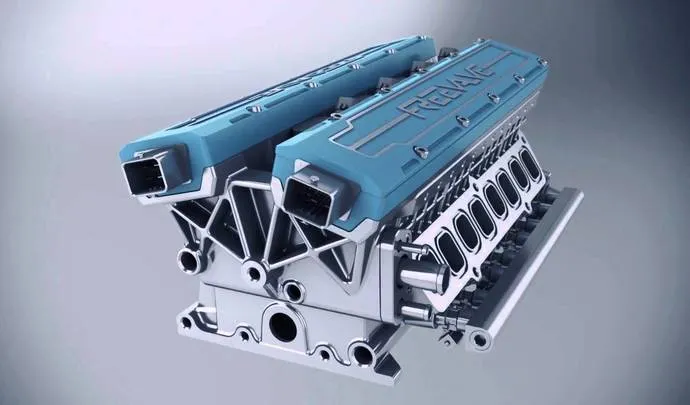
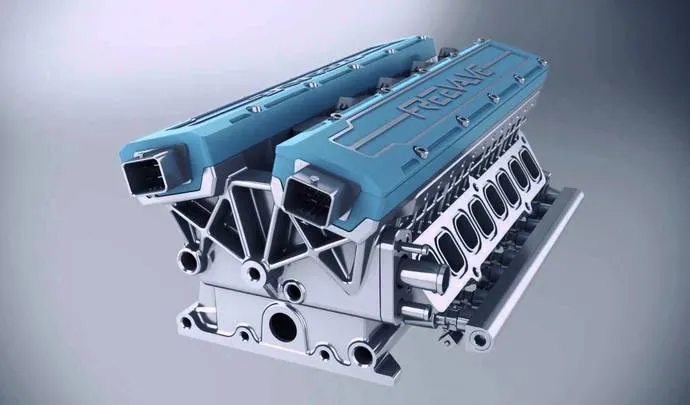
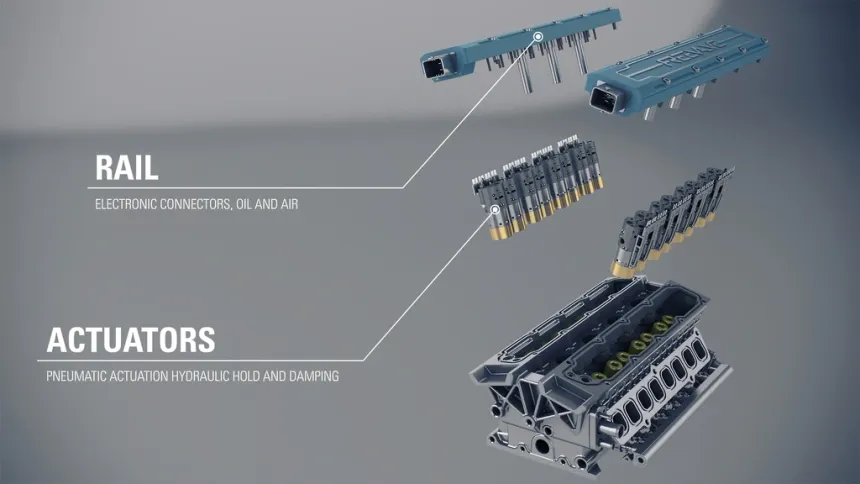
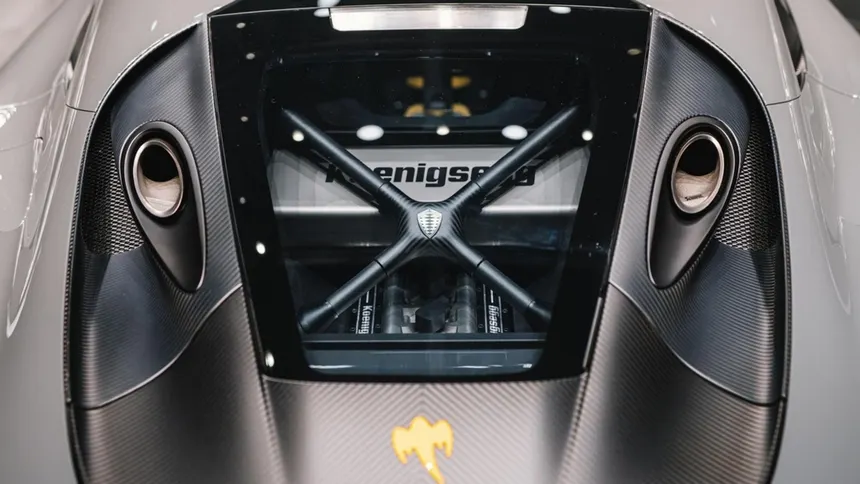
Freevalve removes the camshaft completely. Not just on the intake side. There is no lobe anywhere. In its place, above each valve, sits an actuator. On Koenigsegg’s TFG, the 2.0-litre three-cylinder, there are four valves per cylinder, two intake and two exhaust, and each gets its own actuator. Twelve actuators in total.
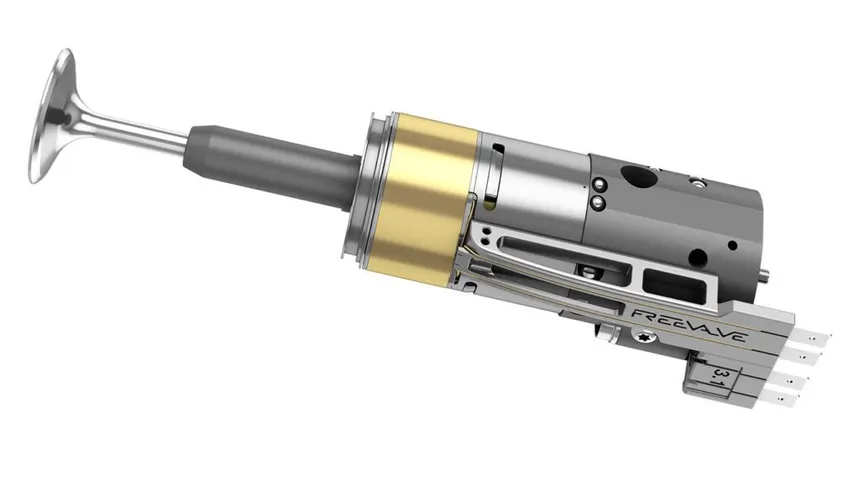
The actuator is a small piston. To open the valve, a measured pulse of compressed air pushes against that piston and the valve drops. To close it, two options: release the air and let the spring snap it shut, or lock it open with an oil reservoir and hold it there as long as the ECU dictates. When it’s time to close, that oil bleeds out through a small orifice that damps the closing so the valve doesn’t slam into its seat. The whole thing is called, in full, electro-pneumatic-hydraulic. Electricity to command, pneumatics to move, hydraulics to brake and hold.
The conceptual difference from MultiAir is sharp: MultiAir still needs a mechanical lobe to generate the hydraulic pressure that moves the valve. Freevalve doesn’t. The opening energy is external compressed air, fed by a compressor driven off the engine. And because there is no camshaft at all, the exhaust valves are independently controlled too, not just the intakes. That’s the difference that matters.
Removing the entire camshaft gives a long list of capabilities. The engine can run the Otto, Miller or Atkinson cycle on the fly, switching as it pleases. It can deactivate whole cylinders by shutting all their valves. It pulls clever tricks like the TFG’s twin-turbo arrangement: at low revs, the engine keeps the exhaust valves feeding one turbo shut, dumping all the gas at the other turbo so it spools up fast and alone, no lag. The engine uses its own valves to do work that would otherwise need extra hardware.
And a long list of parts disappears. No timing belt or chain. No phasers. No throttle butterfly, since the valve itself meters the air. No wastegate. No variable-geometry turbo. No cold-start pre-cat. No external EGR. Not even direct injection is required, port injection does the job.
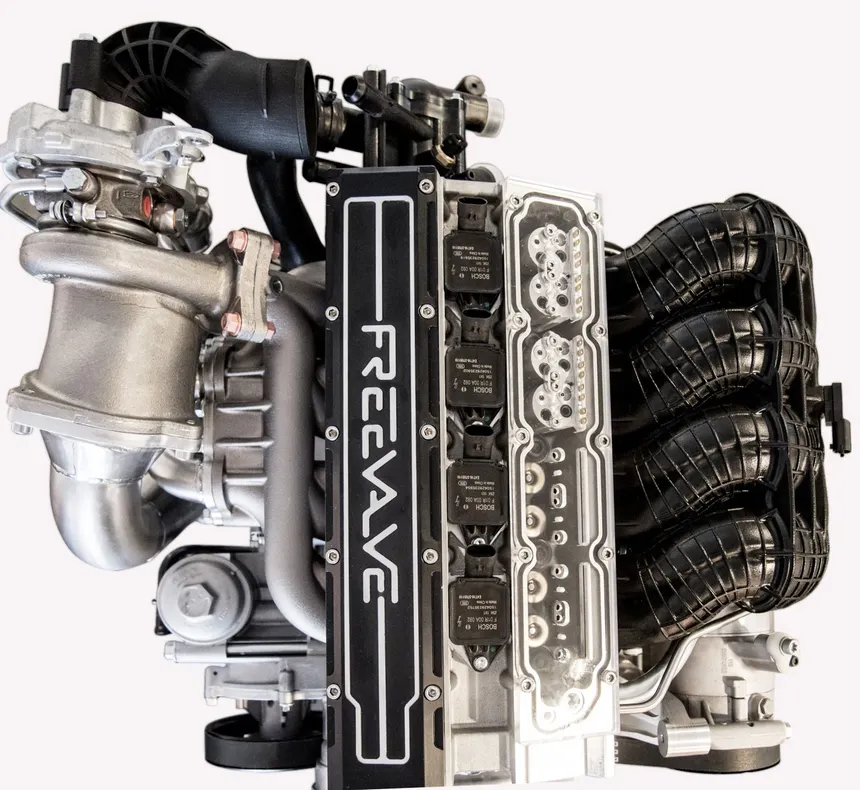
The TFG specs, from Koenigsegg’s own sheet: three cylinders, 2.0 litres, 70 kg dry, magnesium-alloy block and head, 9.5:1 compression, runs on E85, E100 or methanol, 600 horsepower at 7,500 rpm, around 600 Nm. Three hundred horsepower per litre. Serious numbers for a road-legal triple.
So why can’t you buy one?
This is where I want to be careful, because the answer is more mundane than the mythology suggests.
Start with the first real attempt at production. In 2016, at the Beijing Auto Show, a Chinese brand called Qoros showed a Freevalve-powered car. Months later, at Guangzhou, they drove a working Qoros 3 hatchback onto the stage with a 1.6-litre turbo Freevalve unit making 230 horsepower, with nearly 50 percent more power and torque than the equivalent conventional engine. Freevalve itself called it the world’s first Freevalve engine intended for mass production, with the assembly line pencilled in for 2017. It never arrived. Not because of the tech. Qoros was a brand bleeding money, 129 million dollars lost in the first half of 2016 alone, passed from Chery and Israel Corporation to Baoneng, and when Baoneng itself slid into financial crisis, Qoros bled out until a court auctioned the production line. The brand was dissolved in 2022. The first attempt to put Freevalve into volume production didn’t fall to physics. It fell because the partner went bust.
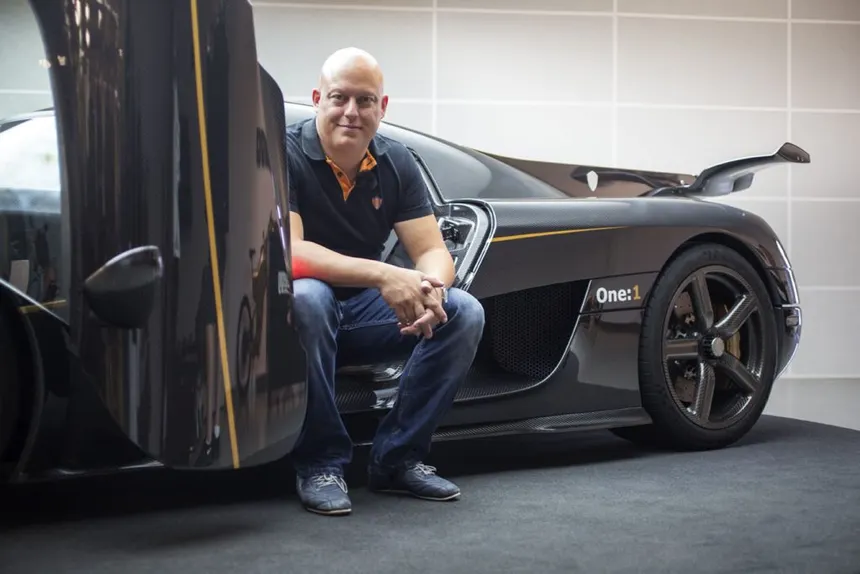
Then came the Gemera, unveiled in 2020. The TFG with Freevalve was the heart of the car and would have been the first Freevalve engine in any production vehicle. But in 2022, Koenigsegg offered an alternative: the Jesko’s 5.0-litre twin-turbo V8, good for 2,300 horsepower on E85, as a roughly 400,000-dollar option over the base price. And here is the fact as it is, without drama: with both engines on the table, nearly every customer picked the V8. Christian von Koenigsegg laid it out on a Top Gear podcast in July 2024. So few buyers were still asking for the TFG that he personally talked the remaining hold-outs into switching to the V8 as well. The Gemera shipped as V8-only. The TFG, in his exact words, on the shelf, but “for the time being.”
There was no betrayal here, no villainous customer. It was a rational decision in the market the car serves. Offered 1,400 horsepower from three revolutionary cylinders against 2,300 from a known, proven V8, hypercar buyers will mostly pick the V8. The choice to put the V8 on the menu was Koenigsegg’s, made knowing exactly what would happen. And what happened, happened.
The drawbacks that don’t make the brochure
Before getting to the structural reason this hasn’t gone mainstream, the technical caveats Koenigsegg’s marketing doesn’t lean into need to be on the table, because without them the story is incomplete.
The first, and the most measurable, is the system’s own energy bill. Freevalve needs a constant supply of compressed air to open the valves, and that air comes from a belt-driven compressor running off the crankshaft. So the engine is robbing itself of power to drive its own valve actuation. A camshaft costs energy too, of course, but it’s a well-known, fairly flat loss. With Freevalve, according to a 2022 academic study of the TFG, the friction mean effective pressure of the valve actuation system grows exponentially with engine speed. In plain English: the faster the engine spins, the hungrier the actuators get, and that parasitic loss is one of the things pulling torque down at the top end. Not a footnote. It’s the energy price of not having a camshaft.
The second, harder to measure but just as real, is long-term reliability. Here Koenigsegg, through Freevalve CEO Urban Carlson, claims the actuators show “no measurable wear” after “hundreds of millions of cycles” in bench testing, giving them the same life expectancy as a current engine. That is their claim, not independent validation. Sturman has run electro-hydraulic valve actuation in heavy trucks for years, but no fully camless system has yet accumulated the million-vehicle, fifteen-year fleet record that MultiAir has on the road. Until that happens, “no measurable wear in bench testing” is a reasonable promise, not a proven certainty.
The third is control. A system with twelve, thirty-two or forty-eight independent actuators needs an ECU that makes the right call in every imaginable condition, from a minus-thirty cold start to the tenth consecutive lap of the Nürburgring with the oil hot and the exhaust glowing. Calibrating that for a limited-run hypercar is doable. Calibrating it for a car that will be sold by the million, with industrial manufacturing tolerances and 200,000-kilometre service lives, is a calibration job orders of magnitude larger.
These three fronts, energy parasitism, unproven mass-scale reliability, and industrial-scale calibration, are problems that money alone doesn’t solve. They are solvable, but they need time, money and iteration. Which is why the “it’s ready” line repeated in so many articles needs hedging: it’s demonstrated, it’s bench-validated, it’s running in a car that exists, but it isn’t running in a car that’s been sold by the thousand yet.
The structural reason, which is the one that matters
If we step back from the Gemera episode and look at the underlying question, namely why Freevalve, twenty-five years after Cargine started, still isn’t in a single production car, von Koenigsegg himself gave the most candid answer in 2025.
The three-cylinder isn’t the problem. Twelve actuators in a triple is, in his words, no industrial drama. They have it solved. The problem appears at scale. Putting Freevalve in a V8 means thirty-two actuators, each bespoke, each calibrated individually. A V12 needs forty-eight. The cost and complexity climb to the point where the economics break, precisely in the multi-cylinder engines that sell in the volumes that matter.
That’s the real Freevalve trap. It shines small and drowns big. And mass-market manufacturers, when they had to pick a path, picked the MultiAir route: simpler, partial, keeps a camshaft, solves only the intake side, but buildable by the million at a cost that pencils out. Taking the idea to the fully camless extreme, as Freevalve does, is engineering brilliance and industrial brutality at the same time.
Even so, Koenigsegg hasn’t binned it. The patents keep coming. A two-stroke cycle has been developed for the TFG. There’s a patent for a dual-purpose compressor that both balances the engine and feeds air to the actuators, and opens a door to aviation and VTOL aircraft, where the power-to-weight ratio justifies the cost of calibrating each valve individually. The shelf the TFG sits on, for now, is a waiting room.
What the story really tells you
Freevalve isn’t the story of a revolutionary invention the world wouldn’t buy. It’s the story of a very old idea, the camshaftless engine, that has been knocking on every door for over a century and only got through halfway, via Fiat’s MultiAir. Freevalve is the most ambitious version of that idea, the most radical, the one that goes all the way. And that is precisely why it’s also the hardest to scale.
What sets it apart from the other attempts isn’t being first. It’s being the cleanest, conceptually. It doesn’t lean on a mechanical lobe like MultiAir. It doesn’t stop at the intake side like Valvetronic. It doesn’t piggy-back on the injectors’ hydraulic circuit like Sturman did on that International truck in 2000. Every valve is genuinely free. The price of that purity is that the industry, when it runs the numbers, keeps preferring the cheaper, proven middle path.
Next time you fire up your car and hear the camshaft turning in there, that lobed bar that’s been making the call for a century, remember that there’s a MultiAir running in millions of cars today that has already shed half of the compromise, and there’s a TFG sitting on a shelf in Ängelholm that has shed the compromise entirely, waiting for several things that aren’t only money to line up at once: industrial-scale calibration, real-world reliability validation beyond the bench, and the energy bill of keeping the whole system running. When those three equations balance, not before, someone will lift it off the shelf.
Check you’re still alive.