Porsche 959: The Supercar That Rewrote the Rules of Performance

Not Enough Cylinders — Unfiltered Automotive Opinion
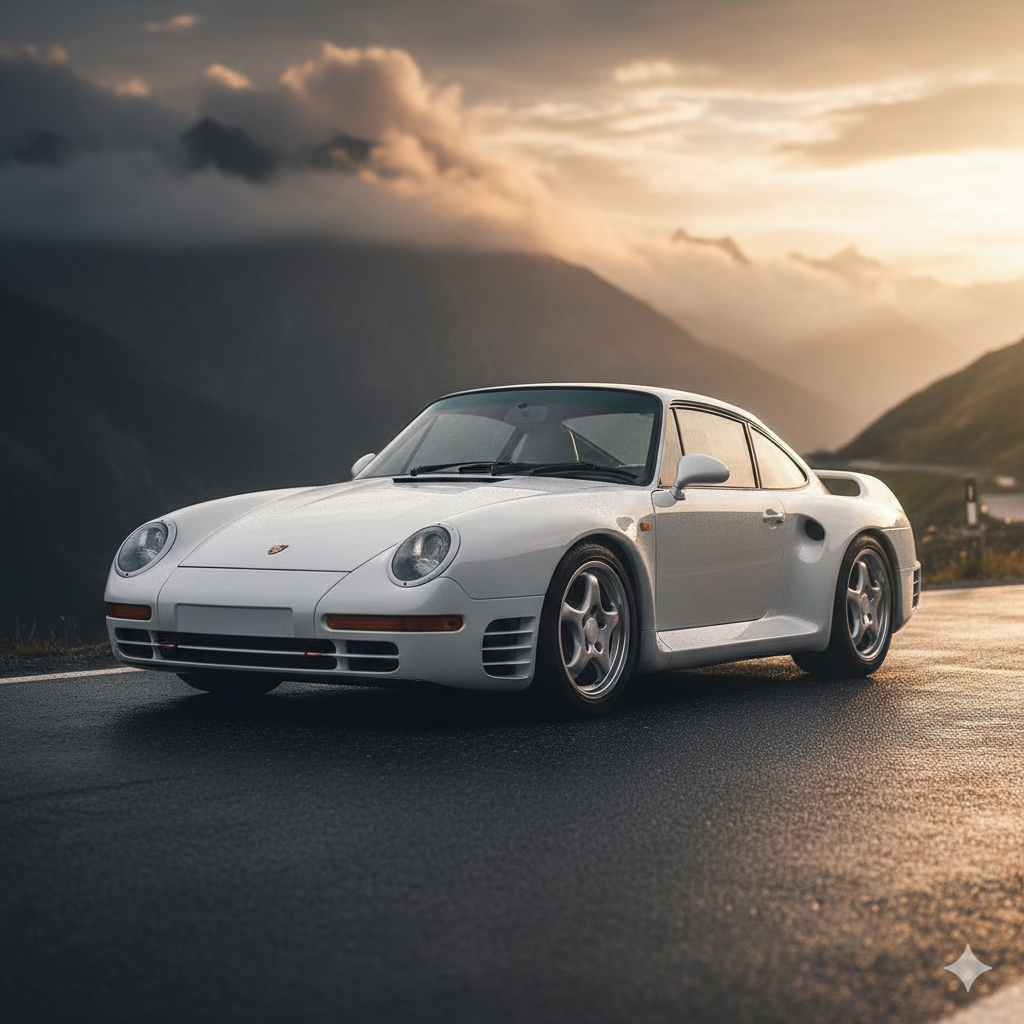
There is a moment in automotive history when a manufacturer stops playing by the existing rules and decides to write new ones. For Porsche, that moment was the 959. This wasn’t just a faster 911. It wasn’t another Group B rally homologation exercise. The 959 was a full-scale technological assault on the very concept of what a road car could be. When it debuted in 1986, the rest of the industry wasn’t just trailing behind—it was living in a different century.
Born of Competition, Built for the Future
The story starts in the early ’80s with the “Gruppe B” project. Porsche set out to create a weapon for the wildest era of rallying ever conceived. But Porsche, being Porsche, couldn’t help but turn the project into something much bigger than a rally car with a license plate.
The silhouette was familiar—deceptively so. But underneath, everything was new. The body panels were a high-tech mix of Kevlar, aramid fibers, and aluminum. The suspension? It featured electronically adjustable ride height with three modes—Comfort, Sport, and Traction—in 1986. Let that sink in for a second.
The Heart of the Beast: 2.85 Liters of Brilliance
The Type 959 engine was a 2,849 cc twin-turbo flat-six. It introduced sequential turbocharging: a small turbo kicked in early to kill lag, while a larger second turbo took over at high RPMs for peak power.
- Output: 450 HP and 369 lb-ft of torque.
- Cooling: Water-cooled cylinder heads on air-cooled cylinders. A hybrid solution that solved high-performance heat issues while keeping the classic Porsche layout.
- Performance: A top speed of 197 mph and 0–60 in 3.7 seconds. It was the fastest production car in the world until the Ferrari F40 showed up two years later.
All-Wheel Drive: Porsche’s Secret Weapon
The PSK (Porsche-Steuer Kupplung) system was arguably the 959’s most revolutionary feature. This wasn’t the crude, locked AWD of the era. It used a variable center differential that electronically distributed torque between the axles—from a 20/80 split in normal driving to 50/50 when things got hairy.
It was intelligent, adaptive, and predictive. In an era where 911 Turbos were nicknamed “Widowmakers” for their tendency to try and kill their owners in the rain, the 959 offered a revelation of stability and confidence.
The Paris-Dakar Connection
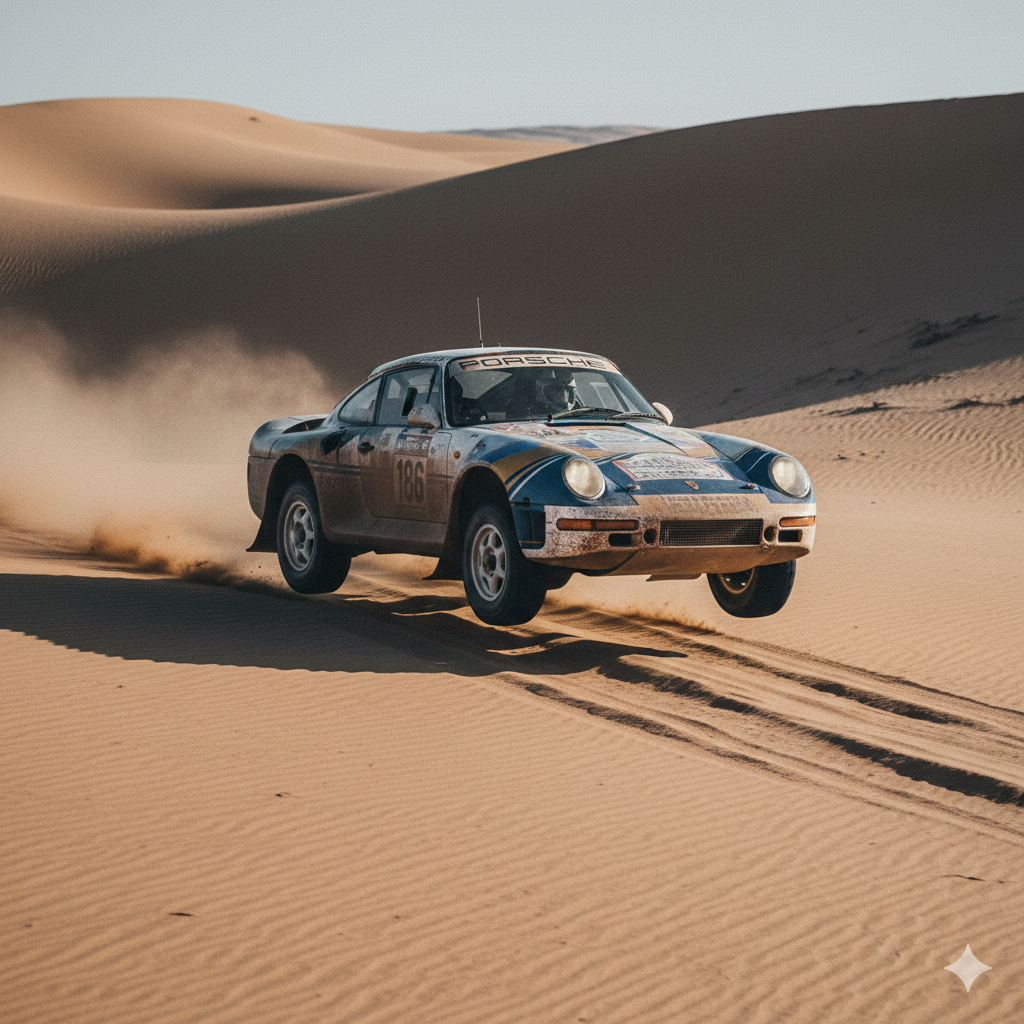
Before it ever wore a license plate, the 959’s DNA was forged in the desert. In 1986, Porsche entered three 959-based rally cars in the Paris-Dakar. They finished 1st, 2nd, and 6th overall.
This wasn’t a marketing stunt with a shell. The rally cars shared the same fundamental architecture as the road cars. The desert simply proved that Porsche’s high-tech wizardry could survive the most brutal conditions on Earth.
337 Built — And Every One Was a Loss
The 959’s history is wonderfully absurd. Porsche built just 337 units (including prototypes), and it is widely accepted that they lost money on every single one. The $225,000 price tag didn’t even come close to covering the astronomical R&D costs.
But profit wasn’t the point. The 959 was an investment in the future. Technologies like sequential turbos, electronic AWD, composite body materials, and tire pressure monitoring eventually trickled down to every Porsche we see today. It was a rolling research lab that happened to be the fastest car on Earth.
The Bill Gates Import Ban
For years, the 959 was illegal in the United States. It never underwent EPA emissions or DOT crash testing, and Porsche wasn’t interested in trashing a limited-run masterpiece for US certification.
The most famous victim was Bill Gates, whose 959 was impounded by customs and sat in a warehouse for years. Gates and other wealthy owners eventually lobbied for the “Show or Display” exemption, which passed in 1999. The 959 literally changed American federal law.
Technical Specifications
| Spec | Porsche 959 |
| Engine | 2.85L Twin-Turbo Flat-Six |
| Power | 450 HP @ 6,500 rpm |
| 0-60 mph | 3.7 seconds |
| Top Speed | 197 mph |
| AWD System | PSK (Electronically Controlled) |
| Production | 337 units |
| Original Price | ~$225,000 |
| Current Value | $1.5M – $2.5M+ |
Legacy: 20 Years Ahead of the Pack
Look at any modern supercar today: electronic AWD, minimal-lag turbos, adaptive suspension, tire pressure sensors. In 1986, these features existed together in exactly one car.
The 959 was so far ahead that it took the rest of the world two decades to catch up. The Nissan GT-R, the Bugatti Veyron, and Porsche’s own 911 Turbo S all owe a philosophical debt to this masterpiece. The idea that technology could make a car faster, safer, and more accessible was radical in the ’80s. Today, it’s the foundation of the entire industry.
With the 959, Porsche proved that six cylinders were more than enough to change the world.
— Not Enough Cylinders
3 thoughts on “PORSCHE 959”