

SLR Stirling Moss: The Goodbye That Beat Everyone by a Decade

Some cars close a chapter. A rare few close it so well that, without meaning to, they open the next one. The SLR Stirling Moss is one of those.
It’s the final page of a story this site has been telling in instalments. The 1955 Mercedes 300 SLR, the real racing car that carried Moss across Italy. The 2000s SLR McLaren 722 Edition, the modern tribute that borrowed that car’s race number. And Stirling Moss himself, the man who drove all of it and handed away his only title with a gesture of pure sportsmanship. All of it pours into this one car. The one that wears his full name across the back.
And it’s the perfect car to end on, because it isn’t just any tribute. It’s a farewell in the fullest sense of the word.

The end of a marriage
Let’s set the scene. Mercedes and McLaren had built the SLR McLaren together, their first and only joint car. A tense relationship, the kind covered here before: two philosophies that never quite fit, a luxury GT at war with a racing missile inside the same carbon tub. Out of that fight came the standard SLR, then the 722 Edition when they finally let McLaren win the argument, and now came the curtain.
Because the partnership was ending. Each would go its own way: Mercedes toward the SLS AMG and its own supercar line, McLaren toward its Woking factory and a solo history. And before parting, they decided to say goodbye in style. Not with some token special edition, not with a bit of trim and a numbered plaque. With the most extreme, most expensive, most radical car in the entire SLR family.
They unveiled it at the Detroit Motor Show in January 2009. Production ran from June to December of that same year. Seventy-five units. Not one more. Chassis numbered 1 to 75, every one hand-built at the McLaren Technology Centre in Woking, England. And here’s the crucial part: they were sold only to customers who already owned an SLR. You couldn’t simply turn up with the money. You had to be family. It was, quite literally, a thank-you to the most loyal.
Around 750,000 euros. More than twice a standard SLR Roadster. And it sold out instantly.
It’s worth dwelling on what that “existing SLR owners only” clause really means, because it isn’t a marketing footnote. It’s a decision that seals the car as a collector’s item before it even exists. If buying the most exclusive car in the range requires proving you already own one from the range, you’re building a closed club inside an already small club. It didn’t matter how much money you had: if you weren’t already in, you didn’t get in. In the collector world, that multiplies value and mystique. The car wasn’t bought, it was earned. And the 75 fortunate owners knew it perfectly well when they signed the cheque.

A real speedster, no cheating
Now the car itself, because the car is absurd in the best way.
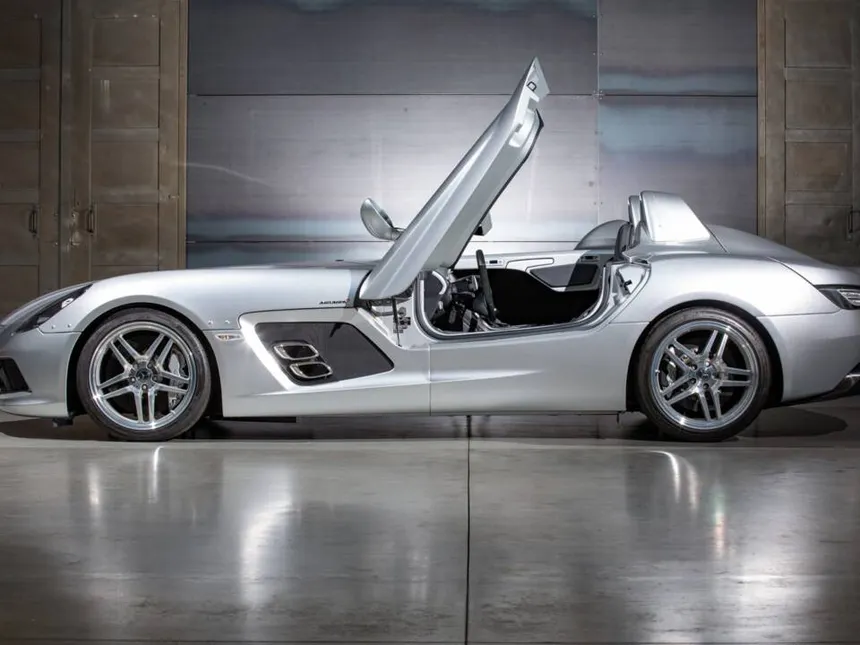
The SLR Stirling Moss has no roof. Fine, so far it’s a convertible. But it also has no windscreen. No side windows. Nothing. Between you and the air at 200 mph there is absolutely nothing but your helmet and your nerve. That is a pure speedster, in the oldest and most savage sense of the word. Like the open racing cars of the 1950s, where the driver met the wind chest-first.
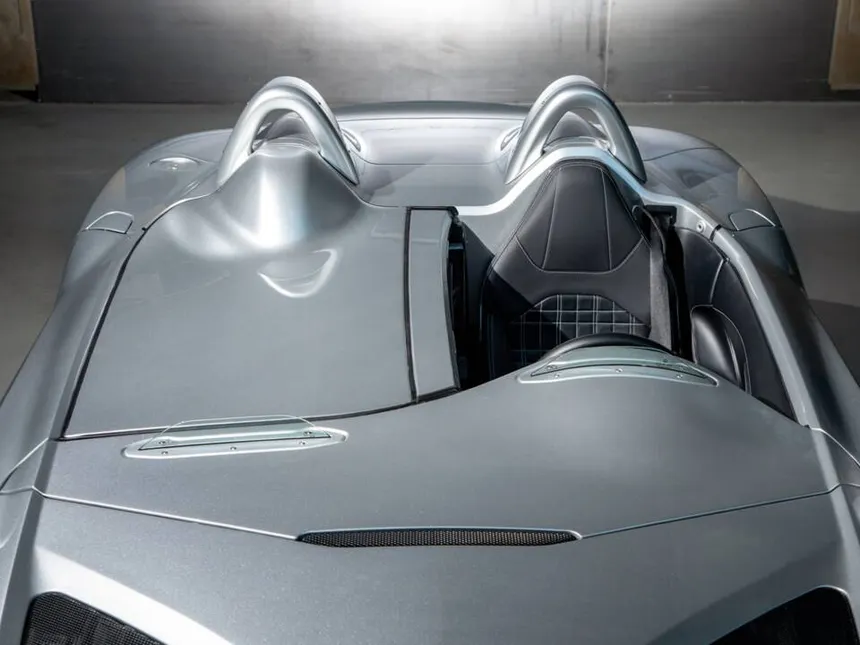
In place of a windscreen, the car carries two small air deflectors ahead of each occupant, there to stop the wind from tearing your head off. But the message is clear: you come here to feel, not to travel in comfort. Whoever bought this car didn’t want to be insulated from the world. They wanted to swallow it whole.
There’s a piece of engineering in those deflectors worth explaining, because people see them and assume they’re decoration. They aren’t. When you remove the windscreen from a car doing 217 mph, the air doesn’t vanish: it hits you square on. Without some way of managing that flow, driving the car at speed would be flatly impossible, it would rip your hands off the wheel. Those two small deflectors ahead of each occupant are shaped to create a bubble of air that passes over the heads instead of slamming into them. It’s the same principle the open racing cars of old relied on, solved with half a century more aerodynamic knowledge. Small, discreet, and absolutely essential to keeping the car from being merely a sculpture.
And the figures live up to the theatre. The same 5.4-litre supercharged AMG V8, 650 hp. Zero to 62 mph in under 3.5 seconds. And a top speed of 217 mph. Read that with the rest in mind: 217 mph in a car with no windscreen. At the time, no other series-production car on earth was simultaneously this open and this fast. Nothing else came close. It was the fastest roofless thing money could buy.
What almost nobody tells you about the chassis
Here’s the detail that separates the people who know from the people who recite brochures.
Plenty assume the Stirling Moss is a 722 Edition with the roof sawn off. It isn’t. Yes, it shares the underpinnings; the mechanical base comes from there. But above that base, not a single body panel is shared with any other SLR. Not one. The entire skin of the car is new, designed from scratch in carbon fibre. The rear diffuser is also new and far larger than any previous SLR’s, because without a windscreen or roof the aerodynamics change completely and all that underbody work had to be reset.
That new body, besides giving the car its aggressive, utterly distinct silhouette, shed around 200 kilos versus a standard SLR. Two hundred kilos. On a car that carried a reputation for being heavy, thanks to that racing tub loaded with S-Class equipment, stripping that weight changes everything. The Stirling Moss is the SLR that finally took off its overcoat.
The design was penned by Korean designer Yoon Il-hun, and the inspiration is transparent: the long nose, the crouched stance, the two separated cockpits behind the deflectors. Everything looks to the 1955 300 SLR. It isn’t a hidden reference. It’s a bare-faced tribute, never more literally.
And the fact that all 75 cars were hand-assembled at Woking, in McLaren’s house rather than on a Mercedes line, says a great deal about who held the reins on this project. The last SLR wasn’t built in Germany. It was built in England, piece by piece, like the McLaren F1. McLaren didn’t just win the final argument. It took the car home to see it off.
The farewell that invented a trend
And here’s the part that makes this car more than a collector’s curiosity.
In 2009, an extreme windscreenless speedster, two-seat, hugely expensive and built in tiny numbers, was an eccentricity. A beautiful madness only a handful could afford. People saw it as the last indulgence of a dissolving partnership, a car looking backward, to the 1950s, to Moss nostalgia.
But look what happened next. Over a decade later, Ferrari launched the Monza SP1 and SP2, windscreenless speedsters inspired by its classic barchettas. McLaren released the Elva, no roof and no glass. Aston Martin presented the V12 Speedster and the DBR22. Suddenly, every major supercar maker discovered there was a market for the bare-chested open car, for pure experience, for the luxury of feeling the air on your face at three figures.
They all arrived ten years late. The SLR Stirling Moss had already done it in 2009.
And the reason it could lead rather than follow is buried in that Woking address. McLaren had the institutional memory of the F1, a car built around the idea that lightness and purity beat luxury and gadgetry every time. When Mercedes finally let that philosophy run unchecked on a halo car, you got a windscreenless missile a decade ahead of the curve. The same engineering culture that would soon spin off McLaren’s own supercar empire was already showing its hand here, on a car still wearing a three-pointed star. In hindsight, the Stirling Moss wasn’t just the last Mercedes-McLaren. It was the first glimpse of what McLaren was about to become on its own.
That’s what I love most about this car. It was born looking backward, to 1955, to one man’s feat on an Italian road. And without trying, it ended up looking forward, marking the path the others would follow a decade on. A car that is at once the end of one story and the start of another.

The circle closes
Think of it as a timeline biting its own tail.
In 1955, a silver roofless racing car, the 300 SLR, carried Stirling Moss to glory on the Mille Miglia. In 2009, another roofless car, also silver in its launch livery, also without a windscreen like that one, wore Moss’s full name and closed the Mercedes-McLaren collaboration forever. There are 54 years between them, but it’s the same gesture: putting yourself in front of the wind with nothing to protect you, and letting the car tell you who you are.
And there’s a symmetry that raises the hairs if you stop to look. The original 300 SLR was never sold to the public: it was a competition tool, exclusive by nature. The Stirling Moss Edition wasn’t sold to the general public either: only to the chosen, exclusive by decision. Both cars share that quality of the unreachable object, the piece that isn’t available to just anyone no matter how much money they have. One because it’s a racing weapon, the other because it’s a thank-you. But the result is the same: cars the rest of us can only look at.
The 722 Edition was the moment McLaren won the technical argument. The Stirling Moss Edition is the moment both marques, already on their way out, shook hands and signed their goodbye with the name of the man who started it all. Not a number this time. His whole name.
Because some goodbyes are made with words. And some are made by taking the windscreen off a million-euro car and putting a legend’s name on top of it. Mercedes and McLaren chose the second. Which is why, nearly two decades on, this is still the SLR everyone talks about when they want to talk about the last one.
The perfect ending to a story that, really, never wanted to end. Because as long as someone is still building 300 SLR replicas in a workshop, as long as someone still says Moss’s name across a bar, the story keeps rolling. The car stopped being made in December 2009. The legend has never stopped at all.