From refrigerator to grand tourer
How Renzo Rivolta made the most improbable leap in Italian industrial history, hired a former Ferrari engineer, and built two cars with American hearts that still embarrass Maranello today
There is an Italian gentleman you already know without realising it. He’s the one who in the 1950s ran a refrigerator factory near Milan and decided to build a microcar shaped like an egg. Then he sold the licence to BMW, saving the German brand from bankruptcy. His name was Renzo Rivolta. The microcar was the Isetta. And what he did after that is what really deserves telling slowly.
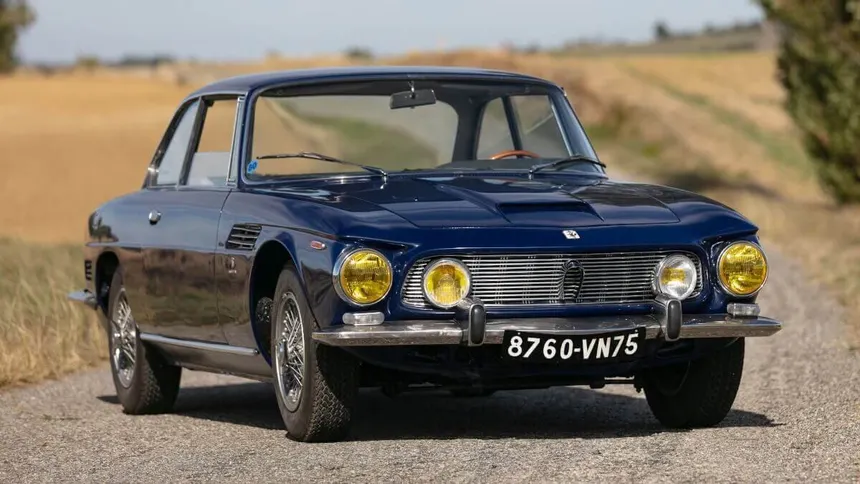
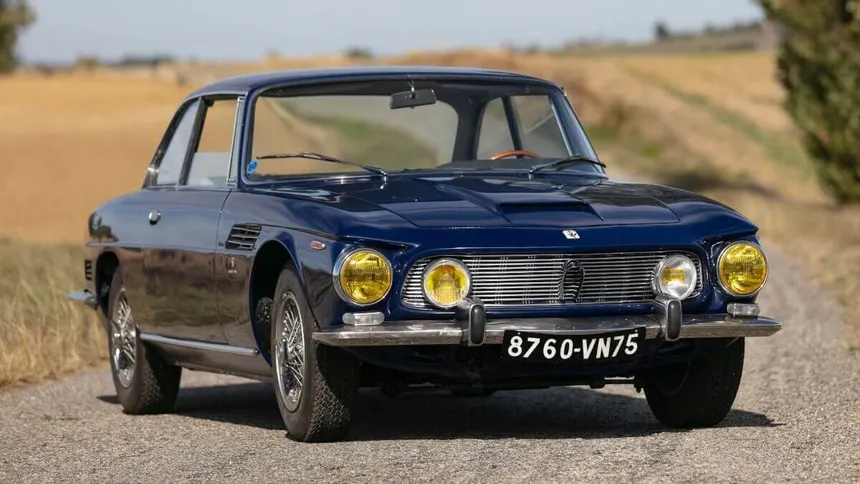
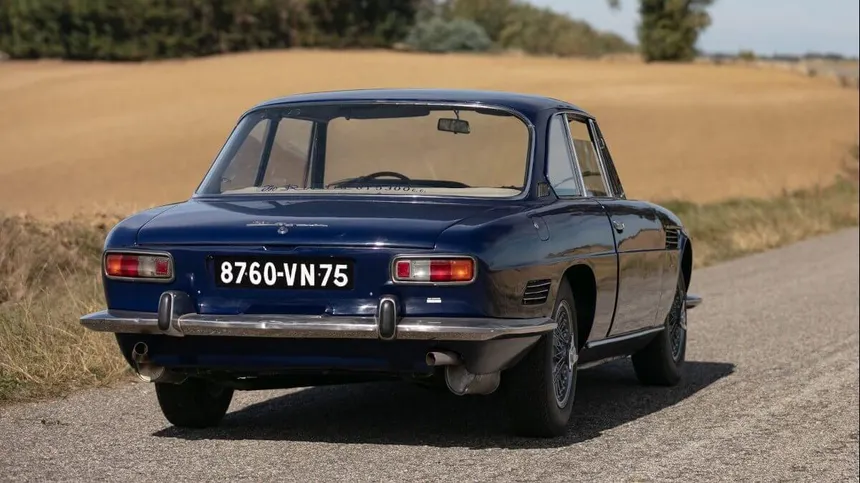
In October 1962, eight years after cashing the German cheque, Rivolta stood up at the Turin Motor Show with a car that left the Italian press struggling to figure out how to report it. It was an Italian four-seat grand tourer, front-engined longitudinal layout, rear-wheel drive, with a chassis designed by a former Ferrari engineer, a body designed by a 24-year-old kid called Giorgetto Giugiaro, and a 5.4-litre American V8 under the bonnet. It was called the Iso Rivolta IR300. And it was the last car anyone expected to see coming out of the father of the Isetta’s factory.
Three years later, at the same Turin show in 1963, Iso turned up with two more cars: the Grifo A3/L road car and the Grifo A3/C competition car. Same American engine. Same signature from the kid Giugiaro. Same signature from the ex-Ferrari Bizzarrini. But now two two-seat coupés, radically more aggressive bodywork, undisguised sporting intent. The two cars with which Renzo Rivolta tried to sit down at the table of Ferrari and Maserati with his own cheque.
This is the story of those cars, of how they were made, of who made them, and of why today, sixty years later, they remain one of the most fascinating industrial gestures Italian motoring has ever produced. The story includes a falling-out between two men with egos the size of Italy. It includes a Turin Motor Show where the two rivals displayed their versions of the same car from two separate stands. It includes a sudden death in Milan and a 25-year-old son who took the reins. And it includes a final bankruptcy caused by an oil crisis no one had seen coming. But it begins, as all good stories do, with a man who decides to spend the money in his pocket on something he had never done before.
Renzo Rivolta before the Isetta
Renzo Rivolta was born in Desio, near Milan, in September 1908. The son of a wealthy family in the lumber business, he received a good education, spoke several languages, and from an early age developed a passion for motorbikes, racing cars and speedboats. He studied engineering. And in his thirties, in 1939, he bought a company called Isothermos, which manufactured electric heaters and refrigerators, based in Genoa. The company moved to Bresso, on the outskirts of Milan, in 1942 after the Genoa offices were destroyed in a bombing raid. There Rivolta consolidated the brand as one of Italy’s serious manufacturers in the domestic appliance sector.
After the war, Rivolta noticed that the refrigerator market was tough and margins were thin. Italy needed cheap transport. He shifted production to motorcycles and scooters under the Iso brand, and by the early 1950s Iso was the third-largest Italian two-wheel manufacturer, behind Vespa and Lambretta. In 1953 he renamed the company Iso Autoveicoli S.p.A. to reflect the transition. And two years later, with the global success of the Isetta reaching its peak, Rivolta had something many Italian industrialists of the period didn’t have: cash. Lots of cash.
The royalties BMW paid for every Isetta built in Munich between 1955 and 1962, multiplied by the almost 162,000 units the German brand produced, plus the additional licences Rivolta had sold to Velam in France, Isetta of Great Britain in Brighton, Metalmecánica in Argentina and Romi in Brazil, gave Iso solid financial footing throughout the second half of the 1950s. And Rivolta, who was a man of clear ambition, did not want to spend the rest of his life collecting royalties on a car he already considered closed. He wanted to do something big. Something that would seat him at the table of Ferrari and Maserati. Something that would justify his surname in the history of Italian motoring.
In late 1961, with funding secured by the Isetta royalties, Rivolta called Giotto Bizzarrini.
Giotto Bizzarrini
If Renzo Rivolta is a name little known outside specialist circles, Giotto Bizzarrini is precisely the opposite. Born in Quercianella, Livorno, in 1926, an engineer trained at the University of Pisa, between 1957 and 1961 Bizzarrini had been one of the key technical figures at Ferrari. He was chief engineer of chassis development. He was technical lead on the Ferrari 250 GTO, the car today considered the most valuable production automobile in the world (some examples have sold for over USD 70 million at auction). And he was one of the protagonists, in October and November 1961, of the famous “Palace Revolt”: a collective walkout by five Ferrari executives who left the company at the same time after an internal crisis with Enzo Ferrari over the role of his wife Laura in the management of the factory. Carlo Chiti left with Bizzarrini, Romolo Tavoni and two others. That collective walkout is documented as one of the most turbulent episodes in Ferrari’s history.
When Rivolta called Bizzarrini in late 1961, the engineer was freshly out of Ferrari, with top-tier experience in competition chassis, and no firm contract with anyone. The timing was perfect. Rivolta commissioned him to develop the entire new Iso grand tourer. He gave him almost total technical freedom. And he asked him just one thing: that the car be fast, reliable and elegant, capable of being sold in industrial quantities, and with enough character to embarrass Maranello.
Bizzarrini, in parallel, had set up his own consulting firm, Società Autostar (later Bizzarrini Prototipo and then Bizzarrini S.p.A.) in Livorno. That allowed him to work as an external contractor for several clients simultaneously: Iso, ATS, Lamborghini (where he designed the first V12 engine that would end up in the Miura), and other one-off projects. His relationship with Rivolta was, from day one, a collaboration between two independent companies, not an employment contract.
Giorgetto Giugiaro and Bertone
For the bodywork, Rivolta turned to the most prolific design studio in Turin at the time: Bertone. The firm run by veteran Nuccio Bertone, son of founder Giovanni Bertone, had dozens of projects open in those years with Alfa Romeo, Fiat, Lamborghini, Aston Martin. And within Bertone worked a thin, tall, bespectacled kid, barely 24 years old, whose talent the Italian press of the period was already singling out as exceptional: Giorgetto Giugiaro.
Giugiaro had joined Bertone at 17, in 1959, after a stint in Fiat’s design office. In 1961 he was named head of Bertone’s style centre, with responsibility for signing the body design of every client that walked through the door. His signature in the Bertone years includes, in addition to the IR300 and the Grifo, the Alfa Romeo Giulia Sprint GT, the BMW 3200 CS, the Maserati 5000 GT, the Iso Lele and the Lamborghini Miura (this last one designed under the direction of Marcello Gandini once Giugiaro had already left Bertone for Ghia). That is, practically the entire crest of mid-1960s Italian grand touring passed across the desk of that thin, tall kid.
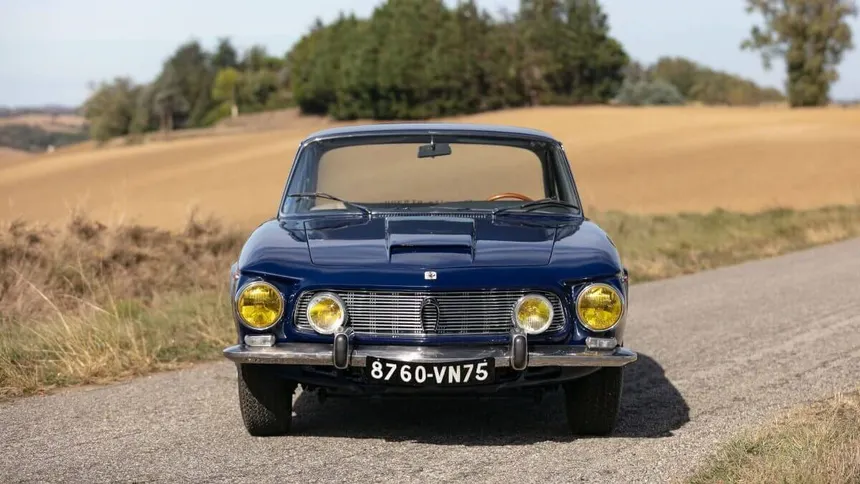
Rivolta presented the Bizzarrini chassis and the hard points: track width, wheelbase, engine position, gearbox position, pedal box and fuel tank placement. Giugiaro had to draw an elegant, well-proportioned body that would mount on those points. And what he signed off, within a few months, was a silhouette that anyone with aesthetic sensibility today instantly recognises as Italian 1960s. Long lines, long bonnet, upright windscreen without aggression, restrained fastback rear glass, elegant four-seat proportions. It is not a flashy car. It is a well-resolved car.
The IR300 and its mechanicals
The Iso Rivolta IR300 was publicly unveiled at the Turin Motor Show of November 1962. Series production began in April 1963 at Iso’s plant in Bresso. The name, no mystery: IR for Iso Rivolta, 300 for the engine’s horsepower.
The chassis is pure Bizzarrini signature. A welded sheet-steel platform with a reinforced central backbone and boxed side members. 2.7-metre wheelbase between axles. Independent front suspension with unequal-length double wishbones and an anti-roll bar. And at the rear, the technical detail that set the IR300 apart from any European competitor of the moment: a De Dion axle guided by two trailing arms and a Watt’s linkage. The De Dion is a compromise architecture between the traditional live axle and full independent suspension: the two wheels remain connected by a tube, but the differential is fixed to the chassis (not to the axle), which dramatically reduces unsprung mass and improves dynamic behaviour. It’s an architecture Bizzarrini had studied at Ferrari and applied to the IR300 with the conviction of someone who knew what he was doing. Coil springs and telescopic dampers at all four corners. Servo-assisted Dunlop disc brakes all round, 298 mm front and 286 mm rear, with the rears mounted inboard (next to the differential, not at the wheels) to further reduce unsprung mass.
And then there is the engine. Rivolta could have made life complicated by designing an Italian V12 from scratch, like Ferrari. He could have asked Lamborghini to sell him one. He could have asked Maserati or Alfa to build him a straight-six. But Rivolta was a pragmatic industrialist. And the decision he made is the one that best defines the entire Iso project: he called General Motors and bought American V8s.
The engine the IR300 ran was the Chevrolet 327, the 5,354 cc small-block that GM had just introduced in 1962 for the Corvette C2. Four versions were available, from 250 to 360 hp depending on specification. Iso chose the 5.4-litre L75 with 300 hp and a twin-barrel Carter carburettor, one of the most reliable in the American catalogue. The reason was double: proven reliability (tens of thousands of units manufactured in Detroit with solid industrial tolerances) and worldwide parts network (any American mechanic could service a 327, whereas Italian V12s were exclusive and ruinously expensive to repair). The gearbox was a BorgWarner T-10 manual with four speeds, later replaceable with a BorgWarner five-speed or a GM Powerglide three-speed automatic. Salisbury limited-slip differential at the rear.
The IR300’s performance, on paper and on the road, was competitive with any Ferrari 250 GT/E or Maserati 3500 GT of the moment. 218 km/h top speed. 0-100 km/h around seven seconds. And a ride comfort that anyone who has driven a contemporary Ferrari 250 GT/E describes as noticeably better: the American V8, with its enormous low-rev torque, did not demand the nervous driving style required by Italian V12s of the era. And the De Dion suspension absorbed bumps better than the live axles of some rivals.
The first press tests were positive. The magazine Quattroruote published a 1963 comparison test pitting the IR300 against a Ferrari 250 GTE and a Maserati 3500 GT, and while Ferrari won on image, Iso won on ride comfort and value for money. Rivolta had hoped to sell 1,500 units a year. The real figures were much more modest: 797 total units between 1962 and 1970, including 167 IR340 (the 340 hp version introduced in 1964). The IR300 was never a sales hit. But it was an industrial success: it established Iso as a serious grand-touring manufacturer, justified the investment in the platform, and opened the door to the next projects. The first of which would be the car that gives this article its second title.
The Grifo
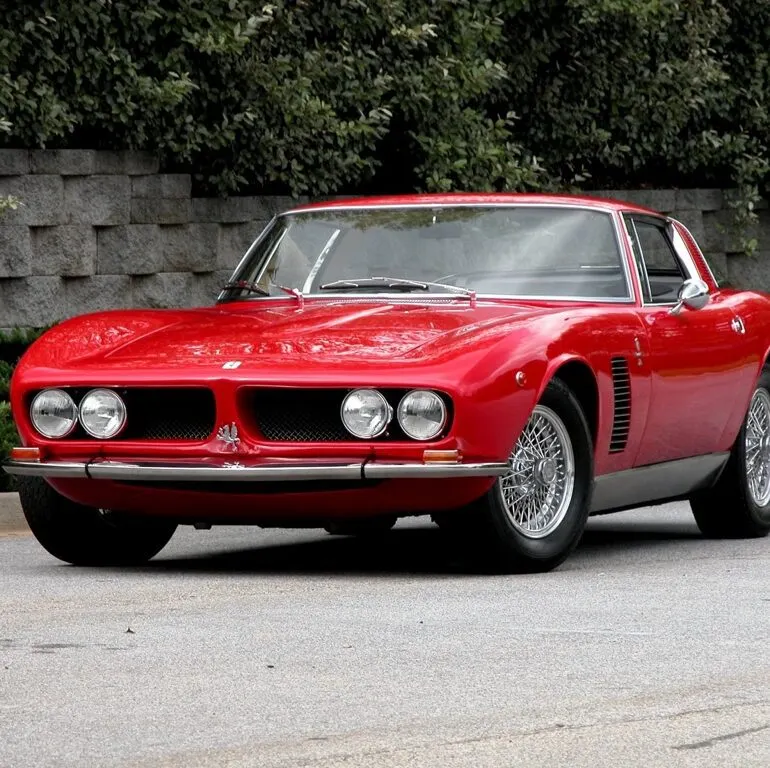
Late in 1962, with the IR300 freshly unveiled and series production about to begin, Bizzarrini began pressuring Rivolta to make a more radical version of the IR300. A two-seat coupé, shorter, lower, more aggressive, with the IR300’s mechanicals but aimed at a different public: the buyer who wanted a Ferrari but couldn’t afford one, or the one who had a Ferrari and wanted something different. Something that could compete with an Aston Martin DB5 and a Maserati Mistral. Something truly sporting.
Rivolta said yes, with conditions. The new car would be called the Iso Grifo, after the mythological griffin (half eagle, half lion), also the creature in the Rivolta family crest. And two simultaneous versions would be developed: the A3/L (Lusso, luxury) as a 2+2 road coupé, and the A3/C (Corsa, race) as a lightweight competition car homologated for endurance racing.
The A3/L and A3/C debuted together at the Turin Motor Show of November 1963. But here’s the lovely detail: each was displayed on a separate stand. The A3/L road car, more elegant and conservative, was shown on the Bertone stand. The A3/C competition car, more aggressive, with riveted aluminium bodywork, was shown on the Iso stand. And that physical separation at the show foreshadowed, although nobody knew it yet, the falling-out that was about to happen between the two personalities who had signed both cars.
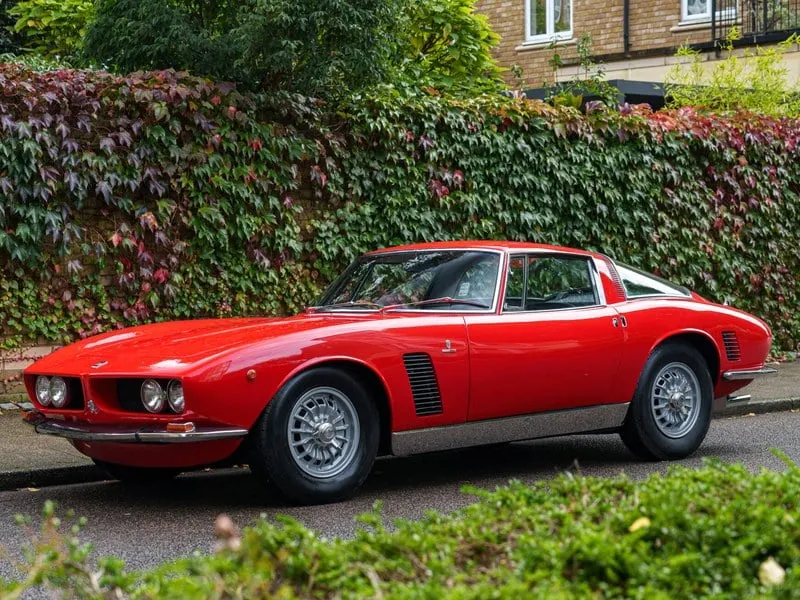
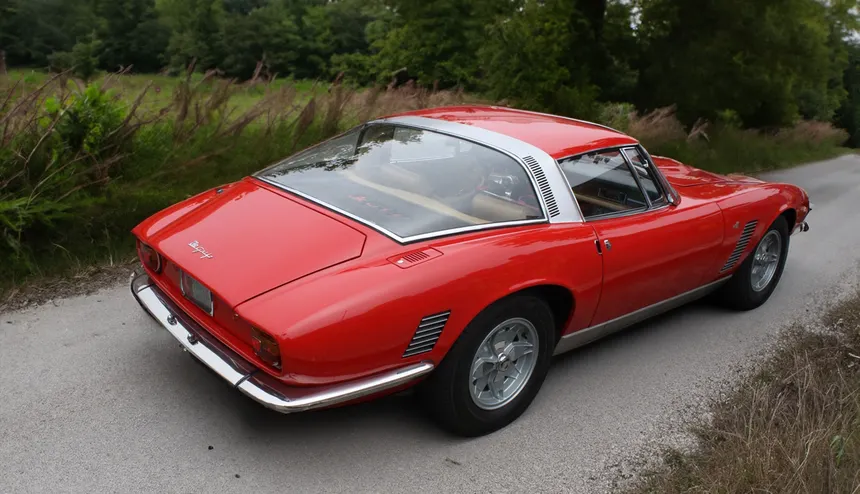
The A3/L was completed by Bertone with Giugiaro. It is the silhouette of the road Grifo that is still instantly recognisable today: two seats, long bonnet, raked windscreen, fastback-style rear glass, more curvaceous and aggressive lines than the IR300 but with the same controlled elegance. The body was steel. The interior, leather, velvet, Veglia instruments and Blaupunkt radio. It weighed 1,500 kg. Declared top speed: 270 km/h with the most powerful engine. The customer received the car at Bresso after about eighteen weeks’ wait.
The A3/C was completed by a different coachbuilder: Piero Drogo, at Carrozzeria Sports Cars of Modena. Drogo was a specialist in lightweight competition bodies who had worked for Ferrari (the famous 1962 “Breadvan” is also his, by the way, a direct NEC connection to a previously published article). The A3/C had a Duralumin aluminium body riveted to the chassis with 7,000 visible rivets (another Drogo signature). The engine was set further back than in the A3/L, giving an almost perfect 50/50 weight distribution. The fuel system was a three-tank arrangement of two side saddles plus a central tank, totalling 145 litres, designed by Bizzarrini so that weight distribution would not shift more than 1% as the tanks emptied. It weighed 1,000 kg. With the most radical version of the Chevy V8 tuned to 400 hp, it reached 290 km/h. And from its debut at the 12 Hours of Sebring in March 1964 until late 1965, it raced in the World Sportscar Championship against the Porsche 904, the Ford Daytona Cobra, the Jaguar E-Type and the Ferrari GTO. Le Mans 1964 and 1965, where the A3/C was among the fastest cars on the Mulsanne Straight.
The split
And here we arrive at the NEC moment of the article. Because between 1964 and 1965, while the A3/L and A3/C trickled out and the A3/C raced European circuits, the relationship between Renzo Rivolta and Giotto Bizzarrini began to fray.
The reason was structural. Rivolta was an industrialist who wanted production ramp-up, reasonable margins, clean numbers on the accounts, and orderly brand growth. His priority was selling road cars: the 2+2 A3/L was more important to him than the A3/C competition car. Bizzarrini, in contrast, was an engineer with a racer’s soul. What he wanted was to go to Le Mans, win Le Mans, and build ever fewer units but ever faster. The A3/C was, for him, the car, not the A3/L. And the money Rivolta spent on advertising elegant cars, Bizzarrini would have spent on racing engines.
On top of that, Bizzarrini, working from Livorno, was juggling several clients simultaneously. Iso was one customer, but not the only one. Bizzarrini was also designing engines for ATS, for Lamborghini, and projects of his own under his new personal marque. Rivolta started to feel that Bizzarrini was prioritising his own projects over the Iso assignments. And delivery dates for the A3/Cs began to slip.
In the summer of 1965, after a series of arguments that the Italian press of the time never documented in detail but which are well established in collector sources, the two parties decided to part ways. Bizzarrini left Iso. And he signed an agreement with Rivolta that allowed him to continue building the A3/Cs under his own marque, now rebadged as the Bizzarrini 5300 GT Strada and Bizzarrini 5300 GT Corsa. In other words: the same car, same Bizzarrini chassis, same Chevy engine, same Drogo bodywork, but now sold as a Bizzarrini, not an Iso. The agreement closed at 22 units of the A3/C built under the Iso badge. And from 1965 to 1968, Bizzarrini alone would build around 133 additional units under his own name before his company went bankrupt for financial reasons in 1969.
Iso, for its part, kept the A3/L and developed it for the next ten years under the name Iso Grifo, without the C. Renzo Rivolta appointed engineer Pierluigi Raggi as head of technical development (the same Raggi who had co-designed the Isetta with Ermenegildo Preti in 1951, an internal connection to NEC’s previous Isetta article).
The Grifo evolution and the death of Renzo Rivolta
The Iso Grifo Series I entered series production in 1965, with the Chevy 327 V8 of 5.4 litres and 300 hp (a 350 hp version with four carburettors was also available), BorgWarner four- or five-speed manual gearbox, or GM three-speed automatic. Bertone bodywork, Iso assembly in Bresso. Between 1965 and 1970, 330 units of the Series I were built, a modest but steady figure.
And in August 1966, two years after the Grifo’s launch, the unexpected happened. Renzo Rivolta died in Milan of a sudden heart attack. He was 57 years old. He had built three distinct industrial businesses in his life: refrigerators, motorcycles and scooters, and cars. He had saved BMW from bankruptcy through the Isetta. He had built two cars that sat at the table of Ferrari without being Ferrari. And he was gone without anyone seeing it coming.
The torch passed to his son Piero Rivolta, who was 25 at the time. Piero was a mechanical engineer, like his father, and had been preparing to enter the family business. The sudden death forced him to assume control with barely two weeks’ notice. And under his leadership, Iso lived through its last creative phase, between 1966 and 1973, before the final bankruptcy.
In 1968, Piero introduced the Grifo 7 Litri, a version with the Chevy big-block L71 of 427 cubic inches (7.0 litres) and Tri-Power triple carburettor, producing 435 hp. The bonnet had to be redesigned with a huge air intake (nicknamed “Penthouse” for its size) to house the taller block. Declared top speed: 300 km/h with appropriate gearing. 90 units built by 1971. In October 1966, the brand had also presented a Targa version of the Grifo at the Turin show, with removable roof; only 18 units built in total across Series I and II.
In 1970 came the Grifo Series II, with frontal styling changes (pop-up headlights, redesigned grille). 83 units of the Series II. And of those, the versions with the Chevy 454 (7.4-litre) engine called IR-9 “Can Am” and the versions with the Ford 351 Boss engine called IR-8 (these with an even taller bonnet scoop). The switch from Chevy to Ford in the early 1970s was not a technical decision but a political one: General Motors began tightening supply conditions to external customers from 1971, and Piero Rivolta found Ford more receptive to maintaining the engine flow. It is the same reason that De Tomaso, in those same years, also switched to Ford engines.
In parallel with the Grifo, Iso launched two more cars under Piero Rivolta’s leadership. The Iso Fidia of 1967, a four-door saloon advertised as “the fastest four-seat car in the world”, with Ghia bodywork and a Chevy V8, which sold 192 units by 1974 (among its buyers: John Lennon, Pete Townshend, Sonny Bono). And the Iso Lele of 1969, a 2+2 fastback with Bertone bodywork designed by Marcello Gandini, conceived as the IR300’s successor, which sold around 295 units.
The end of Iso
From 1972 onwards, things turned bad. Italy was going through an economic crisis, the costs of artisanal grand-touring production were rising faster than retail prices, and the brand had cash-flow problems. In June 1973 Piero Rivolta made the hardest decision of his industrial life: he sold Iso to an Italian-American group led by a financier named Ivo Pera. The company was renamed Iso Motors & Co.
That same summer of 1973, Pera signed a deal with Frank Williams to enter Formula 1 under the name Iso-Marlboro-Rivolta, with a Cosworth DFV-powered single-seater. The team raced in 1973 and 1974 with modest results. But the decision was financially irrational. Iso had no cash to sustain a Formula 1 programme.
And then came the Oil Crisis of October 1973. Petrol prices spiked across Europe. The market for 5.4-litre grand tourers consuming 20 litres per 100 km collapsed overnight. Iso, which depended entirely on that segment, could not hold on. In the summer of 1974, the company entered insolvency. Total accumulated production over its ten years as a grand-touring manufacturer: around 1,700 cars. IR300, IR340, Grifo Series I and II, Grifo 7 Litri, Targa, Fidia, Lele. Ten years. One thousand seven hundred cars. And it was over.
Piero Rivolta tried to relaunch the brand in 1990 with a prototype called the Grifo 90, but the project never reached production. There were other isolated attempts in the 2000s and 2010s, none of which materialised. The Iso brand today exists only as a collection of trademark rights managed by the Rivolta family. The surviving cars (the 797 IR300s, the 413 Grifos) are serious collector items. A well-restored Grifo Series I 5.4 L now moves between USD 350,000 and USD 500,000 at auction. A Grifo 7 Litri can pass USD 700,000. An original A3/C (one of the 22 Iso built before the split) is north of USD 1 million. And a Bizzarrini 5300 GT Strada from the post-split era hovers around USD 1.2 million. Serious numbers.
Why it matters
There are three things that make the IR300-Grifo binomial a fascinating object in Italian motoring of the 1960s, beyond the production numbers and the names on the panels.
The first is Rivolta’s decision to use an American engine. In 1962, no Italian grand-touring manufacturer had done that. Ferrari, Maserati, Lancia, Alfa Romeo, all designed and built their own engines. The idea that an Italian car could carry a Chevrolet V8 sounded like industrial heresy. But Rivolta, who was a pragmatic engineer, saw what others missed: that the reliability and parts network of an American engine were real competitive advantages for a grand-touring buyer, not concessions. The Ferrari buyer knew his V12 would break occasionally and that every repair would cost a fortune. The Iso buyer knew his V8 was the same engine fitted to a Corvette or a Camaro, that any American mechanic could open and close it, and that parts were as accessible as any Chevy product on the network. That difference was structural. And it opened a path later followed by De Tomaso (with Ford engines), Bristol (with Chrysler engines) and Iso itself in its later models.
The second is Giugiaro’s role as transition designer. The IR300 and the Grifo are two of the first serious commissions Giugiaro signed at Bertone before moving on to Ghia in 1965 and before founding Italdesign in 1968. Without those two cars, there is arguably no Giugiaro as we know him today. That is: the VW Golf Mk1, the Lotus Esprit S1, the DeLorean DMC-12, the Maserati Bora, the BMW M1, every car Giugiaro signed in the 1970s and 1980s has its genealogical line in those first Rivolta commissions. Iso was the platform where Giugiaro learned to design grand-touring bodies. From there, he left.
The third is Bizzarrini. The split with Rivolta in 1965 gave Bizzarrini the freedom to build, under his own name, the car he believed the A3/C should be. That Bizzarrini 5300 GT Strada was built until 1968 and yielded only 133 units, but it has entered history as one of the most radical and desired Italian grand tourers of the 1960s. Without the split, Bizzarrini would have continued as Iso’s chassis engineer. With the split, he became his own marque. And the Bizzarrini brand has been revived in 2020 with a new Bizzarrini 5300 GT Revival, produced in limited series by a British company that purchased the marque’s rights from Giotto Bizzarrini himself before his death in May 2023 at the age of 96. The legend has not gone out.
The Rivolta leap
If I had to summarise this whole article in one sentence, it would be this: Renzo Rivolta is the only Italian automotive industrialist of the 20th century who made the complete jump, from refrigerator manufacturer to builder of Le Mans-homologated grand-touring competition cars, in less than twenty years. No other Italian grand-touring manufacturer made that journey. Ferrari came from pure racing. Maserati came from pure racing. Lamborghini, the other parallel case, came from making tractors, a business considerably closer to cars than refrigerators are. Lancia and Alfa Romeo were established brands from before the war. Iso is the only one that crossed the entire border, from white goods to Le Mans, in a single industrial generation.
And he did so, moreover, in unfavourable conditions: with no prior racing tradition, no specialised supplier network for the segment, no established brand, no Enzo Ferrari standing behind him. Only with a German cheque of Isetta royalties, a former Ferrari engineer hired at exactly the right moment, a 24-year-old designer who would later become the most important of the century, and a pragmatic industrial decision: American engines. With those four elements, Rivolta built two cars that today fetch higher prices than many of his contemporary Ferraris.
And that is why, when someone today looks at an Iso Grifo at a gathering and says “what a beautiful car”, they are looking, without quite knowing it, at the last chapter of a story that began in 1939 with a man from Milan buying a refrigerator factory. The lines connecting the dots are long, sinuous and easily missed. But they exist.
Check you’re still alive.