The Italian egg that saved BMW
How a microcar designed by an aeronautical engineer for an Italian refrigerator maker kept the lights on in Munich until the Neue Klasse arrived
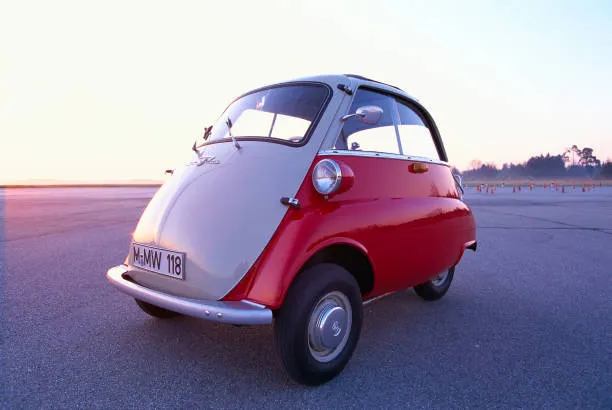
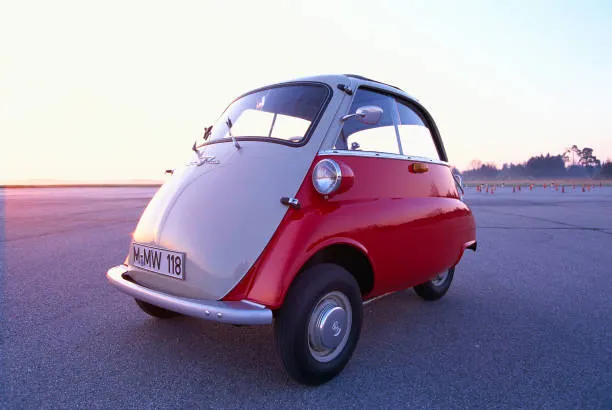
There’s an image the German press of the 1950s made viral before the word viral existed. A man in a hat, suit and tie, opening what looks like a refrigerator door while an egg-shaped microcar greets him with its steering wheel and column swung outwards, as if the appliance had just thrown open its main compartment. It was a promotional shot for the BMW Isetta 250, launched in April 1955. It was the strangest car ever to come out of BMW’s catalogue. And it was also, though the public didn’t quite realise it, the car that was saving Bayerische Motoren Werke from bankruptcy.
Without the Isetta there is no modern BMW. The statement sounds exaggerated until you look at the company’s accounts between 1954 and 1962. Then it stops sounding exaggerated and becomes literal. The Isetta was the car that paid the bills while Munich prepared the Neue Klasse 1500 of 1962, the mid-sized saloon that did actually save BMW for the following sixty years. But that mid-sized saloon would never have existed if Iso Rivolta’s Italian microcar hadn’t kept the lights on for seven straight years. The story, told properly, goes like this.
Munich, 1954, the books didn’t balance
By late 1954, BMW’s management was looking at the numbers with grim faces. The brand had serious technical pedigree from before the war (aero engines, premium motorcycles, the six-cylinder 326 and 327 saloons of the 1930s), but its postwar catalogue was a commercial disaster. BMW was making two things at the time: small and medium motorcycles, and luxury saloons. The motorcycles sold well (the R25 and R25/3 were hits in a Germany rebuilding its roads), but margins were thin. The luxury saloons, on the other hand, were a financial black hole. The BMW 501, the famous Barockengel (Baroque Angel, named for its rounded bodywork), had been in production since 1952 and was selling poorly. The BMW 502 with its V8 was the most expensive car in Germany but found very few buyers. And the new 503 and 507, unveiled in 1955, were luxury sports cars that didn’t return profits either.
The postwar marketing strategy had been to remain a premium brand. The economic reality of the average German customer was that there was no money for a premium brand. People wanted personal transport without paying more than absolutely necessary, over short distances, with the lowest possible running costs. The small-car segment was dominated by Volkswagen with the Beetle, Goggomobil with their tiny Goggos, Messerschmitt with the KR175 (later KR200), Lloyd with the LP 300, and half a dozen other manufacturers offering basic personal transport at prices far below anything BMW had on sale.
The accounts in autumn 1954 said BMW was losing close to 30 million marks a year on car production. The board began to consider options: sell the car division and keep just motorcycles, merge with Daimler-Benz (Mercedes had begun to probe the possibility), or rush out a small car that would fill the gap between the R25 motorcycle and the Barockengel saloon. The last option was the riskiest, but also the least humiliating. To do it, BMW needed a small car. To have a small car quickly, you had to buy it from someone who already had one designed.
That’s where Italy came in.
Turin, 1953, the egg
At the 1953 Turin Motor Show, an Italian manufacturer that until then had been making refrigerators, scooters and motorcycles unveiled a car that didn’t look like anything else. Iso Autoveicoli, owned by Renzo Rivolta, had commissioned two young engineers in 1951 (Ermenegildo Preti, an aeronautical engineer with experience in gliders, and Pierluigi Raggi, a mechanical engineer) to develop a vehicle that would bridge the gap between the motorcycle and the conventional small car. The company already made small-displacement scooter engines and wanted to use them in a closed, weatherproof vehicle capable of carrying two adults and a child under cover.
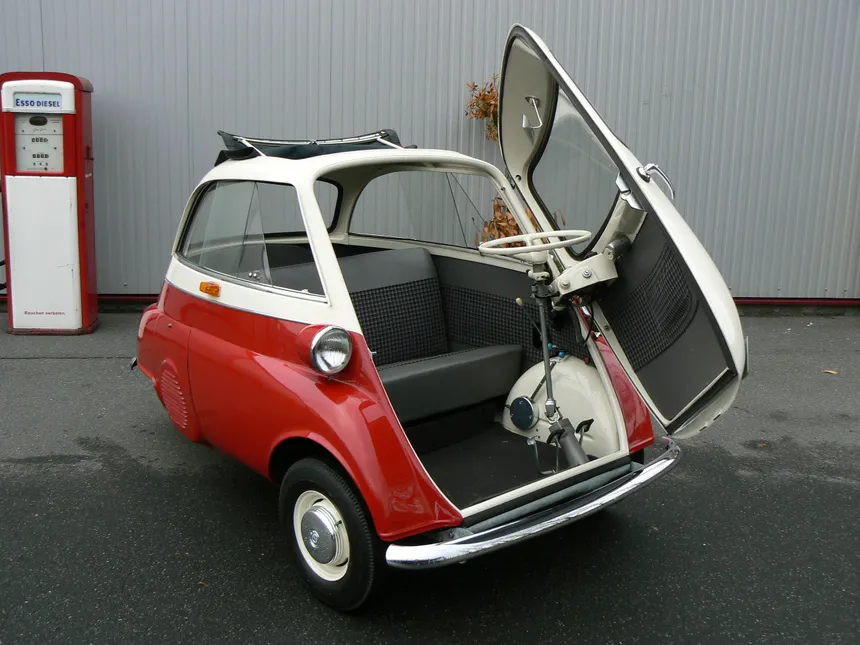
Preti approached the problem from his training. Aeronautical design teaches you to maximise interior space and minimise weight. The gliders he had worked on had small cabins with moulded Plexiglass canopies and forward access through the fuselage nose, not through side doors. That idea, translated to a car, gave you a vehicle with a single front door (not two side doors) and a glass roof that doubled as window. The consequence was that the steering, mounted to the door, had to swing outwards with it when it opened. Preti designed a hinged steering column with a Cardan joint that allowed the wheel to literally exit the car with the driver as the front door opened.
The result, presented in Turin in November 1953, was 2.29 metres long, weighed under 500 kg, ran a 236 cc two-cylinder two-stroke engine in the rear delivering 9.5 hp, and reached 75 km/h. The rear was narrow (the rear wheels sat close together, a leftover from an early three-wheeled prototype), the roof was glass with six panels, and the front door, hinged as Preti had hinged his glider noses, gave direct access from the pavement to the seat without opening anything sideways. Rivolta’s secretary, on first seeing Preti arrive with a scale model under his arm, reportedly laughed and told her boss that “a madman with a wooden watermelon” had appeared. The car was named Isetta, “little Iso” in Italian.
In 1954, to promote the car, Rivolta entered four Isettas in the Mille Miglia. They started first and finished last, but they completed the thousand miles at an average of 70 km/h. The organisers gave them a special trophy for “the quirkiest vehicle in the race”. An affectionate gesture, not a performance one.
The problem was that the Isetta wasn’t selling. Iso built around 5,000 units between 1953 and 1956 in Italy, a ridiculous figure for an industrial operation. Fiat launched the 600 in 1955 and the 500 Nuova in 1957, and swept the Italian microcar segment clean. Rivolta, a businessman with a clear vision, quickly understood that the Isetta wasn’t going to save Iso in the Italian market. But he also saw the idea was a good one. What he needed was to sell the licence to the right manufacturer in the right country. Someone with strong commercial reach to produce the Isetta at proper volume. In 1954 Rivolta took the Isetta to the Turin show, where some visitors from Munich sat down to study it.
The deal
The BMW delegation that visited the Iso stand in Turin was stunned. The car solved exactly the problem Munich had failed to solve: it was a closed vehicle, not a motorcycle, didn’t need monocoque chassis engineering (which BMW didn’t know how to do at that point, having no tradition of building small cars), weighed less than 500 kg, consumed four litres per 100 km, and sold at a popular price. If BMW could secure the licence, they could put it on the market within months without spending years on development.
The negotiation with Rivolta closed quickly. For a figure neither party ever made public (some sources estimate around two million marks), BMW acquired in 1954 the licence to manufacture the Isetta for Germany and all the physical tooling from the Italian plant. The dies, moulds, presses, everything. Rivolta retained the freedom to keep selling licences to other manufacturers in other markets (which he did: Velam in France, Isetta of Great Britain in the UK, Metalmecánica in Argentina and Romi in Brazil all eventually built Isettas under licence in the following years), and focused on his real personal project, which was Italian grand tourers with front-mounted engines. From that effort would come, in the 1960s, the Iso Rivolta IR300 and the Iso Grifo, two of the most respected GT cars of the era, with Bertone bodywork, Chevrolet V8 engines and De Dion rear ends. But that’s another story.
BMW took the Isetta to Munich. And began to redesign it.
What changed, what stayed
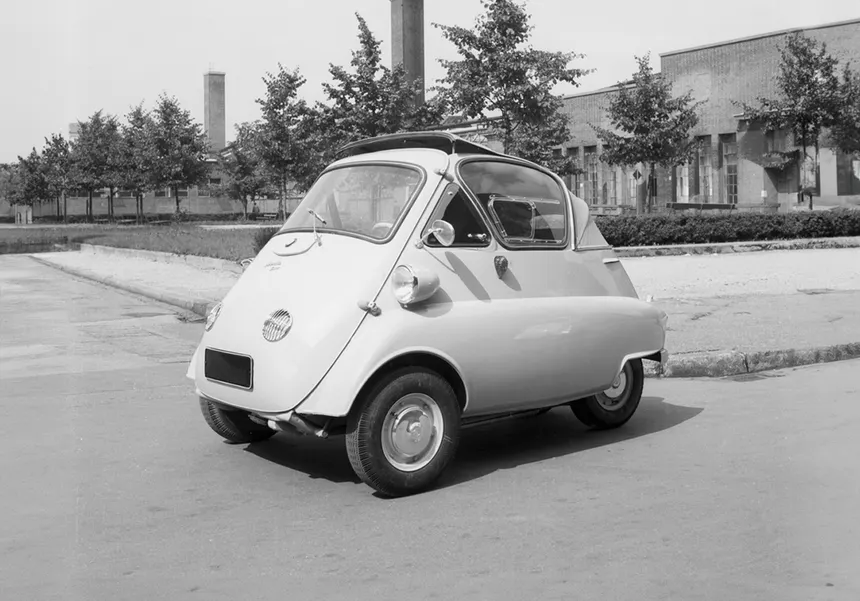
The first German Isetta hit the market in April 1955 as the BMW Isetta 250. On the surface it looked like the Italian car, but Munich’s engineers had worked over it with remarkable intensity. Octane Magazine summarises it well: BMW redesigned the car to such an extent that almost no original Italian part was interchangeable with the German ones. What they kept was the concept (front door, rear engine, glass roof, hinged steering) and the silhouette. Almost everything else changed.
The engine became a four-stroke instead of the Italian two-stroke. BMW used the single-cylinder 247 cc unit derived from their own R25/3 motorcycle, modified for the car, producing 12 hp. The reason was double. First, technical: four-stroke engines were more reliable, cleaner and more fuel-efficient than two-strokes. Second, commercial: the R25 engine was already in production at Munich, BMW made it in volume, and using it for the Isetta let them leverage the existing assembly line, cut costs and guarantee reliability. But there was a third reason, less obvious and more important: in Germany, a motorcycle licence was sufficient to drive a vehicle of less than 250 cc displacement. By using the 247 cc engine, the German Isetta 250 could be driven on a motorcycle licence, far easier and cheaper to obtain than a car licence. For a Germany rebuilding its active workforce, where many people took the motorcycle licence before the car licence, that difference was a massive commercial accelerator.
The suspension was modified to add a fourth wheel (the Italian had three in some markets), the headlights were repositioned slightly higher, heating was added as standard (the Italian had none), a folding canvas sunroof was added that doubled as solar roof and emergency exit (because the front door, if jammed by an accident, would trap the occupants without escape), and the braking system was modified. The wheels were 10-inch. The fuel tank was 13 litres. Average consumption around 3.5 litres per 100 km. Top speed, 85 km/h. And the dealership price in April 1955: 2,580 German marks. It was, officially, the cheapest car in Germany.
The commercial explosion
What happened in April 1955 was one of the fastest demand spikes in postwar European industry. BMW sold 22,000 Isettas in the first year. The second year, before 1956 closed, it had sold another 26,000. The marketing forecast was for around 10,000 units a year. They doubled it, then tripled it. The Munich plant had to reorganise production to sustain the pace. And while the Munich plant was at capacity with Isetta orders, the luxury saloon division kept selling in token quantities. BMW’s financial balance in autumn 1956 was already completely different from what it had been two years earlier. The saloons still lost money, but the Isetta more than covered for them. The company, which in 1954 had been studying a possible sale to Daimler-Benz, was profitable again by 1956.
The Suez Crisis of November 1956, when Egypt nationalised the canal and oil prices spiked across Europe, played to the Isetta’s favour. Petrol became a scarce and expensive commodity for several months. The car that did 3.5 litres per 100 km became precisely what millions of German families needed. Demand spiked again. BMW sold 30,000 Isettas in 1957. And the bonus: the Isetta gave the brand access to a customer base that would never have considered BMW before (young families, skilled workers, small business owners with little capital), and many of them, as they progressed economically in the following years, stayed with the brand and bought larger BMWs. The Isetta also functioned as a customer acquisition tool.
In total, between 1955 and 1962, BMW built 161,728 Isettas in Munich. Of those, 8,500 were exported to the United States. To those figures we have to add licensed production in other countries: Velam in France, Isetta of Great Britain in Brighton (by far the most prolific licensee, around 30,000 units), Metalmecánica in Argentina and Romi in Brazil. The Isetta was, officially, an Italian-origin German car built in six countries.
How it drives
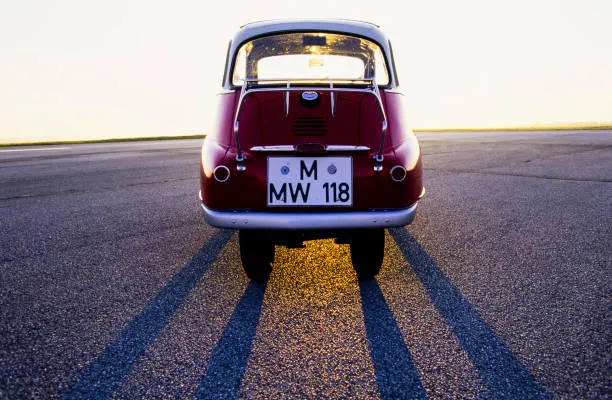
If today you climb into a restored Isetta and turn the key, what you’d expect happens: a motorcycle engine starts up. One cylinder, 247 cc on the 250 and 297 cc on the 300 (the version introduced in 1956 when Germany closed the motorcycle-licence loophole, and BMW responded by increasing displacement to maintain performance). Twelve horsepower in the 250, thirteen in the 300. Four-speed manual gearbox. Manual clutch. And a small steering wheel that, the moment you press the clutch and open the door that’s directly in front of you, comes outwards with you like a kitchen drawer. The mind doesn’t process what’s happening until you’re seated inside and the door clicks shut.
Once inside, there’s room for two adults pressed shoulder to shoulder, and perhaps a small child between them if the family is of modest build. The boot is physically nonexistent; what people do is fit an exterior luggage rack at the rear and strap their bags to it. The windows are enormous for the car’s size, almost a Plexiglass panorama. Visibility is excellent because you are basically sitting inside a glass tumbler. The heater works (sometimes). The single-cylinder, air-cooled engine’s whirring works its way through every opening.
What’s remarkable is how it drives. It is slow, obviously. Zero to 60 km/h in numbers no decent stopwatch is willing to record. But the chassis is honest, the car has notable agility for U-turns in narrow streets (its turning radius is 4.7 metres), the wider front track and narrower rear track give reasonable stability, and the low weight (350 kg dry) means the modest suspension doesn’t have to work hard. Road testers who have run restored Isettas describe them unanimously as “surprisingly refined for what they are”. The body doesn’t creak, the car doesn’t bounce over bumps like a go-kart, the modest but adequate brakes stop the car in reasonable distances, and the BMW R25-derived motorcycle engine is, within its modesty, mechanically solid.
It is a car for three things: to go very slowly around a small city, to go slowly along a secondary road, and to park in impossible places. Nothing else. And for those three things, it is perfect.
The Isetta 600 and the end of the line
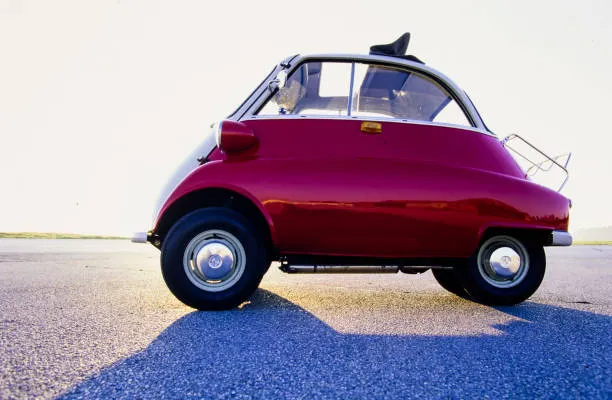
In 1957 BMW launched a stretched version of the Isetta called the BMW 600. Same concept, longer: 2.90 metres long, four seats, an identical front door to the original Isetta, an additional side door on the right for rear passenger access, a conventional rear axle with independent suspension (the first time BMW had fitted independent suspension to a road car, a technology that would be standard in the brand for the following four decades), and a larger engine, the 582 cc flat-twin boxer from the R67 motorcycle.
The 600 didn’t work commercially. Volkswagen was cutting Beetle prices and a Beetle clearly offered more car for less money. But the 600 served as a bridge. It validated internally that BMW could build a four-seat car with independent suspension and refined mechanicals. And it positioned the brand for the next step, which was the BMW 700 of 1959, a small two-door car with a 697 cc boxer engine and a Michelotti-designed body. The 700 was the first BMW car to deliver a profitable operation in the small-to-medium segment. And that, in turn, allowed BMW to invest in the development of the Neue Klasse 1500, presented in 1962, the mid-sized saloon with a four-cylinder engine that actually opened BMW’s modern era as a dynamic premium brand.
The sequence is what matters. The Isetta paid the bills. The 700 proved the brand could make money with small cars. The Neue Klasse opened the future. Three cars, eight years, one company saved from bankruptcy.
Isetta production ceased in May 1962. The last unit left Munich that month. By then, the Isetta was no longer the car paying the bills; the 700 was. And the Neue Klasse, launched that same year, was the car that would define the future. The Isetta had done its job. Eight years keeping a brand alive that had been on the edge of bankruptcy. Eight years bringing home the money the board had spent on luxury saloons that didn’t sell. And eight years building a customer base that stuck with the brand for the good products that came later. There aren’t many cars in industrial history with a service record that clean.
What the Isetta means
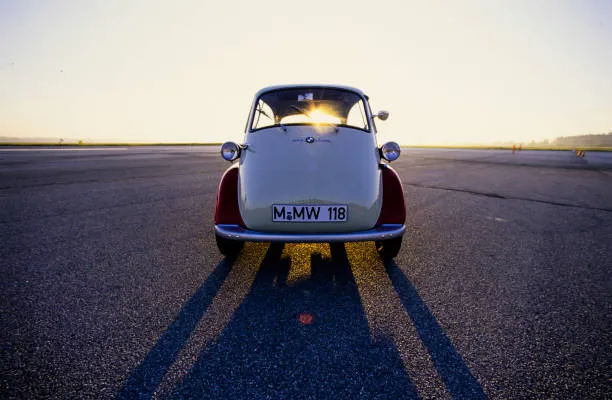
There’s an easy way to read the Isetta. The collector’s nostalgic view of a curious object, a 1950s eccentricity, a toy-microcar worth between USD 25,000 and 40,000 today in the United States depending on condition, that makes you smile when you see one pass by on the street. That reading is correct, but superficial.
The industrial reading is more serious. The Isetta is the clearest example in European automotive history of how a well-negotiated licensing operation can save an entire industrial company. BMW didn’t invent the Isetta. They didn’t spend years designing it. They didn’t take the risks of clean-sheet development. They bought a validated idea, adapted it to their market with industrial intelligence (their own engine to amortise the production line, sub-250 cc displacement to exploit the motorcycle-licence loophole, canvas roof as emergency exit), and brought it to market within months. With that decision they rescued a company sitting on 200 million marks of accumulated losses.
Viewed in perspective, the Isetta is one of the few cars of the 20th century that is where it is for one single reason: because the management of a company, at a specific moment, made the right decision. It wasn’t an engineer’s passion. It wasn’t a designer’s vision. It was a survival decision. Renzo Rivolta sold the idea to Munich because he knew he couldn’t carry it alone. BMW’s management bought the idea because they knew that without it, the brand might not survive. And between the two of them, Italian and Germans, they put together an industrial operation that kept one of European motoring’s most important brands alive through the most difficult seven years of its history.
When today’s BMW M3 closes a corner with all four tyres on the edge, there is a historical line that connects that moment to a man in a hat opening the door of an Italian egg in April 1955 in Munich. It is a long, sinuous, easily missed line. But it is the line that exists.
Check you’re still alive.