Peugeot 205 T16: When France Decided to Crush the Rally World with a Street Car

The story of the 205 that went from adorable economy car to Group B beast
The 205: A Subcompact That Changed the Rules of the Game
In 1983, Peugeot was in a tough spot. The brand was dragging a stale image, associated with reliable but boring cars for “beret-wearing gentlemen” and Parisian taxi drivers. They needed something to shake off the dust. They achieved it with a car that shouldn’t have worked as well as it did: the Peugeot 205.
Designed by Pininfarina, the 205 was a compact hatchback with clean, modern lines and a visual personality that set it apart from everything else in the European B-segment at the time. But the truly revolutionary part wasn’t its looks—it was how it drove. Peugeot invested serious resources into the chassis, suspension, and steering. The result was a small car with dynamic handling that put much more expensive vehicles to shame.
The 205 literally saved Peugeot. Sales skyrocketed, the brand image did a 180-degree turn, and suddenly Peugeot was synonymous with driving fun. But the story doesn’t end here. Not by a long shot.
The 205 GTI: The Ultimate 80s Hot Hatch
If the base 205 was already a fun car, someone in Sochaux decided to take that fun to the next level. In 1984, the 205 GTI 1.6 arrived with 105 hp, followed shortly by the 1.9 with 130 hp. On paper, the figures don’t look impressive. On the road, it was a completely different story.
The 205 GTI weighed barely 1,918 lbs (870 kg) in its 1.6 version. Do the math: the power-to-weight ratio was brutal for the era. But what really made the GTI special wasn’t the numbers; it was the sensation. Steering that told you everything happening on the pavement. A chassis that invited you to enter every corner faster. An engine that screamed for more RPMs. It was an honest car, without electronic aids, without filters between you and the road.
The 205 GTI became the absolute benchmark for hot hatches. The Golf GTI was more refined, the Renault 5 GT Turbo was rawer, but none made you feel as connected to the drive as the little Peugeot. Today, a 1.9 205 GTI in good condition is a highly sought-after collector’s item, and for good reason. It was arguably the best hot hatch ever made.
But while the GTI was conquering the backroads of Europe, the offices of Peugeot Sport were cooking up something that would make the GTI look like a toy.
Group B: The Wildest Era of Motorsports
To understand the T16, you have to understand the context. In 1982, the FIA created the Group B category for rallying. The rules were, to be generous, quite lax: manufacture 200 homologation units and basically do whatever you wanted with the mechanics. Unlimited power. No material restrictions. Free aerodynamics. All-wheel drive permitted.
What the FIA didn’t anticipate was that manufacturers would take this freedom as a declaration of war. Audi arrived with the Quattro and its integrated traction. Lancia responded with the 037 and later the supercharged Delta S4. Ford had the RS200. And Peugeot, true to its style, decided to take its best-selling economy car and turn it into a racing monster.
Group B was the most spectacular, dangerous, and absolutely insane era of motorsports. Cars with over 500 hp on dirt tracks, with spectators inches away from the course. It was magnificent. And it was unsustainable.
Peugeot 205 T16: The Lion Becomes a Beast
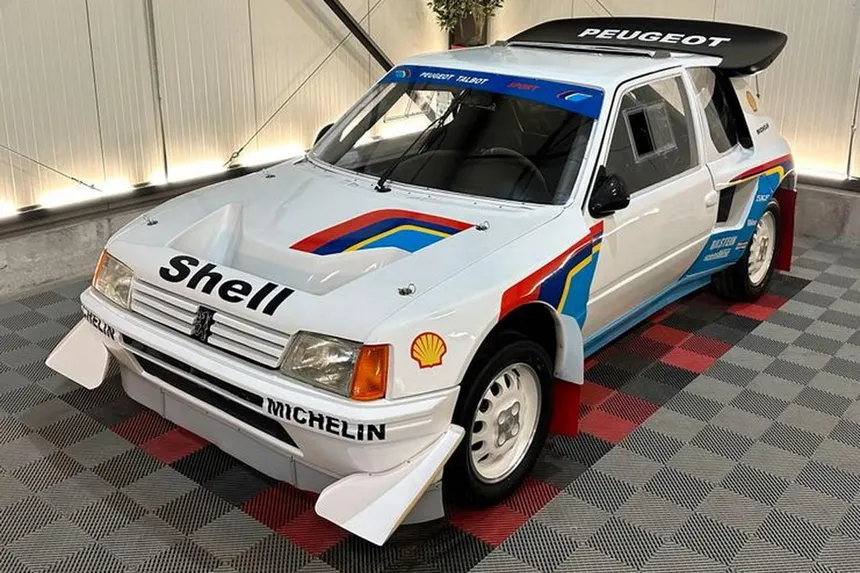
The Peugeot 205 Turbo 16, introduced in 1984, shared exactly three things with the street-legal 205: the name, the front doors, and part of the windshield. Everything else was completely different. And when I say everything, I mean EVERYTHING.
Let’s start with the most obvious: the engine. A 1,775 cc inline four-cylinder block with a turbocharger and electronic injection, mounted in a mid-rear position. Yes, you read that right. Mid-rear. Where the normal 205 had the back seat, the T16 carried a race engine. The street homologation version developed 200 hp. The Evolution 2 racing version exceeded 540 hp. In a car that weighed less than 2,200 lbs (1,000 kg).
The structure was a tubular steel chassis covered with composite and Kevlar panels. Permanent all-wheel drive with a center differential. Independent suspension on all four wheels with massive travel to absorb the jumps and bumps of rally stages. Oversized brakes with four-piston calipers.
The exterior appearance was unmistakably 205, but swollen and aggressive, with brutal fender flares, a massive rear air intake, and a rear wing that generated real downforce. It was like seeing a house cat suddenly reveal the fangs of a tiger.
Total Domination: 1985 and 1986

The T16 debuted in competition in mid-1984 with promising results, but it was in 1985 when Peugeot showed it was dead serious. With Timo Salonen and Juha Kankkunen behind the wheel, the T16 Evolution 1 swept the World Rally Championship. Salonen was crowned World Champion and Peugeot won the Manufacturers’ title. The car’s evolution was unstoppable.
In 1986, the Evolution 2 arrived—an even more radical version with revised aerodynamics, an improved engine reaching 540 hp in race trim, and dynamic behavior that drivers described as addictive. Juha Kankkunen won the Drivers’ Championship and Peugeot defended the Manufacturers’ title. It was an absolute technical and sporting domination.
But 1986 was also the year it all ended. The fatal accidents of Henri Toivonen and Sergio Cresto at the Tour de Corse in their Lancia Delta S4, along with other serious incidents throughout the season, led the FIA to take a drastic decision: Group B was canceled at the end of the season. The cars had become too fast for the roads they raced on and for the spectators crowding the tracks.
The T16 retired undefeated in its last full season. A bittersweet ending for an extraordinary machine.
The Street Version: 200 Units of Homologated Madness
To homologate the T16 in Group B, Peugeot needed to build 200 street units. And they did. The road-going 205 T16 was, and remains, one of the most extreme production cars ever built by a mass-market manufacturer.
200 hp from the mid-mounted turbo engine, all-wheel drive, a spartan but functional interior, and a price tag that was astronomical at the time. It wasn’t a car for grocery runs. It was a precision weapon with a license plate. Total production was 200 units for the original version and another 20 for the Evolution 2. Each of them is worth a fortune today on the collector market, with prices easily exceeding $325,000 (€300,000) for mint examples.
It is fascinating to think that the same manufacturer selling economy cars to French families was also producing, at the same time, one of the most advanced racing machines on the planet. That is what made the Group B era special: the direct connection between the street car and the race car. A connection that has never been seen again with that intensity.
The Legacy of the T16
The Peugeot 205 T16 wasn’t just a successful rally car. It was proof that a generalist manufacturer could create a machine capable of humiliating specialists. It was proof that French engineering, when it sets its mind to it, can compete with anyone. And it was the last great representative of an era of motorsport that will likely never return.
Group B died young, like rock stars. And the T16 was its final anthem of victory. A French subcompact transformed into the most dominant rally machine of its generation. A car that started as a 205 and ended as a legend.
Today, when we see WRC rally cars with infinite restrictions, mandatory hybrids, and controlled power, it’s hard not to feel nostalgic for that era when engineers had total freedom and the results were machines like the T16. Cars that were born to win and won with a forcefulness that still gives you goosebumps.
The 205 T16. The lion that roared louder than anyone.