MA-FIA Chapter VII: Balance of Performance, or how to punish the kid who did their homework
Chris Harris once said that the best motor racing is the kind where the best car, driven by the best driver, wins. Old-school logic. The kind of thing Clarkson would nod at while James May rolled his eyes.
Here’s the problem: modern endurance racing doesn’t work like that any more. Modern endurance racing works on a thing called Balance of Performance. The BoP, for short. It’s a system designed to level the playing field between cars built under fundamentally different philosophies, with fundamentally different budgets, by fundamentally different engineering teams. In theory, it’s the only reason you get Toyota, Ferrari, Porsche, Cadillac, BMW, Peugeot, Alpine and Aston Martin on the same Le Mans grid in 2026.
And let’s settle this upfront: BoP needs to exist. Some form of equalisation between hybrid and non-hybrid cars, between AWD and RWD, between high and low energy deployment, is the only way a class with eight different concepts can race together. The argument isn’t whether BoP should exist. The argument is what the current version of BoP — opaque, political, increasingly gagged — is quietly costing the sport. Case by case.
The original sin: the Maserati MC12
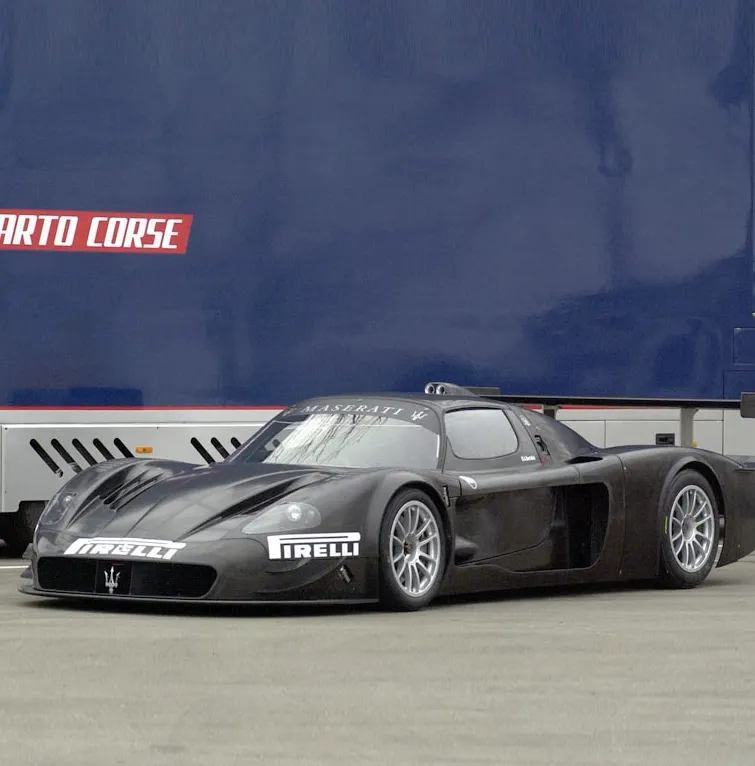
You can’t tell the story of BoP without telling the story of the Maserati MC12. The car was a homologation special built on the Enzo’s chassis with Frank Stephenson’s hand on the design, Giorgio Ascanelli leading the engineering side, and an engine that traced directly back to Maranello. The MC12 was Maserati doing what proper manufacturers do when they decide to go racing: spend the money, hire the people, build something better than anyone else.
The FIA didn’t say no. The FIA said yes, with conditions. The car was too wide. The car was too long. The rear overhang stuck out past the regulations. For Le Mans, the ACO simply refused to let it run at all — the dimensions wouldn’t fit any existing class. In the FIA GT, the car was allowed to take part at Imola in late 2004 but couldn’t score points. Three races, no points. Finally, at the season finale in Zhuhai, the FIA gave it full homologation. It won.
From 2005 to 2010, the MC12 won the FIA GT Championship every single year. Six titles. Three Spa 24 Hours wins. And every year, the FIA piled on more restrictions: shortened rear wing, added weight, tighter air restrictors. Andrea Bertolini, the man who developed the car more than anyone alive, has called it one of the first serious cases of Balance of Performance in motor racing. They throttled the MC12 because the rest of the grid couldn’t keep up.
Here’s the pattern that defines modern BoP doctrine and that the MC12 showed before anyone else: if your car is too good, you get penalised. If you put in the work, you get clipped again at the next revision. The effort of the innovator gets neutralised on a spreadsheet. You can read the full MC12 piece in the NEC archive for the technical and historical detail, but the figure that matters here is this: two decades later, the few MC12 Stradale road cars appearing at auction comfortably clear six million euros. On track they treated it like a suspect from day one. In the collector market, the verdict went the other way.
The bridge: from FIA GT to global GT3
Between 2010 and 2020 a lot happened, and I’m not going to walk you through all of it. What matters is that BoP, which started as a patch to squeeze the MC12 onto the grid, became universal doctrine. The FIA GT died in 2012, replaced by the GT3 series promoted by SRO Motorsports Group. Mercedes-AMG steamrollered everyone with the SLS GT3 in 2011-2012. GT3 became the dominant category in world motorsport: Blancpain GT, IGTC, IMSA, Nürburgring 24, Spa 24, the rebooted DTM from 2021, and eventually the LMGT3 class in the WEC from 2024. Each series with its own BoP, each one with its own criteria, all with the same structural problem: nobody outside a small room knows how the adjustments are actually calculated.
In 2021 a new layer arrived: Hypercar. The FIA and ACO opened Le Mans up to convergent regulations with IMSA’s LMDh, and created a cross-platform BoP that affects cars designed under incompatible philosophies. Without an equalisation mechanism, the class falls apart inside fifteen minutes. That’s true and nobody serious is arguing against it.
The problem, again, isn’t that BoP exists. The problem is what BoP starts to do when it’s administered without transparency, for years, across a growing field with asymmetric budgets.
Glickenhaus: when the privateer can’t keep up with the OEM
Jim Glickenhaus is one of those characters who reminds you why people fall in love with motorsport in the first place. American, son of a successful businessman, Ferrari collector, the commissioner behind the Pininfarina P4/5 one-off, occasional film producer, and the man who put his money where his mouth was when the Le Mans Hypercar regulations were announced in 2018.
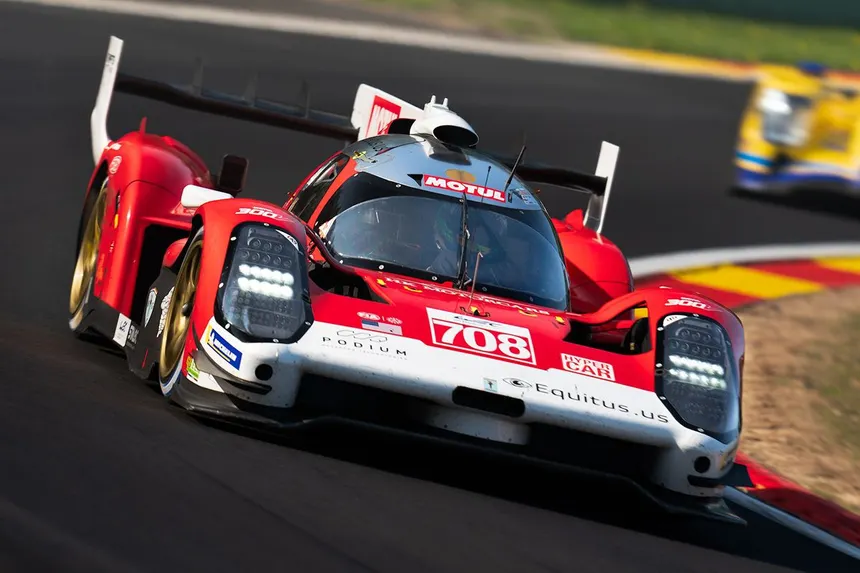
Scuderia Cameron Glickenhaus was the first manufacturer to commit to LMH. Not Toyota. Not Ferrari. Not Porsche. Glickenhaus. Before any of the big names. The SCG 007 LMH, built with Podium Advanced Technologies and run by Joest Racing, debuted in 2021. Non-hybrid, twin-turbo V8, hand-built, brilliant-looking. In 2022 they finished fourth at Le Mans. Podiums at Sebring. Pole at Monza and Spa. An American privateer team going toe-to-toe with the factory armies of Toyota and Peugeot.
End of 2023, gone. Glickenhaus told RACER that the cost of keeping up with OEM development cycles required a seven-figure investment he simply didn’t have. His issue wasn’t the BoP itself. His issue was the dynamic the BoP created. When manufacturers can pour money into evolution after evolution, knowing the FIA will adjust their performance back down, they always retain the upper hand on raw pace ceiling. A privateer who built a great car on day one has nowhere to go. They can’t out-evolve a billion-dollar OEM machine.
Glickenhaus remains the last privateer team to stand on the overall Le Mans podium. That record probably isn’t getting broken any time soon.
Lamborghini Temerario GT3: when BoP can’t save you from your own car
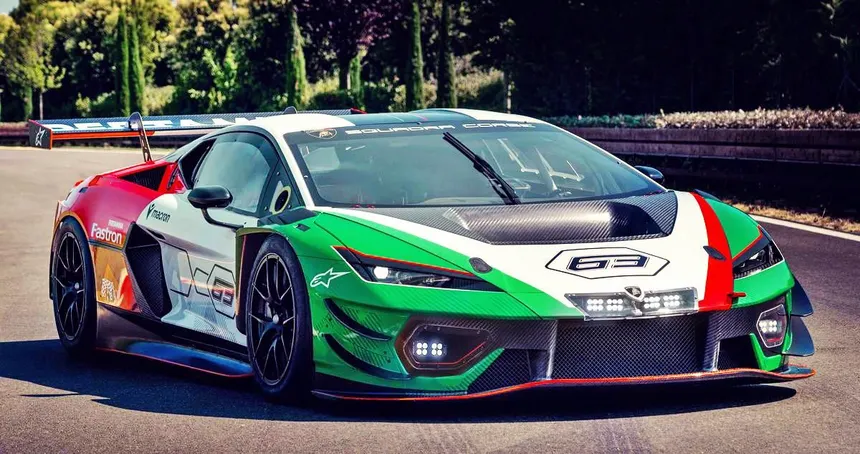
Recently at the Red Bull Ring, 24-26 April, Lamborghini debuted the Temerario GT3, the replacement for the Huracán GT3 Evo2 that fought for the title down to the wire last year. Mirko Bortolotti, Maximilian Paul, Luca Engstler, Marco Mapelli — four top drivers, two top teams (TGI Team by GRT and Red Bull Team Abt).
The result was, charitably, a disaster. Bortolotti finished twelfth in Race 1 and sixteenth in Race 2. Thirty-six seconds adrift after thirty-seven laps. Roughly a second a lap behind the leader. The four Lamborghinis fighting each other at the back rather than fighting the rest of the grid. The paddock has already coined the nickname Lamaghini Dromedario.
Who won Race 1? Thomas Preining in the Manthey-run Porsche 911 GT3 R Evo. And here’s the interesting bit. A BoP fix is unrealistic because the gap is too big to close with kilos and watts alone. But there’s something worse. FIA homologation freezes development for two years. An Evo update isn’t permitted until 2028 unless it’s a safety modification. The Temerario is locked.
This is the point worth grasping. BoP exists, in theory, to equalise different cars. But when the regulations also forbid developing the car for two years and the BoP can’t bridge a gap this large, the whole mechanism falls apart. The problem isn’t really BoP malfunctioning here. The problem is the ecosystem the BoP lives inside: if you make a mistake at the initial design stage, you’re stuck rotting at the back for two seasons. Lamborghini has spent serious money, customer teams have bought into the product, and everyone’s trapped.
Audi gave up earlier. At the end of 2023 they shut down their factory GT3 programme entirely, fired fourteen factory drivers, and stopped selling race cars. Chris Reinke, head of Audi Sport customer racing, broke the news to employees, drivers and team bosses in a single day. Official line: strategic realignment. Real line: when GT3 costs explode and technical differentiation gets regulated out of existence through BoP, the business stops making sense.
And what does the governing body offer in response? The muzzle.
IMSA 2026: shut up, or else
In January 2026, two weeks before the Rolex 24 at Daytona, IMSA published its sporting regulations for the season. Article 2.2.3, buried in the document, reads as follows: manufacturers, competitors, drivers, constructors, and any persons or entities associated with their entries must not attempt to influence the establishment of the Balance of Performance or make any public comments regarding the BoP process, methodology, data, or outcomes — including through traditional media, digital media, or social media platforms. Who decides if a comment crosses the line? IMSA, at its sole discretion. When can they impose sanctions? Before, during or after any competition. No statute of limitations.
This isn’t a guideline. It’s a muzzle. And it isn’t new — it copies a policy the WEC introduced in 2023. So is it actually enforced or is it just paper? Let’s look.
In July 2024 at Interlagos, Rob Leupen — then team director at Toyota Gazoo Racing — answered questions from a Motorsport.com journalist (in the Dutch and Italian editions) about WEC BoP. Leupen said the late BoP change before Le Mans 2023 “wasn’t compliant with the regulations” and called for more transparency. The result: Toyota was given a €10,000 fine, suspended for the rest of the 2024 season pending any similar infringement. The stewards’ official bulletin stated: “all competitors are put on notice that future violations may not receive a suspended penalty.” Three months later, Leupen left Toyota.
Since then, silence. According to both The Race and Sportscar365, Leupen is the only WEC paddock figure ever sanctioned under the rule since it was introduced. And the reading is the obvious one: if the only person willing to speak with rigour about the problem loses his job three months later, the rest of the paddock learns quickly. There’s no need to fine anyone else. The rule has done exactly what it was designed to do.
To his credit, Leupen didn’t completely shut up. In a follow-up interview he said BoP had been better in 2024, but the process was still not transparent. He suggested the FIA could define the processes BoP is based on publicly, publish them, and accept feedback. A reasonable proposal. And it cost him his job.
Gary Watkins, writing for Autosport in April 2026, put it more bluntly: transparency is everything in this sport, in any sport. The Premier League has now started giving on-field explanations of VAR decisions. That’s a step forward. The WEC has gone in the opposite direction by refusing to publish BoP data. That’s a step back. Hard to argue with him.
What the governing body actually says
For the sake of giving the other side its fair hearing — because that matters — the FIA and ACO defend BoP with three main arguments. First: without BoP, no manufacturer with an inferior car would have any incentive to compete, and the grid would empty out. Second: confidentiality protects manufacturers from competitive intelligence leaks, avoids communications wars, and keeps the focus on the sport. Third: the current BoP system, with telemetry collected at every race and predictive simulation models, is the most sophisticated equalisation tool in existence.
All three arguments have some basis. The first is probably correct: without a compensation mechanism, brands like Cadillac or Alpine wouldn’t be at Le Mans. The second is debatable: confidentiality protects the federation more than the manufacturers, who aren’t stupid and know perfectly well how fast their rivals are by analysing external telemetry themselves. The third is hard to evaluate precisely because the methodology isn’t public. If it were that sophisticated, they could show it.
But there’s a fourth argument the governing body doesn’t make, and it’s the strongest one: without BoP, the OEMs would leave anyway. Toyota doesn’t want to win Le Mans 28 times in a row. They want to win enough to justify the investment, and they need credible rivals for that victory to have marketing value. BoP is what keeps the polite fiction alive that the win is up for grabs. Without that fiction, marketing budgets stop signing off the spend. From this angle, BoP isn’t just a sporting tool. It’s economic insurance for the whole ecosystem. Which is why no Hypercar manufacturer voted to scrap it when given the chance.
What BoP kills, intentionally and otherwise
BoP was born from a sensible idea and solves a real problem. But the way it’s currently administered — opaque, political, sealed with NDAs and muzzles on the people who actually do the work — produces side effects worth looking at:
It punishes excellence. If your car is fast because your engineers nailed the aero, the cooling, the suspension geometry, the tyre strategy — you get weight added and power taken away until you’re equal with the team that finished the car late and never tested it properly. The message to the engineering community is brutal: don’t try too hard.
It kills technical differentiation. To make BoP work, the regulations narrow the design windows. Minimum weight. Maximum power. Mandatory torque sensors. Maximum energy per stint. The narrower the window, the more the cars look alike. Endurance racing’s historical role as a technology laboratory — the thing that gave us disc brakes, fuel injection, turbocharging, hybrid powertrains, ground effect — gets quietly retired.
It pushes out the privateers. When OEMs have budgets to absorb performance penalties and privateers don’t, BoP functions as a hidden economic filter. Glickenhaus walked. ByKolles-Vanwall walked. Even Lamborghini — hardly poor, but smaller than Toyota or Ferrari — admitted through CTO Rouven Mohr that they had “perhaps underestimated” the costs involved, and pulled out of Hypercar.
It creates permanent suspicion. When nobody knows how the calculations work, every win gets a question mark next to it. Ferrari won Le Mans in 2023 and people still mutter about pre-race BoP adjustments. Toyota won in 2024 and the same conversations started.
And it silences the people who could tell the other side. The Leupen case is the perfect example. When the only professional willing to talk seriously about the problem ends up out of his job, the rest learn. Pascal Vasselon, the current head of Toyota Gazoo Racing Europe, once said in Fuji 2023 that the system was “unsustainable because it removes any performance responsibility from manufacturers”. You barely hear that kind of statement any more. The gag order works.
The success handicap that wasn’t
In September 2025, behind closed doors, the Hypercar manufacturers met the rule makers. According to a Daily Sportscar report dated 22 September 2025, the meeting had no formal agenda and was described as “overwhelmingly positive” by a key participant. A vote was held on BoP’s future, and in the words of the report, all but one of the Hypercar manufacturers voted to keep it. Scrapping the system was shelved.
But there was a second conversation: success handicaps. The same system that ran in LMP1 between 2019 and 2020, where winning a race meant carrying ballast to the next one. According to Motorsport.com in November 2025, Ferrari pushed back; Toyota and Porsche saw merit in the idea; Cadillac asked for stability and warned against adding complexity. The 2026 WEC sporting regulations include provision for success handicaps, but the mechanism hasn’t been activated yet.
The success handicap has one thing structural BoP doesn’t: it’s transparent about what it is. You win, you carry weight. You lose, you carry less. Anyone can understand it. Nobody can accuse the federation of favouritism. But applying it requires admitting that the cars aren’t actually equal — and that admission undermines the polite fiction BoP depends on to exist.
So what happens next?
Flag planted. Here’s what I think comes over the next two or three years.
BoP will keep existing, will keep being opaque, and the gag order will spread to more series. SRO Motorsports has been flirting with similar policies for a while, and I wouldn’t be surprised to see ELMS, GT World Challenge and Asian championships adopting equivalent clauses in their 2027 or 2028 regulations. Once the FIA, ACO and IMSA have blessed the formula, copying it is free.
At manufacturer level, expect more exits. Lamborghini already walked from WEC and has now “paused” its LMDh programme in IMSA. Audi shut its entire GT3 operation. Aston Martin keeps walking in and out of Hypercar like an accordion. And privateers basically don’t exist any more in the top class. The next to leave will probably be a brand that came in late and isn’t willing to invest what it takes to stay competitive in a system where your real speed matters less than your permitted speed.
The only question that really matters is whether anyone with authority inside the system — a new FIA president, a new ACO CEO, a change at IMSA — will eventually have the courage to open the curtain and show how BoP gets calculated. Nobody needs to invent anything new: publishing the per-car per-session telemetry, the adjustment criteria, the simulation models would be enough. Doing it in the open would defuse most of the suspicion and force the federation to defend each decision on technical grounds. The sport would be healthier, and engineers could start celebrating their work again knowing it won’t be erased the following week.
Will it happen? Place your bets. But the day it does, we’ll know something has actually changed. Until then we’ll keep watching brands that put in the work pay the bill for brands that arrived late, and we’ll keep watching professionals brave enough to say so out loud lose their jobs.
And if the governing body running this show happens to be called the FIA, you can probably guess why this article belongs to the series it does.
Check you’re still alive.