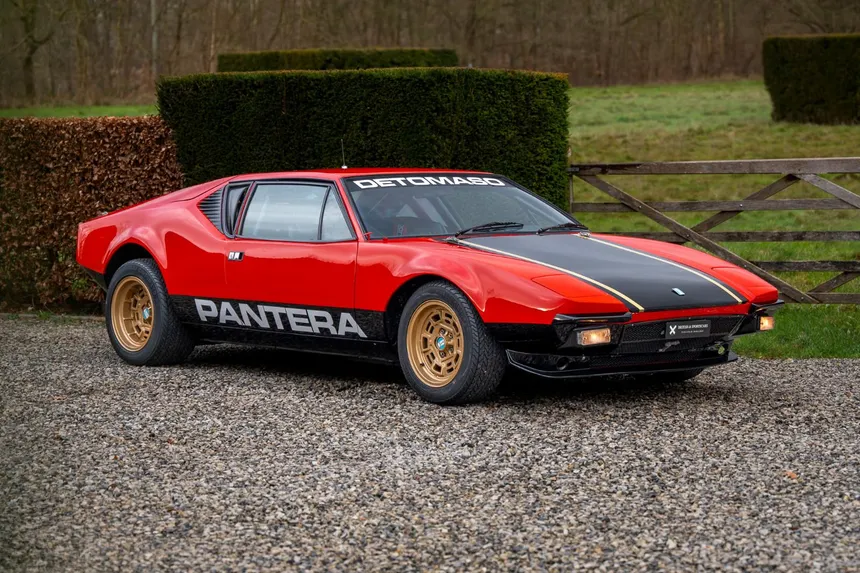
De Tomaso Pantera: The Dream That Fit in a Poor Kid’s Hand
Thirty grams of painted metal. That was my Pantera. A little diecast rolling across the living room floor while I made the engine noise with my mouth, because I’d never heard the real one.
I was a kid. I didn’t know what a 351 Cleveland was. I didn’t know who Alejandro de Tomaso was. I knew the thing was low, it was wide, and it looked like nothing that ever drove down my street.
That thirty-gram toy understood the Pantera better than half the people bidding on one today.
The Argentine who wanted to steal the rich man’s dream
Alejandro de Tomaso had more nerve than capital. A racing driver turned industrialist, the sort who walks into rooms without knocking. And he had an idea that in 1969 sounded like blasphemy: build a mid-engine car that could look a Ferrari in the eye, and sell it for half the money.
He didn’t want to build another exotic for the same four people. He wanted to take the dream Maranello kept locked in a safe and put it out on the street.
He was short of two things: money and a dealer network. He went looking for them in the most heretical place imaginable. Detroit. He shook hands with Lee Iacocca, and out of that handshake came one of the most gloriously absurd things this business has ever produced. An Italian supercar, built in Modena, that you bought from the same dealer where your neighbour picked up his Sunday wagon.
A mid-engine exotic parked between saloons and station wagons in a Lincoln-Mercury showroom in some Texas town. No flight to Italy. No surname. No salesman in a tie sizing you up to decide whether you deserved his attention.
You walked in, you signed, you took it home.
That wasn’t a product launch. That was a boot through the clubhouse door.
The body of a god, the heart of a working man
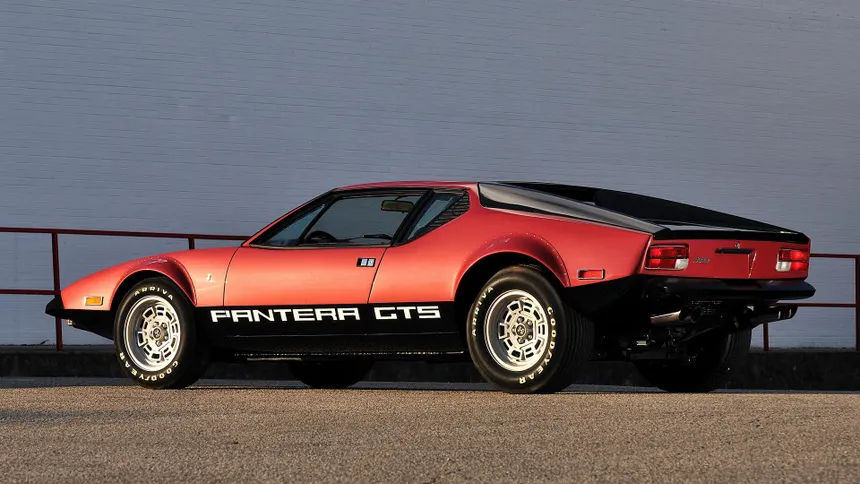
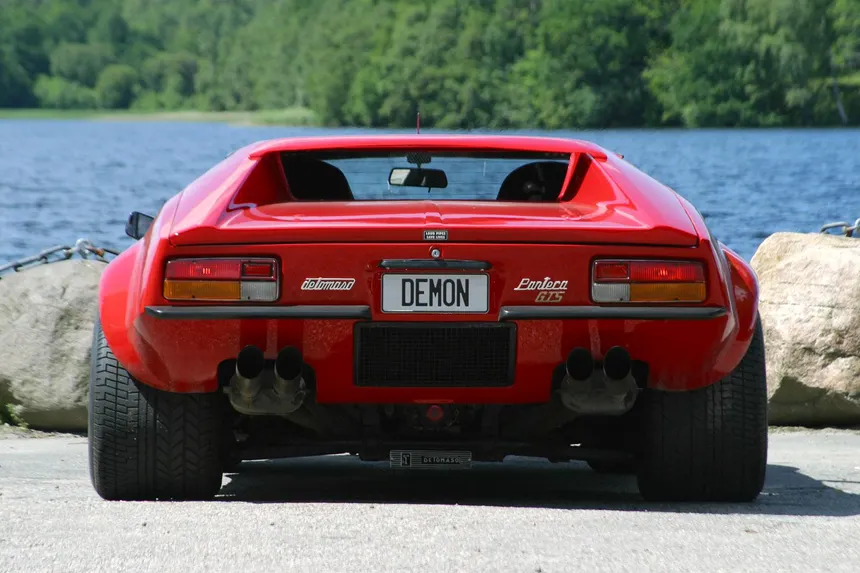
Tom Tjaarda drew it at Ghia. Low, taut, a shark’s face. In 1971 it looked like it had arrived from a decade nobody had invented yet. Underneath, a steel monocoque, the first time De Tomaso abandoned the backbone chassis to build something serious.
Even the badge has blood in it. The Argentine flag turned on its side with a T-shaped brand, the iron Alejandro’s grandfathers used to mark cattle out on the pampa. Three continents in an emblem the size of a coin.
And in the middle, right behind your skull, a Ford 351 Cleveland V8. Five point eight litres of muscle, no frills, the kind you open with a half-inch wrench. 330 horsepower from the factory, though real measurements pointed closer to 380. Bolted to a five-speed ZF transaxle. The same one from the Ford GT40 that won Le Mans.
A 1971 Ferrari gave you a V12 that sang like a choir and broke if you looked at it wrong. And when it broke, and it broke, you made the pilgrimage to Maranello, left the car for six months and prayed somebody picked up the phone. The Pantera gave you the same traffic-stopping shape with an engine you fixed using Mustang parts at the garage down the road.
The Cleveland had a wall of torque down low. It pulled from the basement. It moved you through town without ever needing to be wrung out. It wasn’t a hysterical Italian screamer demanding nine thousand revs before it gave you anything. It was a lazy, generous lump. The kind that never leaves you stranded on a hill with the clutch smoking.
The bill came in degrees. Cramming that V8 behind the driver, tight against the bulkhead to clear the ZF, created a cooling problem that has haunted the car since day one. Every Pantera owner lives watching the temperature gauge. It’s their friend and it’s their executioner.
The exotic you bought in Texas
Between 1971 and 1975, Ford moved around 5,500 Panteras in the United States through the Lincoln-Mercury network. More than three quarters of all production ended up in American hands.
In the early seventies, if you wanted a mid-engine car that looked like that, your options were a Miura or a Dino. Ruinous, fragile, reserved for an elite of four. The Pantera gave you the same silhouette, the same neck-snapping doors, comparable performance, for a fraction of the money.
Alejandro’s promise, beaten into steel: beat Maranello at half the price.
He didn’t beat it on the circuits or in club prestige. He beat it where it counted. In the shop window where a kid pressed his nose to the glass.
The price of selling dreams to poor people
The early Panteras were a botch job. Rust from the factory. Panels that didn’t line up. Solder shovelled on to hide the disasters in the bodywork.
Ford, which came from building millions of cars to watchmaker tolerances, couldn’t believe it. So it climbed inside the process: precision stamping, quality control, standards hauled up overnight. One of the few moments in history when a Detroit giant had to teach a Modena house how to bolt a car together so it didn’t shed itself across the road.
And out of that comes the legend. They say Elvis, sick to death of his refusing to start, put a .38 round into it. It’s been told so many times nobody knows what’s left of the truth, so I’ll leave it where it belongs: legend, not fact. But it says plenty about a car that seduced you from the outside and drove you mad from within. Some swear what failed that day was the American engine, not the Italian half. Sixty years on, people still argue about it. And the argument is part of the myth now.
A warrior that never won a war
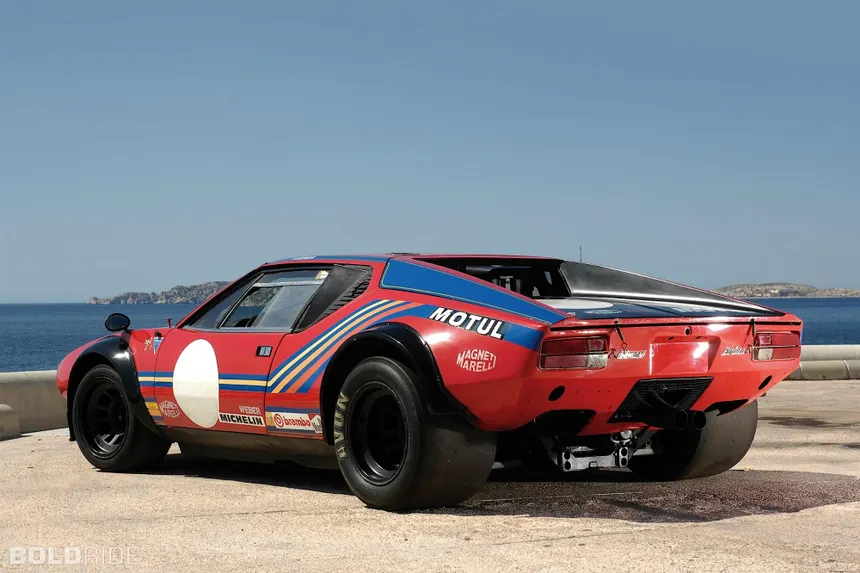
It tried, on track. Group 3 and Group 4 cars ran Le Mans, and later Group 5 machines in private hands went endurance racing across Europe. Retirements, breakages, poor results, and a quiet exit from the category in the early eighties.
It never won a big war. And it doesn’t matter, because its victory was a different one: outlasting almost every one of its nobly-bred rivals and being loved by people who weren’t born when it launched.
Some cars win championships and are forgotten inside a decade. And some cars win nothing at all and turn immortal.
When Ford walked, the Pantera let its hair down
In 1974 Ford and De Tomaso split. The giant kept the design rights and Ghia, and stopped importing the car to the States the following year. Losing your partner and your main market should have been the end.
It was when the car turned wild.
Alejandro kept building them in Modena, practically by hand, around 75 a year for a half-clandestine Europe. And in that second life, poorer and freer, he fathered the versions that are legend today.
The GT5 of 1980: riveted-on flared arches, a wing, side skirts. Circuit aggression dragged onto the street without asking permission.
And above all the GT5-S of 1984, where the flares were no longer a bolted-on patch but steel integrated into the body. Those Coke-bottle hips wallpapered half the bedrooms of a generation. The rear arches even carried vents on the leading edge to cool the brakes.
The GT5-S stood in front of any Lamborghini or Ferrari of its day and didn’t look away. As the family bastard.
The final chapter was signed by Marcello Gandini, the man behind the Stratos and the Countach, who redrew it in 1990 as the Pantera 90 Si. A handful were made before the Guarà pulled the shutter down. The Pantera died in 1992 with around 7,260 units behind it.
By the standards of hand-built Modena exotica, that isn’t a collector’s curiosity. That’s a real production car. At its peak, three a day rolled out. Three. A day. Ferrari and Lamborghini didn’t dream of it.
The best-selling road car in the entire history of De Tomaso. The summit of everything Alejandro ever touched.
Closing argument: spare me the pedigree
For forty years the Pantera was the car everyone sniggered at. Too cheap to be noble. Too American to be Italian. Too Italian to be reliable. The rowdy cousin who crashed the club wedding smelling of pump fuel instead of Maranello leather. “It isn’t a real exotic,” said the ones with the membership card. “It’s got a Ford engine.”
It’s got a Ford engine. Thank God.
Since when does the nobility of a car get decided by the name cast into the rocker cover? Since when is an engine worth less for being easy to fix?
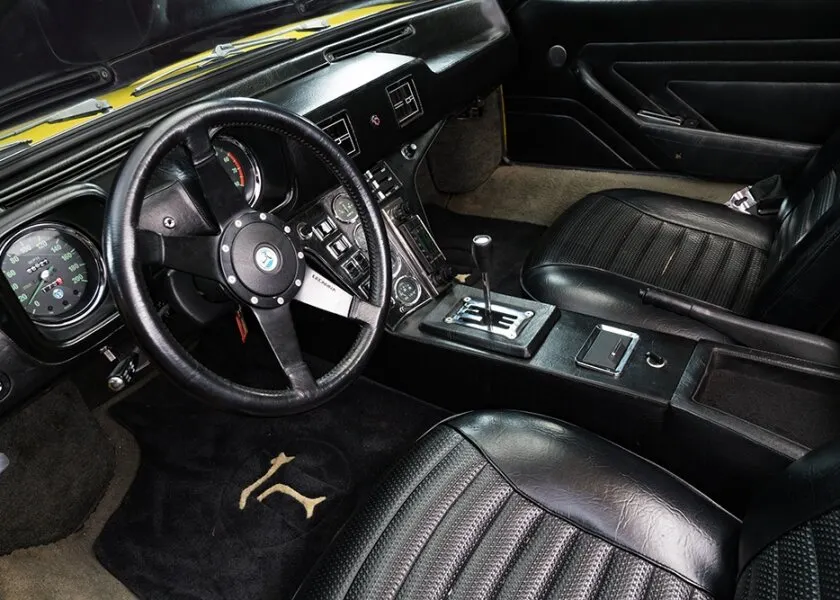
The people who sneered at the Cleveland for being vulgar are the same ones who have never opened an engine in their lives. The ones who drop the car at the dealer and sign the invoice without reading it. An engine you can repair yourself, in your own garage, on a Sunday morning, is not an inferior engine. It’s a free engine. The rest is snobbery in white gloves.
The Pantera was the last time anyone up top bothered to build a dream for the people down below. The last time a manufacturer said: I’m going to take this thing only the rich get to touch, and put it within reach.
Look at the industry now. Runs of eighty units sold before they exist. Waiting lists by invitation. Cars bought to be sealed in a nitrogen-filled warehouse until the value climbs. Seven-figure machines that will never see a real road, designed to appreciate rather than to be driven.
They don’t build cars anymore. They build financial assets with wheels.
And the kid staring through the shop window no longer sees “one day”. He sees “never”.
Alejandro, with all his botch jobs and his premature rust, did the opposite. He took the dream off the pedestal and left it where you could touch it. And for that, precisely for that, they laughed at him for forty years.
The same people who ignored it for decades, the collectors, the auction houses, the pedigree crowd, are now asking a quarter of a million for one. Now it’s noble. Now it’s a classic. Now that the dream no longer fits in a poor kid’s hand, it turns out it was a masterpiece all along.
What a coincidence.
They sneered at it while it was attainable and canonised it the moment it stopped being so. That isn’t love for the car. That’s love for the price.
I have seen two Panteras in my entire life. One moving, so long ago I couldn’t tell you where anymore, some hotel around here I think, but I wouldn’t swear to it. The other one parked at a meet.
Two. In a lifetime.
And it’s been years since I saw the last one.
There it is. The car you bought off a Texas forecourt without asking anyone’s permission doesn’t touch the road anymore. It sits in a humidity-controlled garage waiting for the bidding to climb.
What I’ve got left is the weight of that little diecast in my palm. The Pantera was never a rich man’s car that went popular. It was our car, and the rich ended up kidnapping it.
Check you’re still alive.