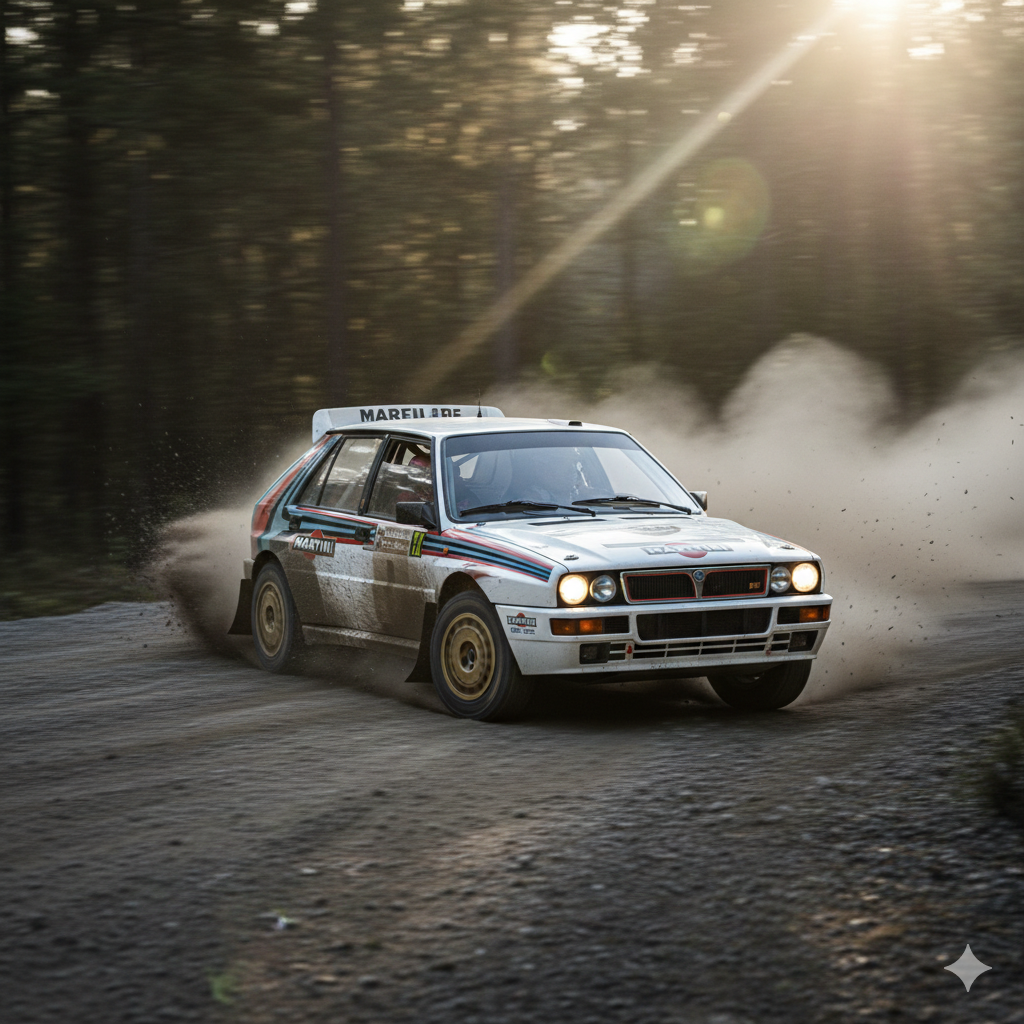
The Lancia Delta Integrale: The Rally God That Destroyed Its Maker

Six Consecutive Titles and a Bankruptcy
Between 1987 and 1992, one car dominated the World Rally Championship with such ruthless efficiency that competitors essentially gave up trying to beat it on talent alone.
The Lancia Delta Integrale won six consecutive manufacturers’ titles. Six. In a sport where mechanical failure, driver error, and sheer luck usually prevent any car from winning twice in a row, the Delta simply refused to lose.
And then Lancia, the company that built this unstoppable machine, essentially stopped existing as a real automaker.
This is the story of how the greatest rally car ever built helped kill the company that created it.
The DNA of Domination
The Delta Integrale didn’t emerge from nothing. It was the culmination of Lancia’s rally expertise, refined over decades.
Lancia had pioneered rally technology since the 1950s. The Fulvia won the 1972 World Championship. The Stratos became the first purpose-built rally car and won three consecutive titles from 1974-1976. The 037 was the last rear-wheel-drive car to win the championship, in 1983.
Each car taught Lancia something crucial about winning.
The Fulvia taught them that handling mattered more than raw power. The Stratos taught them that purpose-built weapons beat adapted road cars. The 037 taught them that even perfection has limits—when Audi showed up with four-wheel drive, the rules changed forever.
By 1986, Lancia had learned every lesson. The Delta Integrale was the final exam.
Engineering Brutality
The recipe sounds simple: take a family hatchback, add a turbocharged engine and all-wheel drive.
The execution was anything but simple.
The 2.0-liter four-cylinder engine, originally developed for the 037, produced 185 horsepower in early road versions. By the end of production, the Evoluzione II made 215 horsepower—from a motor that could reliably rev to 8,000 RPM when prepared for competition.
Rally-spec engines exceeded 300 horsepower without sacrificing reliability. Some factory-backed cars reportedly pushed past 350 horsepower while running flat-out through Scandinavian forests at midnight.
The all-wheel-drive system used a center differential with a viscous coupling—technology that seems commonplace now but was revolutionary in 1987. Power went where grip existed, automatically, without driver intervention.
Wide fender flares housed larger wheels and tires. The functional hood scoop fed the intercooler. The rear spoiler actually generated downforce rather than just looking aggressive.
Nothing was decorative. Everything worked.
The Competition’s Nightmare
Understanding the Integrale’s dominance requires understanding what competitors faced.
Ford brought the Sierra Cosworth—a brilliant car that lacked the Delta’s precision. Toyota developed the Celica GT-Four—fast enough to win occasionally but never consistently. Mazda tried the 323 GTX. Mitsubishi fielded the Galant VR-4.
All of these cars were competitive. None could match the Integrale’s combination of power, handling, and reliability.
But here’s what truly demoralized the competition: the Integrale kept getting better.
Each evolution addressed weaknesses before they could be exploited. The HF 4WD became the HF Integrale. The 8v became the 16v. The 16v became the Evoluzione. The Evoluzione became the Evoluzione II.
Every time competitors closed the gap, Lancia widened it again.
The Drivers’ Machine
Miki Biasion won two World Championship titles in the Integrale. Juha Kankkunen won one. Didier Auriol won one. The car made champions out of excellent drivers and made excellent drivers look transcendent.
But ask any of them what made the Integrale special, and they’ll tell you the same thing: confidence.
The car communicated constantly with the driver. Steering feel was immediate and honest. The chassis telegraphed grip levels through the seat. The turbo, while laggy by modern standards, delivered its power predictably.
Rally drivers describe a feeling of being “at one” with certain cars. The Integrale apparently induced this state more consistently than any competitor. Drivers pushed harder because the car rewarded aggression rather than punishing it.
The Road Car Reality
Here’s where the story gets complicated.
The road-going Delta Integrale was, by any objective measure, a fantastic driver’s car. But it was also built by 1980s Italian manufacturing, which meant:
Quality control was aspirational. Panel gaps varied. Electrical gremlins multiplied. Rust attacked with enthusiasm that suggested personal vendetta.
Parts availability was limited. Even when new, getting replacement components required patience and connections.
Reliability required attention. These cars needed maintenance schedules measured in weeks, not months.
Enthusiasts accepted these compromises because the driving experience justified them. The Integrale made you work for its magic, but the magic was real.
Those who owned them describe a relationship more than ownership—constant negotiation, occasional frustration, frequent joy.
Killing the Golden Goose
Lancia’s rally program was expensive. Massively expensive.
Each championship-winning season reportedly cost more than developing entirely new road cars. The homologation specials—the Evoluzioni that justified the racing parts—sold at prices that barely covered their exotic components.
Meanwhile, Lancia’s regular car sales collapsed. The brand’s reputation for unreliability, earned fairly through decades of electrical failures and structural rust, devastated showroom traffic. People loved the Integrale but refused to trust the Dedra.
Fiat, Lancia’s parent company, faced a choice: continue funding rally glory while the brand died commercially, or redirect resources toward products that might actually generate profit.
In 1992, Lancia withdrew from the World Rally Championship. The Integrale, at the peak of its dominance, was retired undefeated.
The Collector Market Reckoning
Today, the Integrale represents one of the most compelling collector car investments of the past decade.
Clean Evoluzione II examples routinely sell for €80,000-€100,000. Exceptional specimens with documented history have exceeded €150,000. Original HF Integrales, once considered lesser, now command €40,000-€60,000.
The market has finally recognized what rally fans knew in 1987: this was an epoch-defining car.
But here’s the catch: finding a good one is nearly impossible.
Decades of deferred maintenance, rust, and amateur modifications have claimed most examples. The cars that survived often did so through expensive professional restorations that exceeded original purchase prices several times over.
When shopping for an Integrale, the saying goes: “buy the most expensive one you can afford, because it will still be cheaper than buying a cheap one and fixing it.”
The Legacy Problem
Lancia today sells exactly one model: a rebadged Peugeot crossover available only in Italy.
The company that invented the V6 engine, pioneered rally technology, and built the most dominant competition car of its era now exists only as a badge slapped on French-engineered appliances.
Some blame Fiat’s neglect. Some blame Italian manufacturing culture. Some blame the Integrale itself—suggesting that its racing costs drained resources from commercial development.
The truth probably involves all three. But watching a brand with Lancia’s heritage reduced to corporate life support remains painful for anyone who cares about automotive history.
Why It Still Matters
The Delta Integrale matters because it proved something important: a relatively small company could build a car that defeated everyone, everywhere, for years.
Not through budget. Toyota, Ford, and Mitsubishi all had more resources than Lancia.
Not through luck. Six consecutive titles eliminates luck as an explanation.
Through obsessive engineering focus on a single goal: winning rallies.
The Integrale was never the most powerful rally car, the most technologically advanced, or the most reliable. It was simply the best combination of every quality that mattered, executed by people who understood winning required no compromise in priority.
Modern rally cars are faster. Modern road cars are more refined. But nothing since the Integrale has dominated its era so completely while remaining genuinely usable on public roads.
That combination—total competitive dominance with real-world accessibility—may never be replicated.
The Final Verdict
The Lancia Delta Integrale is the greatest rally car ever built, period.
Not the most innovative (Audi Quattro). Not the most terrifying (Group B monsters). Not the most successful in absolute terms (Citroën’s early 2000s dominance lasted longer).
But the greatest, because it combined peak performance with actual usability. You could drive an Integrale to work on Monday, compete on Saturday, and return to work on Monday. No other car that won world championships offered that.
The tragedy is that building it helped destroy the company that created it.
The triumph is that forty years later, we still remember why it mattered.
Is the Delta Integrale the greatest rally car ever, or does another deserve that title? Make your case in the comments—just be prepared for fierce disagreement.
6 thoughts on “LANCIA DELTA INTEGRALE”