
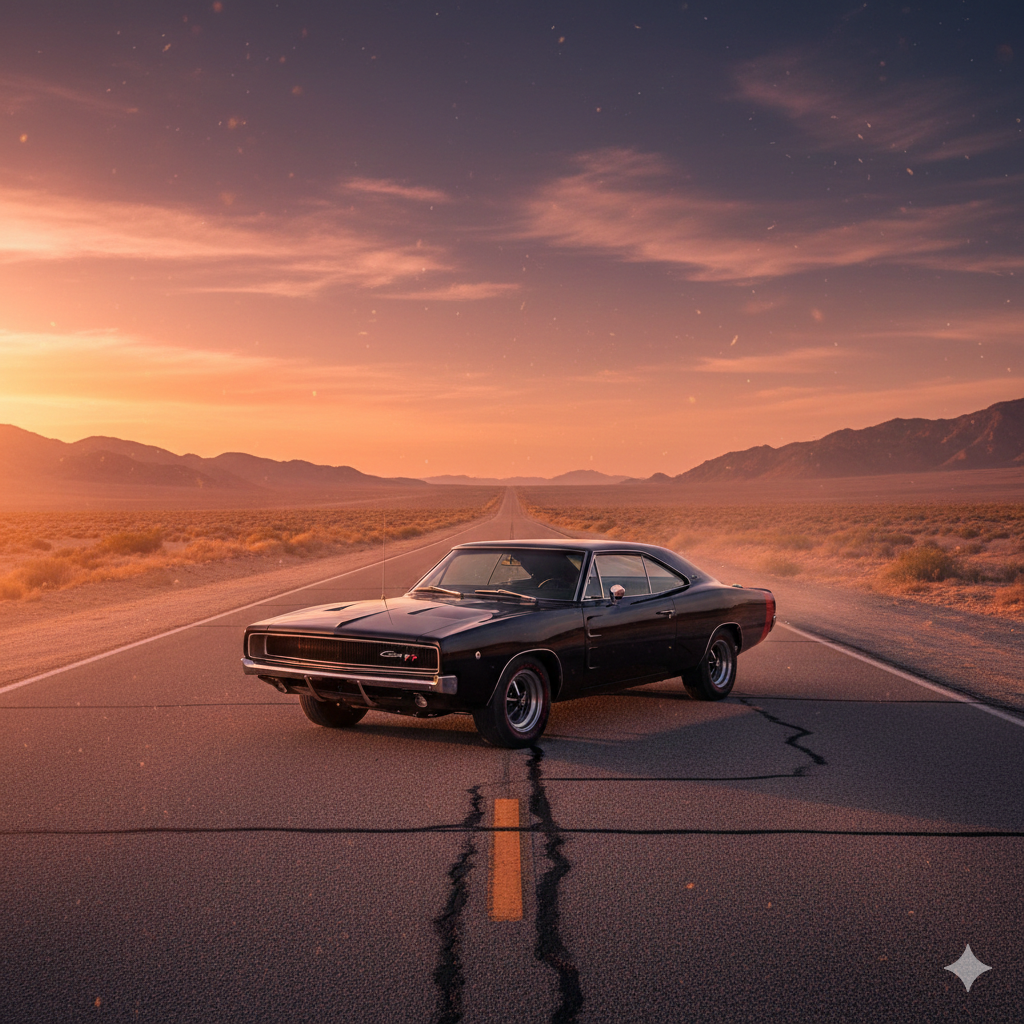
Muscle Cars: The Most Absurd Machines on Earth (And Why You Want One Anyway)

You don’t need it. It makes zero sense. But the second you twist that key, none of that matters.
I’m going to try to explain something that defies rational thought: why a massive, heavy, gas-guzzling boat—one that doesn’t brake, can’t corner, and is technically inferior to almost any European or Japanese sports car—exerts such a brutal magnetic pull.
The American Muscle Car is an absurdity on wheels. And that is exactly why it’s irresistible.
Why They Exist: Context is Everything
To understand the muscle car, you have to understand 1960s America.
- Gas was practically free. While Europe was rebuilding cities and paying for fuel like it was liquid gold, in the States, a gallon cost cents. Consumption wasn’t a problem; it was an afterthought.
- Infinite Highways. Eisenhower had built the Interstate system. Thousands of miles of straight asphalt where the only things that mattered were top speed and 0-60. Curves? What curves?
- Cheap Displacement. Detroit had been building massive V8s for full-size cruisers for decades. The tech was there, the tooling was ready, and producing a 427 (7.0L) cost nearly the same as a 302 (5.0L). So why not swap it into a “small” car?
- Marketing Warfare. Pontiac stuffed a big-block into the Tempest and called it the GTO. It sold like crazy. Chevy fired back with the Chevelle SS. Ford with the Mustang. Dodge with the Charger. Every year meant more horsepower, more cubes, more madness.
- The Quarter-Mile Culture. Drag racing was the national pastime. The only thing that mattered was those 1320 feet. Win on Sunday, sell on Monday.
The muscle car wasn’t born from sophisticated engineering. It was born from a unique storm: cheap energy, infinite space, and savage commercial competition.
What a Muscle Car IS NOT
Let’s be honest before we go any further:
- It is NOT a sports car. A ’69 Mustang weighs 3,300 lbs, has the suspension of a horse-drawn carriage, rear drum brakes, and steering with more play than a Tarantino flick. On a twisty backroad, a 90s GTI will humiliate it.
- It is NOT efficient. A 454 big-block with a 4-barrel carb will drink 8 to 12 mpg if you’re driving it the way it was meant to be driven. In the city? Forget about it.
- It is NOT practical. They are huge on the outside and tiny on the inside. The hood is six feet long, but nobody fits in the back. The trunk is massive, but the opening is awkward.
- It is NOT reliable (in the modern sense). American V8s are bulletproof and simple, sure. But 60s/70s manufacturing tolerances were what they were. Oil leaks, mediocre fit and finish, inconsistent materials. Don’t expect German precision.
- It is NOT refined. Noise, vibration, a shifter with a mile-long throw, a clutch heavy enough for a semi-truck, and steering that requires two hands to park. This isn’t a BMW.
If you judge a muscle car by European performance standards, it’s a bad car. Objectively bad.
What a Muscle Car IS
And now we get to the part you can’t explain with a spec sheet.
- It’s Presence. A ’68 Charger parked on any street in the world stops traffic. Kids, grandpas, people who don’t know a piston from a spark plug—everyone looks. There’s something in those proportions, that endless hood, and that aggressive stance that communicates without words.
- It’s the Sound. An American big-block V8 sounds like nothing else on earth. That rhythmic, loopy idle, that deep-chested roar when you step on it, that vibration you feel in your sternum. Europe has “sport exhausts.” This is something else. This is primal.
- It’s Raw Honesty. No electronic nannies. No traction control. No power steering (often). The car does exactly what you tell it to do—including killing you if you’re an idiot. That direct connection between your right foot and the rear tires is addictive.
- It’s Garage-Friendly. You pop the hood and you see the engine. All of it. With actual room to work. You can tune the carb with a screwdriver. You can swap plugs without tearing the car apart. You can understand how it works just by looking at it.
- It’s an Event. Starting a muscle car isn’t like starting a regular car. It’s a ritual. Pump the gas, turn the key, listen to the starter crank until it fires into life with a bark. Every time you start it, you feel like something important is happening.
The Evolution: Glory, Fall, and Resurrection
The Golden Era (1964-1971)
The ’64 GTO started the fire: Big engine, mid-size car, 348 HP for the price of a grocery getter. What followed was an arms race:
- 1966: Chevelle SS 396 (375 HP)
- 1967: Shelby GT500 (355 HP)
- 1968: Dodge Charger R/T 440 (375 HP)
- 1969: Camaro ZL1 (Officially 430 HP, likely over 500 real)
- 1970: Hemi ‘Cuda (425 HP), Chevelle SS 454 LS6 (450 HP)
The Crash (1972-1979)
Then came 1973. The Oil Crisis. Gas prices quadrupled. Insurance companies blacklisted young drivers. Emissions regs forced compression ratios down. The Corvette went from 435 HP in 1970 to a depressing 165 HP in 1975. The Mustang became the “Mustang II”—a Pinto-based humiliation.
The Dark Ages (1980-1986)
Depressing power figures, plastic interiors, and 4-cylinder “turbos” that blew up constantly. The low point? The 1980 Mustang Turbo with 132 HP.
The Fox Body Renaissance (1987-1993)
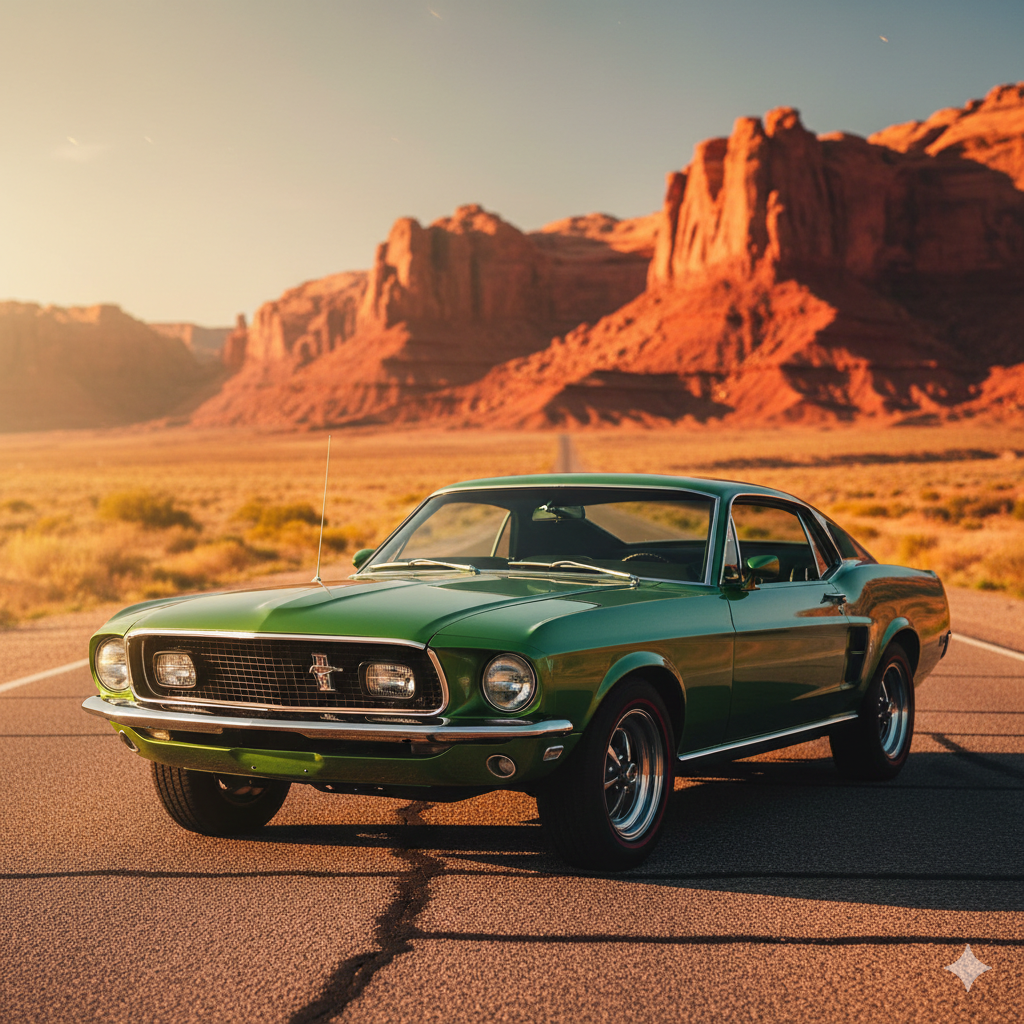
Ford was smart: they kept the 5.0L Windsor V8 alive while others gave up. The late 80s/early 90s 5.0 LX is the most underrated muscle car in history. It was light (2,900 lbs), cheap, and infinitely modifiable.
The Modern Era (2005-Present)
The 2005 S197 Mustang brought back the retro look. The Camaro returned in 2010. Dodge never stopped pushing the Challenger. Today’s muscle cars are objectively the best ever: 450+ HP, real brakes, real suspension. You can daily a 2023 Mustang GT without ruining your back.
But… What We Lost
Modern muscle cars are better cars, but they aren’t necessarily better muscle cars. They are too heavy (a modern Challenger is nearly 4,300 lbs), too refined (electric steering filters everything), and too perfect. Part of the charm of the classics was their imperfection. They demanded respect; they punished you for being sloppy.
The Real Market Truth
60s icons are overpriced. A ’67 Fastback that was $10k thirty years ago is now $80k. They are being bought as investments by people who never drive them.
The real steals are the 80s-90s “Rad Era” cars:
- Fox Body Mustang (87-93): $15k-$25k. Light, legendary, and easy to wrench on.
- IROC-Z Camaro (85-92): $12k-$22k. The 350 TPI is a great foundation.
- C4 Corvette (84-96): $15k-$30k. Real supercar performance for the price of a used Civic.
- 94-96 Impala SS: $15k-$25k. The ultimate sleeper with an LT1.
Final Thoughts
Muscle cars prove that cars aren’t just transportation. Logically, a Golf R is faster in the real world. An Miata is more fun in the canyons. A Corolla is more practical.
But none of those cars make you feel what you feel when a big-block V8 shakes your soul. That’s the magic: it turns rational adults into grinning idiots. And isn’t that exactly what a great car is supposed to do?
Not Enough Cylinders – Technical opinion with grit, not algorithms.
2 thoughts on “MUSCLE CARS”