
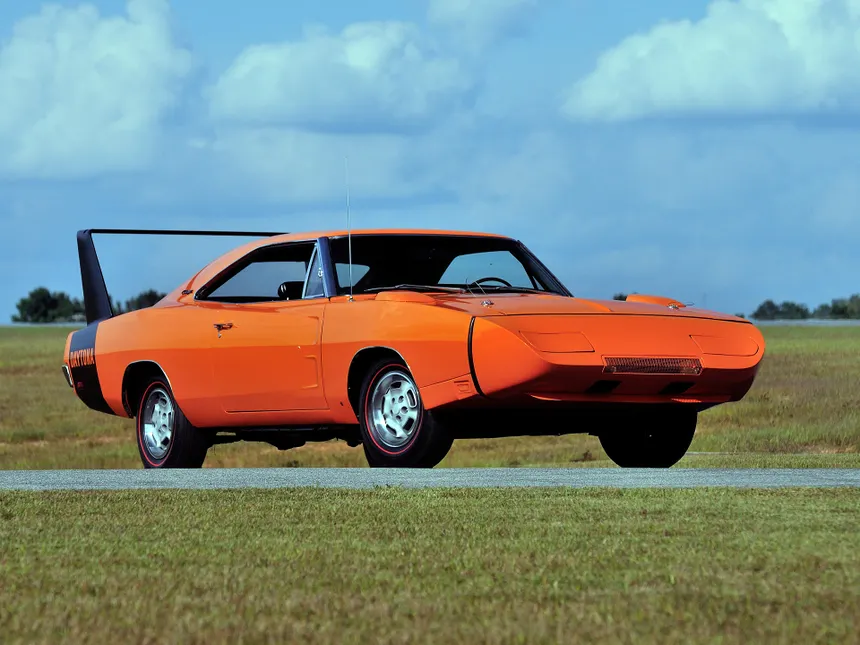
Dodge Charger Daytona: The Car That Was Too Fast for NASCAR and Had to Be Banned

When Engineering Took Racing Too Seriously
In 1969, Chrysler engineers had an obsession that bordered on pathological: dominate NASCAR so absolutely that Ford would consider abandoning competition entirely. They didn’t want to win races. They didn’t want championships. They wanted total humiliation, the kind of dominance that makes your competitor question their reason for existing.
The result of that obsession was the Dodge Charger Daytona, a missile with wheels that broke the 200 mph barrier on a NASCAR oval, a car so ridiculously effective that the organization had to change the rules specifically to stop it.
They didn’t ban it for safety. They didn’t ban it for cheating. They banned it because it won too much and competition had ceased to make sense.
This is the story of how a group of obsessed engineers created an aerodynamic monster the world wasn’t ready to accept, how it failed commercially in spectacular fashion, and how time proved them right by turning it into one of the most valuable muscle cars on the planet.
The Context: NASCAR’s Aero Wars in the 1960s
To understand the Charger Daytona, you need to understand the battlefield where it was born. By the late 1960s, NASCAR had become an involuntary aerodynamics laboratory. Manufacturers discovered that on superspeedways like Daytona and Talladega, where cars spent most of their time at speeds exceeding 180 mph, aerodynamics mattered more than raw power.
Ford had struck first with the Torino Talladega, a car with a sharper nose and modified roofline that dominated the straights. The standard 1969 Charger, despite its legendary Hemi engine, simply couldn’t compete. It was a beautiful car, with muscular lines and imposing presence, but aerodynamically it was the equivalent of pushing a brick with wheels against the wind.
Chrysler needed an answer, and they needed it fast. What their engineers proposed would have given any marketing executive a heart attack.

The Radical Solution: Making It Look Like a Spaceship
Chrysler’s engineers didn’t bother with subtlety or compromise. Their philosophy was simple: if aerodynamics is the problem, we’re going to solve it in the most extreme way possible, and the design department can deal with it.
The 18-Inch Pointed Nose Cone
The first modification was an 18-inch fiberglass front extension that transformed the Charger’s front end into something that looked like it came from a fighter jet. This piece, known as the “nose cone,” dramatically reduced the drag coefficient by directing air more efficiently around the car.
But it wasn’t just aesthetics. The design included an opening at the bottom that channeled air to the radiator, keeping the engine cooled even at speeds exceeding 200 mph. The original headlights were replaced by retractable units that were covered when closed, creating a completely smooth front surface.
The 23-Inch Rear Wing: Functional Madness
If the nose was radical, the rear wing was straight out of science fiction. A 23-inch-tall aluminum structure, mounted on two vertical supports, that rose above the car’s roof as if someone had glued an airplane wing to the trunk.
The height wasn’t arbitrary. Chrysler engineers discovered that airflow over the Charger’s roof created a turbulence zone that made any wing mounted at conventional height useless. The only solution was to raise the wing above that turbulent zone, where it could work with clean air.
The result was visually absurd. It looked like it was designed by an 8-year-old who had just watched their first science fiction movie and had unlimited access to aluminum parts. But it worked devastatingly well: it generated enough downforce to keep the rear planted at speeds where other cars started to float.
The Rear Window and Other Obsessive Details
The engineers didn’t stop at the obvious modifications. The rear window was replaced by a more inclined piece that improved airflow to the wing. Wheel well openings were modified to reduce turbulence. Every surface was analyzed looking for ways to reduce drag.
The final result had a drag coefficient of approximately 0.28, extraordinary for the era and competitive even by modern standards. The standard Charger had a Cd close to 0.50. The difference was abysmal.
The Monster’s Specifications: Numbers That Competed with Supercars
The Charger Daytona wasn’t just aerodynamics. Underneath that science fiction bodywork was serious mechanicals:
| Element | Specification |
|---|---|
| Base engine | 440 Magnum V8 (375 hp / 480 lb-ft) |
| Optional engine | 426 Hemi V8 (425 hp / 490 lb-ft) |
| Transmission | 4-speed manual or TorqueFlite automatic |
| Top speed | 200+ mph (320+ km/h) |
| 0-60 mph | 5.3 seconds (Hemi version) |
| Overall length | 222 inches (5.64 meters) |
| Wing height | 23 inches above trunk |
| Curb weight | 3,800 lbs (1,724 kg) |
| Units produced | 503 |
The 426 Hemi engine was a masterpiece of American engineering. Two oversized valves per cylinder, hemispherical combustion chambers that gave the engine its name, and a revving capability that surpassed most of its contemporaries. In racing configuration, the Hemi could produce over 600 hp with relatively simple modifications.
NASCAR 1969-1970: Total Victory and Inevitable Exile
The Season of Dominance
The Charger Daytona debuted in the 1969 NASCAR season and the effect was immediate. In its first race at Talladega, the Daytona showed a speed advantage that made the competition look like they were racing in a different category.
Ford drivers, who had dominated with the Talladega, suddenly found themselves struggling to stay in contact. The Daytona was simply faster on the straights, and on superspeedways, the straights are everything that matters.
The 1970 season was even more dominant when Plymouth introduced the Superbird, basically the same aerodynamic package applied to the Plymouth Road Runner. Between the Daytona and the Superbird, Chrysler’s “aero cars” won 38 of the 48 races that season.
The 200 MPH Record
On March 24, 1970, Buddy Baker wrote his name in motorsport history. Piloting a Dodge Charger Daytona with a Hemi engine at Talladega Superspeedway, Baker completed a lap at over 200 mph (322 km/h).
It was the first time in history that a modified production car broke that barrier on a closed circuit. The record was a defining moment, but it was also the death sentence for the aero cars.
NASCAR’s Banhammer: Changing the Rules
NASCAR had a problem. Chrysler’s aero cars were so superior that races had stopped being competitive. Ford and other manufacturer teams threatened to withdraw if something wasn’t done.
NASCAR’s solution was elegant in its brutality: for the 1971 season, “aero” cars (defined as those with significant aerodynamic modifications) would be limited to maximum 305 cubic inch engines (5.0 liters), while conventional cars could use engines up to 430 cubic inches (7.0 liters).
The message was clear: you can race with your aero cars, but with engines that produce half the power. It was a ban disguised as a technical regulation.
Chrysler did the math and reached the obvious conclusion: it made no sense to compete with one hand tied behind their back. The aero car program was abandoned immediately.
The Problem of Selling Them: Too Radical for America
Here comes the most brutal irony in the entire Charger Daytona story: NASCAR required producing 500 units for homologation, but the American public didn’t want to buy the car.
A Normal Charger Was What Everyone Wanted
In 1969, the Dodge Charger was one of America’s most desired muscle cars. Its aggressive lines, imposing presence, and performance reputation made it the car young Americans dreamed of owning.
The Daytona was another story. With its spaceship nose and nearly 23-inch-tall wing, the car was considered ugly, impractical, and frankly ridiculous by the average buyer. How were you supposed to park that thing? How were you supposed to fit it in a garage with that wing?
Desperate Dealers
Dodge dealers found themselves with an unexpected problem: they had Daytonas on their lots that nobody wanted to buy. The premium over a standard Charger was significant, and customers didn’t see the value in paying more for a car they considered ugly.
Some solutions were creative. Several dealers offered reverse conversions: they would buy the Daytona and remove the aerodynamic kit, converting it back into a conventional-looking Charger so they could sell it.
Others simply applied massive discounts. Cars that are worth fortunes today were sold below list price because nobody wanted them.
The Most Advanced Car of Its Era Was a Commercial Failure
It’s hard to overstate how ironic the situation was. Chrysler had created the most aerodynamically advanced production car of its era, a vehicle capable of speeds other manufacturers could only dream of, and the public rejected it because they didn’t like how it looked.
The Daytona proved an uncomfortable truth about the automobile market: function doesn’t always sell. Form matters, sometimes more than performance.
Current Value: When Time Proves You Right
The Revenge of the Misunderstood
Fast forward five decades and the Dodge Charger Daytona has become one of the most valuable and sought-after muscle cars in the world. The same cars dealers couldn’t give away now command prices that rival classic Ferraris and Lamborghinis.
A Charger Daytona in good condition with the 440 engine can easily exceed $300,000 at auction. Exceptional examples with complete documentation and low mileage have surpassed $500,000.
But the real prize is the Hemi-powered Daytonas. Of the 503 units produced, only 70 carried the legendary 426 Hemi. These cars are the holy grails of American muscle car collecting.
In 2023, a perfectly restored Charger Daytona Hemi with complete documentation sold for over $900,000. Other exceptional examples have approached the million-dollar mark.
Why Values Have Exploded
Several factors explain the Daytona’s astronomical appreciation:
Extremely limited production: 503 units is nothing in automotive production terms. Compare with the thousands of Mustangs, Camaros, and standard Chargers produced every year.
Indisputable historical significance: The Daytona was the first production car to exceed 200 mph. That record is engraved in motorsport history.
Unique and unrepeatable design: Nothing looks like the Daytona. It’s immediately recognizable and absolutely distinctive.
Redemption story: The narrative of the rejected car that becomes legend adds emotional value that transcends technical specifications.
Muscle car culture: The Daytona represents the pinnacle of America’s golden muscle car era, a moment that will never be repeated due to emissions and safety regulations.
The Twin Brother: Plymouth Superbird
No Daytona story would be complete without mentioning the Plymouth Superbird, basically the same concept applied to the Plymouth Road Runner.
The Superbird arrived in 1970 with the same extreme aerodynamic modifications: extended nose, giant wing, and all the airflow modifications. The main difference was cosmetic: the Superbird used Plymouth Fury fenders to accommodate the nose, giving it a slightly different appearance.
Plymouth produced 1,920 Superbirds, significantly more than the 503 Daytonas, which explains why Daytonas are generally more valuable. However, Hemi-powered Superbirds (135 units) also command astronomical prices.
Together, the Daytona and Superbird represent the pinnacle of American aerodynamic madness, a moment when manufacturers decided that winning was more important than common sense.
The Legacy: When Winning Was Literally Everything
The Dodge Charger Daytona represents a unique and unrepeatable moment in automotive history. It was the result of a philosophy that would be unthinkable today: build a car whose only purpose was to win races, regardless of how absurd it looked or how impractical it was for street use.
Chrysler’s engineers weren’t thinking about focus groups or market trends. They were thinking about how to make a car faster than anything else on the track. The result was technically brilliant and commercially disastrous.
But time has proven them right. The Daytona wasn’t ugly; it was the future. The aerodynamic shapes that seemed ridiculous in 1969 became the norm decades later. The rear wings that provoked laughter now adorn every racing car on the planet.
The Dodge Charger Daytona was a car ahead of its time, misunderstood by its contemporaries and vindicated by history. They had to ban it because it was too good.
That’s a legacy no conventional design can match.
Is the Daytona art or unfiltered engineering? Does it justify its million-dollar price or is it pure collector speculation? Leave us your opinion in the comments.
Article published on Not Enough Cylinders – The blog where gasoline and strong opinions flow equally.