
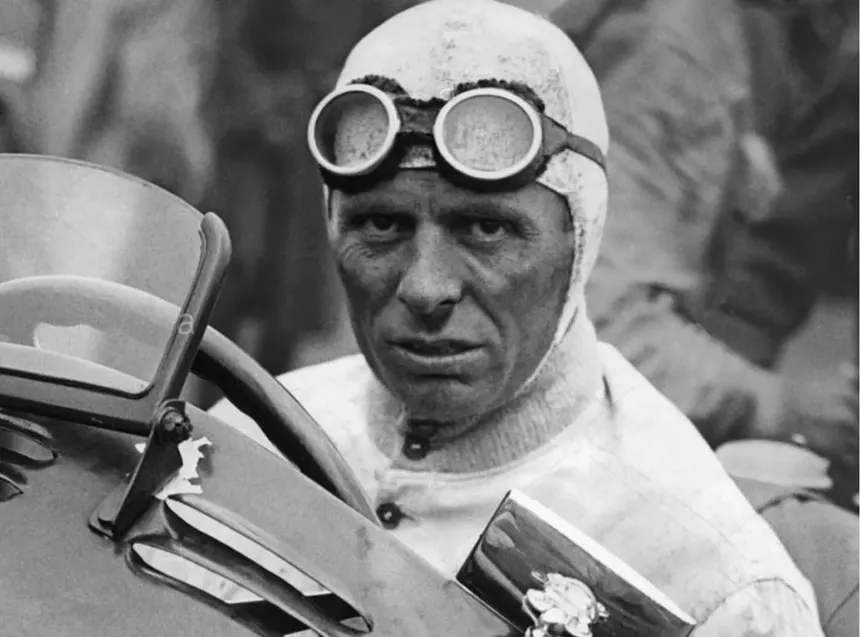
Achille Varzi: The Anti-Nuvolari, the Morphine, and the Helmet He Wasn’t Wearing
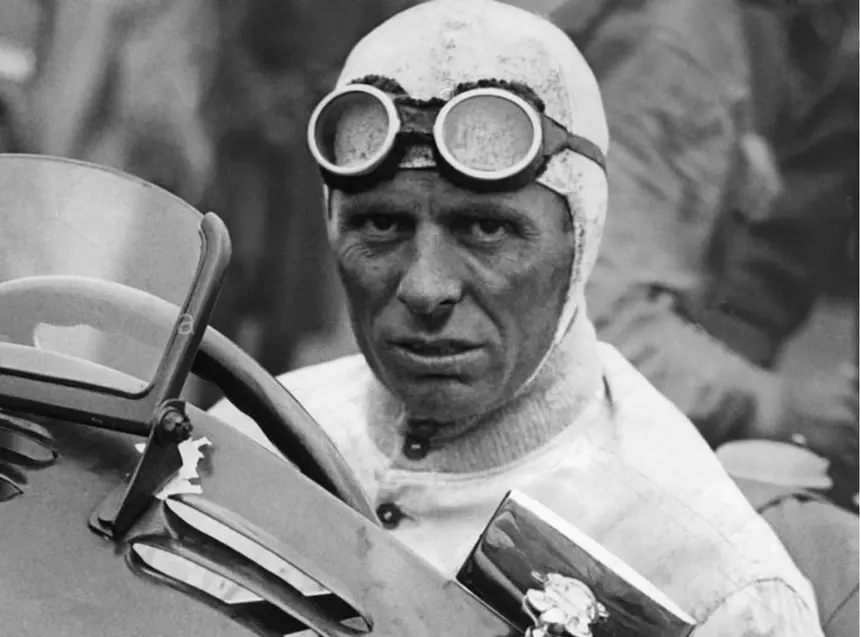
Drop Tazio Nuvolari and Achille Varzi into the same room and the only thing they share is the language they speak. Everything else divides them.
Nuvolari came from a Lombard farm, the son of a cyclist. Varzi came from a Piedmontese textile factory, the son of the owner. Nuvolari raced in a canary-yellow short-sleeved shirt with his initials embroidered in white, light blue trousers, and a gold tortoise round his neck given to him by the poet D’Annunzio as a talisman against bad luck. Varzi raced in immaculately pressed white linen overalls (courtesy of the family mill), with a cigarette permanently glued to his lip, and no amulet of any kind, because cold calculation was his only superstition. Nuvolari drove on the edge of grip, losing the car and snatching it back through instinct and wrist muscle. Varzi drove without ever losing the car, calculating every metre the way an accountant calculates a quarterly statement. Nuvolari survived a full decade of brutal accidents and died in bed at sixty. Varzi had two serious accidents in his entire career, and the second one, in Bremgarten in 1948, killed him on the spot.
And yet, through the 1930s, those two Italians were the two most important Grand Prix drivers in the world, and their rivalry was the Ayrton Senna versus Alain Prost of the pre-war years, played out half a century before anyone in Brazil or France had picked up a steering wheel. Twelve years separated them by age. Dozens of Grands Prix pitted them against each other. And when Varzi died in 1948, Nuvolari, who would still outlive him by five years, said he missed all the rivals he’d ever had, but he missed Varzi the most.
This is the story of the other great one. The driver Juan Manuel Fangio — future five-time World Champion — publicly named as his personal role model. The driver Enzo Ferrari described with one of the sharpest sentences he ever wrote about a competitor: “Intelligent, grim when necessary, ferocious in exploiting the first weakness, mistake or mishap of his adversaries.” And the driver who, for two years at the end of the 1930s, vanished into morphine addiction so thoroughly that he disappeared from the paddock altogether, before staging one of the most improbable personal recoveries in motorsport history, only to die in a Swiss forest corner without the helmet that the FIA — thanks specifically to his death — would make mandatory for every driver from that point onwards.
Galliate, August 1904
Achille Varzi was born on 8 August 1904 in Galliate, a town in the province of Novara, in Piedmont, about fifty kilometres west of Milan. The date and place set up the first distance from Nuvolari straight away. Galliate was not an agricultural village. Galliate was an industrial textile town. Achille’s father, Menotti Varzi, owned a prosperous cotton mill, one of the mid-sized family industrial firms that propped up the pre-war Piedmontese economy. The Varzi household did not smell of soil or livestock. It smelled of spun cotton, pressed linen, and steam-driven textile machinery. Achille grew up surrounded by fabrics, industrial looms, skilled mill operatives and annual accounts. Order, industrial discipline, and an eye for physical precision were his primary schooling.
The aesthetic rivalry with Nuvolari started in the cradle without either of them knowing it. When Varzi later insisted on racing in immaculately pressed white linen overalls, it wasn’t affectation. It was industrial DNA: the textile-mill scion publicly modelling the product of the family business.
At the age of fifteen he began racing motorcycles. His father, rather than forbidding it, bought him his first bike and encouraged him. Achille had clear mechanical aptitude from the start. He moved through a roll-call of marques any British rider of the era will know: Garelli, DOT, Moto Guzzi, and Sunbeam. He rode in the Isle of Man TT seven times from 1924 onwards, a figure few Italians of his generation can match. And here, on the international motorcycle racing circuit of the mid-1920s, he first crossed paths with a 12-year-older Lombard veteran called Tazio Nuvolari. Two competitors in the same paddock, on similar machinery at times, with diametrically opposed styles. The rivalry began before either of them switched to four wheels.
The switch to cars, 1928
In 1928, aged 24, Varzi moved to cars. His first racing car was a Bugatti Type 35, the most successful French Grand Prix car of the decade and the natural entry vehicle for any driver whose family had money. But Varzi switched quickly. By 1929 he was driving an Alfa Romeo, and that season he started accumulating victories in the Italian calendar. The 1929 season established him as one of the most serious rookies in the Italian paddock.
1930 was his first major year. He won the Targa Florio, one of the two most prestigious classics on the Italian calendar. And he fought wheel-to-wheel with Nuvolari for victory in the Mille Miglia, losing it in the closing kilometres when the Lombard overtook him with one of those last-corner moves only Nuvolari could pull off. That lost Mille Miglia in 1930 was probably the moment the rivalry shifted into something far more serious. Varzi had been fastest for 90% of the race. Nuvolari took the win in the final 10%, on pure instinct. Any driver with a racing-grade ego would have been wounded. Varzi processed it his way: quietly, coldly, planning the rematch.
The rivalry: two faces of Italian racing
The stylistic opposition between Varzi and Nuvolari is one of the most-discussed subjects in pre-war motoring journalism. There are dozens of articles, books and chronicles that compare them. The synthesis is relatively clean: Nuvolari won at the rhythm of his pulse. Varzi won at the rhythm of his head. Nuvolari never spared the car. Varzi always spared it. Nuvolari finished every race with the engine smoking and the brake pads gone. Varzi finished every race with the car essentially ready to go out again the next day.
To understand the Varzi style you need a workshop-floor phrase that you learn only by spending years on the assembly bench: don’t break the component before the component needs to break. Varzi drove with the mechanical knowledge of a factory-owner’s son. He knew where the supercharger’s limit was. He knew the clutch’s limit. He knew the suspension’s limit and the tyres’ limit. And he stayed one millimetre below it all the way round the lap. Nuvolari, in contrast, would step on the limit and sometimes cross it. Both methods work. The difference is statistical. Nuvolari had brutal accidents almost every year. Varzi had only two serious accidents in his entire career, according to his own biographers. The second one killed him.
The rivalry was lived out like Senna-Prost half a century in advance. Wheel-to-wheel races. Italian newspapers selling tens of thousands of copies on the weeks the two coincided on track. Mille Miglia 1930 to Nuvolari. Monaco 1933 to Varzi, in a race where the two of them swapped the lead several times before the Piedmontese took the closing laps. Targa Florio: two wins each. Mille Miglia: two to Nuvolari, one to Varzi. 24 Grands Prix won by Nuvolari, 17 by Varzi.
The traitor who came back, then jumped to Auto Union
At the end of 1931 Varzi did something controversial: he left Alfa Romeo and signed for Bugatti. The Italian press called him a traditore, “traitor”, and in Mussolini’s Italy of the early 1930s that wasn’t trivial branding. But Varzi was cold and businesslike. When Bugatti offered him a better car and a bigger contract, he took it. Three years later, when Jano’s Alfa P3s were once again dominating the European calendar, Varzi came back to Alfa. No public apology. No gesture of regret. Just numbers and a rational call. He took his second Italian Championship during that phase. He kept winning.
Then in 1935 the big move happened. After Nuvolari’s reconciliation with Ferrari (covered in the previous article in this series), Tazio went back to Alfa Corse. Varzi understood that the Italian paddock wasn’t going to be big enough for both egos. He signed for Auto Union, the German outfit that was revolutionising Grand Prix racing with its mid-engined V16 single-seater designed by Ferdinand Porsche.
The technical decision is what matters here. Auto Union Type B: 5-litre V16, mounted behind the driver. A radically different architecture from anything Varzi had driven before. Most veteran drivers of the time hated the car: it was brutally hard to dominate, with a rear-biased balance that produced violent oversteer if you entered a corner badly. Varzi adapted in a matter of weeks. In his very first Grand Prix for Auto Union, the 1935 Tunis GP, he won. Unprecedented. In August, at the Pescara Coppa Acerbo, he won again.
That is what Varzi’s biographer calls “quick reflexes and a delicate touch”. Any mechanic who has worked on a mid-engined car knows you can’t drive it with the same aggression as a front-engined one. It demands a different acceleration geometry, a different braking technique, a different cornering line. Varzi understood that within weeks. That is genuine talent of the deepest kind.
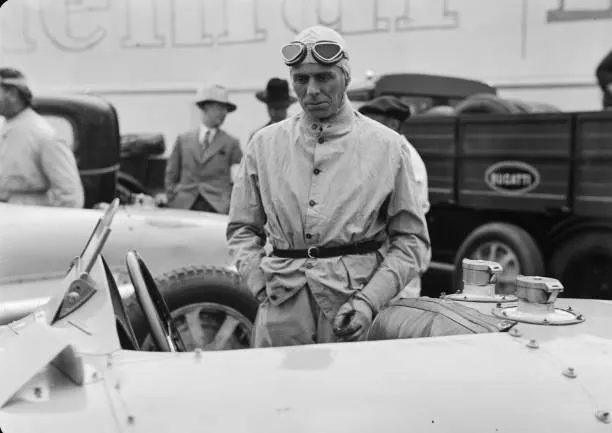
Tripoli 1936: the poisoned victory and the arrival of Ilse
On 10 May 1936, Varzi won the Tripoli Grand Prix, one of the Italian colonial African calendar events. He set a lap record of nearly 142 mph (228 km/h average), a historic figure for 1936. And here begins the episode that would destroy him.
The Tripoli victory was tainted by political interference inside Auto Union. The team had ordered its other works drivers (Bernd Rosemeyer, Hans Stuck, Rudolf Caracciola) to brake deliberately to let Varzi win. The reason: Varzi had a better relationship with the Auto Union management, and the team wanted to compensate him for an internal decision that had hurt him in an earlier race. Varzi, a proud man obsessed with clean competition, felt humiliated by a victory he knew had been gifted. That night in Tripoli, according to his biographers, he couldn’t sleep.
And that night, Ilse Pietsch appeared. The wife of Paul Pietsch, another driver in the German paddock. Ilse was a charismatic, beautiful, troubled woman. She was addicted to morphine. That early-morning, in the Tripoli hotel, Ilse Pietsch offered Varzi his first dose. To combat the insomnia, she said. To “calm the nerves” after a victory the driver felt was dirty. Varzi accepted.
The painkiller he took that night became his daily drug for the rest of the 1930s.
The addiction: 1936-1939, the lost years
What happened next is one of the darker stories of pre-war Grand Prix racing, and modern accounts often tell it with a certain cheap morbidity. I prefer to tell it dry. Varzi, a man obsessed with order and control, became morphine-dependent within months. He started meeting Ilse at hotels. They began an open affair that scandalised the German paddock. Paul Pietsch, the husband, knew about it and didn’t accept it well. Internal tension at Auto Union became impossible to sustain.
Varzi’s reflexes, previously legendary for their precision, started to slow down. In Tunis 1936, only a few weeks after Tripoli, he had a serious accident from which he walked away by sheer luck. That escape was probably the last time his luck functioned the way it had always done. He won nothing else in 1936. In 1937, he was absent from most of the European calendar. Auto Union gave him second and third chances, fascinated by his talent, but at the end of 1938 they formally fired him. He was unrecoverable as a working professional driver.
At 34 years old, Achille Varzi was finished. Holed up in a Milan hotel room for months, with the addiction and with Ilse alternating between presence and absence. The driver who had won Tripoli at 228 km/h average, who had beaten Nuvolari at Monaco, who had taught himself an Auto Union in fifteen days, could not hold a coffee cup without his hand trembling.
The war and the silent recovery
The Second World War arrived as a forced full stop for the entire European motorsport. Varzi withdrew from the paddock by simple force of historical events. And here something happened that almost no English-language account tells properly. During the war years, far from the social cocaine of the paddock and far from Ilse Pietsch, Varzi overcame the morphine addiction. There is no detailed public testimony of how. But the biographical sources agree: by 1944-1945, Varzi was clean. He had married Norma Colombo, an Italian woman who supported him in silence throughout the rehabilitation. And when the war ended and European motorsport began to reopen in 1946, Varzi was 42 years old and clearly determined to come back.
That recovery, viewed from the workshop floor, is the most impressive thing in his entire biography. Beating an opioid addiction in 1942 with no modern medical therapy, no support groups, no methadone, nothing more than willpower and a wife who held on. In the 1940s. With no clinical literature on the subject. That is, in modern medical terms, nearly supernatural.
The comeback, Argentina, and Fangio
In 1946 Varzi returned to racing. He tried Indianapolis 500 with a Maserati but failed to qualify. In 1947 he won three minor Grands Prix in Italy and Europe, and travelled to Argentina to race in the Buenos Aires Grand Prix. There he met a young Argentine called Juan Manuel Fangio who was just starting his European career. Fangio was utterly impressed. Years later, by then a five-time World Champion, Fangio publicly declared that Varzi had been his personal role model as a driver. Not Nuvolari, whom he also admired, but Varzi, for the cold calculation and the technical precision. Fangio’s style of the 1950s — managing the car, never throwing it around, finishing races at the lowest possible pace required to win — was much more Varzi than Nuvolari. That direct filiation is one of the most important symbolic bridges in the entire history of Italian Grand Prix racing.
In 1947 Varzi also signed for the reborn Alfa Corse for the 1948 season, in the Alfa Romeo 158 Alfetta, the dominant post-war Grand Prix single-seater. The 158 was in the middle of a five-year unbeaten run in major events. Varzi, at 43, looked as if he were about to close a full comeback.
The Mantua Circuit, June 1948
There’s a moment before the death that needs telling because of its symbolic weight. On 13 June 1948, the Mantua Street Circuit race was run, an urban Grand Prix-style event organised in memory of Tazio Nuvolari’s two sons, Giorgio and Alberto, who had died within the previous decade (covered in the Nuvolari article). Nuvolari, by then with his health destroyed after decades of inhaled exhaust gases, raced in his own city in front of tens of thousands of his fellow citizens. Varzi attended as a guest of honour and entered the race.
Before the start, Nuvolari and Varzi crossed paths in the paddock. The two fiercest rivals of the previous decade, both now entering their racing twilight, both with lives shaped by personal loss (Nuvolari his sons, Varzi his addiction). They stopped, looked at each other for a moment, and embraced in silence. The sources agree that it was one of those moments when two men know they are at the end of something and don’t need to say anything. Three weeks later, Varzi was dead.
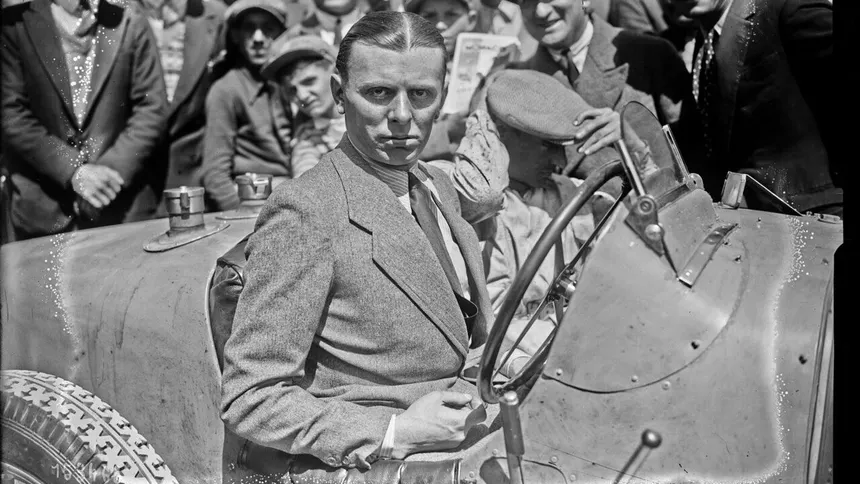
1 July 1948, Bremgarten
The 1948 Swiss Grand Prix was being held at the Bremgarten Circuit, on the outskirts of Bern. A seven-kilometre forest road track, fast, technically brutal in the wet. On 1 July, practice day, a light rain had wetted the track surface in the morning. The sun was beginning to dry it but dark patches remained where the asphalt was still slippery. Some of them, additionally, marked by oil stains.
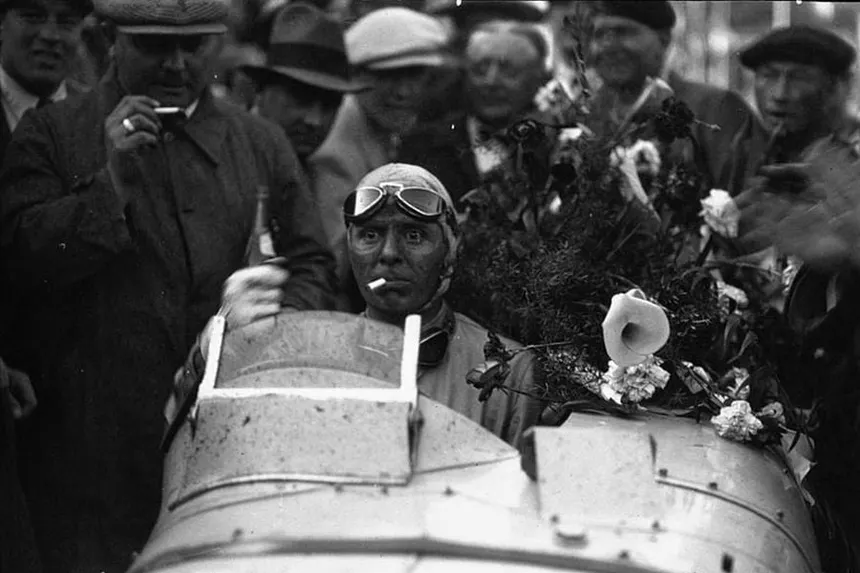
Varzi went out around midday in his Alfa Romeo 158. He was dressed in his immaculate linen overalls, with his cigarette in his mouth, and without a protective helmet. In 1948, crash helmets were not mandatory in Grand Prix racing. Most drivers wore a simple linen or thin-leather cap, with no real impact-absorbing function. Varzi was one of the linen-cap preferrers. No amulets, no grease, nothing weighing on the head. Just pressed white linen.
He arrived at the Jordenrampe corner at approximately 110 mph (177 km/h). The corner was fast but well known to him. Varzi had driven through it dozens of times. But on that particular second of that particular lap, the Alfa slid on a wet oil patch. The car spun several times. The accounts agree that it was almost stationary when, on the last rotation, it tipped backwards and crushed the driver under the chassis. Varzi died on the spot. The linen “helmet” absorbed nothing. The tubular frame of the 158 broke his cervical spine and several ribs.
He was 43.
The helmet that was no longer optional
Varzi’s death had an immediate regulatory consequence. Three months later, the FIA made impact-rated crash helmets mandatory at every Grand Prix event on the international calendar. Until that moment, helmets had been optional. The vast majority of drivers used the linen cap or soft-leather equivalent, with no structural function. Varzi died because of the absence of a rigid helmet that would probably have saved his life in his specific accident. The biographers agree: a modern helmet, even a basic 1948 one, would probably have left him alive under the car, seriously injured but recoverable.
That’s the second great regulatory legacy of Varzi, after the first, which was not regulatory but technical: demonstrating that a driver could pilot a radically new mid-engined Grand Prix car within weeks. A technical contribution in life, a safety contribution after death. No other Italian pre-war driver left two such concrete legacies.
What the great ones said
Enzo Ferrari, whose judgements on rivals were rarely generous, wrote of Varzi: “Intelligent, grim when necessary, ferocious in exploiting the first weakness, mistake or mishap of his adversaries.” Coming from Ferrari, that is an unqualified statement of technical respect.
Juan Manuel Fangio, future five-time World Champion, said Varzi had been his model as a driver. To understand the dimension: Fangio could have named Nuvolari (more famous, more legendary), Caracciola (multiple European champion), Rosemeyer (the young idol). He named Varzi. For the precision, for the cold calculation, for the perfect management of the car. The Fangio style of the 1950s is the Varzi style of the 1930s transposed into a different technical context.
Tazio Nuvolari, who survived Varzi by five years, said the line that opens this article: “I miss them all, but I miss Varzi the most.” That was said by the man who had lost Antonio Ascari in 1925, Sivocci in 1923, Bernd Rosemeyer in 1938, and his own two sons in 1937 and 1946. And even so, the one he missed most was Varzi. The rival. That kind of sentiment is something only racing drivers fully understand.
What I take from Varzi when I get back to the workshop floor
There’s something you learn over the years on the assembly bench, and it is that both ways of doing engineering well are valid. The instinctive way of the person who walks into the engine, listens to it, feels it, and diagnoses through accumulated perception. And the methodical way of the person who measures everything, catalogues it, writes it down, and diagnoses through system. Both methods can reach the same diagnosis. Both can fit the same component correctly. Both have their racing-driver equivalents: Nuvolari is the instinctive method, Varzi is the methodical method.
The difference is that the method can be taught. The instinct can’t. That is why Fangio, who needed to systematise what he was doing in order to compete in an era of increasingly complex cars, chose Varzi as his model. Because the Varzi model was replicable. The Nuvolari model was unrepeatable.
And yet both of them died before the other: Varzi on track at 43, Nuvolari in bed at 60. The cautious driver lost the bet first. The reckless driver lost it second. That tells you everything you need to know about the false security of methodology when the external variable is an oil patch on a wet Swiss forest corner. No system survives what doesn’t enter the system. Varzi knew the Jordenrampe corner perfectly. He knew the Alfa 158 perfectly. He knew the effect of water on asphalt perfectly. He didn’t know about the oil stain that happened to be on his exact line that morning.
The lesson, looked at from the workshop floor a century later, is this. The cautious driver remains cautious only until the variable he didn’t control appears. And then, without the instinct safety net that Nuvolari had to react to the unexpected, the cautious one gets killed. Varzi died because reality introduced a variable his method didn’t contemplate. Not from arrogance. Not from excess. From an oil patch nobody had seen.
That is what they carried to the Galliate cemetery in Piedmont where he is buried. And that is what the FIA, without quite knowing it, tried to protect against three months later when it made the helmet mandatory. Protecting the method from the variables the method does not contemplate.
When you see a modern Formula 1 driver climb out of the pit lane today, with his fireproof suit, his HANS device, his composite helmet and his personalised seat insert, what you are looking at is the regulatory inheritance of Achille Varzi. A man so obsessively methodical that he wouldn’t even wear a rigid leather skullcap, because it broke the line of his pressed linen overalls. A man so methodical that his method itself included not wearing the only thing that would have saved his life.
Check you’re still alive.