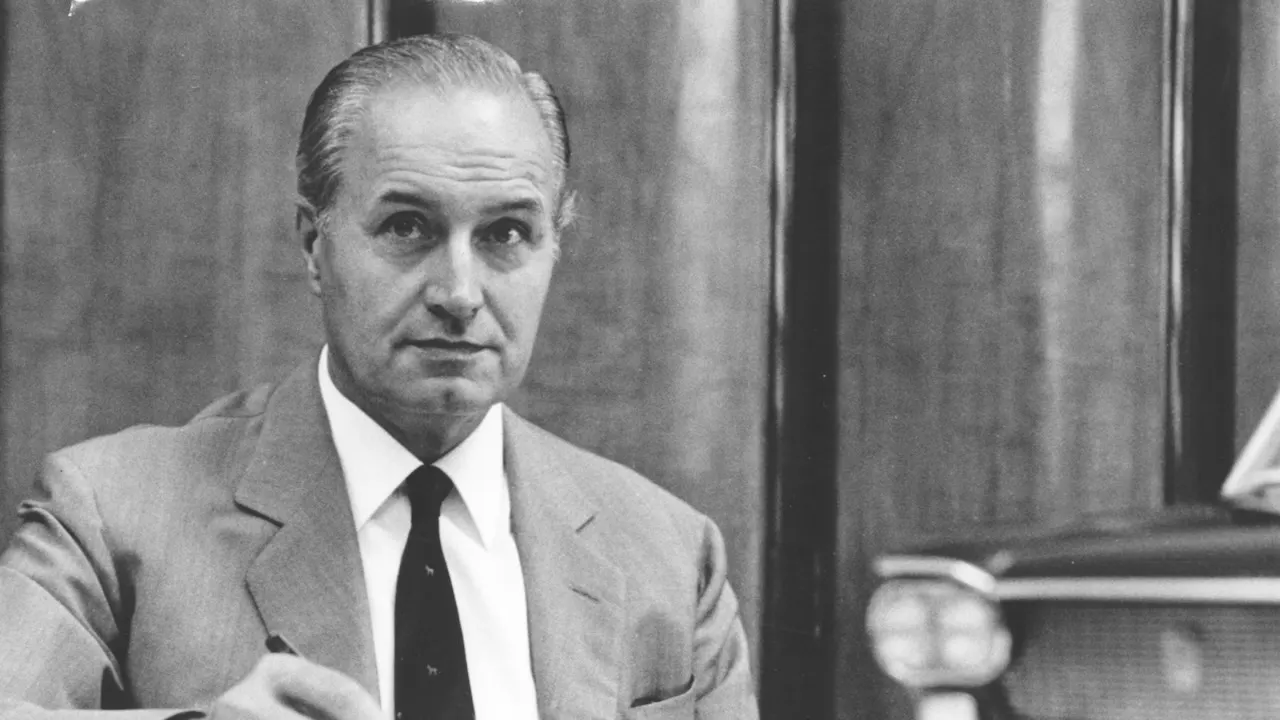
Dante Giacosa: the man who fit Italy inside a three-metre car
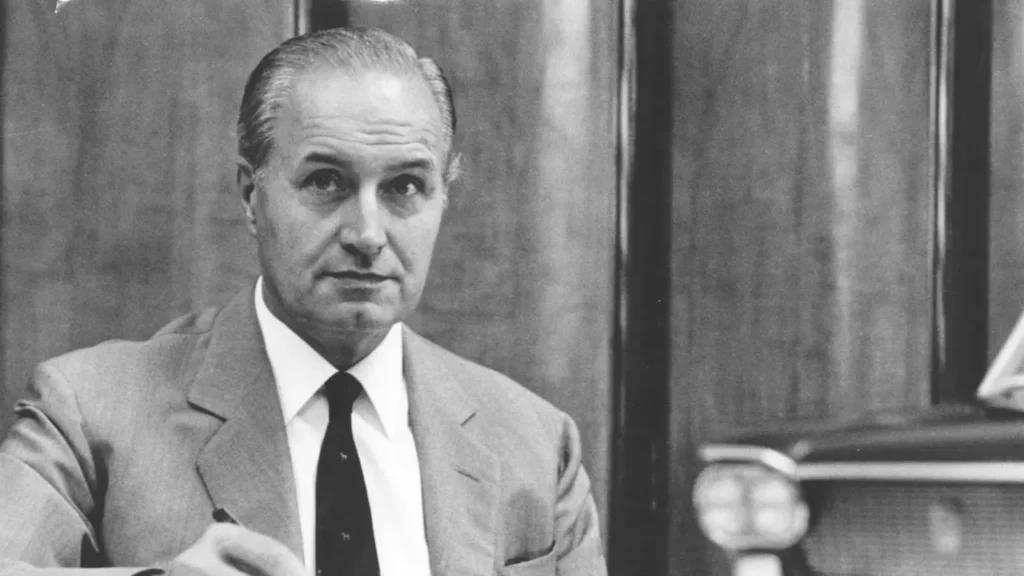
Someone at Top Gear should have made a documentary about him. Someone at Netflix. Someone at Amazon. Someone at any of the outlets that pumped out hagiographies of Alec Issigonis (the Mini) or Ferdinand Porsche (the Beetle) in the last twenty years. Because the third name in that list of great postwar small-car engineers — arguably the biggest of the three by industrial reach and technical output — never got the same treatment. He was Italian, he stayed inside Fiat for 47 years, he never courted publicity, and he wrote his memoirs in a language most English-speaking journalists never bothered to read.
His name was Dante Giacosa. And the front-wheel-drive, transverse-engine architecture in the car you drove to work this morning was invented by him.
Born by accident in Rome, 3 January 1905
Dante Giacosa was born in Rome only because his father, Costantino, was doing his compulsory military service in the capital at the time. The family came from Neive, a small hill town in southern Piedmont — wine country, quiet, agricultural, sensible. As soon as the military service ended, the family went home. Dante grew up in Alba. He did the studi classici — Latin, Greek, philosophy, literature — and years later would say that this humanist grounding gave him “a sense of measure and balance without which I could never have done my work”. An engineer who quoted Virgil wasn’t common. Then or now.
In November 1922, aged 17, he enrolled at the Politecnico di Torino in Mechanical Engineering. He graduated on 22 November 1927, aged 22. The following year, in 1928, he answered a newspaper advertisement: Fiat was looking for a design draughtsman. He got the job. Starting salary: 600 lire a month. Context: a skilled worker at Mirafiori was earning around 350-400 lire at the time. Giacosa walked into his first job at qualified-technician wages.
And here comes the first fact that gets forgotten: he started in the aviation department. Not in cars. Under Tranquillo Zerbi, the engineer who had designed Fiat’s winning Grand Prix cars of the 1920s. Giacosa spent his first years at Fiat drawing aircraft engines. That’s what gave him the subtraction mindset, the minimum-weight discipline, the obsession with reliability. An aircraft engine that fails kills people. A car engine that fails annoys people. Giacosa learned his craft thinking about not killing anyone. That discipline stayed with him for the rest of his career.
In 1933, aged 28, he was made head of the Ufficio Tecnico Vetture — Vehicle Technical Office. That same year he married Laura Gherzi-Paruzza. That same year he got his first major brief: a small popular Fiat. The Zero A. From that project would emerge, three years later, the Topolino.
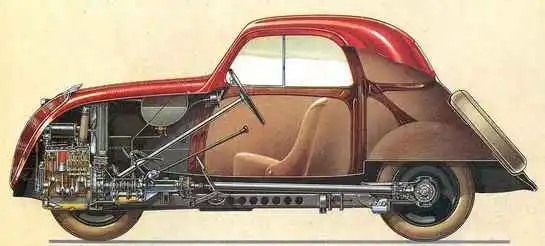
Topolino, 1936: the first car he signed
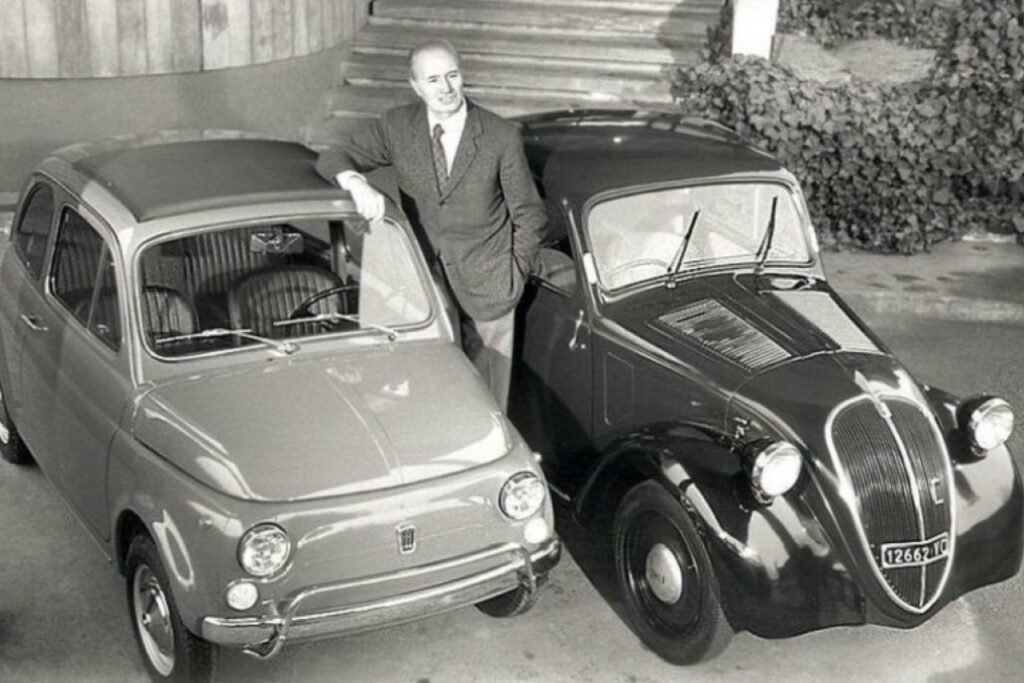
We’ve already covered the Topolino in its own piece. Just the summary for the Giacosa arc: he inherited the poisoned project when Antonio Fessia — his boss, the man who had bet on him as assistant — lost the internal fight over front-wheel drive. Front-engined, rear-drive, ridiculous budget, suffocating deadline. Giacosa applied pure aircraft engineering: no water pump (thermosiphon), no fuel pump (gravity feed), almost no oil pump (splash lubrication), block and head cast as a single piece, radiator behind the engine to drop the bonnet line. 569 cc, 13 hp, 745 kg, 85 km/h. 520,000 units built between 1936 and 1955.
It was the first European people’s car ordinary citizens could actually afford before the Second World War. And it carried the signature of Dante Giacosa, 31 years old, Fiat’s chief vehicle engineer. The first of many.
Cisitalia D46, 1946: the car he built after hours
Here comes a chapter that gets under-told inside Italy, and completely ignored outside.
In 1944, while the war was still raging, one Piero Dusio approached Giacosa. Dusio was a Turin industrialist, a former Juventus footballer and president of the club, and an amateur racing champion. He wanted to found his own racing team and needed an engineer to design a single-seat monoposto that could be sold at a reasonable price to gentleman drivers. Fiat was rebuilding after the bombing. Giacosa had a full-time job. He took Dusio’s brief anyway. And he designed it in his spare evenings.
The result was the Cisitalia D46. And it was a technical revelation.
Multi-tubular chromoly steel spaceframe — the superleggera construction that Touring in Milan would later popularise. Total weight: under 400 kg. Fiat 1100 engine modified with dry-sump lubrication, 62 hp. Independent suspension derived from the Fiat 500 and 508C, adapted for racing. A tubular spaceframe monocoque, decades before Colin Chapman made it standard at Lotus. The chromoly steel was in Dusio’s warehouse because he had “acquired” it during the war — the word is used with air quotes in the sources.
Debut: 3 September 1946, in the Parco del Valentino in Turin. Dusio won. Louis Chiron third. Later that year, at Mantua, Tazio Nuvolari finished second in a D46. In 1947, Piero Taruffi won the Italian 1100 cc championship. Achille Varzi, Felice Bonetto, Alberto Ascari, Franco Cortese all raced them. There was even a Cisitalia-only race organised in Cairo, Egypt, won by Cortese ahead of Ascari and Taruffi. Frank Kennington brought the first D46 to England and raced it at Goodwood.
And on the basis of the D46, the follow-on project was born: the Cisitalia 202. Giacosa did the initial engineering of the 202. As his Fiat workload grew, he passed the project to Giovanni Savonuzzi, another former Fiat aviation engineer, who in turn passed the body design to Pinin Farina. The Cisitalia 202 GT, finished in 1947, is today the first car in the world to be permanently exhibited in a modern art museum: it entered MoMA New York’s collection in 1951 and is still there. Giacosa signed it, though the public credit went to Savonuzzi and Pinin Farina.
When Fiat celebrated the 50th anniversary of the D46 in 1996 at the Parco del Valentino, Giacosa was 91 and bedridden. He died a few weeks later. He never stopped reminding people that the D46 had been designed in his spare time, without a single extra lira from Fiat.
Fiat 1400 (1950): the first Italian monocoque
After the war, with reconstruction under way, Fiat needed mid-range cars for the recovering middle class. Giacosa led the Fiat 1400 project. And he did something new in Italy: fully monocoque body, no separate chassis. The 1400 of 1950 was the first Italian production car built that way. The 1900 followed. The rest of the Italian industry copied the layout over the next few years.
Here Giacosa collided for the first time with something that would define the rest of his career: Fiat’s sales department had more power than the engineering department. The 1400 was a moderate success. Giacosa wanted more technical innovation. The commercial side wanted higher margins and lower risk. It’s a battle he fought his whole life. His autobiography devotes whole chapters to the friction.
Fiat 8V (1952): the V8 Fiat didn’t want
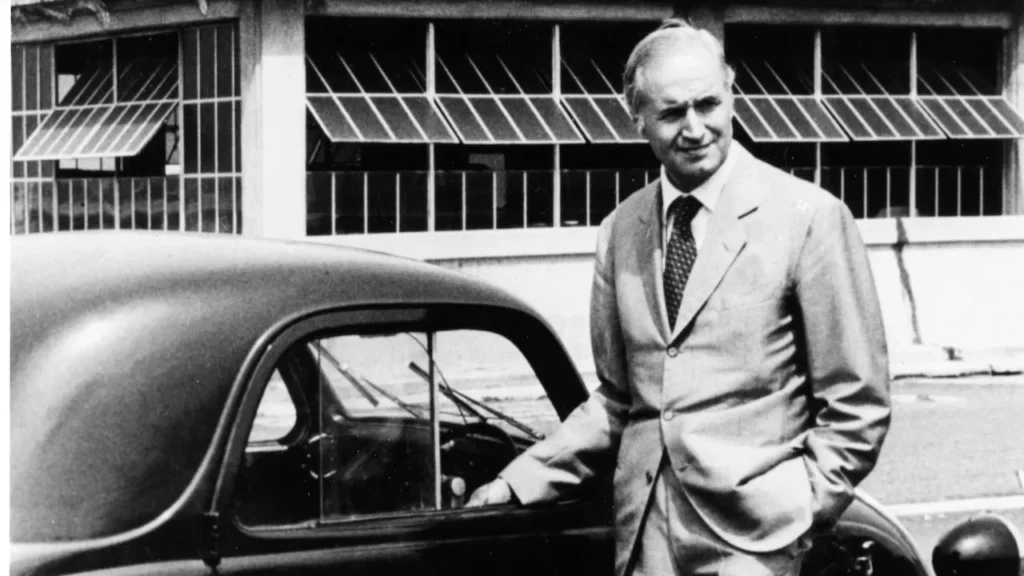
In 1952, Giacosa collaborated with Fabio Luigi Rapi (formerly of Isotta Fraschini) on an unusual project: a sports coupé with a V8 engine. Fiat didn’t build sports cars and had no intention of starting. But Giacosa wanted to prove Fiat could. 114 units of the 8V were built. 70-degree V8 (not 90 like the American motors — a matter of packaging), 1,996 cc, 105 to 127 hp depending on version. Tubular chassis, self-supporting steel body, independent suspension on all four corners.
The name — “8V” — came from a legal footnote: Ford held the international trademark on “V8” in several jurisdictions. Fiat, to dodge the paperwork, simply reversed the characters. The 8V raced at Le Mans, won the Italian GT championship between 1954 and 1959, and became the base for special-bodied variants by Vignale, Zagato and Ghia. A forgotten car today, but technically brilliant. Without it, Fiat wouldn’t have considered a sports car with its own engine again until the Dino Coupé of 1966.
1955: the 600, or how to motorise a country
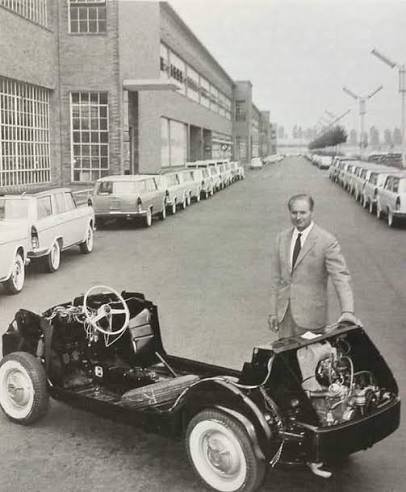
Here Giacosa entered his golden period. Vittorio Valletta gave him the 600 brief. Cheaper than the 1100, room for a family, priced below the annual salary of a working man. Giacosa’s answer: longitudinal rear engine, water-cooled, rear-wheel drive, self-supporting monocoque body, suicide doors. 633 cc, 21.5 hp, 585 kg, 95 km/h. Launch price: 590,000 lire.
The 600 sold the way very few things sell. Over 2.7 million units between 1955 and 1970. Built in Spain as the SEAT 600 from 1957 (motorising the whole country under Franco), in Yugoslavia as the Zastava 750, in Germany as the NSU-Fiat/Neckar, plus assembly in Argentina, Chile, Colombia, South Africa. The 600 was, in absolute numbers, the highest-selling Giacosa car of his career. Higher than the classic 500.
1957: the Nuova 500
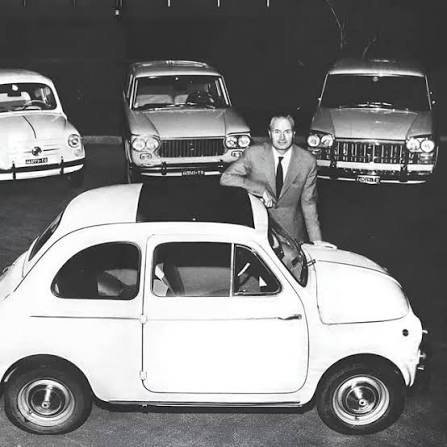
The 500 has its own dedicated piece. What matters for the Giacosa arc: it was the culmination of his entire philosophy. Rear-mounted air-cooled twin (to eliminate the radiator and the entire water-cooling system), 479 cc, 13 hp, 499 kg. Everything he’d learned drawing aircraft engines, everything he’d practised on the Topolino, everything he’d refined on the 600 — funnelled into the simplest possible utility vehicle.
In 1959, ADI awarded him the Compasso d’Oro. First industrial design prize ever given to a car manufacturer. Giacosa was 54, had been at Fiat for 31 years, and was the most respected technician in the house. And he still had fifteen years and five more major cars ahead of him.
The transverse FWD obsession
Here’s the part that Italy knows in some detail and the outside world still doesn’t. Giacosa had been thinking about front-wheel drive since 1947. That year he designed a 570 cc transverse four-cylinder for a FWD application. He couldn’t build it because he couldn’t solve the mechanical problem of packaging the differential and the gearbox onto the same axle as the engine. He shelved it. And went back to rear-engine cars.
Seventeen years later, in 1964, he solved it. Gearbox and differential placed side-by-side with the engine, connected by unequal-length driveshafts. No geometric elegance — a stunning engineering compromise. Neither of his predecessors (Alec Issigonis on the original Mini, André Lefèbvre on the Traction Avant Citroën) had solved it this way. The 1959 Mini had gearbox and engine sharing the same oil in one sump. Clever, but a service nightmare. Giacosa separated the lubricants. That seemingly minor detail is what turned his layout into the global standard.
Fiat, cautious, wouldn’t put the new layout on a Fiat-branded car straight away. Too much commercial risk. So they tested it on the Autobianchi subsidiary. The Autobianchi Primula of 1964 was the first car in the world with the complete Giacosa layout: front transverse engine, gearbox in parallel, FWD, hatchback. In practice, the manual of instructions for every 21st-century small hatchback.
And here Autobianchi played a role history has largely forgotten: it was Fiat’s secret laboratory. Before the Primula, in 1963, Autobianchi launched the Stellina, the first Italian fibreglass-bodied production car (502 units). After the Primula, in 1969, the A111. In 1971, the A112, essentially the first modern Italian city car. Autobianchi was where Fiat tested what it didn’t dare put its own logo on. Same principle Tesla is using with the Cybertruck, or DS is meant to be doing inside Stellantis. Autobianchi invented it. And the architect of those experiments was Giacosa.
1969: Fiat 128, the first official Fiat FWD
Five years after the Primula, once the European market had digested the Mini and the BMC 1100s, Fiat finally put the Giacosa layout on a Fiat-badged car. Out came the Fiat 128. European Car of the Year 1970. Transverse engine, FWD, refined Primula engineering. From that moment on, virtually every European small car started copying the layout. The Volkswagen Golf of 1974. The Renault 5 of 1972. The Peugeot 205 of 1983. All direct descendants of the 128.
Every time you turn the key in a European or Japanese small car today — from a Panda to a Yaris to any compact hatchback — you’re starting an engine positioned exactly the way Giacosa positioned it in the Primula of 1964. That’s his real legacy. Not a small car. A global architecture.
127, 130, 132, 124: the run of hits
Between 1966 and 1972, Giacosa signed four more capital cars:
- Fiat 124 (1966) — Car of the Year 1967. Aluminium twin-cam designed by Aurelio Lampredi (ex-Ferrari) under Giacosa’s technical direction. This 124 would later be built for 45 years in Togliatti as the Lada. 17.3 million units total — the second-highest single-design production figure in automotive history.
- Fiat 130 (1969) — Fiat’s flagship saloon, aimed at Mercedes S-class buyers. V6 engine, rear-wheel drive. Commercial flop, technical masterpiece. Base for the Pininfarina 130 Coupé.
- Fiat 127 (1971) — Car of the Year 1972. The first mass-market European transverse FWD supermini. Direct ancestor of every modern supermini.
- Fiat 132 (1972) — mid-size saloon, rear-drive, incorporating many ideas from the 130.
1970: the retirement that wasn’t a retirement
On 29 January 1970 Giacosa turned 65. Fiat’s internal rules forced him to step down for “age limit”. But he didn’t leave. He stayed on as Consulente Ingegneristico della Presidenza e Direzione Generale, a title long enough to make clear it meant “you stay because we need you”. He worked on the next generation of Fiat projects until 1975, when he retired for good. Total service: 47 years at Fiat.
He kept publishing. Kept lecturing. Wrote “I miei 40 anni di progettazione alla FIAT”, his technical and human autobiography. It’s an extraordinary book. And an odd one: an Italian engineer of the 1930s writing from a place of classical nostalgia, quoting Manzoni and Leopardi between suspension schematics and compression calculations. An engineer-humanist. A species that no longer exists.
He taught “Costruzione di Motori” at the Politecnico di Torino from 1947 to 1966. Nineteen years. He trained directly the generation of engineers who in turn trained the next generation. A technical genealogy that’s still alive today.
He filed 62 patents over the course of his career.
1996: the end
Dante Giacosa died in Turin on 31 March 1996. He was 91. A month earlier, in January, on his 91st birthday, he had received in bed a Fiat delegation bringing him a final honour from the company.
A few months after his death, Fiat organised the 50th-anniversary celebration of the Cisitalia D46 in the Parco del Valentino where it had debuted. Descendants of the original drivers took turns behind the wheel. Many nice things were said. But the man who had designed that monoposto in his spare time was no longer there to hear them.
What’s left of Giacosa today
In Italy, a statue was put up in Neive, his home village. A street in Turin near the Politecnico is named after him. The Museo Nazionale dell’Automobile in Turin has a Giacosa room with scale models of his projects. There’s a foundation carrying his name. ADI keeps the 1959 Compasso d’Oro file in its archive with original drawings of the 500.
Outside Italy, silence. His name doesn’t appear on the popular “mythical designers” lists in Anglo-Saxon magazines. No Netflix documentary. No Amazon biopic. No merchandise. In an industry that treats Alec Issigonis as an icon for the Mini (rightly, it’s a masterpiece) or Ferdinand Porsche for the Beetle (a political commission), Dante Giacosa — the man who signed the Topolino + the 600 + the 500 + the 128 + the 127 + the world patent for transverse FWD + the Cisitalia D46 that Nuvolari raced — doesn’t get one quarter of that recognition.
And the global car industry runs on his architecture. Every morning, in every city on the planet, millions of engines fire up positioned exactly as he laid them out. Nobody knows he existed. Not the drivers. Not the salespeople. Not the mechanics.
That’s Dante Giacosa. An Italian engineer with a classical education, who started earning 600 lire a month, who wrote quoting Virgil, who designed a Grand Prix car in his spare evenings, who fit the whole of Italy inside three metres of steel, and who invented the layout we all use today.
Happy birthday, ingegnere.
Check you’re still alive.