The LS Engine: The Most Popular Swap in History

If there’s one engine that has redefined the concept of versatility in the modern automotive world, it’s the GM LS series. We’re not just talking about power, though it has plenty. We’re talking about an engine that has colonized garages, workshops, and racetracks around the world with the quiet efficiency of something that knows it has the best argument. The LS goes in everything. And when we say everything, we mean it literally.
At the Engine’s Syndicate, we don’t just seek the most brutal engines in history. We seek those that changed something. The LS changed how the world understands the engine swap. And that, in the world of enthusiast motorsport, is a revolution.
The Birth: 1997 and the Reinvention of the American V8
To understand the LS you need to go back to 1997, when General Motors introduced the LS series as a replacement for the legendary Small Block Chevy that had served the company since 1955. The goal was ambitious: create a modern V8 engine that was light, powerful, and efficient enough to serve in both high-performance applications and more conventional vehicles.
The result was the LS1, a 5.7-liter V8 that debuted in the C5 Corvette. Compared to the Small Block it replaced, the LS1 was smaller, 25% lighter, made more power, and was considerably more efficient. The paper numbers were good — 345 horsepower in the Corvette version — but the reality on asphalt was even better.
What GM had created, without entirely realizing it, was the most swap-friendly engine ever to leave a factory. It wasn’t an explicit design goal. It was the happy consequence of doing things right.
The Anatomy of Success
What makes the LS so special from a technical standpoint? The answer lies in several design decisions that, taken together, create an extraordinarily capable and adaptable platform.
The block is aluminum or cast iron depending on the variant, with an overhead valve (OHV) architecture that may sound outdated but in GM’s hands proved to be brilliant. By keeping the camshaft in the block rather than the cylinder head, the engine can have heads with larger intake ports, a lower center of gravity, and reduced overall height — critical factors when you want to put the engine in a car that wasn’t designed for it.
The pushrod architecture that many European engineers would dismiss turns out to be an enormous advantage in the swap context. Less overall height, less complexity above the engine, greater compatibility with different hoods and engine bays. In a world where you’re bolting a V8 into a chassis that never expected one, those millimeters matter enormously.
The electronic management is modern and, crucially, hackeable. The tuning community has developed massive infrastructure for reprogramming LS engine ECUs, meaning any tuner with basic knowledge can optimize the engine for a specific application with affordable tools. This was not the case with most performance engines of the era.
And finally, weight: an aluminum LS weighs around 400 lbs. For a V8 of this size and power, that’s an extraordinarily competitive figure.
The LS Family: A Universe of Its Own
Calling it “the LS engine” is an oversimplification. The LS family is an entire universe of variants sharing the same fundamental architecture but differing in displacement, materials, cylinder heads, and specifications.
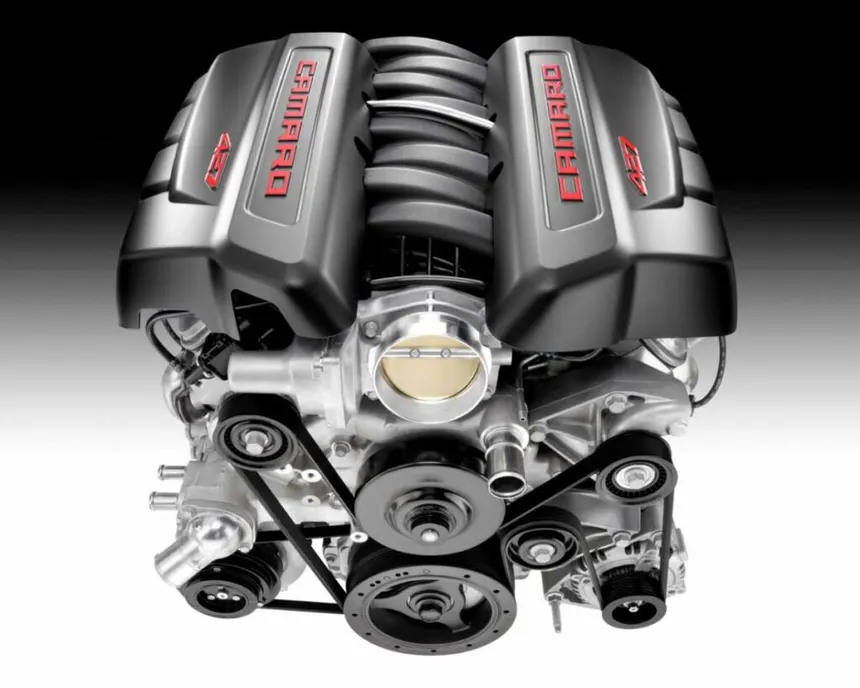
The LS1 (5.7L, 1997–2004) was the starting point. The Corvette C5 and the fourth-generation Camaro and Firebird carried it proudly. 345–350 horsepower from the factory, aluminum architecture, the DNA from which everything else would follow.
The LS6 (5.7L, 2001–2004) was the high-performance evolution of the LS1. With improved-flow cylinder heads, a more aggressive camshaft, and a revised intake manifold, it reached 405 horsepower in the Corvette Z06. It was the first clear signal of what the family could do when GM got serious.
The LS2 (6.0L, 2005–2007) marked the jump to six liters. More displacement, more torque, more power. 400 horsepower in the Corvette, the perfect foundation for more aggressive preparation.
The LS3 (6.2L, 2008–present) is arguably the sweet spot of the family. 430 horsepower from the factory, high-flow cylinder heads, an architecture refined over a decade of production. It’s the engine most people consider ideal for a street swap — more than enough power, proven reliability, and massive community support.
The LS7 (7.0L, 2006–2014) deserves its own chapter. The largest naturally aspirated V8 GM has produced in the modern era, 505 horsepower from the factory, forged titanium connecting rods, forged pistons, competition-spec camshaft. The Corvette Z06’s engine is probably the most accomplished naturally aspirated V8 to come out of Detroit in the modern era.
And then there’s the world of truck and SUV LS variants — the 4.8, 5.3, and 6.0-liter iron-block engines that powered millions of GM pickups and SUVs. These are the foundation of choice for budget builds: robust engines, cheap on the used market, and with the right heads and an aggressive camshaft capable of becoming 500-horsepower machines at a cost that would make any European engine owner weep with envy.
The Swap: Why the LS Goes in Everything
The question isn’t why to put an LS in something. The question is why not.
The LS engine has been successfully transplanted into a list of vehicles that would make any engineer with a sense of humor smile: BMW 3 Series, Mazda RX-7, Toyota Supra, Nissan 350Z, Porsche 944, Fiat 124 Spider, Alfa Romeo GTV, Land Cruiser, classic 1950s trucks, tractors, boats, desert buggies. If it has an engine bay and four wheels, someone has put an LS in it.
Why? Because the ecosystem surrounding the LS engine is unique. There are engine mounts for virtually every conceivable application. Intake and exhaust manifolds adapted to hundreds of configurations. Manual and automatic transmissions that bolt directly on. Sensors, wiring harnesses, adapted ECUs. The infrastructure that 25 years of LS swap community has built is simply unmatched.
Add the price. A truck LS in good condition on the used market can be found for $500–800. A complete LS3 with transmission, for $2,000–3,000. For the ratio of available power to price to technical support to community backing, there is no competition.
In Competition: From NHRA to Le Mans
The LS isn’t just a garage and weekend swap engine. In competition it has proven equally formidable.
In NHRA, prepared LS engines dominate several Stock and Super Stock categories. With aggressive preparation — CNC cylinder heads, radical camshaft, stroked block — LS engines can easily exceed 1,000 horsepower in street configuration, and considerably more in pure competition form.
At the 24 Hours of Le Mans, Corvette C5-R, C6-R, and C7-R equipped with LS engine variants dominated the GT class for years with a consistency that left European rivals perplexed and slightly embarrassed. An American pushrod V8 winning at Le Mans, repeatedly, against DOHC engines of far more sophisticated design on paper. The lesson is a good one: architecture matters less than detailed engineering and execution.
In road racing, the LS-powered Corvette has been a competitive benchmark in GT-class racing across multiple series for over two decades. The engine’s combination of power, torque, and durability under sustained high-rpm conditions has made it a trusted platform for endurance competition in a way that few production-derived engines can match.
The Community: The Fifth Element
There’s a factor in the LS’s success that can’t be measured in horsepower or torque figures: the community.
In 25 years, the LS swap ecosystem has generated a volume of documented technical knowledge that is, frankly, incalculable. Forums, YouTube channels, Facebook groups, technical blogs — the LS swap is probably the most thoroughly documented technical process in automotive enthusiast history. Whatever problem you encounter during your build, someone has had it before, documented it, and published the solution.
This community has standardized processes, created affordable adaptation kits, developed accessible tuning software, and turned what could be an intimidating task into something a skilled amateur mechanic with basic tools can approach with confidence.
The community is an integral part of the engine. Without it, the LS would be an excellent American V8. With it, it’s a cultural phenomenon.
The Legacy: The Engine That Democratized Power
The 426 Hemi was raw power for a few. The LS is accessible power for everyone. They’re two sides of the same American performance coin.
The LS’s legacy is the democratization of high performance. Before the LS swap ecosystem matured, putting a powerful engine in a custom project required considerable budget, specialized knowledge, and accepting significant compromises. The LS fundamentally changed that equation.
Today, in any workshop in the world where people talk about hot rods, project cars, or custom builds, the LS is the reference point. Not because it’s the most powerful or the most sophisticated. Because it’s the most sensible, the most accessible, the most supported — and yet, when you ask it to run, it runs exactly like it should.
Welcome to the Engine’s Syndicate, LS. We always knew you’d make it.
9 thoughts on “LS ENGINE”