AUSA PTV: the Spanish carmaker that survived by killing its own car
The first site dumper ever built in Spain ran on the engine out of a two-seat convertible. Manresa, 1960. Same engine, same carburetor, same shed, same men. The only thing that changed was who was paying: instead of a gentleman in a hat buying his first car, it was a laborer hauling concrete up a muddy ramp.
That is not a nice metaphor to open an article with. It is in the company’s own archive, with unit numbers and dates attached.
If you rent compact equipment in North America, you know JLG. You may have used a SkyTrak 3013, the ultra-compact telehandler JLG launched at The ARA Show. That machine is built in Manresa, a mid-sized industrial town an hour inland from Barcelona, by the company that built that convertible.
Every Spanish microcar brand died in the early sixties. Exactly one survived, and it survived because it was the first with the stomach to kill its own car before the market got around to killing it. Its name is AUSA, it now leads its category worldwide, and back home its story still gets told as if it were about a cute little car that got run over by a Fiat.
A repair shop that made its own parts
Start in a garage, because that is where it actually starts.
Antoni Tachó opened Garaje Tachó in Manresa in 1932, repairing cars and motorcycles. His brother Guillem joined later, coming from the Hispano-Suiza plant in Barcelona. The shop grew into a Renault dealership and an official Montesa agency.
They did not stop at repairs. Spare parts were hard to find in Franco-era Spain, so the brothers designed and manufactured their own, selling them under two house brands, Tachó and Titán. That habit matters. Everything that comes later rests on a shop that treated “we can’t buy it” as “we’ll make it.”
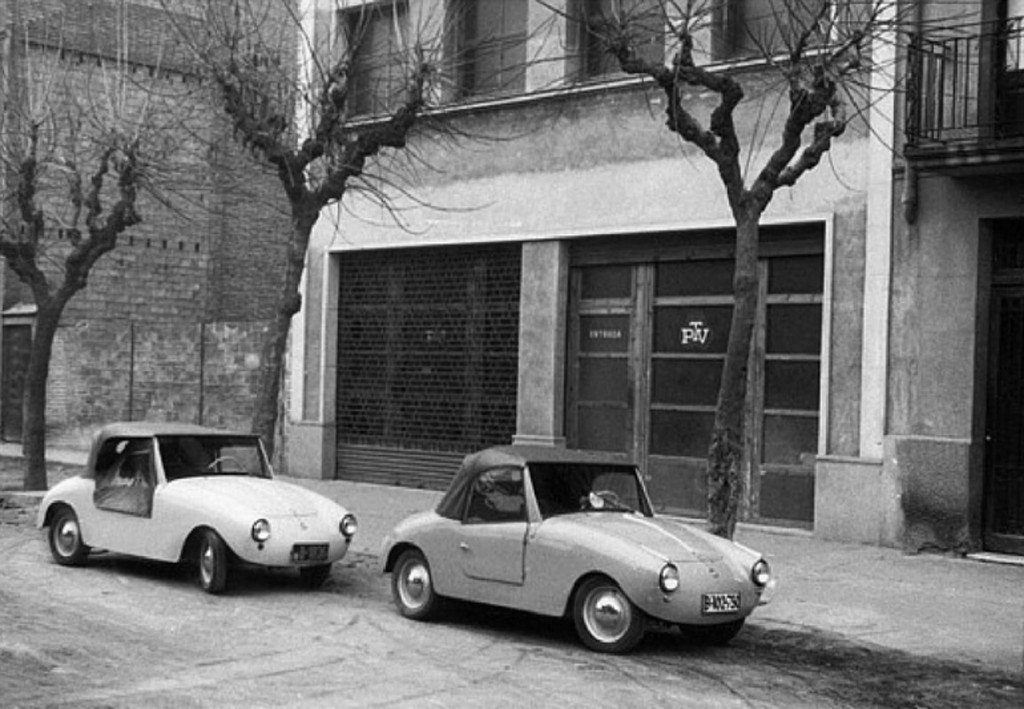
They built two cars of their own. The first, finished in 1950 and nicknamed La Ballena, the Whale, had a tapered aerodynamic tail that looked like a shrunken 1930s sports car. The second, El Coca, arrived in 1953 and was far more practical. Both wore Tachó badges.
El Coca is what brought in the money. Industrialist Maurici Perramon, who had known the brothers from the wartime gasogene years, saw it and decided to invest. Together with Josep Vila, who had worked on El Coca, they incorporated Automóviles Utilitarios, S.A. on May 4, 1956. Take the first letters of Perramon, Tachó and Vila and you get the brand name: PTV.
Why Spain was buying microcars in 1956
American readers need one piece of context here, because otherwise the product makes no sense.
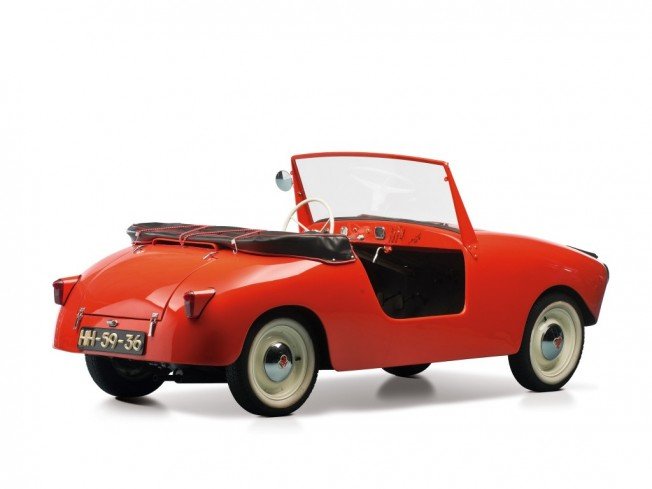
Postwar Spain was poor, isolated and short of everything. Imports were restricted. A middle-class family could not buy a car in the American sense of the word. Across Europe the answer was the microcar: the BMW Isetta, the Messerschmitt, the Heinkel, the Goggomobil. Spain got its own versions, most of them built under foreign license. The Isetta was assembled in Madrid under license from Iso of Italy. The Goggomobil came from Germany’s Glas. The best-selling of them all, the Biscúter, was a Gabriel Voisin design from France.
The PTV was the only widely sold Spanish microcar designed and engineered in Spain from the ground up. Engine included.
The car itself
The PTV 250 ran a single-cylinder two-stroke of 247 cc, bore and stroke 66 x 72 mm, 6.2:1 compression, feeding through a 22 mm Tachó carburetor. In-house engine. In-house carburetor. In a machine shop, in 1956.
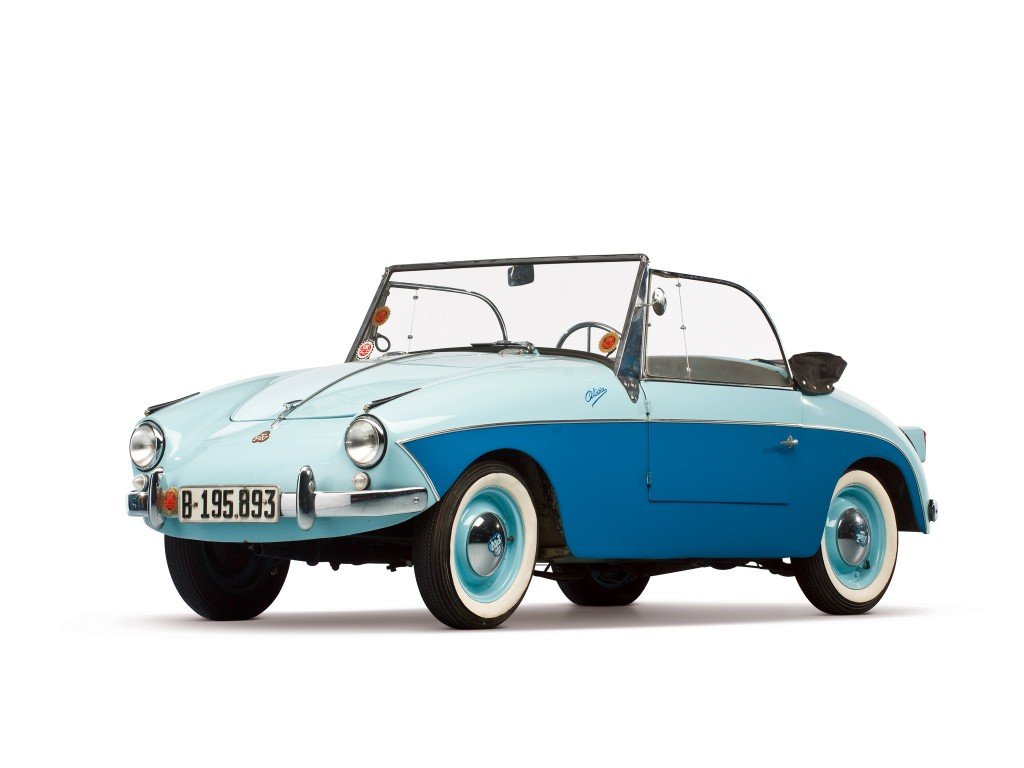
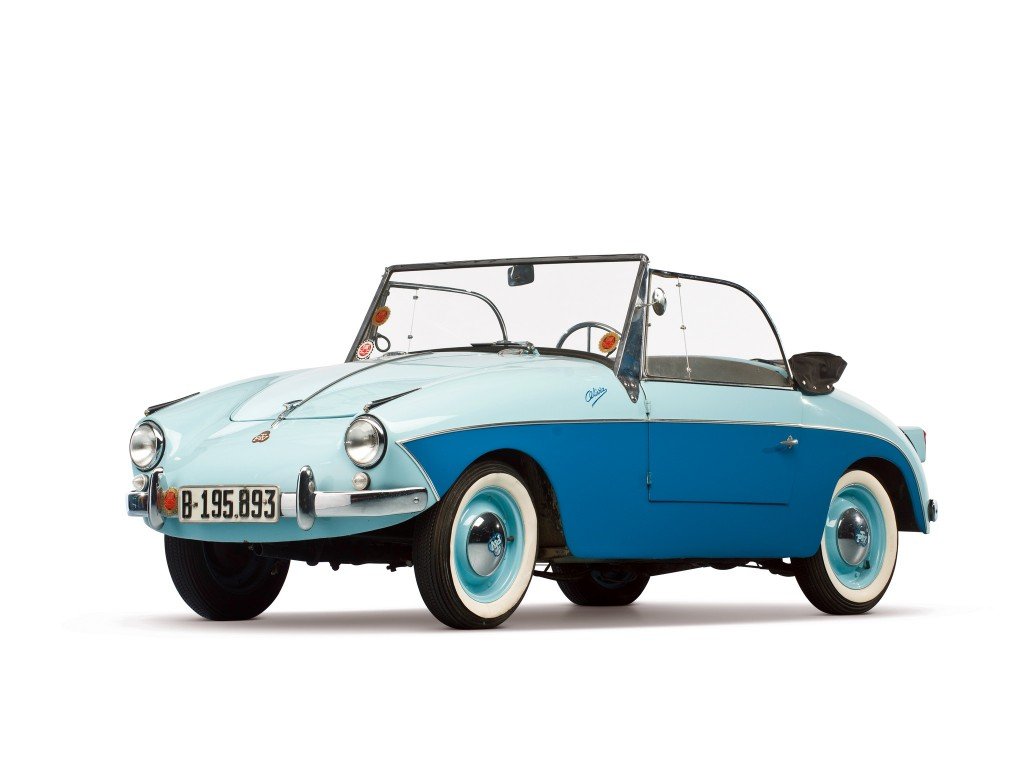
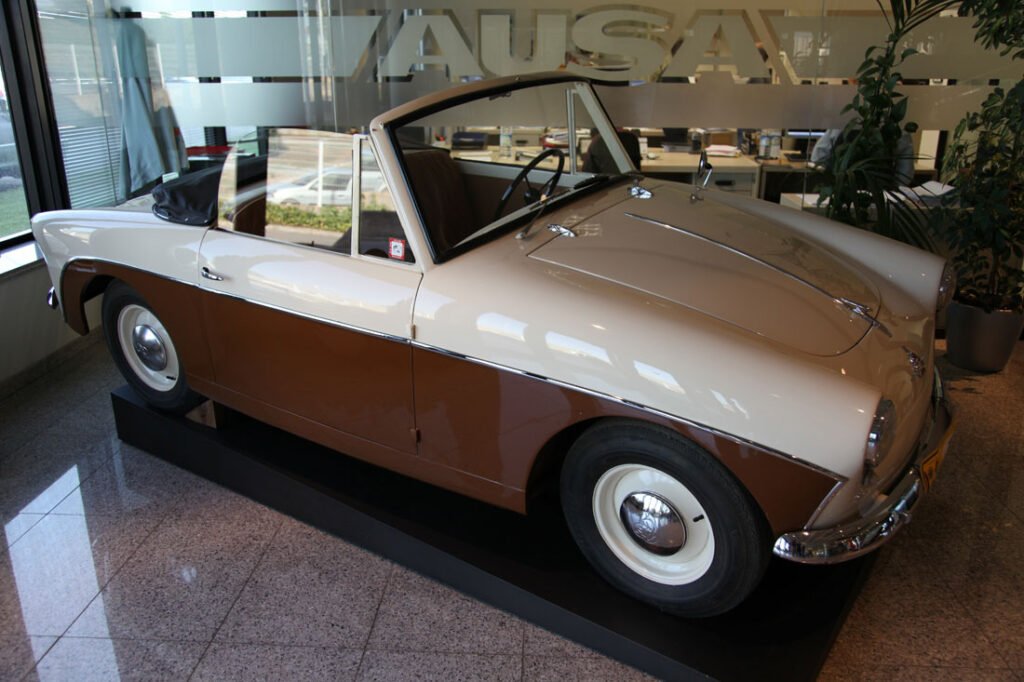
Body construction was sheet-steel monocoque over a tubular steel frame. It measured 2,950 mm long, 1,320 wide, 1,250 tall, on a 1,800 mm wheelbase, weighing 330 kg — about 728 lb. It had independent front suspension and brakes on all four wheels, neither of which its direct rivals offered.
Measure it against the car it was hunting. The Biscúter 200A of 1955 made 9 hp at 4,800 rpm from a 197 cc licensed Hispano-Villiers, weighed roughly 295 kg once the aluminum body gave way to steel, and did not originally have a reverse gear at all; the fix was a mechanism that reversed the engine’s direction of rotation. The PTV, in production form, made 11 hp and 75 km/h, roughly 47 mph, and offered real doors, two-tone paint, chrome trim and 12-inch wheels.
One number needs a warning label. Sources describing the 1956 prototype cite 13 hp and 95 km/h, plus a later 350 cc unit. Spanish production-car sources consistently cite 11 hp and 75 km/h. Whether that gap is prototype-versus-production or a catalog error repeated for decades has never been resolved. Treat it as unverified.
Nobody agrees on how many were built
The figure carried by almost every source is 1,100 cars through 1961. The Roda Roda museum in Lleida, which displays two of them, uses it. So did Toni Tachó Figuerola — son of one of the founders and president of the Clàssic Motor Club del Bages — at a public event in 2024, where he added that 110 survive worldwide.
One outlier source claims close to 5,000. It contradicts everything else, including the founding family, so it does not get repeated here as fact.
The ranking is equally muddled. Some sources call the PTV the second best-selling microcar in Spain behind the Biscúter; others place it fourth by volume behind the Biscúter, the Goggomobil and the Isetta. Both can be defended depending on whether you count license-built foreign designs. Seventy years on, the production records of an entire national industry are still unsettled.
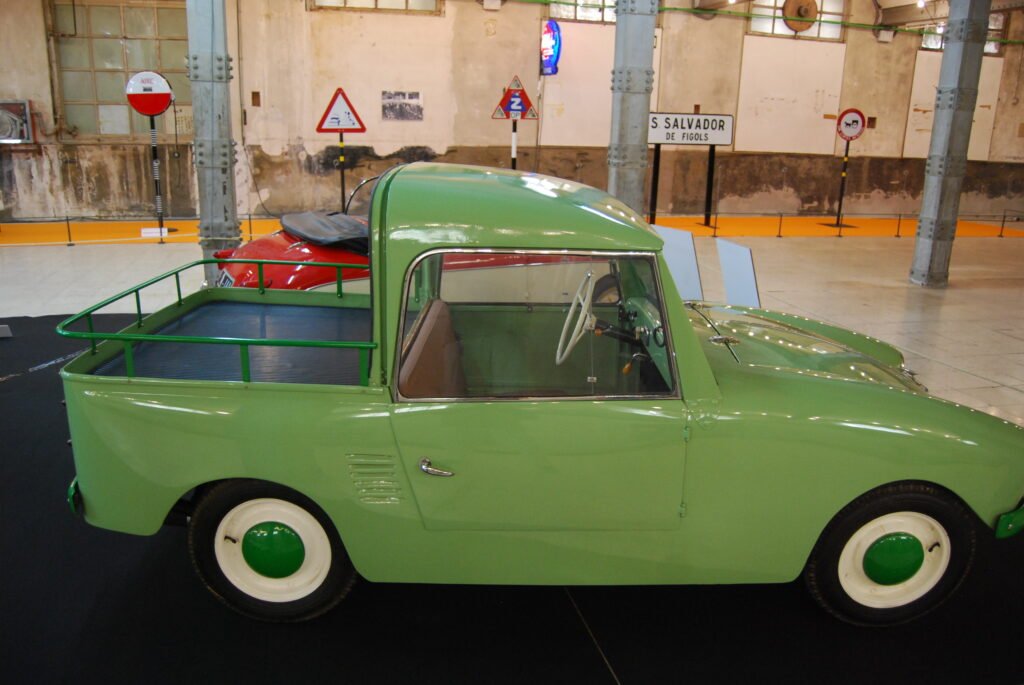
A commercial version was also built: 45 fiberglass-bodied micro-vans, hobbled by a rear engine that ate the load space. A front-engine prototype was built and used inside AUSA as a works vehicle for years. Even the dates on those 45 units conflict between sources, split between 1959-1961 and 1961-1962.
The supercharged microcar Spain never got
Here is the part that should interest anyone who likes engineering for its own sake.
The PTV 400 was a two-cylinder two-stroke of 397 cc making 19 hp, with a four-speed gearbox and a claimed 110 km/h, roughly 68 mph. Supercharged. Specifically, a two-lobe rotary blower, with a system that let it run on straight gasoline rather than premix — unusual for a two-stroke of that era. When the surviving prototype was displayed decades later, the French specialist press zeroed in on the blower.
Think about what that means. A shop that had been making its own spare parts a few years earlier was building a supercharged microcar with nearly double the output of its production model. Sources place the work in 1959 or 1960, and the date is exactly the problem. By the time it was ready, the car that killed the whole segment was already on the road. One unit was built. It was never sold. It still exists.
Fiat’s licensing deal ended an industry
The first SEAT 600 rolled out of the Zona Franca plant in Barcelona on June 27, 1957. It was the Fiat 600 built under license: 633 cc, 21.5 hp at 4,600 rpm, 95 km/h, four seats, four speeds.
A 247 cc microcar does not compete with that. The 600’s launch price is widely quoted at 65,000 pesetas, though model specialists argue the sedan actually launched at 70,000 ex-works and did not drop to 65,000 until September 1962. Either way, for somewhere between 10,000 and 25,000 pesetas more than a two-tone PTV, a buyer got a genuine four-seat automobile with a dealer network, financing and a two-year waiting list.
The 600 wiped out Spain’s microcars, three-wheeled delivery vehicles and sidecar rigs in a few years. Nearly every manufacturer folded. One did not.
The German dumper that never showed up
AUSA’s second life began in an aisle at the Barcelona trade fair, standing in front of a German machine.
What was on display was a dumper built by the German firm Potratz. It is worth explaining what that is, because the object is so unglamorous that nobody looks twice: a site dumper is a tipping skip up front, an engine at the back, a seat in the middle, and exactly one job — moving aggregate, concrete or rubble across ground no truck will touch. It does not need to be fast. It does not need to be comfortable. It needs to go up a grade, loaded, every day.
AUSA asked for authorization to build that vehicle in Spain. What followed will be familiar to anyone who has ever waited on a licensor: problems with the drawings, delays receiving the reference machine.
That is the moment everything else was decided. A company that had spent twenty years making its own spare parts because it could not buy them was staring at a product it wanted to copy and a licensor who would not send the paperwork. The reaction had been written into the company since 1932: they drew it themselves.
From the German machine they kept three specific things and nothing more. The skip shape, the tipping mechanism and the decision to steer with the rear wheel. That is the product concept — what we would now call the layout: what goes in front, what goes behind, and which end turns. Frame, driveline and engine were their own.
Now the question almost no account of AUSA bothers to answer: how do you get from carrying two people down a country road to hauling rubble across a lot?
A microcar is asked for top speed and fuel economy. A dumper is asked for the opposite: pulling power low in the rev range, hours at a near-constant load, tolerance for dust, and the ability to pull away uphill with a full skip. The PTV’s 11 hp sounds like a punchline today, but output stops being the issue when working speed is a walking pace. A 247 cc two-stroke moves a short, slow three-wheeler perfectly well. What we do not know is what was changed inside it: sources record that the PTV engine was adapted “for the new use” without detailing the work. That gap is still open.
What is documented is the outcome. The first AUSA dumper appeared in 1960: three wheels, the PTV’s gasoline engine, 135 units built between 1960 and 1961.
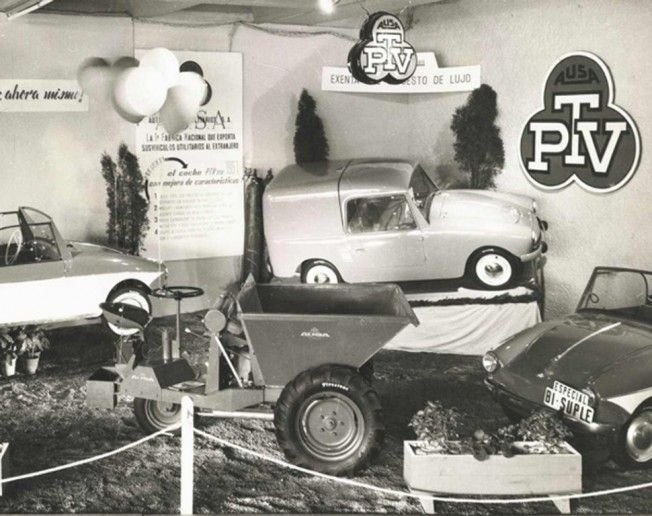
At a 1961 trade stand, the standard PTV 250, the van, a rare Especial Bi-Suple with two folding child seats in the back, and the first motorized skip dumper all stood together. The dying car and the machine that would save the company, sharing one carpet. I would have paid to hear the sales pitch.
Note the overlap. Some sources date the end of PTV production to 1961, others to “around 1960.” There was no wilderness period and no dramatic reinvention. The last cars and the first dumpers were built at the same time, which is how pivots actually work when they work.
From a boat engine to four-wheel drive
The three-wheeler was tippy, which is what happens when you put a skip full of gravel on a triangle. AUSA fixed it in 1962 with the four-wheel 1000 D, using a move only somebody who has understood their own product makes: they took a 9 hp German LK engine built by Düter — designed for boats and water pumps — and Guillem Tachó reworked it to rev higher and survive dumper duty. It sold 3,378 units and became the company’s first popular product.
Look at what that engine swap says, because it says everything. Going from a car engine to a water-pump engine is an admission that construction work has more in common with pumping than with driving: constant load, hours on end, sustained revs, nobody lifting off. It took AUSA two years to learn it was no longer an automaker. Some companies take twenty and never get there.
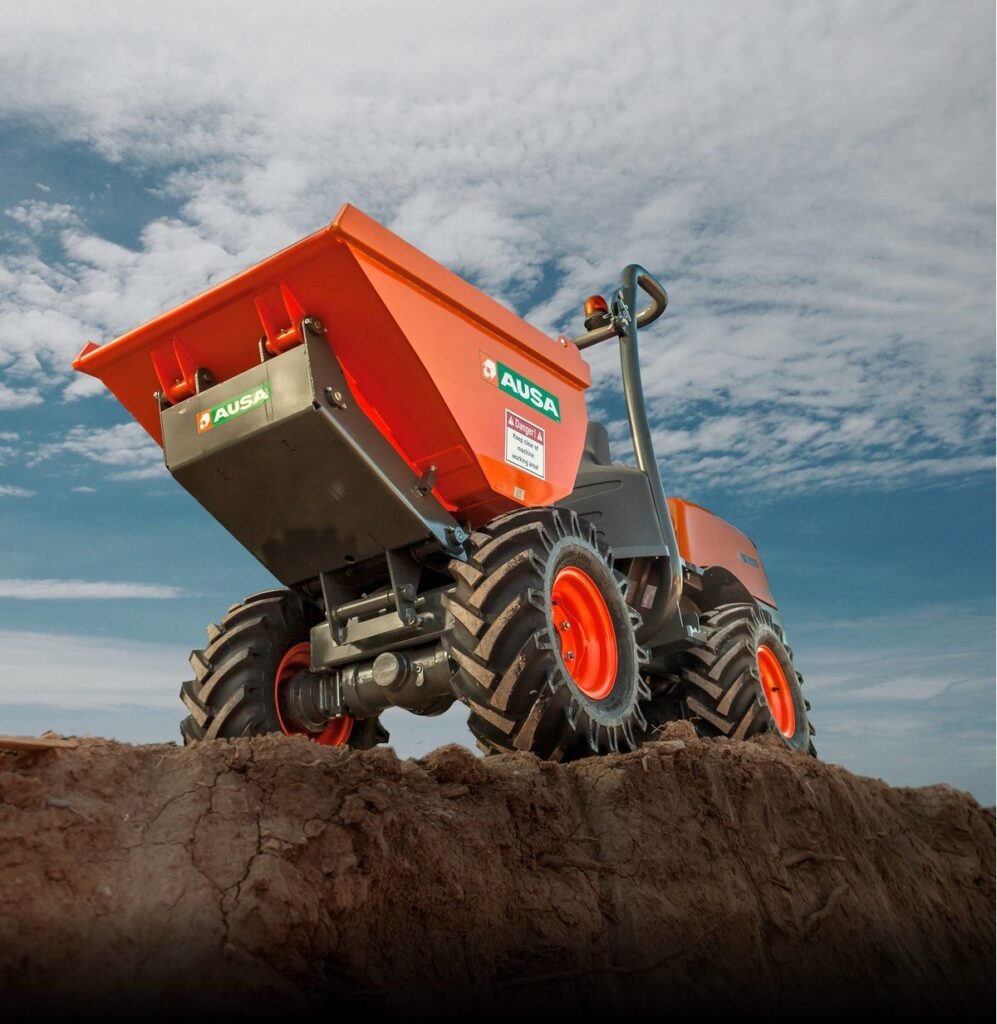
After that, the trajectory is a company that has found its market. The 1500 DS of 1965 introduced gravity discharge and reached 19,085 units. The 1500 DSH of 1967 added a patented hydraulic system that swung and lifted the skip, aimed at placing concrete into formwork in tight spots. The 1500 SHF of 1971, hydraulic discharge, revised in 1992, passed 22,000 units and remains the best-selling model in company history.
The big engineering jump was the Máster. Development began in 1973 around a new four-wheel-drive transmission, 2,200 kg of payload and the ability to work grades of 35%. First units were built in 1974 at a new plant outside Manresa; series production started in 1975. Payload rose to 2,500 kg and, by 1982, to 3,000. All-wheel drive on a site dumper was never a brochure feature: a loaded dumper spinning on a muddy ramp is a stopped machine, and a stopped machine bills nothing.
Dumper number 25,000 came off the line on May 17, 1980. The company turned 25 on May 6, 1981.
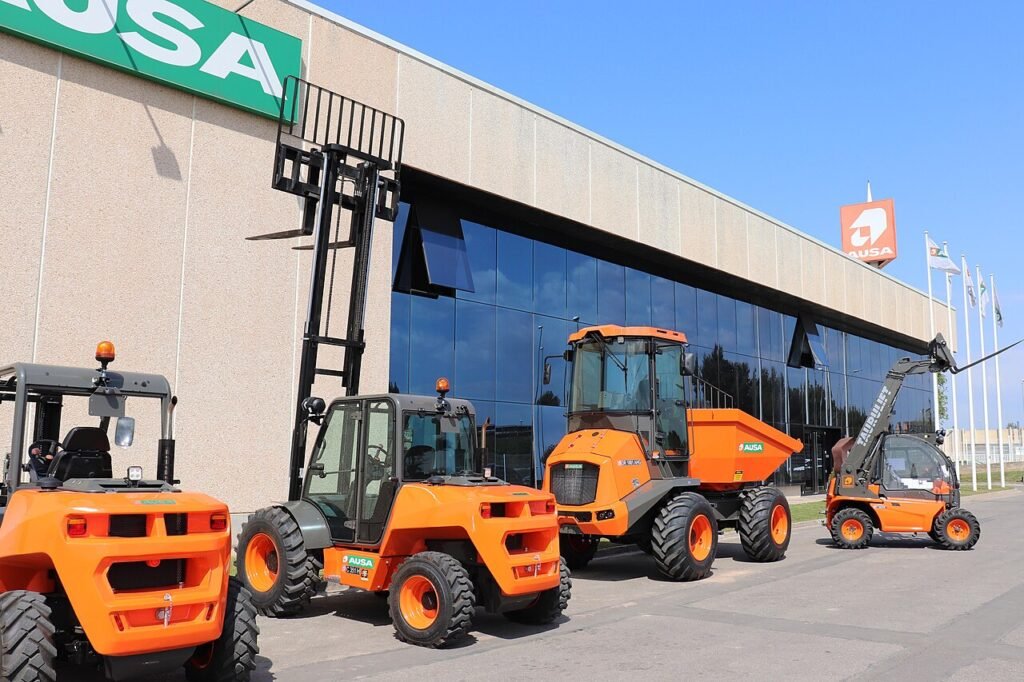
What the company that quit cars actually sells now
Sixty years of dumpers is museum material. The useful question is what AUSA sells today, and how much of that 247 cc is still in there.
The dumper range now runs from one to ten tonnes. The ceiling was set by the D 1000 AP of 2008: a 105 hp Kubota engine, front discharge, a swivel version, permanent four-wheel drive — and despite the size, a 2.48 m width chosen so the thing still fits on a trailer and down a street. Before that came the articulated chassis of 1993, 2,500 to 4,000 kg, which ran on driveline hardware inherited from the Máster for years. Then in 2020 the DR601AHG brought reversible operation: the seat spins 180 degrees and takes the steering wheel, joystick, pedals and cameras with it, so the operator is not spending half a shift working with his neck turned.
The first electric dumper, the D151AEG, arrived in 2022: 1,500 kg payload, a 7.6 kW motor peaking at 17.3 kW, permanent four-wheel drive specifically intended to match the diesel version. It went on to win an Innovative Products Award presented by World of Concrete in the material-moving category.
The battery figure needs care, because the manufacturer’s own releases disagree: some cite up to 12.3 kWh, others 9.3 kWh alongside a reference to “19.6 kW batteries” that cheerfully mixes energy and power units. The product page commits only to a full shift, charged from a 110 V, 230 V or 415 V supply. Unresolved, and flagged as such.
Bauma 2025 brought the C151E, the company’s first electric rough-terrain forklift: 1,500 kg capacity, 4 m lift, a 19.6 kW motor and up to 18.6 kWh of battery. With it came the low-emission combustion C151H and the DR602AHG, a 6-tonne reversible dumper. Every AUSA product line now has at least one electrified model.
Here is the part worth stealing for any argument about electrification. On a jobsite, electric does not sell on the environmental pitch. It sells because the machine can work inside a greenhouse, in an enclosed parking structure, or on a night job in a city with noise limits — places diesel simply cannot go. There is no range anxiety, because the unit of measurement is not miles, it is the shift. There is no test cycle to argue about. There is no consumer rebate. A contractor buys the machine if it lets him bill hours he could not bill before. That is the whole conversation.
While passenger EVs have spent fifteen years fighting over the narrative, the equipment sector settled it quietly. The company that walked away from the automobile in 1961 came back to the electric vehicle through the service entrance, and it is working.
Overhead discharge, articulated frames, ten-tonne payloads, lithium packs — all of it is layers on the same trunk. The trunk is a machine shop in Manresa that wanted to build cars.
The roundabout and the signature
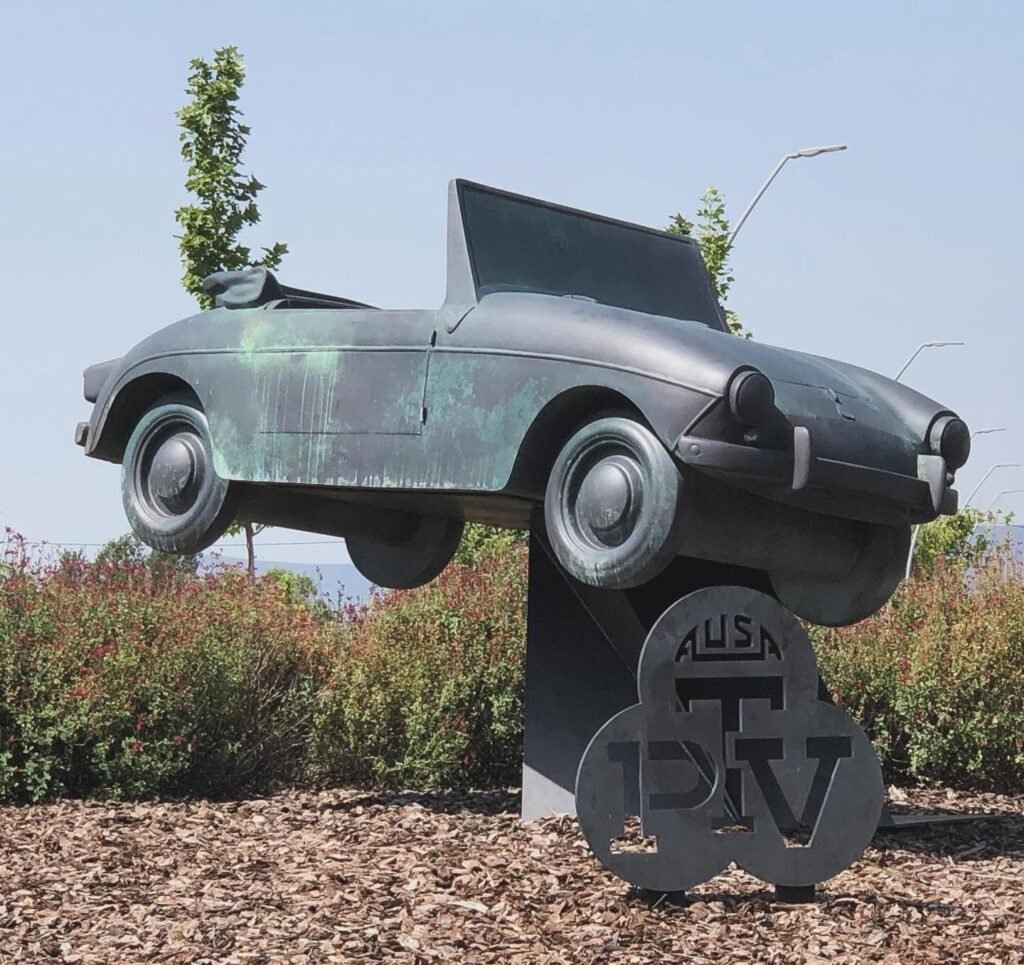
Manresa unveiled a full-size replica of the PTV on a roundabout in July 2024. The mayor spoke. So did Toni Tachó Figuerola and Manuel Perramon Ferran of AUSA. Founding families, collectors, more than a hundred people.
Oshkosh Corporation had announced its agreement to acquire AUSACORP S.L. on May 8 of that same year. The deal closed on September 3, 2024: 100% of the company for €103.6 million, $114.5 million net of cash acquired, per Oshkosh’s SEC filings. AUSA joined the Oshkosh Access segment alongside JLG, bringing a 23,000 m² plant in Manresa and roughly 350 employees. The relationship predated the purchase — AUSA had been building the SkyTrak 3013 for JLG since 2020 under a ten-year commercial agreement — and it followed Oshkosh’s acquisition of Italy’s Hinowa in 2023.
Put the dates in order, because together they tell a joke that isn’t funny. In May, the sale of the company to an American group is announced. In July, the town unveils a monument to the car that founded that company, with the founding families applauding. In September, the signature goes on the paper. Manresa raised the statue while the deal was closing.
Distribution numbers vary too. AUSA cites 600 dealers across 90 countries; the JLG announcement references access to 200 equipment dealers worldwide. They are probably counting different things, but nobody has clarified which.
The argument
The PTV usually gets told as a sad postcard: the pretty little car that arrived too late and got flattened by the 600. That version is comfortable and it is weak.
The real version is that a group of people in Manresa who built their own engine, their own carburetor and their own rotary blower looked at the numbers, accepted that the car was dead, and sold the same competence to a different customer. No bailout, no ministry, no reconversion plan signed in Madrid. A three-wheeled skip dumper running the engine out of a convertible.
And the ending is what it is. A company that outlived the SEAT 600 for sixty-eight years as a Catalan family business is now owned out of Wisconsin for €103.6 million. The machines are still built in Manresa, the orange is still orange, and the brand is a line item in somebody else’s portfolio. If you buy a compact dumper in North America this year, that is the history you are buying into, whether or not the spec sheet mentions a 1956 microcar.
So here is the question worth asking on your side of the Atlantic. How many companies exactly like this one are working in an industrial park near you right now, with the patents written and nobody counting them until the offer arrives?
Check you’re still alive.