Autobianchi Primula: The Car That Won the Engineering War the Mini Took Credit For
Look under the hood of almost any front-wheel-drive car built in the last fifty years and you’ll find the gearbox in the same place: beside the engine, in line with the crankshaft, with its own oil and its own housing. It’s so universal that nobody thinks about it anymore. It’s just how a small car is built.
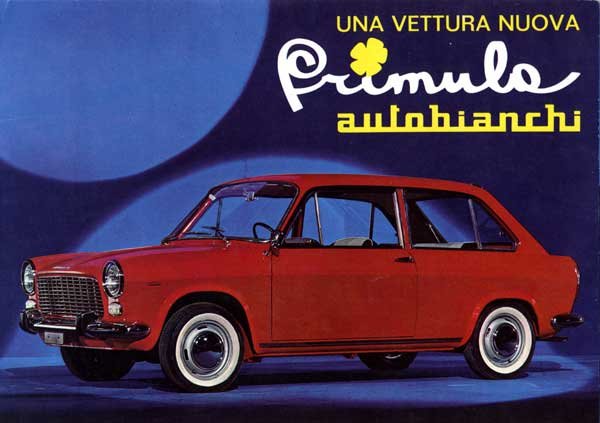
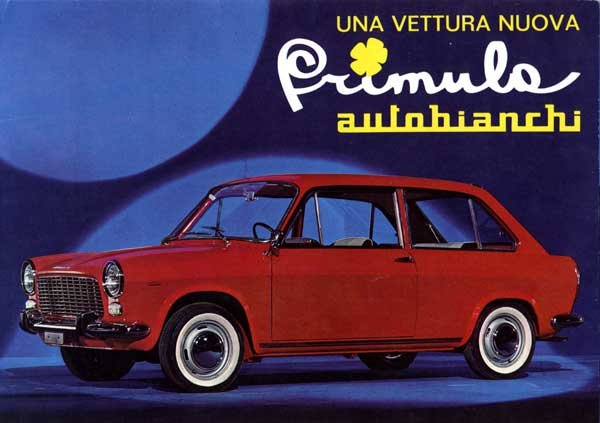
The Mini didn’t make that choice. An ugly Italian car did — from a second-string brand, launched five years later, and remembered by almost nobody. It was called the Autobianchi Primula, and it’s one of the great injustices in automotive history: the car that solved correctly the problem another had solved brilliantly but wrong, and then watched the glory go to both its British rival and to the parent company that wouldn’t even put its own name on it.
This is that car’s story. And the story of the man who paid for it with thirty years of exile and a grave dug before he could see his work finished.
A fire on the Cavoretto hill
The story starts in 1931, a full quarter-century before the Primula existed, because without that day none of it makes sense.
Benito Mussolini had ordered Giovanni Agnelli — the senator who founded Fiat — to build a people’s car that would motorize Italy for under five thousand lire. Agnelli split the job between two teams working in competition. One would go conventional and cheap. The other would go revolutionary, led by an engineer named Oreste Lardone.
Lardone was no journeyman. Born in Turin in 1894, he’d joined Fiat in 1909 at age fifteen as a gofer in the newly formed design office and risen to become the right hand of technical director Giulio Cesare Cappa. In 1928, working at Itala, he’d designed a front-wheel-drive economy car that anticipated what Citroën would later do with the 2CV. The man could see two decades into the future.
His Fiat prototype was exactly that vision: a four-seater with a 500cc air-cooled twin and front-wheel drive. The recipe for the modern European economy car, written in 1931.
That summer, the prototype rolled out of the Lingotto plant for its first road test. On board were the test driver, Lardone himself, and — eager to wire the good news to Mussolini — Senator Agnelli in person. The car ran fine for a few kilometers. Then, on the climb up Cavoretto, the engine caught fire and all three had to bail out of the moving car.
Nobody was hurt. But Lardone’s career had just burned down with the prototype.
Thirty years of taboo built on a false diagnosis
Here’s the detail that turns this from anecdote into tragedy, and it’s the heart of the whole piece: the fire had nothing to do with front-wheel drive.
Sources agree the cause was almost certainly a trivial fuel leak. A fuel-line problem — the kind of fault any prototype of any layout could suffer. Front-wheel drive was innocent.
It didn’t matter. Agnelli climbed out with a scorched jacket and made three snap decisions: Lardone fired on the spot, the project buried, and — the one that would shape half a century of Italian industry — never again a front-wheel-drive car at Fiat. An absolute ban, founded on a misdiagnosis. The correct technology was condemned for a failure that was plumbing, not concept.
The most telling part is that Fiat’s own people knew better. Antonio Fessia and Tranquillo Zerbi, the two heads of the design office, were convinced Lardone’s “forbidden” approach was the right one. They didn’t dare defend it. The economy-car job went to the conventional team, and a young engineer named Dante Giacosa solved it with a front-engine, rear-drive layout: that became the Fiat 500 “Topolino” of 1936. A great car. But not the one Lardone had imagined.
The ban had a staying power that’s hard to believe today. It survived the Second World War. It survived Agnelli himself, who died in 1945. Fifteen years after the man who imposed it was gone, “front-wheel drive” was still taboo in the halls of Turin — a corporate ghost governing engineering decisions from beyond the grave.
Meanwhile, Fessia got tired of waiting. In 1955 he left for Lancia as central technical director, and there he did what Fiat wouldn’t let him: the 1960 Lancia Flavia was front-wheel drive. The idea Fiat had banished found a home at the competition.
Giacosa rescues the idea he’d helped bury
The finest irony here is that the man who eventually resurrected front-wheel drive at Fiat was the same one who, thirty years earlier, had benefited from its ban: Dante Giacosa, father of the Topolino, the 500 and the 600, the most important engineer in Fiat’s history.
Giacosa had never stopped believing that for small cars, front-wheel drive offered unbeatable advantages in space and weight. As the years passed and leadership changed — Vittorio Valletta first, then the return of the Agnelli family with Gianni “L’Avvocato” — a crack finally opened.
And here comes the gesture that redeems the whole story. For the new front-drive project, approved in 1960 and code-named Progetto 109, Giacosa called Oreste Lardone back. The man fired in 1931 over that fire returned to Fiat as an outside consultant, nearly thirty years later, to work on exactly the technology that had cost him his job. The rehabilitation took three decades, but it came.
What didn’t come in time was life itself. Oreste Lardone died in Turin on September 13, 1961, with the project underway but the car still unfinished. He never saw the Primula. He died vindicated, knowing he was finally being proven right, but unable to touch the result. His entire career, as one Italian chronicler put it, revolved around Fiat front-wheel drive — and it culminated in a car unveiled three years after his death.
Why the Primula beat the Mini
Now to the engineering duel, where the Primula goes from forgotten car to keystone.
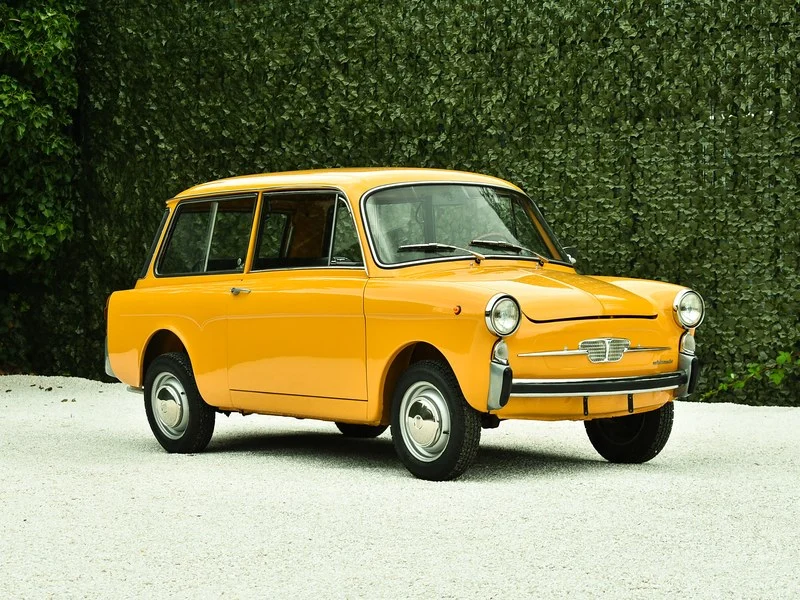
First, the uncomfortable truth for any Italian partisan: the Primula was not the world’s first transverse front-wheel-drive car. That honor belongs to Alec Issigonis’s Mini, from 1959, and anyone who says otherwise is lying. The Mini was first, it was brilliant, and it was enormously influential. Nothing that follows takes that away.
But “first” and “correct” aren’t the same thing. And on the specific solution that endured, Issigonis got it wrong.
The Mini put the gearbox underneath the engine, inside the same sump, sharing oil between engine and transmission. It was a packaging masterstroke: that’s how Issigonis got the mechanicals into a minimal footprint and freed up 80% of the car for passengers. But the engineering price was steep. The same oil lubricated the pistons and the gear teeth, so metal shavings from the transmission circulated through the engine and service intervals became a penance. Anyone who’s ever opened up a classic Mini knows the drill.
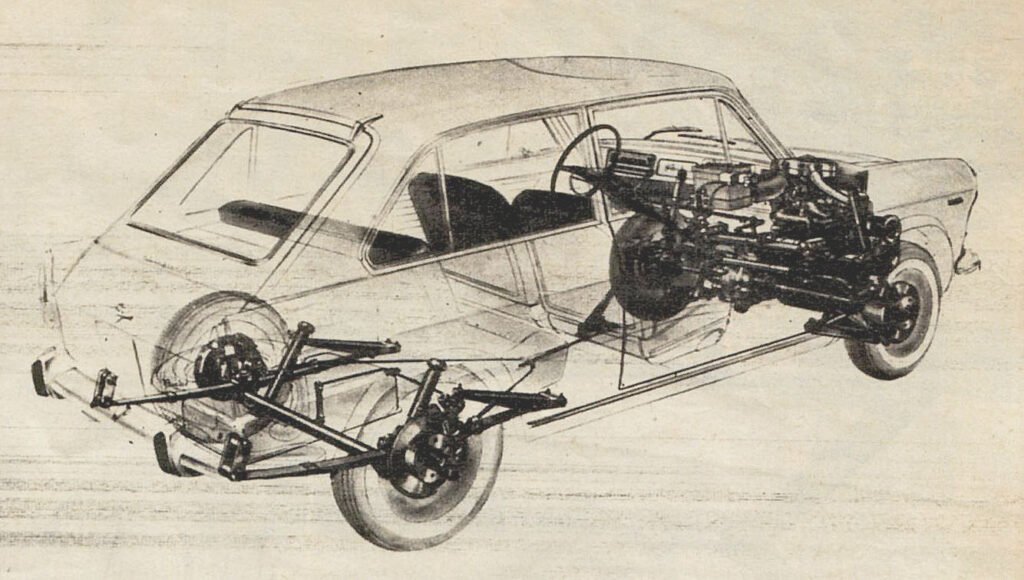
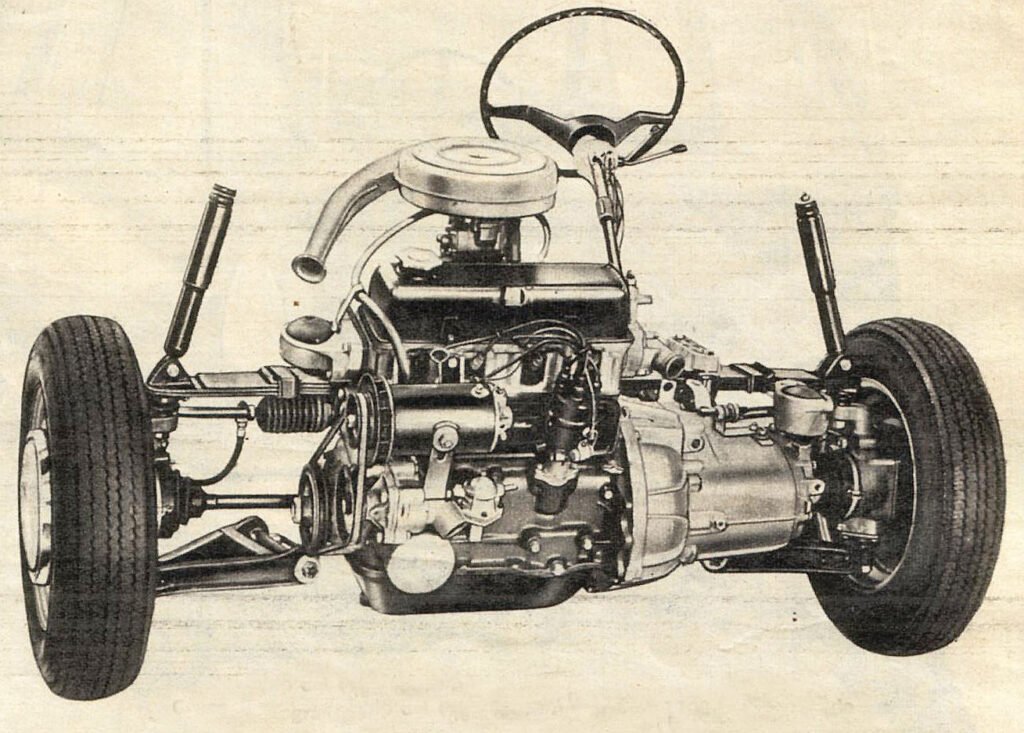
The Primula did the opposite, following the layout Giacosa championed. The gearbox sat beside the block, in line with the crankshaft, with separate housings and independent oil. Engine and transmission, each with its own life. The tradeoff was unequal-length driveshafts — one longer than the other — which brought its own challenges, but a far more manageable problem than sharing oil.
The mechanical base came from the Fiat 1100 D: a 1,221cc inline-four, mounted transversely for the first time in a group car, on a new platform.
And which layout did the world adopt? The Primula’s. When Volkswagen launched the Golf in 1974 and redefined the compact car forever, it did so with a transverse engine and end-on gearbox, separate housings. Same for the Fiat 127, the Ford Fiesta, and essentially everything that came after. Issigonis’s approach — the shared sump — remained a brilliant curiosity of a specific moment. Nobody mixed engine and gearbox oil in a mass-production car again.
Put plainly, and this is what you can carry into any argument: the Mini invented the format, but the Primula defined the architecture. Issigonis got the commemorative photo; the blueprint we still use was signed by Giacosa, on Lardone’s idea.
For an American reference point: it’s a bit like Preston Tucker versus the anonymous engineers whose ideas actually made it into every car you’ve owned. The famous name isn’t always the one under your floorpan.
A car that did more than it was asked to
The Primula didn’t stop at the mechanicals. It got ahead on bodywork too.
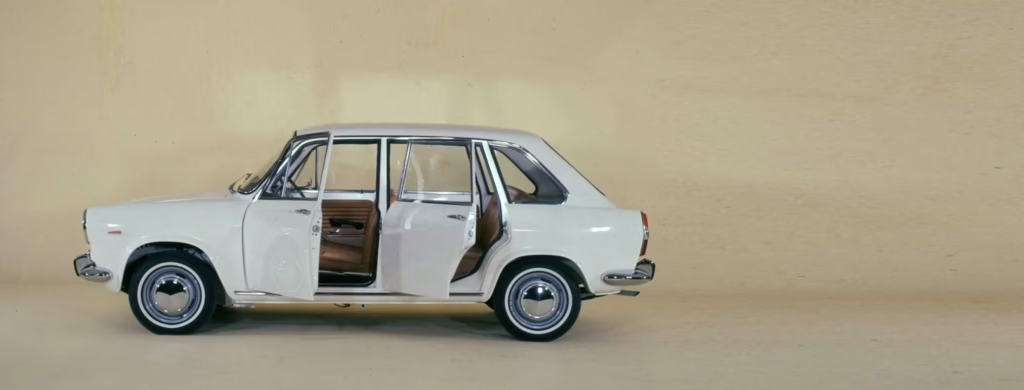
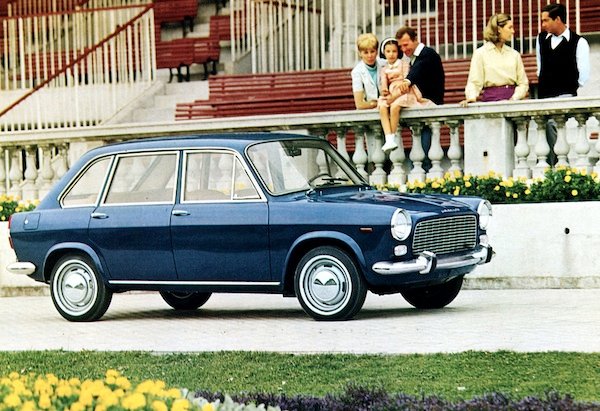
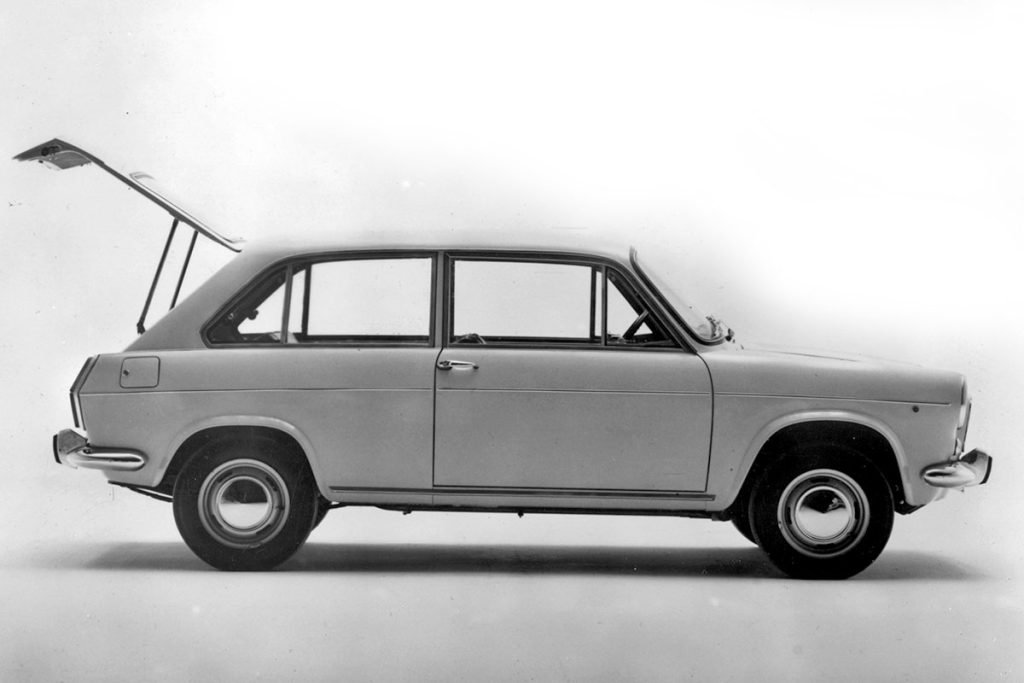
It debuted at the 1964 Turin Motor Show with something nearly exotic for the era: a tailgate. A true hatchback, with the cargo area integrated into the cabin and reached by lifting the rear glass, at a time when half of Europe was still debating whether a trunk needed its own separate lid. It also offered body-style flexibility unusual for its size: two-, three-, four- and five-door sedans, plus a two-door coupe. It was defining modern economy-car practicality while the competition was still thinking three-box.
Commercially it did reasonably well without being a runaway hit. And that nuance matters, because it’s part of the injustice: the Primula sold fine, it delivered, but it never reached the numbers or the iconic status its technical importance deserved. It was a car respected by engineers and forgotten by the public almost simultaneously.
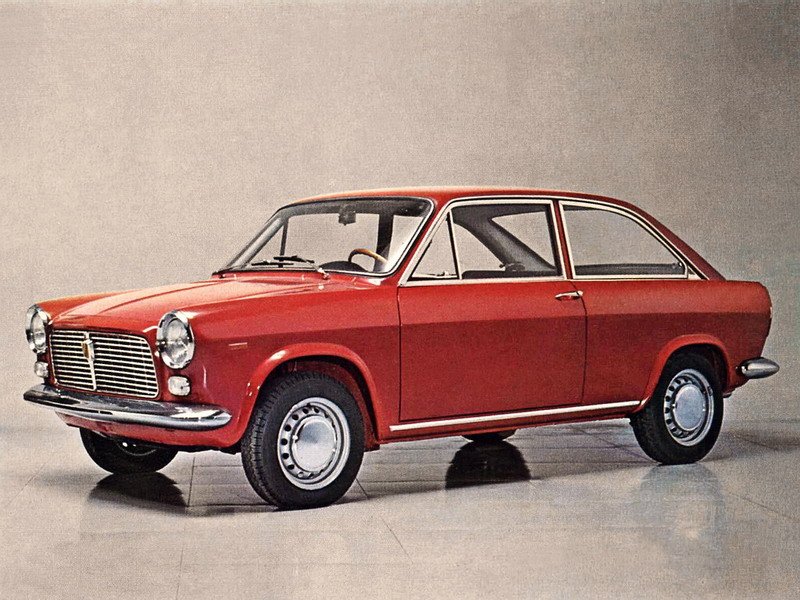
Production ran from 1964 to 1970. In 1968, with all of Autobianchi now in Fiat’s hands, a cleaner-lined coupe version arrived. But by then Turin already had what it wanted.
The medal goes to someone else
Because the Primula’s fate was written from the start: it was a test bed. Autobianchi existed inside the Fiat group precisely for that — to risk what Turin wouldn’t sign its name to. If front-wheel drive flopped, a second-string badge would burn. If it worked, Fiat would collect the reward under its own crest.
It worked. In 1969 Fiat launched the 128 with the layout already validated by the Primula: transverse engine, end-on gearbox, front-wheel drive. The 128 was named European Car of the Year 1970 and became a global bestseller, the benchmark of its class, the car that taught all of Europe how to build front-drive compacts. Its direct predecessor, the one that had done the dirty work and carried the risk, went out of production that same year without a single laurel.
The Primula died the year its heir received the honors. It wasn’t even a dramatic, loud death — just a quiet retirement, the fate of a tool that’s done its job and gets put back in the drawer.
What the Primula teaches us about how history gets written
Autobianchi’s car division vanished in the nineties, absorbed by Lancia. The Mini became a cultural icon — a movie star, a cult object, a multimillion-dollar relaunch under BMW. The Fiat 128 sits in every book as the compact that defined an era. And the Primula, which made half that history possible, is a footnote known only to the deeply initiated.
It’s a textbook case of how credit gets handed out in this industry. Not by who solved the problem, but by who had the name, the marketing, and the cover story at the right moment. Lardone had the idea in 1928 and died in 1961 without seeing it on the road. Giacosa rescued it and validated it in a car Fiat considered expendable. And the applause went to a foreign rival on one side and a later in-house model on the other.
The NEC take
Ours, no anesthetic.
The Primula is proof that in the car world, as in almost everything, history isn’t written by whoever’s right. It’s written by whoever holds the microphone.
Let’s run the facts, because they’re irrefutable and anyone can check them. The mechanical layout every front-wheel-drive car on the planet uses today — gearbox beside the engine, separate housings — is not the Mini’s. It’s the Primula’s. The Mini shared oil between engine and gearbox, a solution nobody repeated in mass production. And yet ask anyone on the street who invented the transverse front-wheel-drive car and they’ll say the Mini. Nobody will say the Primula. Almost nobody will know what it is.
Careful, though, because this is where the easy trap lies: none of this means the Mini is overrated as a car. The Mini was first, it was a packaging masterpiece, and it changed the world. It deserves every bit of praise it’s received. Our claim is more precise, and that’s exactly why it stings: the technical solution that won and survived to today wasn’t the Mini’s — it was the Italian car nobody remembers. Those are two different statements, and confusing them is what makes arguments about this end badly. The Mini won the fame. The Primula won the engineering.
And then there’s Lardone, the part that should genuinely shame the industry. A man who saw the future in 1928, who was fired in 1931 over a fire caused by a fuel leak that had nothing to do with his design, who carried thirty years of blame for a taboo built on an error, who was brought back to work on the very technology he’d been banned for, and who died before he could see the car that finally proved him right. If that isn’t movie material, we don’t know what is.
Next time someone tells you about the genius of Issigonis — and he was one — remind them that whatever car they drive carries inside it the solution of a Turin engineer who got fired over a fire that wasn’t his fault. And that it was validated by a brand Fiat treated as its liability insurance.
Vindication, sometimes, takes thirty years to arrive. And when it arrives, it arrives too late for the one who was right.
Check you’re still alive.