Fiat 500 Topolino: the car Mussolini asked for and Hitler copied

Every car has a story. This one starts with two dictators eyeing each other in 1930.
Benito Mussolini calls Giovanni Agnelli to Rome and tells him — with that particular flavour of authoritarian politeness that comes when the answer isn’t optional — that Italy needs to be motorised. That a car has to be built for less than 5,000 lire. A car for the average Italian. A car that summarises the modernity of the regime. Agnelli nods, drives back to Turin, and hands the problem down the line to the Fiat engineering office. Let them figure out how to build a car for 5,000 lire. He’d done his bit for Rome.
Three years later, in January 1933, one Adolf Hitler is appointed Chancellor of the Reich. And one of his first obsessions — because dictators, it turns out, have very similar taste — is to have his own people’s car. He calls in Ferdinand Porsche. He tells him he needs a car that costs less than 1,000 marks. A car for the average German. A car that summarises the modernity of the regime. That commission, taken directly from the Italian example on the table, will eventually become the Volkswagen Käfer. The Beetle.
Two cars, two dictatorships, one question underneath: how do you build a car for everyone when nobody has money?
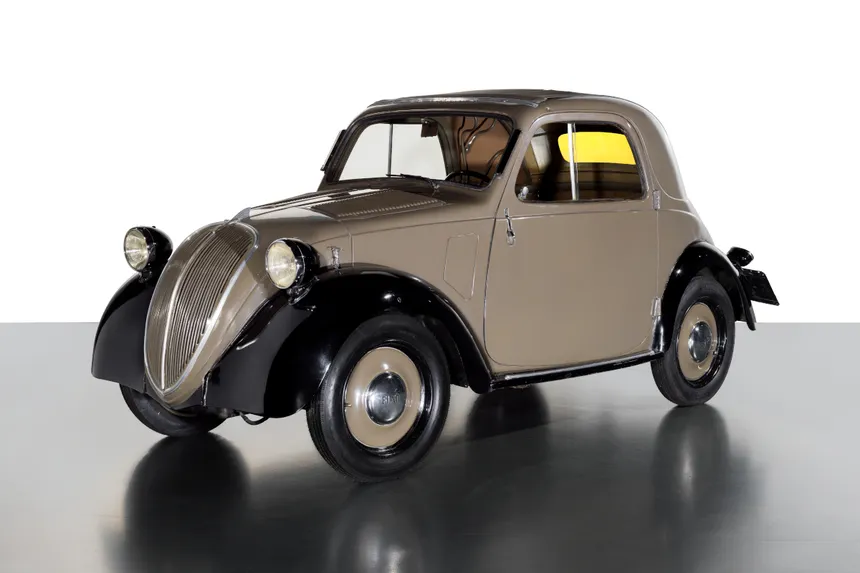
The Italian answer is from 1936. It’s called the Fiat 500. And the whole world knows it as the Topolino.
From aircraft engines to a people’s car
In 1934, in the technical office of the Lingotto factory, two schools of thought are fighting over how to solve the brief. The first is led by Antonio Fessia, technical director: front engine, front-wheel drive. Almost visionary for 1934. The second is more conservative: front engine, rear-wheel drive, because that’s what Fiat knows how to build.
Fessia wins the first round. He assigns the initial prototype to Oreste Lardone, one of his engineers. And this is where the story goes both comic and tragic. During the prototype’s road test — with Giovanni Agnelli himself on board — on the Cavoretto climb south of Turin, the engine catches fire. Everyone jumps clear. Agnelli — 68 years old, not in the mood for engine fires — fires Lardone on the spot and decrees that front-wheel drive is banned at Fiat for ever. That decree lasted 35 years, until the 128 broke it in 1969. But in the meantime, Fessia and his cutting-edge idea were out. The old-school layout was in.
And that’s where the man who would actually sign the car walks in.
Dante Giacosa is 29 years old in 1934. He’s not a car engineer. He comes from Fiat Aviazione — aircraft engines. He’s Fessia’s assistant on the Balilla project. Fessia himself — before he leaves Fiat for Lancia, where he’ll later sign the Flavia — hands Giacosa the small-car brief. “You’ll know what to do”, he essentially tells him. As if that were straightforward.
Giacosa inherits a poisoned project: front engine, rear-wheel drive (mandated), a ridiculous budget, a suffocating deadline, and a Senator Agnelli whose patience has been used up. And he does something only a former aircraft engineer would do. He designs by removing parts. He doesn’t add. He subtracts.
Extreme austerity engineering
This is where the Topolino becomes something to study seriously. Not because it’s beautiful — although it is — but because of what it doesn’t have.
No water pump. The radiator sits behind the engine (not in front) and coolant circulates by thermosiphon: hot water rises up to the radiator, cools, drops back down to the engine. No pump. No belt. No leaks.
No fuel pump. The tank sits above the carburettor and petrol falls into the engine by gravity. No electric pump. No mechanical pump. No fuel-delivery failures.
Almost no oil pump. There’s a minimal one, more of a flow device than a pressurised system. The oil gets distributed around the engine by splash — the moving connecting rods themselves throw it where it needs to go. It’s motorcycle lubrication from the 1920s applied to a 1936 saloon.
Engine: 569 cc, four cylinders in line, water-cooled, side-valve. 13 hp at 4,000 rpm. The block is cast in a single piece, cylinder head integrated — no separate head casting, no head gasket to fail, no coolant leaks between the two. That’s aircraft-engineer thinking. Where everyone else adds pieces to solve problems, Giacosa removes them.
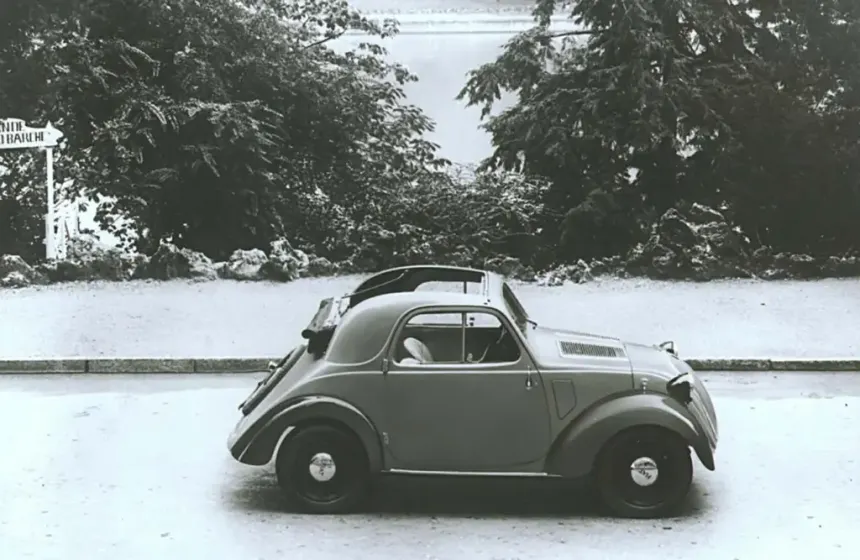
Chassis: two V-section beams running front to rear, ending before the rear axle. Rear suspension hangs from a single transverse quarter-elliptic leaf spring — one component, half a spring. The first 500 A got the nickname balestra corta (short crossbow) because of it. Simple to the point of insult.
The radiator behind the engine isn’t just about thermosiphon. It’s about aerodynamics. With no radiator up front, Giacosa could drop the bonnet line, giving the Topolino that sharp, tapered nose that no small car of 1936 had. Not the Beetle. Not the Austin Seven. Not the Citroën Trèfle. None of them. That’s Giacosa applying what he’d learned drawing fighter aircraft.
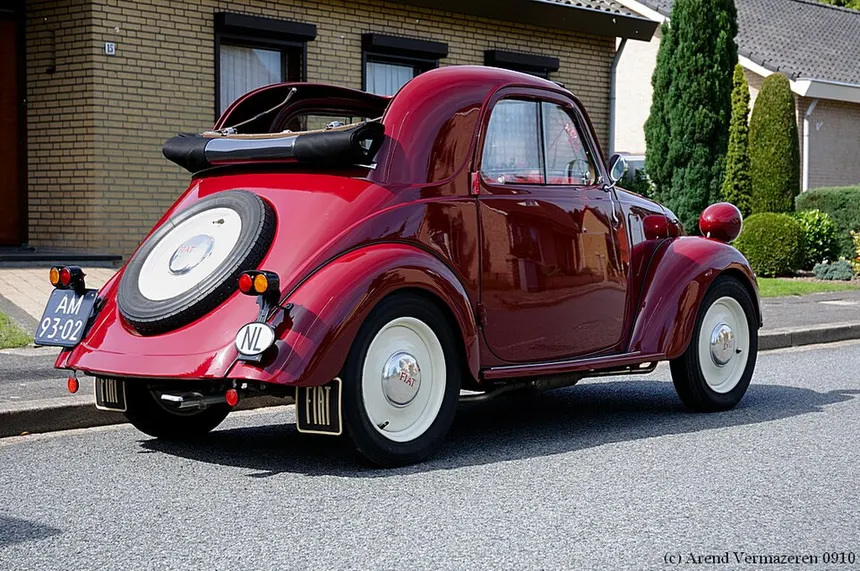
And those two round vertical headlights flanking the low nose are the reason for the nickname. Somebody in 1936 — nobody quite knows who — said that snout looked like Mickey Mouse (Topolino in Italian), with the ears sticking up. The name stuck instantly. Fiat never officially called it Topolino. The public did. And nobody called it anything else after that.
June 1936, launch day
The Topolino is officially unveiled in June 1936. Launch price: 9,750 lire. Nowhere near the 5,000 Mussolini had demanded. Over time the price came down to about 8,900 lire, but it never hit the political target. Mussolini was unhappy. Agnelli showed him the numbers. They left it there.
Even so, it was the cheapest car on the Italian market. Front-engined, rear-driven, 2 metres of wheelbase, 3.21 metres long, two seats, 745 kg, top speed 85 km/h. Fuel consumption around 6 litres per 100 km. Nine thousand seven hundred and fifty lire for a car that took a worker from home to the factory during the week and to the coast in the summer. A car people could afford. A car people could maintain. A car that didn’t break.
It sold like the crash of the market it was trying to save.
Series A, B, C
Like the 500 that came twenty years later, the Topolino had three official series over its production life.
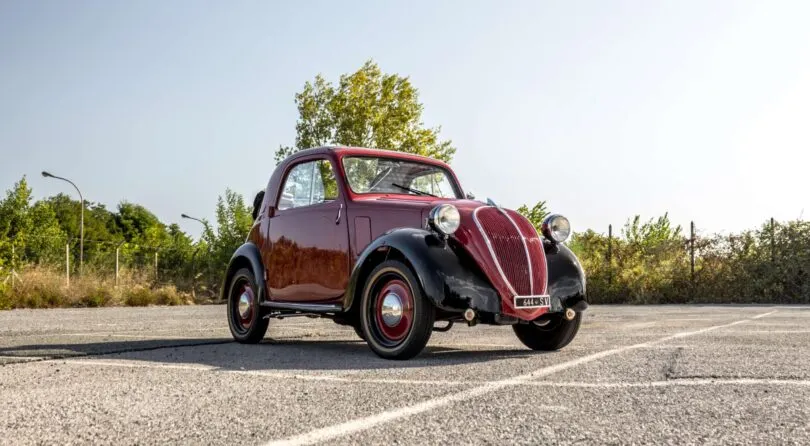
500 A (1936-1948). The original. 569 cc side-valve, 13 hp. Sold before the war and again from 1945 with the factories rebuilt. Twelve years in production, with the Second World War in the middle interrupting sales but not the model. When Germany invaded Poland in 1939, the Topolino had already been on the road for three years, embedded as the face of popular motorisation in Italy. When the war ended in 1945, it was the first car Fiat put back into production. Still valid. Still needed.
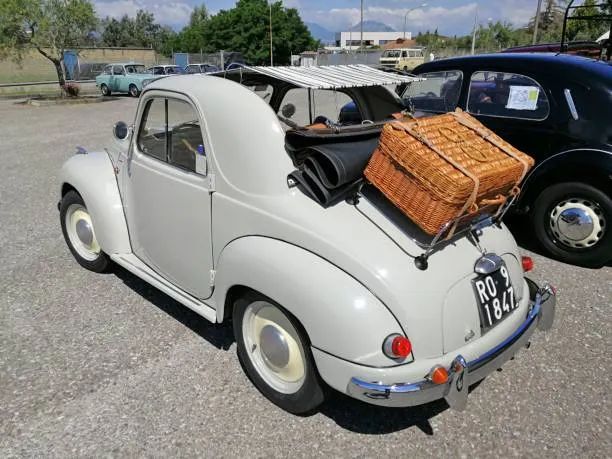
500 B (1948-1949). New engine, same 569 cc but now with overhead valves (OHV). 16 hp instead of 13. More air, more torque, better response. And crucially: the Giardiniera appears — the first-ever Fiat Giardiniera, a three-door estate with a woody-style body featuring real wood side panels (yes, painted wood). It was an idea borrowed from American station wagons, and it worked. The Topolino B Giardiniera opened the door to every Fiat Giardiniera that came afterwards. The 500 Giardiniera of 1960 has its roots here.
500 C (1949-1955). Major front-end restyle. Headlights integrated into the front wings (goodbye Mickey Mouse), single-piece bonnet without vertical slats, wider grille. Aesthetic modernisation to keep pace with 1950s design language. Mechanically, still the Topolino underneath. The C stayed in production until 1955, two years before the launch of the Nuova 500. When Giacosa’s new 500 — rear-engined, air-cooled twin — arrived in July 1957, the Topolino was already retired. But the signature was the same. Giacosa had gone from 29 years old on the Topolino to 50 on the Nuova 500. Two different cars, one engineer.
Roughly 520,000 Topolinos were built across the three series. Not a mass-motorisation figure like the classic 500 or the Polish 126p. But for 1936, for a country emerging from an economic crisis and about to enter a world war, half a million cars is a staggering number.
American hot rodders: the afterlife
Here’s a curious footnote most people don’t know. When the Topolino left production in 1955, it didn’t die. It crossed the Atlantic.
In the fifties and sixties, the American hot rod scene was in full swing. Kids with limited budgets and unlimited hunger for speed were looking for light shells to bolt Ford flatheads and small-block Chevys into. And the Topolino was perfect for it. It weighed 745 kg empty. It was short. It was narrow. And under that ridiculously small bonnet — designed for a 569 cc engine — you could actually, somehow, fit an American V8.
They called them T-Sedans. Even today, at American hot rod shows, you’ll see Topolinos in candy-red paint with V8s sticking out of the bonnet, cut-down exhausts, fat rear rubber. An Italian austerity utility car turned into a drag-strip menace. Giacosa’s chassis holding up to ten times the torque it was designed for. And not breaking. That’s the real test of a properly-engineered car.
What the Topolino left behind
Time for the balance sheet.
The Topolino was the first car Dante Giacosa signed as lead designer. From it came the 600 (1955), the 500 (1957), the 128 (1969), the 127 (1971). Five cars that motorised Italy across three decades. Without the Topolino, there’s no Giacosa as Fiat‘s chief designer. Fessia took the credit for having placed his bet on the young engineer, then walked off to Lancia. Giacosa stayed and signed the rest of the century.
The Topolino was the first European people’s car to reach real market scale. The Austin Seven had preceded it in concept but not in industrial ambition. The Volkswagen Käfer, commissioned by Hitler three years later with the Italian example openly on the table, went into series production in 1938 but almost all pre-war volume was military and political (the KdF-Wagen barely reached civilian buyers before the war). The Topolino was the first real European small car to land in the hands of the average citizen before 1940. And it stayed in production for twenty years with only two significant revisions.
The Topolino opened the door to the Giardiniera. It opened the door to the engineering-by-subtraction philosophy — don’t add, remove. It opened the door to the 500 of 1957, which Giacosa would build two decades later using the same philosophy pushed to the limit (rear engine, air cooling, two cylinders, 499 kg).
And most importantly, the Topolino consolidated something that would define Fiat’s identity for the next forty years: a people’s car isn’t a cheap car, it’s a solved car. A cheap car has the same parts as an expensive one, only worse. A solved car has fewer parts. That’s it. That’s why the Topolino had no water pump. That’s why the 500 had no radiator. That’s why Giugiaro‘s Panda of 1980 wore exposed plastics and right angles. That’s why the Uno of 1983 won Car of the Year. Every one of those cars is a descendant of Giacosa’s philosophy of subtraction.
It all starts with a low, tapered nose from 1936 with two round headlights that looked like mouse ears.
The tribute that wasn’t
In 2023, Stellantis unveiled an electric quadricycle called the Fiat Topolino. 8 hp. Top speed 45 km/h. Range 75 km. 5.5 kWh battery. It can be driven by fourteen-year-olds in some European countries. It’s a badge-engineered Citroën Ami. Same platform, same chassis, same electronics. Only the bodywork changes, with cosmetic references to the original Topolino.
It isn’t a car. Literally, in the EU L6e category, it’s a quadricycle with a Topolino sticker on the side. The same brand that in 1936 designed a small car with splash lubrication and thermosiphon cooling, in 2023 slaps Topolino on a shared product with Citroën and Opel, built in Morocco, sold to urban teenagers in rich European countries.
If Giacosa could see that tribute, he would sit down, pull out a pencil, and start counting how much steel, plastic and motor were unnecessary. He’d probably come back in two months with a real car for half the price. Because that’s what he did. Reduce. Solve. Sign.
The original Topolino had 13 hp, four cylinders and a top speed of 85 km/h. The 2023 “Topolino” has 8 hp, an electric motor, and won’t crack 45. Less car for more brand.
Happy anniversary, little one.
Check you’re still alive.