
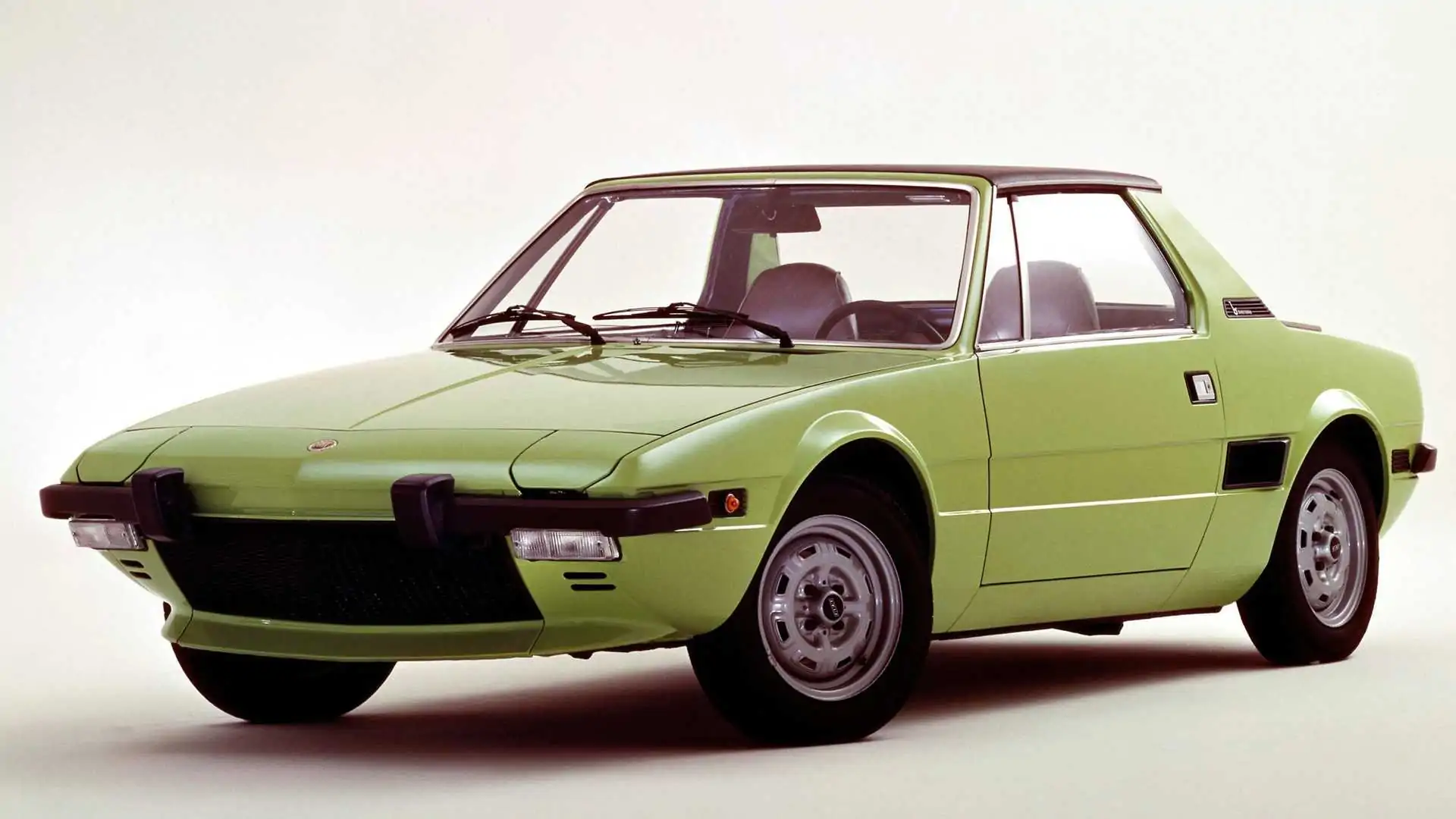
Fiat X1/9: the industrial mid-engine Bertone was hiding in a corner
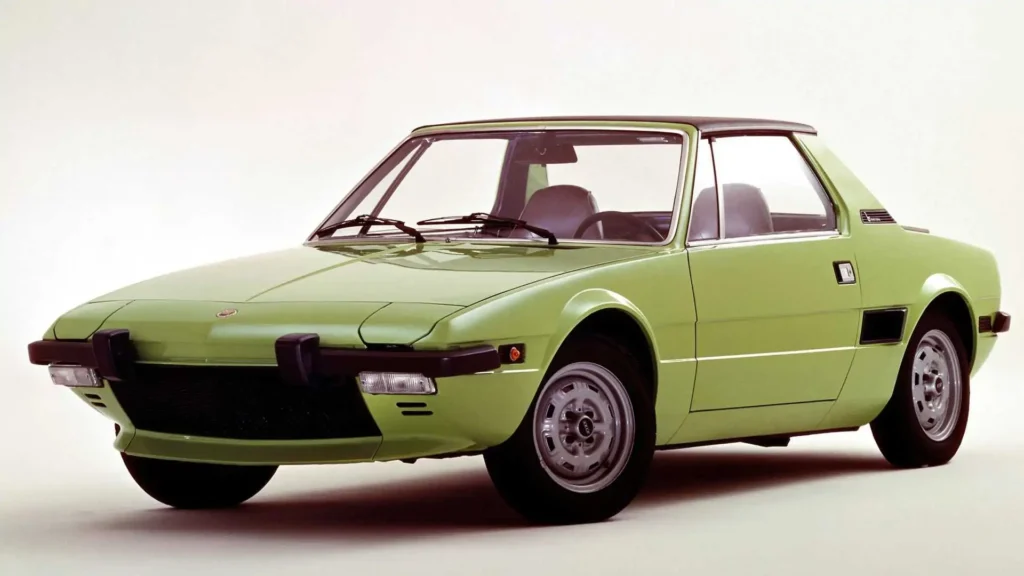
In 1971, Gianni Agnelli is making an informal visit to the Bertone factory in Grugliasco, on the outskirts of Turin. Nuccio Bertone walks him through the production halls, shows him models, talks him through current projects. And in a corner, between development cars and show prototypes, Agnelli stops dead.
A tiny two-seat wedge. Mid-engine, visibly mounted behind the cabin. Removable roof. Retractable headlights. Flat, aggressive shapes, almost powerboat-like. Covered in dust. Nobody quite knew what to do with it.
“What’s this?” Agnelli asks.
“An old prototype. The Runabout, from ’69. Based on the Autobianchi. We never really did anything with it.”
Agnelli stares at it for another five seconds. And then he makes the industrial decision that would change the history of the compact European sports car: this one is going to replace the 850 Spider. Industrialise it. Put it in the Fiat catalogue.
That dusty prototype was the seed of the Fiat X1/9. A car that, when it hit the road in December 1972, became the first mid-engined sports car ever designed from the outset for mass-production in the history of the automobile. Mid-engine layout at small-hatchback prices. Signed off by the same man who had signed the Lamborghini Miura and was about to sign the Countach.
Marcello Gandini: when genius gets bored
Context. Marcello Gandini has been Bertone‘s chief designer since 1965. In five years he has signed the Lamborghini Miura (1966, the definition of the modern supercar), the Alfa Romeo Montreal (1967), the Lancia Stratos Zero (1970, one of the most radical concepts in history). He’s at the peak. And he needs to have fun.
In 1969, Gandini draws the Autobianchi A112 Runabout. A concept barchetta, two-seater, mid-engine transverse, on the Autobianchi A112 platform (small car of the Fiat subsidiary). Length 3.52 m. Weight 660 kg. 1,116 cc, four-cylinder. Presented at the Turin Motor Show of 1969. The crowd looks, applauds, and moves on.
Bertone parks it in a corner. Autobianchi isn’t industrially set up to manufacture it — it’s a styling exercise, not a preproduction vehicle. At Fiat, officially, nobody is interested. The project sleeps for two years.
Then in 1971 comes Agnelli’s visit. And Agnelli — a businessman with a product eye — sees what nobody at Bertone or Fiat had wanted to see: this car is industrialisable, exportable, has a market in the United States, and is what Fiat needs to replace the 850 Spider.
Why it’s called X1/9
Very Italian detail. In Fiat during the seventies, experimental projects carried internal codes. Series X1 meant “passenger vehicles, experimental, series one”. And the following number was the order in which the projects had been started. The Fiat 127 had been project X1/2. The Fiat 130 had been X1/1. The Ritmo was to be X1/38. And the small mid-engine sports car that Agnelli had rescued from the dust at Bertone became the ninth experimental project in Series 1. X1/9.
It was supposed to be a provisional code. It was going to get a normal commercial name at launch. But when the launch came, someone in marketing decided that “X1/9” sounded more futuristic, more sporting, more unusual than any conventional name. It stuck. An Italian car sold in dealerships across the world with an internal department code as its commercial name. Only Fiat could do something like that.
December 1972, Targa Florio: the strange launch
The X1/9 wasn’t launched at a normal motor show. Fiat took it to the Targa Florio circuit in Sicily in December 1972. Theatrical location: the definitive Italian road-race track, at a moment when the Targa as a World Championship round was in its final years (it would die officially in 1977). Presenting a small mid-engined sports car there was a statement: this car is a racing toy for the road.
First-series specifications:
- Engine: 128 AS, inline four, 1,290 cc, SOHC (single overhead camshaft), mounted transversally in the mid-rear. 75 hp at 6,000 rpm.
- Transmission: 4-speed manual.
- Weight: 880 kg.
- Length: 3,830 mm.
- Wheelbase: 2,202 mm.
- 0-100 km/h: 12.7 seconds.
- Top speed: 170 km/h.
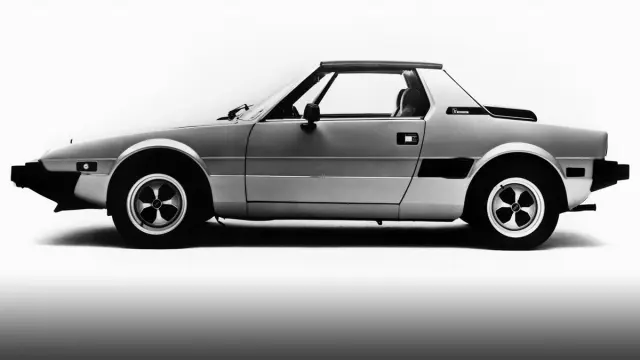
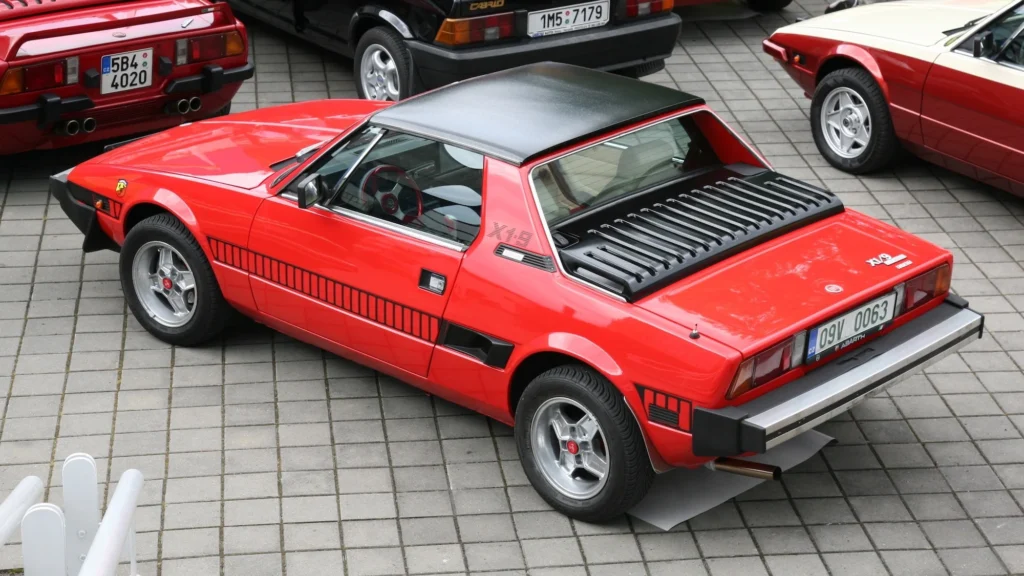
- Targa roof, removable, stored in the front compartment (which also served as boot).
- Retractable headlights, direct inheritance from Gandini’s concept.
- Two boots: one at the front, one behind the engine.
The brilliant engineering detail: it used the Fiat 128 platform backwards. The entire 128 mechanical set — transverse engine, gearbox, front subframe — was moved from the 128’s nose to the X1/9’s mid-rear. What was the driven front axle on the 128 became the driven rear axle on the X1/9. Industrial reuse engineering, pure and simple: same drivetrain group, different layout, transformed result. Without that trick, the X1/9 wouldn’t have existed. Fiat couldn’t afford to develop a specific engine and gearbox for a niche sports car.
And this is where the X1/9 becomes the direct heir to the Giacosa layout. The X1/9 uses exactly the same engine-transmission-differential set as the Autobianchi Primula of 1964 and the Fiat 128 of 1969, both signed off by Dante Giacosa. Without the Giacosa transverse FWD layout, there is no X1/9. It’s literally the same mechanical group, rotated 90 degrees and placed behind the driver.
Why it was revolutionary
Here’s the part many enthusiasts don’t know or underestimate.
Before the X1/9, mid-engined sports cars were artisanal builds: Lamborghini Miura (1966), Ferrari Dino 246 GT (1969), Maserati Bora (1971), De Tomaso Mangusta (1966). All of them with annual production in the low hundreds or tens. Prohibitive prices. None designed for large-series production.
The X1/9 was the first. First in the world. Mid-engine designed from the very start of the project for large-scale manufacturing. Bertone built the monocoque body in Grugliasco, shipped it to Fiat’s Lingotto for engine installation and final assembly. A mid-engine sports car coming off a normal industrial line, not a hand-build workshop.
And the other brutal detail, underplayed in Europe: it was the first Fiat designed from the outset to meet US safety regulations. The whole X1/9 — its integrated roll-over bar in the roof, its redesignable bumpers, its programmed deformation zones — was engineered to pass the Federal Motor Vehicle Safety Standards, which in 1972 were the strictest in the world. Fiat needed the American market. The X1/9 was the first Italian car designed to conquer it.
Ironically, due to bureaucratic delays, the X1/9 didn’t reach the US until 1974. For the first two years it was sold only in Europe. But once it landed in America, it became an instant success — it sold better there than in any other market. The US Fiat and Alfa dealer network ran it as a flagship. A lot of people in North America discovered what a mid-engine layout was for the first time by climbing into an X1/9.
1978: the big upgrade — 1500 cc and five speeds
After six years with the 1.3 engine, in 1978 Fiat updates it:
- 138.A2/A4 engine: 1,498 cc, SOHC, 85 hp. More torque at low revs.
- 5-speed manual gearbox (finally).
- Exterior redesign: bigger bumpers (US requirement), redesigned engine cover, rear spoiler.
- New interior: modernised dashboard, better ergonomics.
The X1/9 shifts from being a purely playful sports car to one that’s usable daily. And sales, especially in the US, take off. It’s during this period (1978-1982) that the X1/9 becomes the best-selling European sports car in its segment in North America.
1982: Fiat drops it, Bertone saves it
Here comes the strangest twist in the X1/9’s industrial history.
In 1982, Fiat decides the X1/9 has reached the end of its commercial life. The company wants to concentrate resources on higher-volume models. Also, the Fiat Uno is about to launch (1983), and Fiat needs to free up Lingotto capacity to build the new hatchback. Fiat announces the end of X1/9 production.
Bertone reacts. Nuccio Bertone believes the X1/9 still has a market, especially in the US, and offers to buy the production rights and manufacture the car in-house. Fiat accepts. Bertone takes over complete production: keeps the Fiat 1.5 engine, keeps the Fiat badge on the bonnet for the first years, then gradually changes the badging to put Bertone in place.
The Bertone X1/9 (1982-1989) keeps going for another seven years, now built entirely in Grugliasco. Minor improvements: better upholstery, more equipment, limited special editions (X1/9 Serie Speciale, X1/9 Gran Finale). The car ages but keeps a loyal buying club, especially in the American market.
Total production: ~140,500 units as Fiat X1/9 (1972-1982) and ~19,500 as Bertone X1/9 (1982-1989). 160,000 units total across 17 years of production. For a mid-engine sports car built to any real volume, that number is astonishing. Nothing equivalent in its segment had sold that much.
On the track: the small trophies
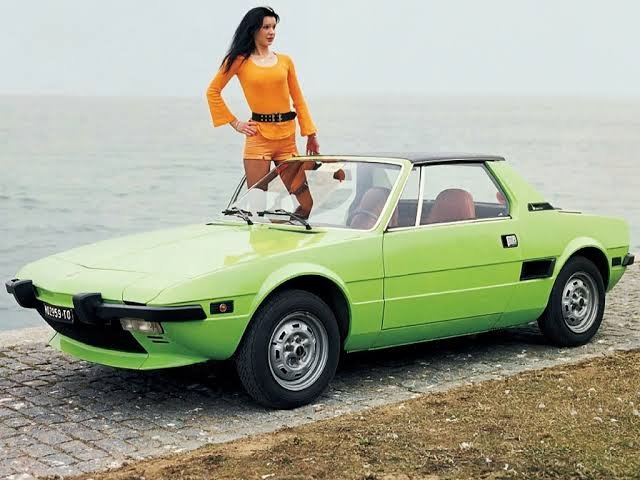
The X1/9 wasn’t designed for serious competition, but for one-make trophies and amateur rallies. Bertone-Fiat organised an X1/9 Trophy through the late seventies, similar to American Formula Ford. A relatively cheap car, tremendously fun, with mid-rear engine layout that teaches you to drive properly. Many Italian drivers who later reached F1 (Riccardo Patrese among them) passed through the X1/9 Trophy.
In rallies, the X1/9 never won at world level. But at national level it took plenty of victories, especially in the 1500 SC class. It faced rivals like the Lancia Beta Montecarlo — another Fiat/Lancia mid-engine sports car — which raced in bigger categories and won the World Championship for Sportscars in 1980 and 1981. But that’s a different story (and a different article).
The headlights trick
A detail owners loved: the retractable headlights. In closed position, the X1/9’s nose is completely flat and aerodynamic. When you switch the lights on, the round headlights deploy mechanically, revealing the “sleeper” face and giving the car a completely different expression. Same trick the Chevrolet Corvette C3 had used since 1968, that the Porsche 928 used from 1977, that the Lamborghini Countach used from 1974.
But on a car in the X1/9’s segment, retractable headlights were essentially a luxury. And they contributed to the car’s visual personality more than any other single design feature.
The Targa roof that fits in the boot
Another brilliant trick: the removable roof. A single rigid panel, held in place by two latches at the roll bar. In about 15 seconds, a passenger detaches it, folds it in, and stores it in the front boot — which was designed with a hollow exactly sized to accommodate it. In winter, the roof stays mounted and the front boot is used normally. In summer, the roof goes into storage and the car works as a spider.
Industrial detail: the front boot was small precisely because the roof had to fit into it. A buyer who wanted a pure roadster with a big trunk bought an Alfa Spider. A buyer who wanted a small coupé with removable roof and two small boots bought an X1/9. Fiat didn’t try to compromise — it made two different cars for two different types of buyer.
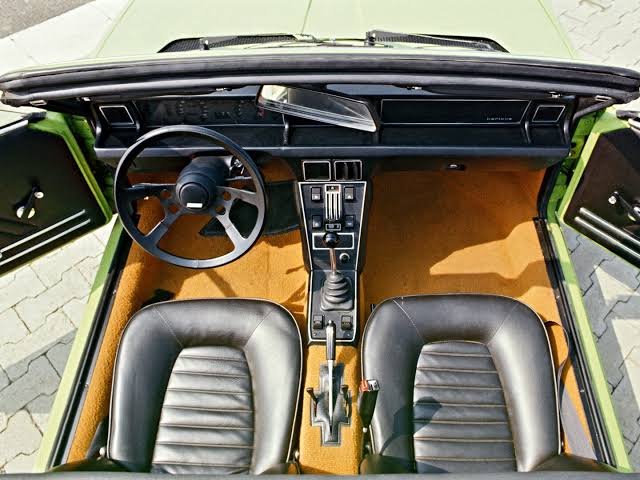
The “problem” with the X1/9
Let’s be honest. The X1/9 had two real problems that owners recognised then and now:
First: rust. X1/9s rusted. And not a little. They rusted enough that finding a structurally-solid X1/9 today is difficult. Rear wheel arches, sills, floor pan, roll-bar hoop — all zones where the metal gave up. An industrial failing of Fiat of the era that also affected the 128, 127 and Uno.
Second: the 1.3 engine was marginal. 75 hp, 12.7 seconds to 100 km/h. In 1972 that was acceptable. In 1978, with the arrival of the Golf GTI, it was outclassed. The 1.5 engine partly corrected it, but the X1/9 was never fast in a straight line. It was fast in corners — and that was its charm. A car where 85 hp was enough because the chassis extracted every last one.
What’s left of the X1/9
Prices today:
- X1/9 1.3 (1972-1978) in good condition: EUR 8,000 – 18,000
- X1/9 1.5 Fiat (1978-1982) in good condition: EUR 10,000 – 22,000
- Bertone X1/9 Gran Finale: EUR 15,000 – 30,000
- Exceptional examples (low miles, concours restoration): up to EUR 40,000 – 50,000
Compared with what other sports cars of the era go for (Lotus Europa, Alpine A310, even a Porsche 924), the X1/9 remains cheap. A mid-engined Italian sports car designed by Gandini, for less than a used Golf. The best-value bargain in the European classic market.
And yet, very few know it. Outside Italian and American enthusiast circles (where the X1/9 has a very strong fan club), it’s a car the mainstream classic market ignores. It rarely appears at concours d’elegance. It never turns up in popular “legendary sports cars” lists. Overshadowed by the older brother (Lamborghini) and the younger brother (Fiat 500). Neither fish nor flesh.
But that’s exactly where its value sits. It’s the only mid-engined sports car designed from scratch for mass production in the history of the automobile. Ferrari, Lamborghini and Maserati did artisanship. Fiat, with Bertone and Gandini’s help, did industry. It sold 160,000 units of a car that technically belonged to the exotic supercar world.
Without the X1/9, there’s no Toyota MR2 (1984, the first Japanese production mid-engine — shamelessly inspired by the X1/9). No Pontiac Fiero (1984). No Honda Beat (1991). No MG-F (1995). The X1/9 opened that industrial category. And today nobody remembers.
Rescued from the corner
There’s an image that sums up this whole story. A prototype covered in dust in a corner of a Turin factory. A businessman with a nose for product who stops and asks what it is. A decision to industrialise what looked like a styling exercise. And seventeen years of production and 160,000 units later, a car that defined an entire industrial category worldwide.
If Gianni Agnelli had walked through Bertone that day without looking at that corner, there would be no X1/9. And probably the “compact mid-engine mass-production sports car” segment wouldn’t exist as we know it.
The industrially important cars of history don’t always start from a blueprint. Sometimes they start from the eye of a businessman who stops in the right place and asks the right question.
Check you’re still alive.