Ferrari F355: The Car Honda Forced Into Existence
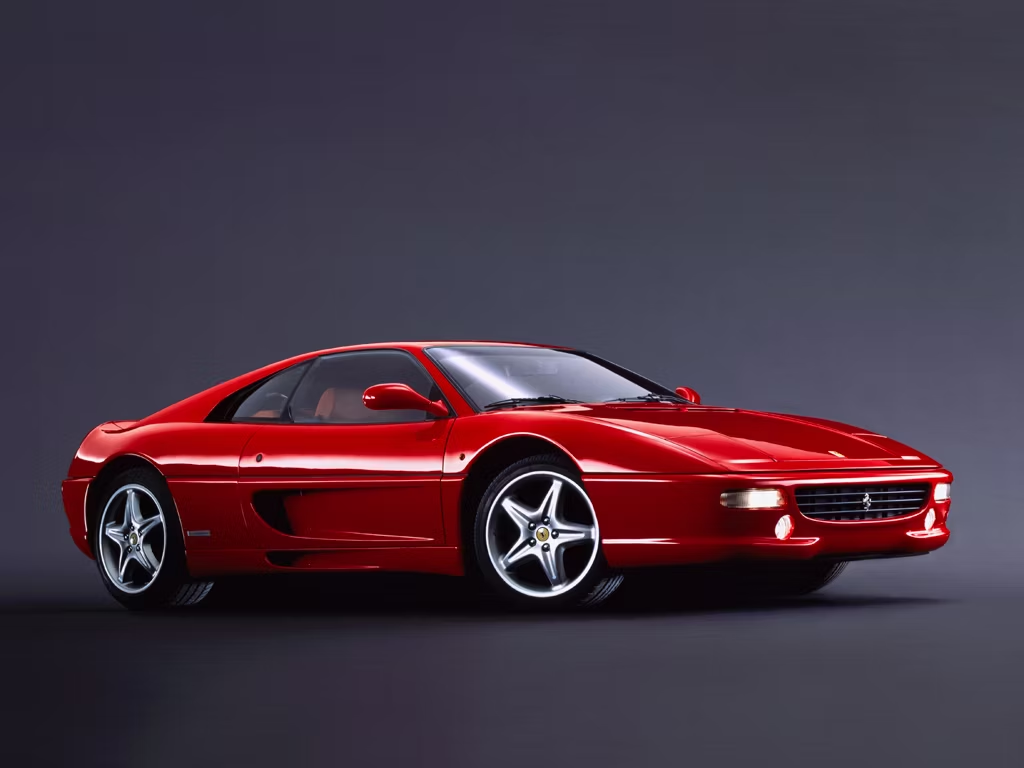
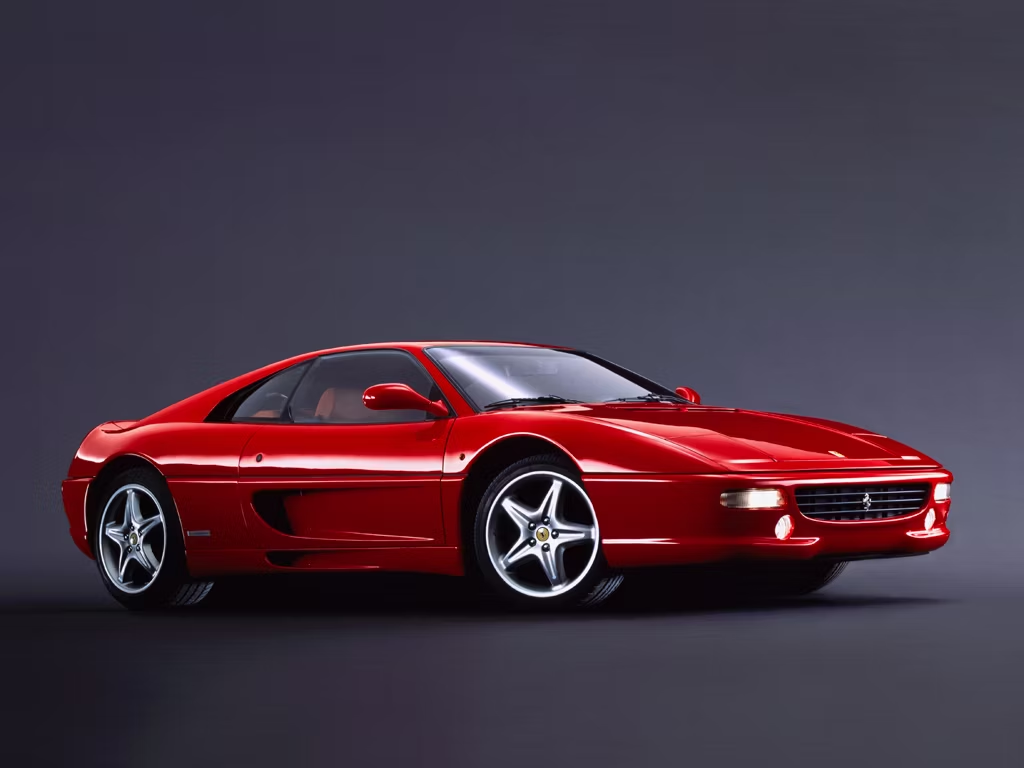
The most beloved Ferrari of the 1990s exists because a Japanese company embarrassed Maranello.
That is the part of the story that gets skipped. People talk about the sound, the five valves, the Pininfarina lines. Far less gets said about the state Ferrari was actually in when this car was commissioned, and about who had held up the mirror.
Ferrari in 1991 was a company in trouble
Enzo Ferrari died in August 1988, and his death automatically handed Fiat control of 90 percent of the company, leaving the remaining 10 percent with Piero Ferrari.
What Luca Cordero di Montezemolo found when he took the presidency on November 15, 1991 was not a brand at its peak. He has described it without decoration: the Maranello factory was obsolete, the engines sat behind the cabin and were hard to work on, and the model range was dated.
The catalog backed him up. Ferrari was selling variations of a Testarossa already seven years old, a Mondial much of the specialist press dismissed, and a 348 that had taken serious criticism for both performance and handling. The F40 was magnificent, but the F40 was not the business. The eight-cylinder entry car was the business.
There is an anecdote in circulation about those months, in which Montezemolo was beaten away from a stoplight by a Golf GTI while driving his own 348 and returned to the factory demanding a car worthy of the badge. It is repeated widely without solid documentary sourcing, so it belongs here as what it is: factory folklore, not fact.
The mirror was called NSX
What is documented is where the real humiliation came from.
Honda launched the NSX in 1990. A mid-engined sports car with an aluminum chassis, developed with Ayrton Senna’s input during testing, that did what a Ferrari did and also started every time, did not cook its occupants, and could be driven to work daily without drama.
The 348 was heading for a beating in every comparison test against it. And that is the point that changes the story: until then, reliability and usability were treated as somebody else’s problem, a tax the Italian sports car buyer paid happily. Honda proved the tax was optional.
The F355 is Maranello’s answer to that demonstration. Not to Lamborghini. Not to Porsche. To Honda.
Five valves per cylinder, and the reason for them
The engine is a 90-degree V8 mounted longitudinally amidships, 3,496 cc, 380 hp, which works out to 109 hp per liter. For 1994, that specific output from a naturally aspirated road engine was extraordinary.
The key is the head: twin overhead cams and five valves per cylinder, three intake and two exhaust. The logic is breathing. Three small intake valves offer more total port area than two large ones and each weighs less, which lets the engine rev higher without the valvetrain losing control. With titanium connecting rods, a flat-plane crank, dry sump lubrication and Bosch engine management, it ran to 8,500 rpm.
That is where the sound this car is remembered for comes from. It is not an acoustic affectation. It is what a flat-plane V8 does when it spins that fast.
The name breaks the rules again
Ferrari had spent decades naming cars by displacement, and changed the system here too. The 355 is 3.5 liters and five valves per cylinder. The company was pleased enough with the cylinder head to put it in the badge.
That is the third different naming system in this series of articles. The Daytona was a 365 GTB/4 for the displacement of one cylinder. The 512 BB used total capacity and cylinder count. The F355 mixes liters and valves.
One more detail: when the F1 gearbox arrived in 1997, the leading F was dropped, because F355 F1 was redundant. Those cars are badged 355 F1.
The flat floor is the real breakthrough
The conversation about the F355 almost always stops at the engine, and the more significant improvement is underneath it.
The car introduced a flat undertray with a diffuser derived directly from Formula 1 aerodynamic work. Air passing beneath the car accelerates and creates low pressure, pulling the car toward the road without a wing that would spoil the shape and add drag.
That is downforce for free in aesthetic and top-speed terms. It explains why the F355 holds together at speed in a way the 348 never managed, far more than the power increase does.
The chassis remained a steel monocoque with a tubular steel rear subframe carrying the engine and suspension. Front and rear used unequal-length double wishbones with coil springs over electronically adjustable two-mode gas dampers. Eighteen-inch magnesium wheels, ventilated discs, ABS.
Two-mode dampers, and why they mattered
One chassis detail that gets a passing mention and was uncommon in 1994: the telescopic gas dampers were electronically adjustable across two operating modes.
That sounds trivial today because every hatchback has drive modes. At the time it was the direct answer to the criticism Honda had exposed. A mid-engined sports car could have a firm setting for a track and a livable one for a real road, without forcing the owner to pick one forever at the point of purchase.
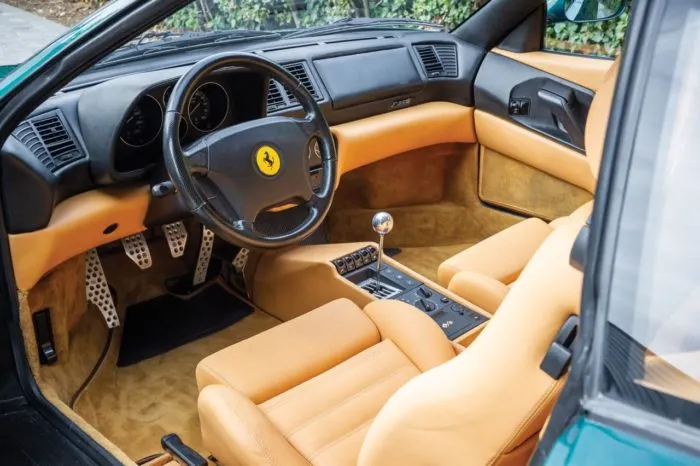
It came alongside a change the spec sheets capture badly: the cabin. The F355 expanded interior space over the 348 to the point of being usable even for tall drivers, which had been a routine complaint about the previous generation. It is an improvement with no romance attached to it, and it explains a good share of the commercial success.
Berlinetta, GTS and Spider
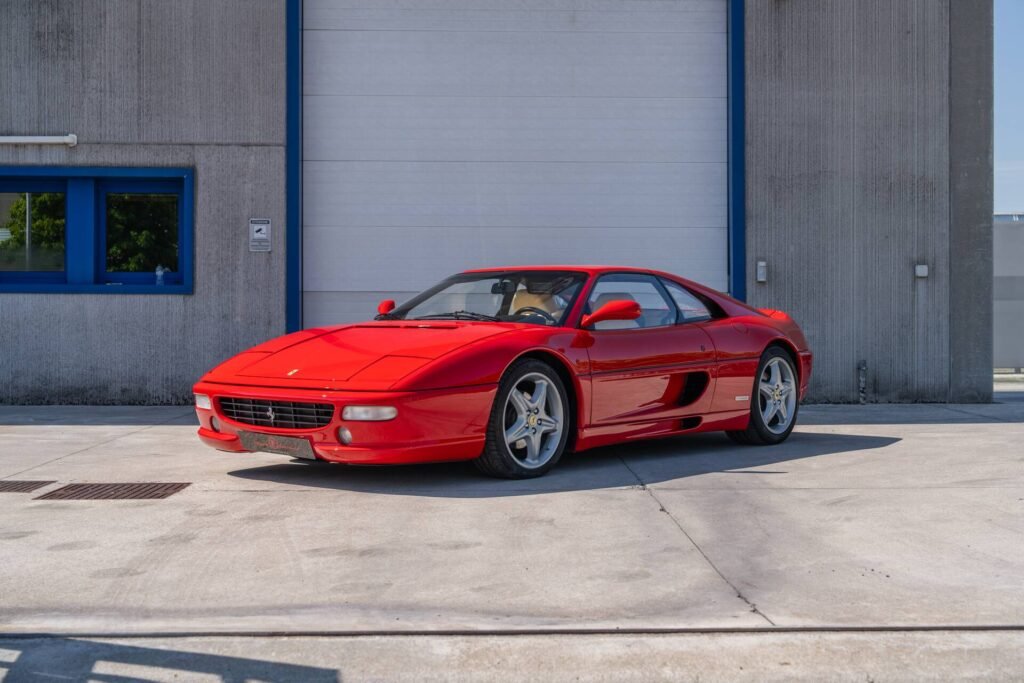
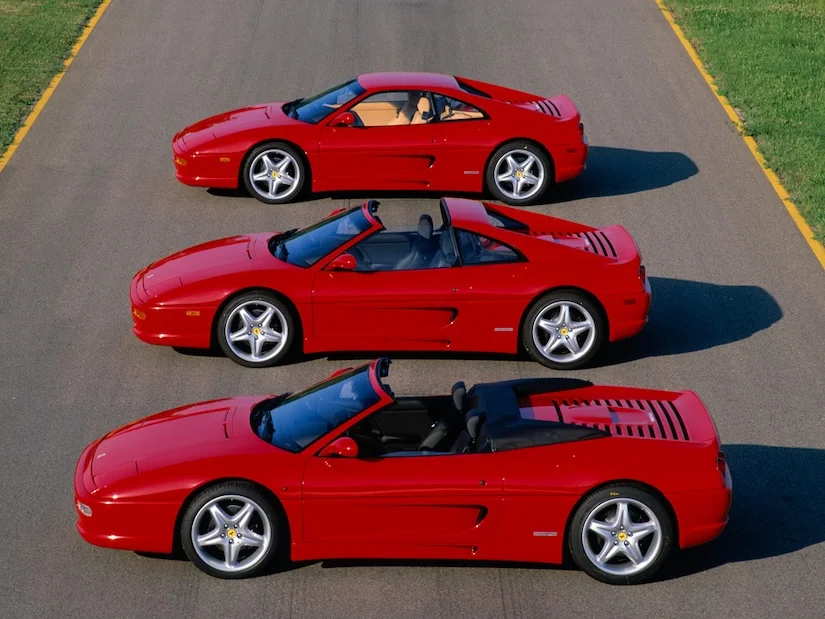
The range launched with two bodies and grew to three. The Berlinetta is the closed coupe. The GTS is the targa, with a removable roof panel that stows behind the seats. In 1995 the Spider arrived, a full convertible with a powered top.
Preferences have shifted over the years. When the car was new, the GTS offered the sensible compromise between rigidity and open air. Today the market rewards the manual Berlinetta above everything else, and the most sought-after cars are exactly the ones combining closed bodywork, six speeds and the aluminum gate.
1997: paddles behind the wheel
The second industry-changing innovation arrived three years after launch.
In 1997 Ferrari offered the 355 with a sequential transmission operated by paddles behind the steering wheel, derived from Formula 1, right to upshift and left to downshift. It was the first time a Ferrari road car offered it, at a premium of roughly £6,000 in the UK.
It coexisted with the six-speed manual and its aluminum gate, which is the selling point of the most sought-after cars today. But the direction was set. From there to the complete disappearance of the shift lever at Ferrari took a little over a decade.
The last Ferrari bodied by hand in Modena
The F355 closes an industrial chapter. It was the last Ferrari with hand-built coachwork produced in Modena, before the full industrialization that arrived with the 360 Modena and its Alcoa-developed aluminum monocoque.
It was also a volume success. Around 11,273 cars were built between 1994 and 1999 across three bodies: Berlinetta, GTS targa and, from 1995, Spider. It was the most-produced Ferrari in history to that point.
For scale: the entire Berlinetta Boxer family managed roughly 2,300 cars across eleven years. The F355 did almost five times that in five.
The invoice the legend leaves out
Here is what to have in front of you before buying one, because the car that fixed the 348’s faults shipped with two design faults of its own that Ferrari never corrected.
The first is the exhaust manifolds. The tubing is bent in manufacture until it becomes relatively thin, and it runs at very high temperature, so the metal eventually cracks. Plenty of specialist mechanics describe the failure rate as effectively one hundred percent, and the symptom is a ticking at idle. The trouble is that this is a design fault Ferrari never redesigned, so fitting the original factory part means it will happen again, with units running around £1,000 per side.
The second is the bronze valve guides, prone to wear, particularly on early cars. The true scope is disputed even among specialists, with conservative estimates putting roughly 20 percent of cars as affected, and most sources placing the fix in later production. When it does happen, the repair reaches five figures.
Both intersect with the belt service, which on the F355 requires removing the engine from the car. The usual range runs $6,000 to $8,000 every three to five years, and that intervention is precisely when the valve guides should be addressed, because doing it separately drives the cost up sharply.
Three more line items belong in the budget before you sign. Rear tires wear quickly, with lives around seven thousand miles under enthusiastic use against roughly fifteen thousand for the fronts, at prices that add up fast. Catalytic converters can fail and cascade into further repairs. And on F1-equipped cars, servicing the hydraulic pump and actuators runs somewhere between $1,500 and $4,000 depending on how tired the system is.
There is also a minor quirk worth knowing so you do not mistake it for a fault: on many cars the throttle pedal resists at the top of its travel, which makes crawling in traffic awkward until you adapt. Early cars used a slightly different mechanism that can be updated, but Ferrari never fully corrected it, and most specialists simply lubricate the linkage at each service.
Translated into buying advice: on this car the folder of receipts matters more than the odometer. A cheap example with no documented engine-out service is not a bargain, it is a deferred invoice.
The gray-market inheritance
American buyers get one advantage here that the earlier cars in this series never offered. Unlike the Berlinetta Boxer, which Ferrari never federalized and which reached the US one car at a time through private importers, the F355 was sold new through official US channels.
That matters for provenance. On a Boxer, sorting out what an importer did to a car in 1979 is part of the purchase. On an F355, the paperwork you need is service history rather than compliance archaeology, and dealer networks that supported the car when new still support it now.
The verdict
The F355 is always told as the moment Ferrari became Ferrari again. It was. But the complete reading is less flattering and more interesting.
Ferrari became Ferrari again because a Japanese company that built commuter cars proved you could make a mid-engined sports car without forcing the owner to choose between excitement and function. Maranello reacted, and reacted well: five valves, 8,500 rpm, a Formula 1 flat floor and, three years later, the gearbox that eventually killed the shift lever across the entire industry. It is one of the most complete technical answers the company has ever produced.
What spoils the heroic version is that this same car left the factory with manifolds that crack by design and valve guides that wear, and that Ferrari never redesigned the offending part. The lesson from Honda was learned halfway: the technical ambition got copied, and the boring part, making things last, was left on the table.
Thirty years on, the F355 is worth what it is worth for the sound and the shape, and it still costs what it costs for the same two faults.
How many cars celebrated as perfect would survive us reading the invoices instead of the spec sheets?
Check you’re still alive.