Alfonso de Portago: The Spanish Marquis Who Tried to Live a Hundred Years in Twenty-Eight
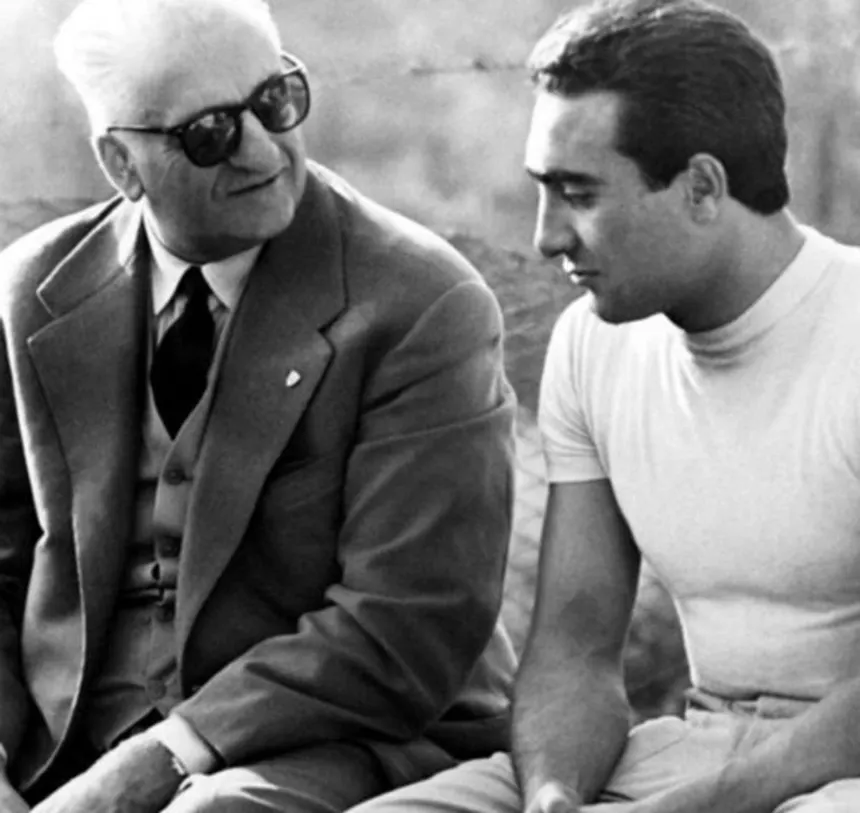
Adam Driver’s Ferrari put a Brazilian actor named Gabriel Leone in the role of a Spanish marquis most American audiences had never heard of, and that’s the injustice this piece is here to fix. Alfonso de Portago wasn’t a side character in Enzo Ferrari‘s story. He was a bobsled pioneer, a jockey at Aintree, a Formula 1 driver, a reckless amateur pilot, and the center of a New York-London-Mexico City love triangle that ended on an Italian road with nine dead bystanders and Ferrari’s owner in a Brescia courtroom facing manslaughter charges. And a good chunk of his life ran straight through American money, American women, and American gossip columns.
An Irish Nurse, an American Fortune, and a King for a Godfather
Born October 11, 1928, in London, Alfonso Antonio Vicente Eduardo Angel Blas Francisco de Borja Cabeza de Vaca y Leighton was baptized with Spain’s King Alfonso XIII as his godfather, which is where his first name came from. His father, Antonio Cabeza de Vaca y Carvajal, 10th Marquess of Portago, was a top-level golfer and a regular at the Monte Carlo tables who died of a heart attack mid-polo match. His mother, Olga Beatrice Leighton, was an Irish nurse who had previously been the young widow of Frank MacKey, the American financier who founded Household Finance Corporation — one of the biggest consumer credit companies in the United States. She brought a sizable American fortune into the marriage. Portago’s grandfather had been mayor of Madrid and a government minister. When his father died, Alfonso inherited the marquessate before he turned thirteen. He grew up split between Madrid, Biarritz, London, and New York rather than settled in Spain full-time, but he kept family property there and always raced under the Spanish flag — it was Spain’s team he built for the Olympics — even though he spent most of the year somewhere else.
The Bet Under London Bridge
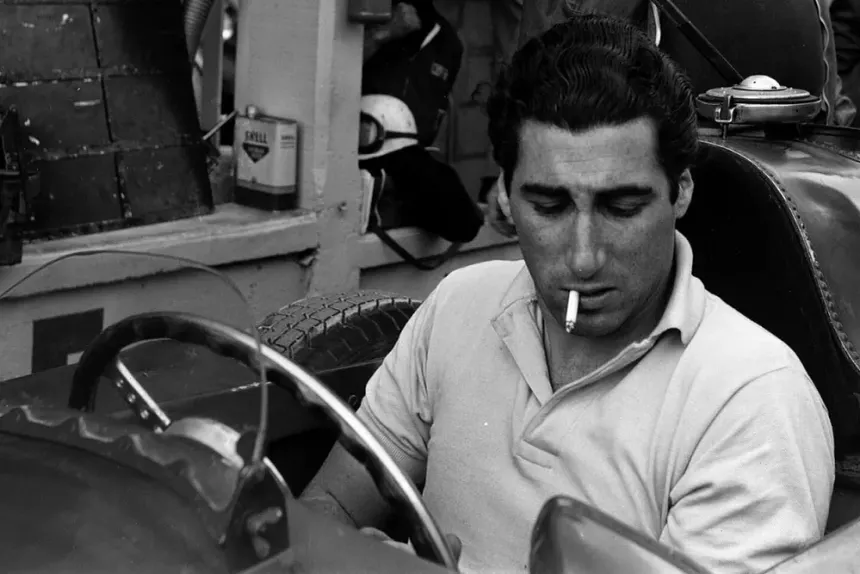
At seventeen, he took a $500 bet to fly a borrowed plane under a bridge over the Thames in London, with no license and no permission from anyone. He won the bet and a reputation for recklessness he never shook. He spoke four languages fluently, played competition-level bridge, boxed, played polo and jai alai, stood nearly six-foot-two, and was photographed relentlessly by the illustrated press of the 1950s. British motorsport writer Gregor Grant, of Autosport magazine, put it this way: “A man like Portago appears only once in a generation… he does everything fabulously well. Never mind the driving, the steeplechasing, the bobsledding… never mind being fluent in four languages.”
The Most Complete Athlete of His Generation
In 1956, Portago and a group of cousins — including Vicente Sartorius — founded Spain’s first-ever bobsled team, from a country with essentially no winter-sports tradition, to compete at the Cortina d’Ampezzo Winter Olympics. The two-man sled finished fourth, sixteen hundredths of a second off the bronze medal; the four-man sled came in ninth. A year later he took bronze at the World Championships in St. Moritz. He also rode, at least once on record, as a gentleman jockey in England’s Grand National at Aintree: in the 1952 running he rode Icy Calm, pulled up at fence 24. No other Spanish nobleman of his era came close to that kind of athletic range — and Formula 1 hadn’t even entered the picture yet.
From Co-Driver to Works Ferrari Driver
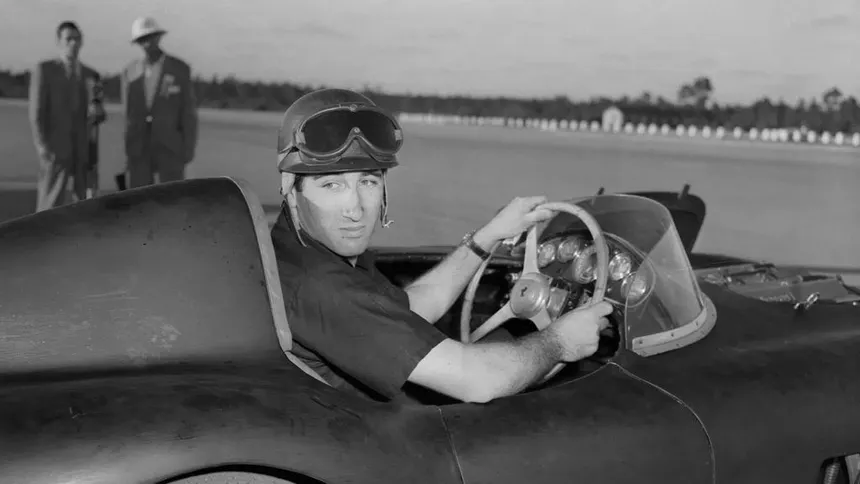
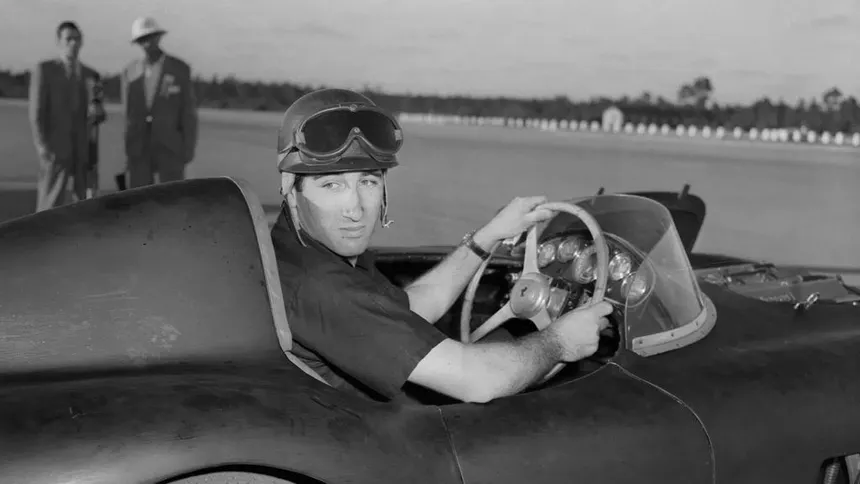
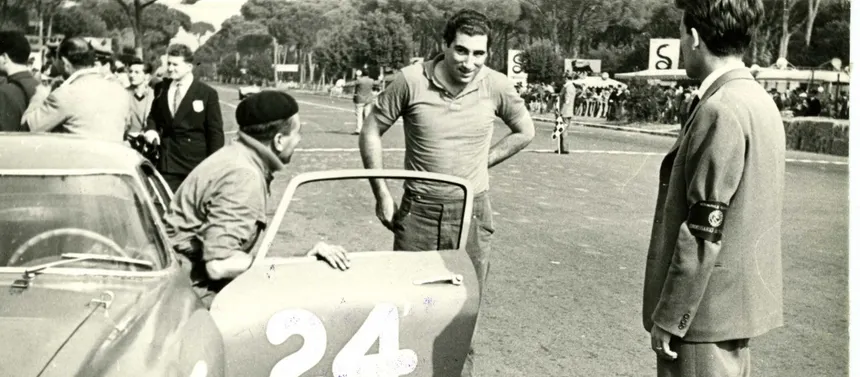
Portago first showed up at the 1953 Carrera Panamericana in Mexico as Luigi Chinetti’s co-driver — Ferrari’s American importer — without getting behind the wheel himself. The experience hooked him enough to buy an Osca, then a Ferrari 750 Monza, to try the race himself the following year; he retired within the first 200 kilometers of the 1954 Panamericana. His first real competitive result came weeks later, at the 1954 Buenos Aires 1000km, sharing a Ferrari 250 MM with American driver Harry Schell to finish second. The opening at the Ferrari works team came in early 1956, when Luigi Musso got injured and Ferrari called Portago in to cover for him — and never let him go. Biographers credit him with as many as six major race wins, though only four are documented by name: the Tour de France Automobile, the Oporto Grand Prix, and the Nassau Governor’s Cup twice over. He also ran the 24 Hours of Le Mans and the 12 Hours of Sebring. The paddock called him “a two-car man,” on account of the burned-out brakes, clutches, transmissions, and wrecked bodywork he racked up race after race. In 1955 at Silverstone, he was thrown from his Ferrari at 140 km/h after hitting an oil patch and broke his leg. It didn’t slow him down.
Spain’s First F1 Podium — Shared, and Earned Anyway
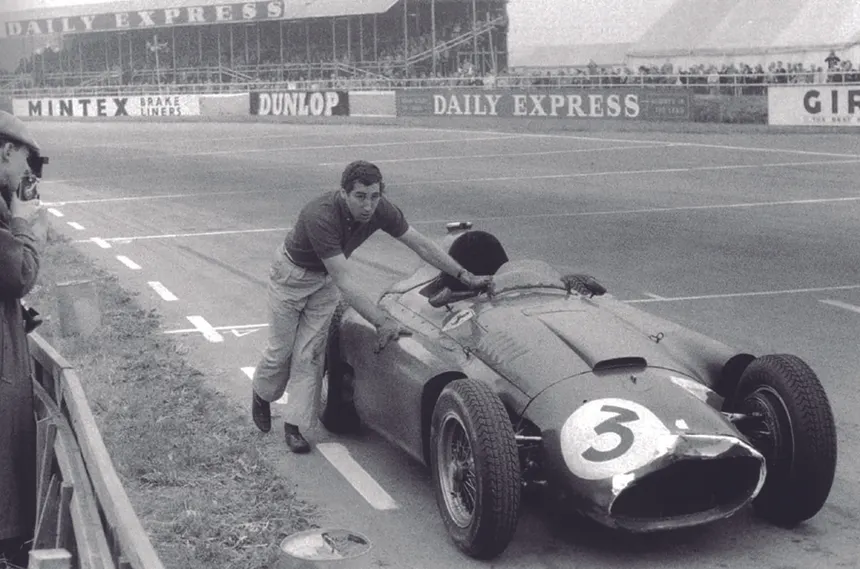
Portago debuted in the 1956 Formula 1 World Championship with Scuderia Ferrari, driving the Lancia D50 — a car Ferrari had inherited when Lancia withdrew from racing. His 1956 teammates were Juan Manuel Fangio, already a multiple champion, Peter Collins, Luigi Musso, and Eugenio Castellotti. At the British Grand Prix at Silverstone, Portago drove seventy of the race’s 101 laps before handing the car to Collins for the final thirty; the resulting second-place finish was split between them, six championship points apiece, under the era’s rule allowing mid-race driver swaps. That made Portago, in effect, the first Spaniard ever to reach an F1 podium — shared car or not. He finished fifth at the 1957 Argentine Grand Prix.
Of that 1956 Ferrari lineup, only Fangio would die of old age. Eugenio Castellotti, considered the best Italian driver since Ascari and the winner of the 1956 Mille Miglia, died on March 14, 1957 — two months before Portago — testing a Grand Prix car at the Modena airfield on Enzo Ferrari’s own instructions, chasing a lap record; he hit a curb, was thrown from the car, and died instantly. Luigi Musso, who’d joined Ferrari from Maserati in 1956, crashed fatally at the 1958 French Grand Prix in Reims on July 6, chasing his own teammate Mike Hawthorn. Peter Collins — the same Collins who’d shared that Silverstone podium with Portago — died a month later, on August 3, 1958, running wide at the Nürburgring during the German Grand Prix and hitting a tree.
An American Wife, an American Supermodel, and Hollywood’s First Bond Girl
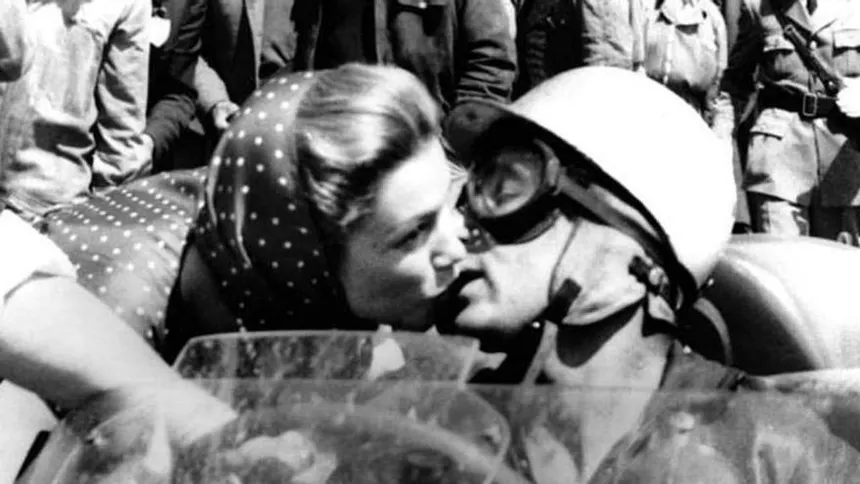
In 1949, freshly twenty-one, Portago married American model Carroll McDaniel. They barely knew each other. They had two children, Andrea and Antonio, and the marriage quietly fell apart over the years without ever being formally dissolved while he was alive. At the same time, he carried on a long, on-and-off affair dating back to the early 1950s with New York supermodel Dorian Leigh — sister of fellow model Suzy Parker — and went through a Mexican wedding ceremony with her that carried no legal weight since he was still married to McDaniel. He and Leigh had a son, Kim, born in Switzerland in September 1955, whose existence stayed secret until Suzy Parker herself told gossip columnist Louella Parsons about him just days after Portago’s death in 1957. Kim grew up largely without his father; as an adult he struggled with addiction and died in New York in 1977, at twenty-two. At the time of Portago’s death, he was in the middle of divorcing McDaniel to legitimize the relationship with Leigh. He was also, since mid-1956 — a month after she divorced actor Tyrone Power — involved with actress Linda Christian, who three years earlier had played Valerie Mathis in the 1954 CBS television adaptation of Casino Royale, making her the screen’s first Bond girl, well before Ursula Andress. Christian was photographed kissing Portago minutes before he climbed into his car for his final race; the picture became known as “the kiss of death,” and Life magazine ran it with the caption: “Death finally takes the man who courted it.”
The Warning Nobody Wanted to Hear
The 1957 Mille Miglia wasn’t just another race for Ferrari — it counted toward the World Sportscar Championship, and Maserati was ahead after the season’s first two rounds: Ferrari had scored in Buenos Aires when Maserati’s leading car retired, but Maserati won Sebring outright while Ferrari struggled with brakes and tires. Enzo Ferrari, who considered the Mille Miglia the toughest and most beautiful race on the calendar, needed the points and pushed Portago to enter. Unusually for him, Portago voiced doubts before the start: a thousand kilometers of public road, with no way to memorize every curve or surface change, struck him as a different kind of risk than a closed circuit. His co-driver, American Edmund Nelson, wasn’t optimistic about his odds either, reportedly saying Portago wouldn’t reach thirty, because “every time he comes back from a race, the front of the car is dented from pushing people out of the way at 130 mph.”
Guidizzolo
On the straight between Cerlongo and Guidizzolo, less than 70 kilometers from the finish in Brescia, the left front tire on Portago’s Ferrari 335 S blew out on May 12, 1957, at over 240 km/h. The car hit a pole, jumped a canal, crossed back over it, and plowed into the crowd lining the unprotected roadside. Portago, Nelson, and nine spectators died, five of them children — among the victims were six-year-old Valentino Rigon and his nine-year-old sister Virginia. A concrete milestone marker torn loose by the impact killed two of the children, and twenty more bystanders were injured. Portago’s body was found split in two beneath his own car. The New York Times ran the crash on its front page with a diagram of the wreck. It wasn’t even the only fatal crash of that Mille Miglia: Dutch driver Josef Göttgens died separately near Florence the same day, after his Triumph TR3 went off the road. Ferrari, with no real opposition left after Maserati’s Jean Behra crashed and Stirling Moss retired later that season, went on to win the manufacturers’ title anyway.
Eleven Manslaughter Counts and a Cat’s Eye for an Alibi
Three days later, the Italian government banned all racing on open public roads; the Mille Miglia never ran in its original format again. Enzo Ferrari was charged with eleven counts of manslaughter. The trial dragged on for more than three years, until a new panel of engineers hired by the defense convinced the court that the tire had failed after striking a “cat’s eye” — a reflective road stud embedded in the asphalt — rather than through tire wear or negligence on Ferrari’s part. He was acquitted in 1961. The Vatican’s newspaper, L’Osservatore Romano, wasn’t shy about it, comparing Ferrari to Saturn: “a modern captain of industry who still devours his children.”
What Happened to the Title
The marquessate didn’t die with him. It passed first to his son, Antonio Alfonso Cabeza de Vaca y McDaniel, 12th Marquess, who died in 1990 with no male heir; then to his sister, Andrea Cabeza de Vaca y McDaniel, 13th Marchioness; and from her to Antonio’s daughter, Theodora Cabeza de Vaca, today’s 14th Marchioness of Portago. Back home, what’s left of him is mostly corner 9 at the Jarama circuit outside Madrid, opened July 1, 1967, which still carries his name — a fast, blind left-hander that demands commitment before you can see the exit, not unlike the way his rivals said he drove. It’s about the only corner of Spanish motorsport where his name still circulates outside the history books, despite him being the first Spaniard ever to reach an F1 podium, with Spanish participation in the championship staying scarce for decades after him.
What the Movie Left Out
Michael Mann’s 2023 film, adapted from Brock Yates’s biography of Enzo Ferrari, gave American audiences their first real exposure to Portago in decades, but it compresses him into what the story needs him to be: a handsome factory driver circling toward a famous crash. It skips the Olympic bobsled program, the Grand National ride, the multilingual bridge-and-boxing résumé that made his own rivals call him the most complete athlete of the era. It also skips Kim, the son nobody in the family talked about until Louella Parsons’s gossip column broke the story days after the crash. None of that fits neatly into a two-hour movie about a car company. It fits into a life that ran in five directions at once and stopped short of finishing any of them.
A man who builds a bobsled program from scratch for a country with no snow culture, rides the Grand National, splits an F1 podium with the reigning world champion, and still finds time for two marriages that were never quite legal wasn’t an aristocrat playing dress-up as an athlete — he was the last of a breed of total sportsman that modern specialization made extinct. A road stud killed him, not a lack of talent. And motor racing needed nine more bodies on the shoulder of an Italian highway, five of them children, to finally learn what it already knew: that speed with no barrier between the car and the crowd isn’t romance, it’s a headstone waiting on a date. How many more Guidizzolos did it take, after this one, before anybody figured out a spectator on the roadside isn’t scenery?
Check you’re still alive.