Ginetta: The Sports Car That Lived by Hiding the Instructions
Most American gearheads have never heard the name Ginetta. That’s not your fault — the little British marque barely crossed the Atlantic. But here’s the hook worth staying for: this is a company whose entire business model, for years, hung on one gloriously absurd detail. They weren’t allowed to put the assembly instructions in the box. The day the law forced them to, the car died. And behind that daft little loophole sits one of the noblest and most infuriating stories in British motoring — four brothers who spent thirty-one years turning a profit on their own steam while the nation’s industrial giant collapsed on a diet of taxpayer handouts. Pour yourself something. This one’s good.
Four brothers and a farm
The story begins, like so many great car stories, nowhere near a car. It begins on the land.
In 1958, in Woodbridge — a town in Suffolk, out in the rural east of England — four brothers named Walklett were working as agricultural engineers. Bob, Douglas, Ivor and Trevers. They earned their living from farm machinery, not automobiles. But they were the kind of men motors get under the skin of, real enthusiasts, and the youngest, Ivor, did what plenty of handy young men did in 1950s Britain: he built himself a car.
There’s a parallel here I love. Regular readers will remember the Goggomobil, which came out of a Bavarian family of seed-drill makers. The Walkletts came from exactly that same world — agricultural machinery — only in the English countryside. Two different corners of Europe, the same root: land people with dirt under their nails who end up building cars. It’s no coincidence. The man who can fix a combine harvester can build just about anything.
Ivor’s first car was a roadster mounted on the underpinnings of a pre-war Wolseley Hornet. Later, when they got the company going, they chose to number the models from that first homemade contraption, even though it no longer existed. That’s why the first one is called the G1 — applied retroactively. The only surviving proof of it is a sketch drawn by Ivor’s own hand. That’s how artisanal this was. A pencil drawing and a lot of graft.
And the way the brothers split the work is pure family workshop. Bob ran the business, the numbers, the management side. Douglas handled the mechanical and electrical engineering. Ivor designed the cars. And Trevers styled them, shaped the bodywork, working shoulder to shoulder with Ivor. Four brothers, four jobs, one table. No departments, no org chart. A family and a shed.
The G4, the little one that bit the big boys
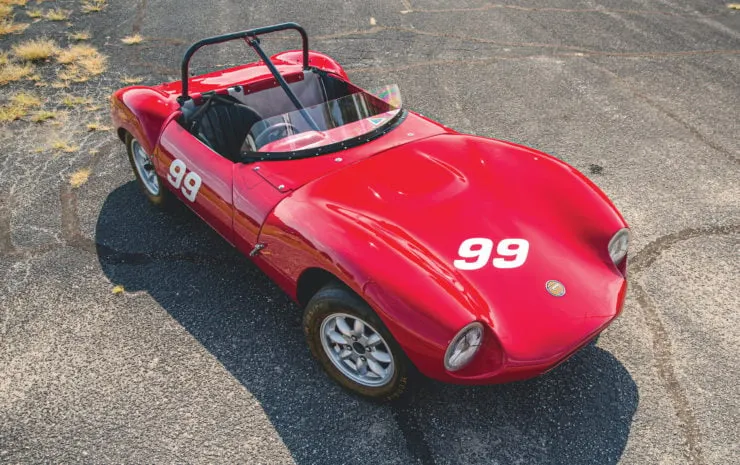
The first Ginettas, the G2 and G3, were essentially competition machines built for the track. But in 1961 came the one that changed everything: the Ginetta G4.
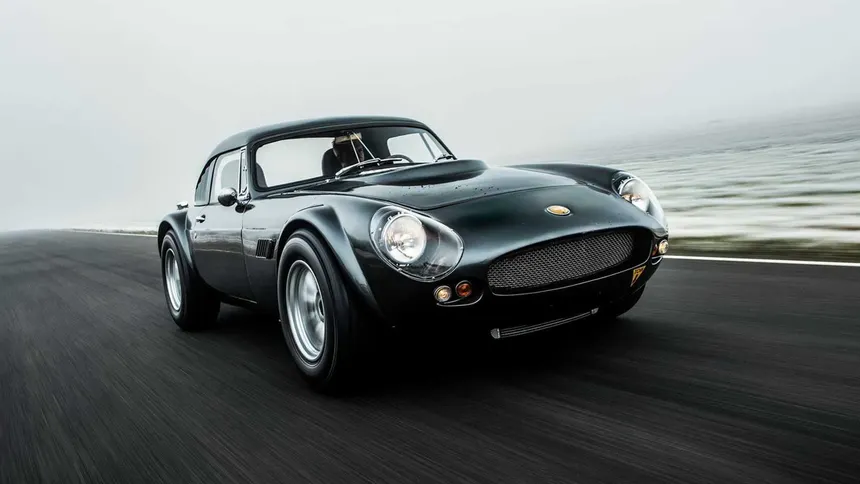
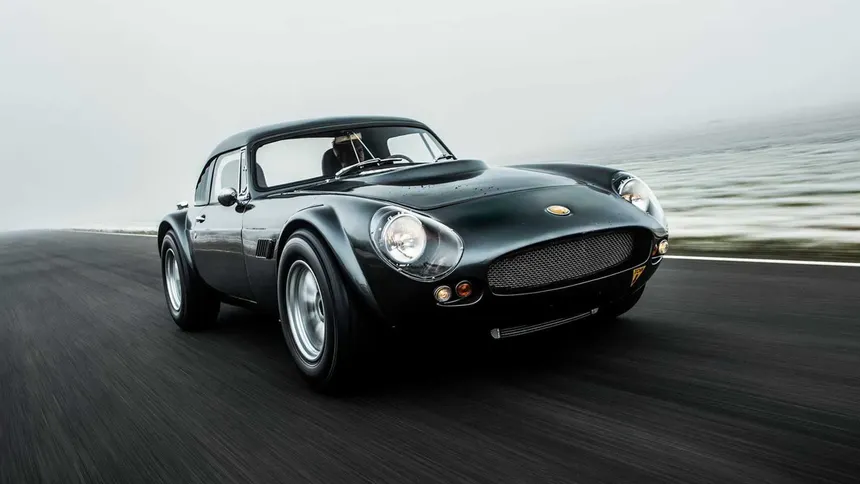
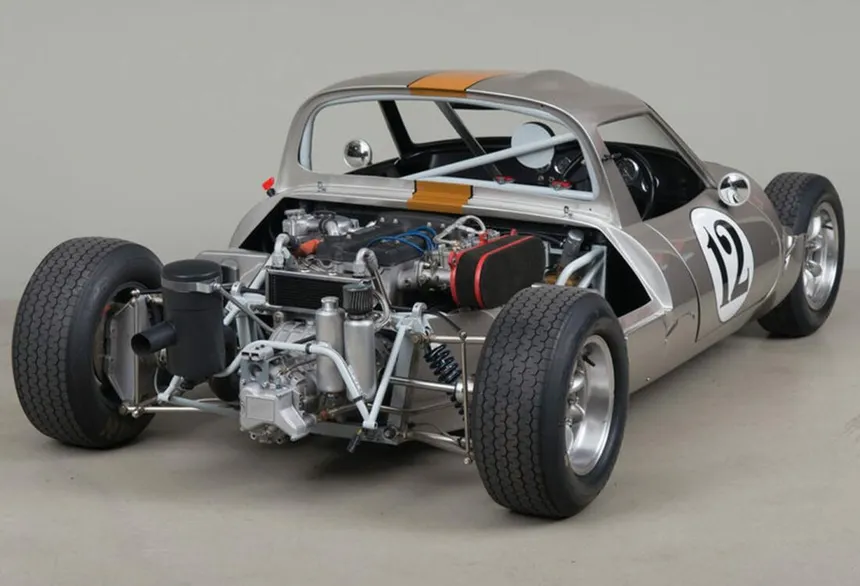
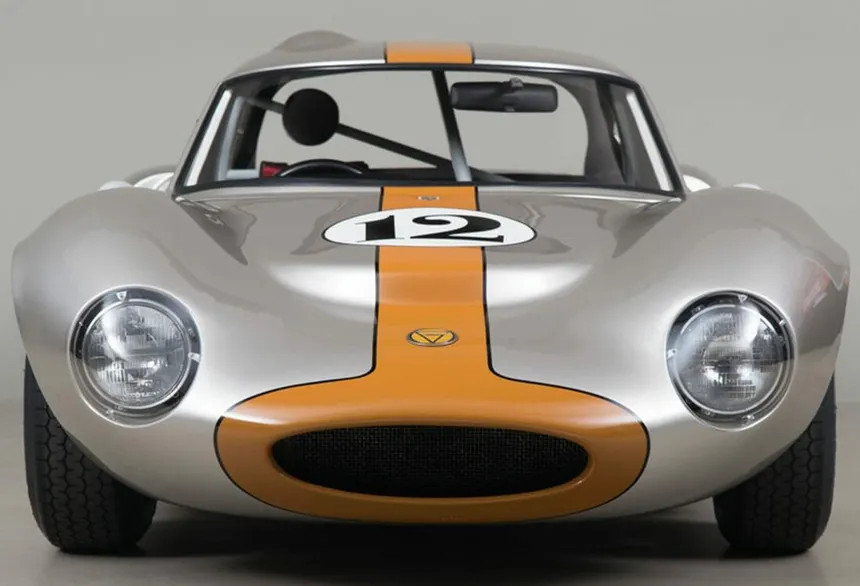
The G4 was a piece of British clockwork. A lightweight tubular steel chassis, a fiberglass body, and the new Ford 105E engine — the same four-cylinder that powered the humble Ford Anglia. It weighed next to nothing, somewhere between 385 and 580 kilograms depending on spec, which is roughly 850 to 1,280 pounds. To put that in American terms: a contemporary MGB tipped the scales at around 2,000 pounds, and a small-block Cobra was heavier still. The G4 could weigh little more than a third of a Cobra and carried a proper sports engine. Physics doesn’t lie. Low weight plus a decent motor equals a car that flies.
And the beauty of the G4 — what made it genuinely special — is that it did both jobs. On Saturday you drove it to the track, entered a club race, and handed a beating to cars from huge marques with huge budgets. On Sunday you drove it home on the road, easy as you like. A race car with license plates. That duality — win on the weekend, run errands on Monday — is the heart of what Ginetta always was. Real cars, for real driving, built by people who really drove.
The G4 put Ginetta on the map and proved to the British public that this tiny young company, run out of a shed in a village, could take on far bigger manufacturers on track. Not with money. With cleverness and with pounds shaved off.
The ambition ran deep, too. In 1965 the brothers built the G10, a 4.7-liter Ford V8 sports car aimed squarely at rivaling the AC Cobra — a Suffolk shed taking a swing at the most feared sports car of the age. Homologation troubles killed it, and it was tamed into the MGB-engined G11, but the sheer nerve of it tells you everything about who these people were.
The crack in the law that held it all up
Now comes the part this article is named for. The loophole. The absurd little detail the whole operation rested on.
In the Britain of those years there was a tax called Purchase Tax — a levy on the sale of goods — and it landed hard on cars, sometimes adding a brutal chunk to the final price. But there was a crack in the law, one of those gaps someone spots and an entire industry pours through. Purchase Tax applied to finished products. So what happened if the car wasn’t finished? If it was sold to you in pieces, to assemble yourself at home?
It escaped the tax. A car sold as a kit — in boxes, for the buyer to assemble in his own garage — wasn’t legally a finished car, and therefore dodged Purchase Tax. The saving ran to around twenty percent. Enormous.
That’s where the entire British kit-car industry was born and flourished, and Ginetta rode that wave better than anyone. But there was a condition, and it’s the one that turns this into a bar-stool story. For the taxman to accept that the thing really was a kit and not a finished car in disguise, the manufacturer couldn’t give you the assembly instructions. If a step-by-step manual came in the box, the revenue treated it as a complete car merely taken apart for convenience, and slapped the tax right back on.
So the makers performed real juggling acts. They’d sell you every last part — but not the manual with the steps. Sometimes they slipped it to you separately, sometimes they published it elsewhere, sometimes they simply trusted the customer was handy enough. The car that wasn’t allowed to tell you how it went together. The most serious engineering, propped up on the silliest tax trick you can imagine.
The G15, the jewel that flew on the trick
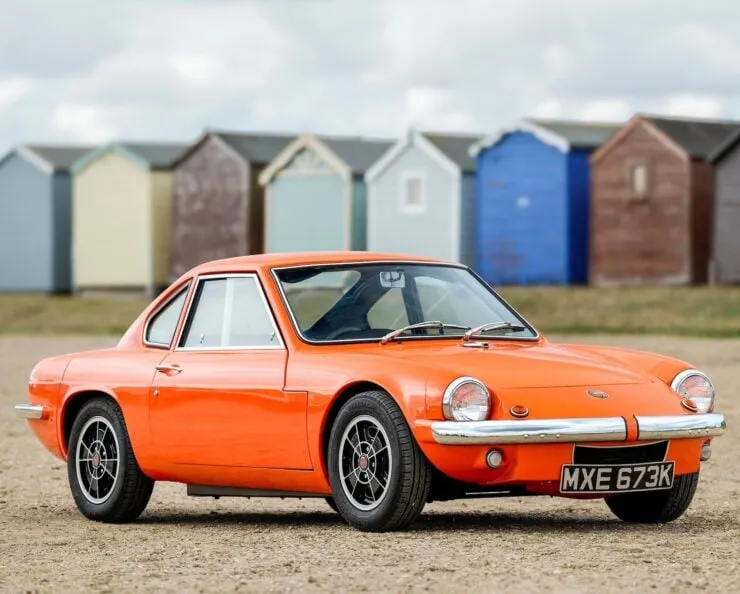
Out of that logic came, in 1967, what would be the best-selling Ginetta in the company’s entire history: the G15. It’s also one of the prettiest small coupes ever built. A perfectly proportioned little gem.
The G15 carried its engine in the back — a small 875cc Hillman Imp unit, an all-aluminum motor derived, of all things, from a Coventry Climax design, the firm that built Formula engines. That little motor, in a car weighing around half a ton, pushed hard: it nudged 100 mph, and with the optional 998cc engine it climbed toward 115. A tiny, light, nimble car that was genuinely quick, not fake quick.
And like every child of the era, the G15 lived on other people’s parts bins and its own ingenuity. To keep it cheap, Ginetta raided the shelves of the entire British industry. See those door handles? Off a Morris Marina. Whatever it took, from wherever it came, as long as the price stayed low. Bought as a kit, dodging Purchase Tax, a G15 cost you around 800 pounds. Fully built, it went over a thousand. The difference was the legal crack. Without the crack, there was no business.
More than 800 G15s were sold. For a company that size — one village, one shed — it was a runaway hit.
The day the crack slammed shut
On April 1, 1973, Ginetta took the blow it would never fully recover from. And it came not from a rival, nor a technical failure, nor a bad decision. It came from a change in the law.
That day, with Britain joining the European Economic Community, the old Purchase Tax was replaced by VAT — the value-added tax we know today. And unlike its predecessor, the new tax did apply to cars sold in pieces. The crack slammed shut. Overnight, the trick of the instruction-less boxes was worth precisely nothing.
The effect was instant and brutal. The G15’s price rocketed: from around 800 pounds to roughly 1,395. Nearly double. The car that had been a bargain became, overnight, an expensive item. And to finish the job, that was exactly when the 1973 oil crisis hit, tanking car sales worldwide. The perfect storm. The G15, the jewel of the house, hung on as best it could until 1974, then retired. The crack that had given it life took it away when it closed.
Thirty-one years without asking for a dime
Here’s the part that truly deserves underlining, the part that puts the Walkletts where they belong. Because while all this was going on, it’s worth remembering where the rest of the British industry stood.
In that same England, the great national automotive giant, British Leyland — the conglomerate that swallowed up half the country’s car industry — was sinking into a pit of strikes, quality disasters and red ink. And it stayed afloat, year after year, on public money. Bailouts, subsidies, injections from the state. The British taxpayer footing the bill to keep the giant from toppling over entirely.
And the Walkletts? The four brothers from the village, with their shed and their borrowed-parts bin, ran Ginetta for thirty-one years in the black. Solvent. Without taking a single one of those state handouts that propped up British Leyland. Thirty-one years earning their keep on their own steam, building cars people actually wanted, owing nothing to anyone.
Let that land for a second. The subsidized giant fell apart on everyone’s money, while the tiny family firm survived alone, on its wits and its work, asking for nothing. Next time someone tells you big companies are efficient and small ones are fragile, tell them about the Walkletts and British Leyland. Sometimes size isn’t strength. Sometimes it’s the opposite.
What remains, and what lives on
The Walkletts held the wheel until 1989. By then, getting on in years, they decided it was time to retire and sold the company. But such was the car in their blood that two of them, Ivor and Trevers, couldn’t sit still: they set up another firm, DARE — Design And Research Engineering — to keep building updated versions of their own creations, the G4 and the G12. And it turned out there was huge demand for those cars in one very specific place: Japan. The Japanese, who know a thing or two about light, well-built sports cars, had fallen for the little Ginettas.
And the marque, against all odds, didn’t die. Ginetta is alive today. It changed hands several times until, in 2005, it was bought by racing driver and businessman Lawrence Tomlinson, who moved it to a modern factory near Leeds. Today it builds customer race cars, runs its own junior championship for young drivers, and even made it to the 24 Hours of Le Mans, in the top class, in 2018. From the Suffolk village shed to the biggest stage in motorsport.
What really matters
It’s easy to look at a Ginetta and see only a kit car, a hobbyist’s toy, something minor beside the big British names. And that would be the usual mistake — confusing size with class.
Because what the four Walklett brothers did was an entire lesson wrapped in four wheels. They proved that with low weight and a sharp head you can beat someone with a hundred times your budget on track. They proved a tiny family firm can survive thirty-one years turning a clean profit while the subsidized colossus crumbles. And they starred, without meaning to, in one of the strangest tales in the tax history of the automobile: an artisan empire propped up on the sly trick of leaving the instruction sheet out of the box.
Next time you see a Ginetta — one of those small, perfect coupes — don’t look down on it. That car is proof you can do things right, on a small scale, owing nothing to anyone, and still square up to the giants. Even if your business model depends, quite literally, on the box not containing the paper that explains how it goes together.
Check you’re still alive.