
Renault Caravelle: The Convertible Renamed So It Wouldn’t Insult 49 States
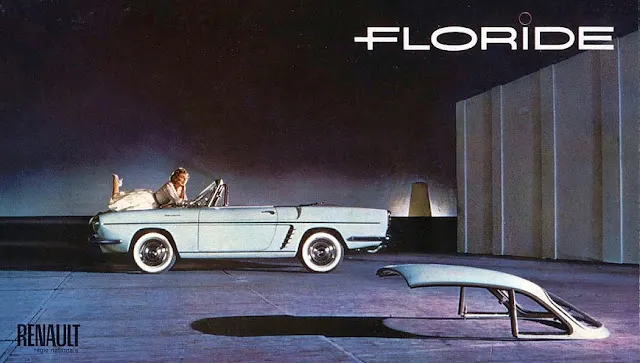
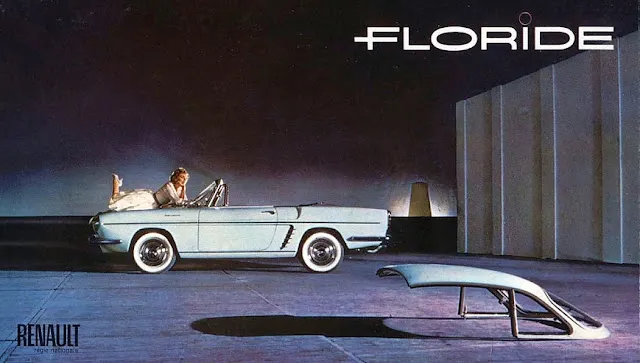
A pretty car, light on its feet, styled by an Italian, with Brigitte Bardot as its face. The Renault Floride had everything it needed to become an icon of French dolce vita. And in a way, it did. But behind that elegant droptop sits a story of names, professional jealousy, and an engine that never quite lived up to the bodywork wrapped around it. It’s a tale that runs from a dealer meeting in Florida to a design feud in Turin, and it explains why the same car wore two different names on two sides of the Atlantic.
And here’s the part that lands close to home for American readers: the very reason you’ve probably heard it called “Caravelle” and not “Floride” comes down to a marketing worry about offending most of your country. Let’s get into it.
A Car Born of Envy
In the late 1950s, Renault looked at the United States with a mix of awe and greed. Its little Dauphine, an 845 cc economy runabout, had somehow charmed a nation raised on land yachts. And across the same market, the Volkswagen Beetle was doing the exact same thing, only better. Renault wanted a bigger slice.
The concrete idea came out of a convention of North American dealers held in Florida. Renault’s US sellers asked for something specific: a Dauphine-based coupe-convertible, a car to lift the brand’s image in the market that actually mattered. Renault president Pierre Dreyfus said yes. And since the idea was born in Florida, the car was instantly nicknamed inside the company the “Floride.”
Here’s the first twist, and it’s a good one. When it came time to sell the thing in the States, someone at Renault spotted a problem. Naming a car “Floride” might play fine in one of the fifty states. In the other forty-nine, it could read as a slight, as if Florida were somehow better than everywhere else. So for North America, and for the UK and other English-speaking markets, an alternative name was chosen from the very start: Caravelle. Same car, two names, depending on whom you’d rather not annoy.
And the American market was no afterthought here; it was Renault’s fixation in those years. The Dauphine was selling briskly across the Atlantic, and the company dreamed of cementing itself there with an image car. The Floride/Caravelle was built largely for that, to lay a silk glove over the economy car’s success. The October 1958 Paris Show debut drew more than 8,000 firm orders, and another 13,000 landed when the car was first shown in the United States. On paper, a smash. The catch, as would become clear, is that an image car ages badly when the reliability and the dealer network don’t keep up, and Renault would eventually come to grief in North America despite the strong start.
Frua, the Italian Who Designed It Without Permission
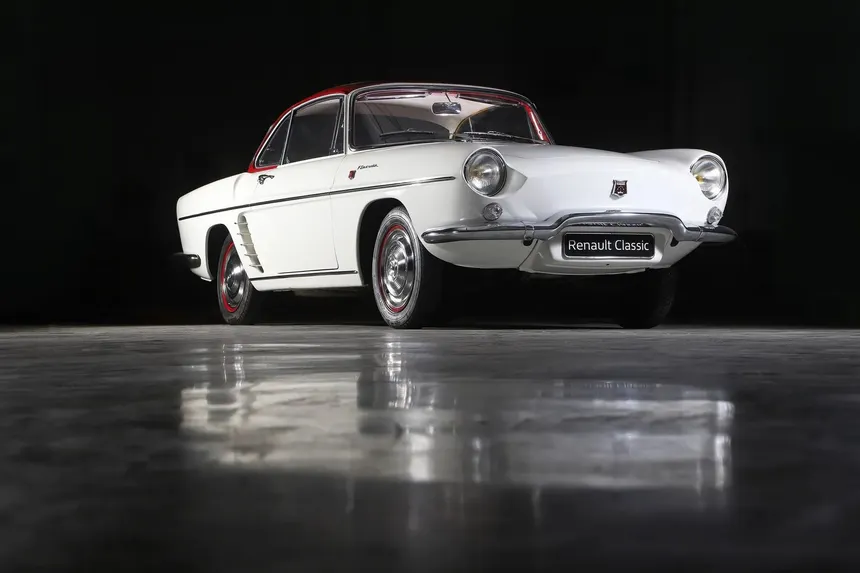
The design job went to the Italian coachbuilder Ghia. But Ghia, bound by exclusivity contracts with Volkswagen and Karmann, couldn’t openly put its name to it, so the work was handed to one of its men: Pietro Frua.
And Frua did something fairly bold. Without official blessing from either Ghia or Renault, he rented a stand at the 1958 Geneva Show and displayed a prototype of his own initiative, badged “Dauphine GT.” A freelance move that caused a stir: Renault boss Pierre Dreyfus reportedly had to call Ghia’s chief to order over it. But the brass liked the design enough to accept it, Frua got his payment, and months later the car reappeared, now official, at the October 1958 Paris Show on the Renault stand as the Floride, in its final convertible form. Two debuts in one year, two different names, for a car that hadn’t yet sold a single unit.
Frua was no nobody. His drawing board later produced the Maserati 3500 GT, the Glas that ended up sold as a BMW, work for Rolls-Royce, Opel, AC. And here, on the humble Dauphine platform, he penned a body roughly 32 cm longer than the economy car underneath, with discreet rear fins very much of the moment, clean and restrained lines. The result was pure glamour. So much so that Renault signed Brigitte Bardot as its face. An elegant convertible, the actress of the hour, “le vrai chic français.” The marketing wrote itself.
One detail ties the car to Italy even more tightly, and French official history tends to tiptoe past it: the Floride’s body wasn’t built by Renault but by the Société des usines Chausson, a firm in Asnières on the northern edge of Paris, best known for building the bodies of the school buses that plied rural France. An Italian-lined droptop with a cover-girl face, assembled by the people who normally riveted coaches together. Post-war industry threw up mixes like that.
The Trouble Was Underneath
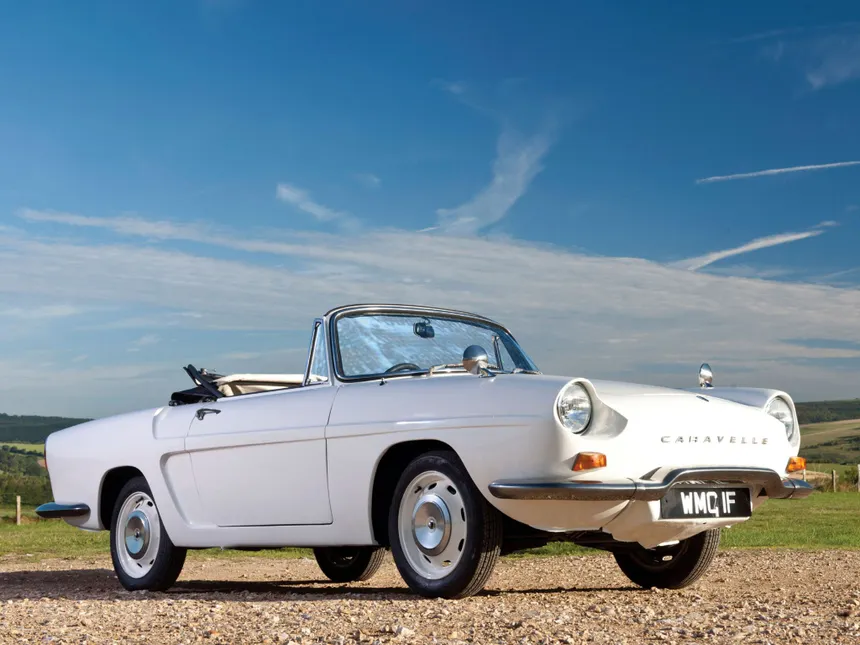
Now the weak spot, the bit that tends to get skirted when a car looks this good. Beneath that Italian skin beat the heart of the Dauphine, and it was a decidedly modest heart.
The launch engine was the rear-mounted 845 cc four, water-cooled. Frua had dressed it in a sports car’s suit, but underneath it was still an economy car. Renault knew it and tried to paper over it: a 32 mm Solex carburetor instead of the Dauphine’s 28 mm, tweaked valves and cam timing, raised compression. All told they clawed out around 37-38 hp against the original block’s 31. A nudge. And for anyone wanting more, a version tuned by Amédée Gordini, yes, the same wizard behind the R8, reached 40 hp through intake and camshaft changes. The mechanicals also brought a curiosity of the era, the Ferlec electromagnetic clutch offered as an option, which let the driver shift without pressing a pedal, an early stab at semi-automatic convenience on a budget car.
Economy-car numbers in a sports car’s body: that was always the Floride’s contradiction, promising far more with your eyes than it could deliver with your right foot. It was a car built for cruising with the top down and being admired rather than for going quickly, much like its natural rival, the Volkswagen Karmann-Ghia.
And that comparison runs deeper than coincidence, because the two cars were near-twins, a point American readers will grasp instantly since the Karmann-Ghia was a fixture on U.S. roads. Launched in 1955, the VW did exactly what the Floride would do: take the humble rear-engined mechanicals of an economy car, in its case the Beetle, and wrap them in dream Italian bodywork. Here’s the kicker: that bodywork was also penned by Ghia, the same Turin house behind the Floride. Two rear-engined coupe-convertibles, styled by the same Italian firm, each built on its country’s most popular economy car. On paper both were modest and closely matched: the Karmann-Ghia of that era made about 30 hp, weighed around 830 kg, and topped out at 115 km/h (71 mph); the Floride, with 37-38 hp, was even a touch livelier. Neither was fast. Both sold the identical fantasy, a sports car’s looks at an economy car’s price and reliability.
The S Model and Four-Wheel Discs
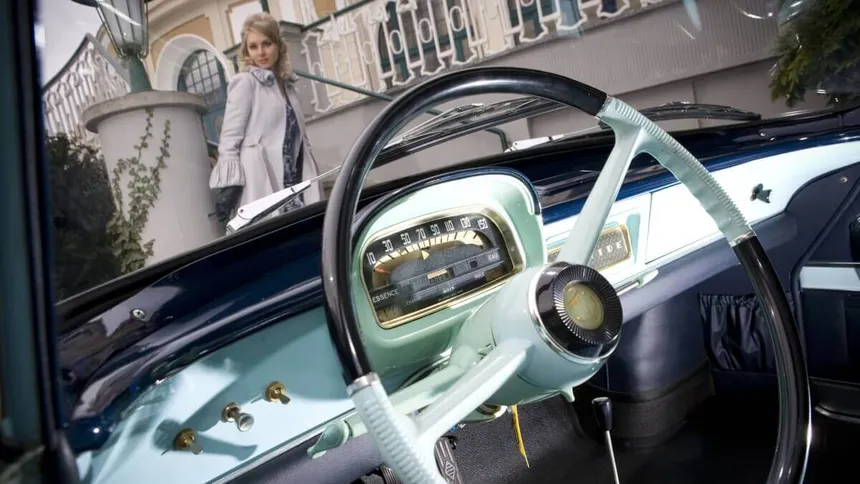
It got better with time. In October 1959, courtesy of the legendary engineer Jean-Albert Grégoire, came the “Aérostable” suspension, aimed at ride comfort and grip. That same year the Type 14 Karmann-Ghia got its own mild restyle with larger, higher-set headlamps, a reminder of how closely these two Ghia-drawn cousins tracked each other through their lives. And in 1962, at Geneva, the Floride S arrived, the real step up.
The S introduced the new 956 cc “Sierra”-series engine, the same one the Renault 8 would launch with months later. A more modern five-bearing block, more power. But the number that really matters is another one: the Floride S was the first volume-produced French car with disc brakes on all four wheels. It’s worth explaining why that was a leap. Until then almost every car stopped on drums: a closed system where shoes press outward against the inside of a drum, cheap but prone to overheating and fading if you ask for repeated hard stops, because the heat has nowhere to go. A disc brake instead clamps pads onto an exposed metal disc cooled by the passing air, which sheds heat far better and holds up without fading. At a time when discs were still expensive-car technology, seeing them on a Renault derived from an economy car was a genuine leap. It also cut unsprung weight by about 6 kg, which sharpened the drive.
It was with this change, from 1962, that the Floride name disappeared for good and the car became Caravelle in every market, the nickname coined to avoid offending 49 states ending up imposed over the original everywhere.
Caravelle to the End
The Caravelle kept growing. In 1964 it adopted another R8-derived engine, the 1,108 cc, lifting output to around 55 hp. It came as a 2+2 coupe, a convertible, and a droptop with a removable hardtop. The rear seats were always more gesture than reality: it was tight back there.
In its first three years, Floride and Caravelle together sold more than 45,000 units, a respectable figure, and across their whole commercial life they came to around 117,000. The car stayed in the catalog until 1968. It was never a sales bomb to match its sportier rivals, but it left a mark that today makes it a collector’s object of desire: rarity, Italian design, a curious backstory, and that air of a French convertible from another age. There’s a closing irony to its survival, because the examples that live on do so thanks to the very thing it was once knocked for: that humble, rugged Dauphine mechanicals, simple to maintain and hard to kill, which has carried many a Floride across six decades while nobler, frailer droptops fell by the wayside.
Renault, for its part, didn’t forget the name: decades later it revived it for the Mégane Coupé-Cabriolet Floride, a nostalgic nod to that first droptop.
A Car That Survived on Looks Alone
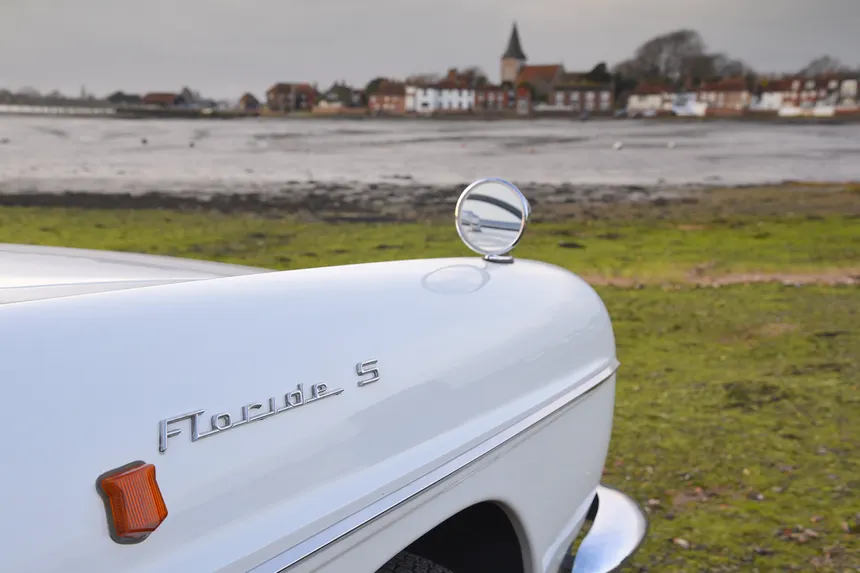
Some cars are remembered for what they did, others for what they were to look at. The Floride belongs, without apology, to the second group: nobody remembers it for its performance, which it never had, but for Frua’s bodywork, for Bardot behind the wheel, and for that story of a name changed to avoid stepping on toes.
Not every car needs to be fast to matter. Sometimes a fine shape, the right timing, and a story to tell are enough, and the Floride had them. In an age like ours, where every launch boils down to horsepower, seconds to sixty, and numbers on a screen, it’s almost startling to recall that a car could earn its place in memory simply by making you smile as it drove past.
Check you’re still alive.