Alpine A110 (1961–1977): The French Underdog That Humiliated Porsche
The Visionary from Dieppe
Jean Rédélé was no industrial tycoon. He was the son of a Renault dealer in Dieppe, a coastal town in Normandy better known for its mussels than its motorcars. But Rédélé had an obsession: hillclimb racing.
In 1945, at just 23 years old, he began modifying production Renaults for competition. He lightened everything possible, tuned the 4-cylinder engines, and developed an extraordinary intuition for chassis dynamics.
His philosophy was simple yet revolutionary: “Power is bought. Lightness is designed.”
By 1955, after several racing successes, Rédélé decided that modifying Renaults was no longer enough. He wanted to build his own car.
Alpine: The Birth of a Legend
The name “Alpine” was an obvious choice: Rédélé had conquered the French Alps in countless mountain rallies. Alpine roads were his territory, his laboratory, and his home.
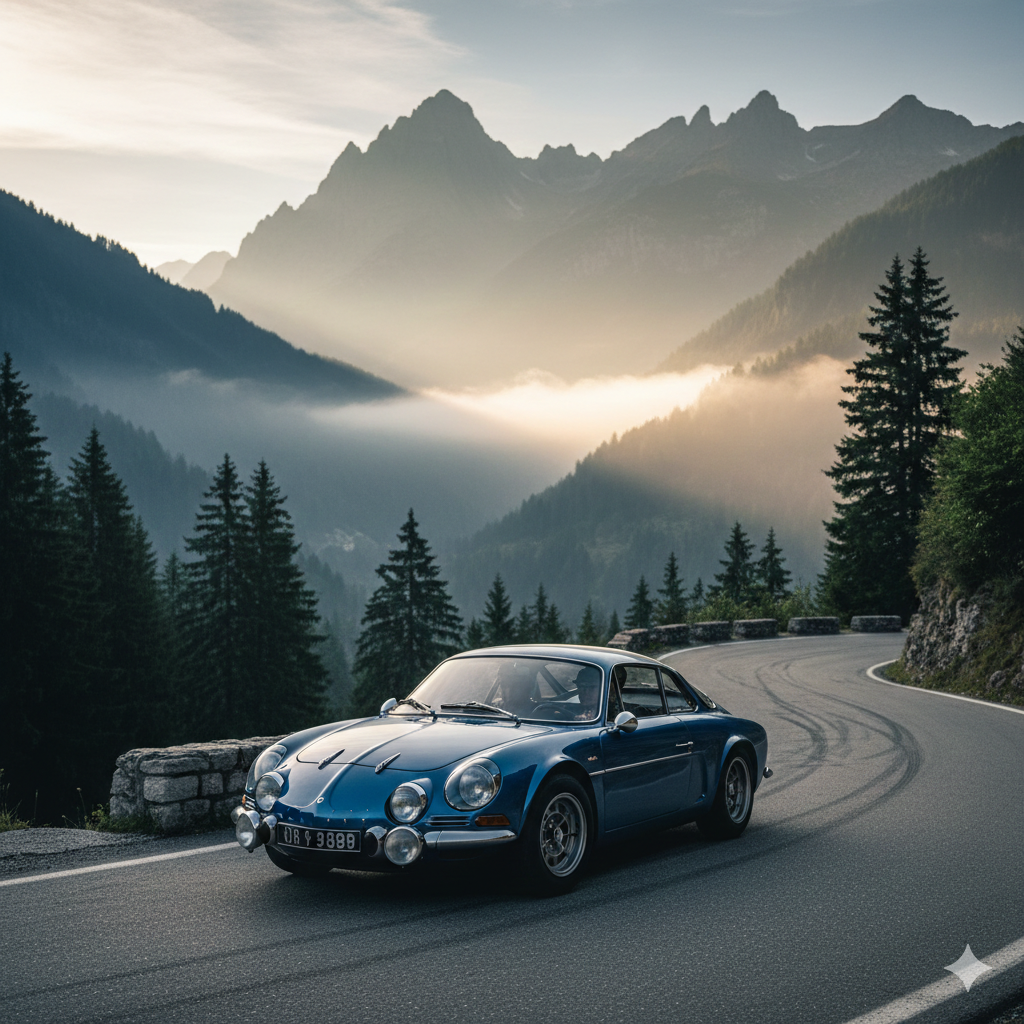
The first Alpine, the A106, used Renault 4CV mechanics with a fiberglass body designed by Rédélé himself. It was quirky, strange, and surprisingly competitive. But the car that would change everything arrived in 1961: the Alpine A110.
The Magic Formula: 1,300 lbs of Pure Agility
The A110 followed a technical recipe that no one else had perfected:
- Fiberglass body over a steel backbone chassis. The result: a total weight of just 1,366 lbs (620 kg). For comparison, a Porsche 911 of the era weighed around 2,300 lbs (1,050 kg).
- Rear-engine layout, based on Renault units but extensively modified. Variations ranged from the 1.3L (100 HP) to the 1.8L (180 HP) in full race trim.
- Four-wheel independent suspension, with geometry designed specifically for tight mountain hairpins.
- Short wheelbase and narrow width, perfect for tight roads where larger cars couldn’t find their rhythm.
The result was a car that felt like a giant go-kart: direct, nervous, and communicative. Drivers said the A110 “talked” to them through the steering wheel.
David vs. Goliath: Monte Carlo Rally 1971
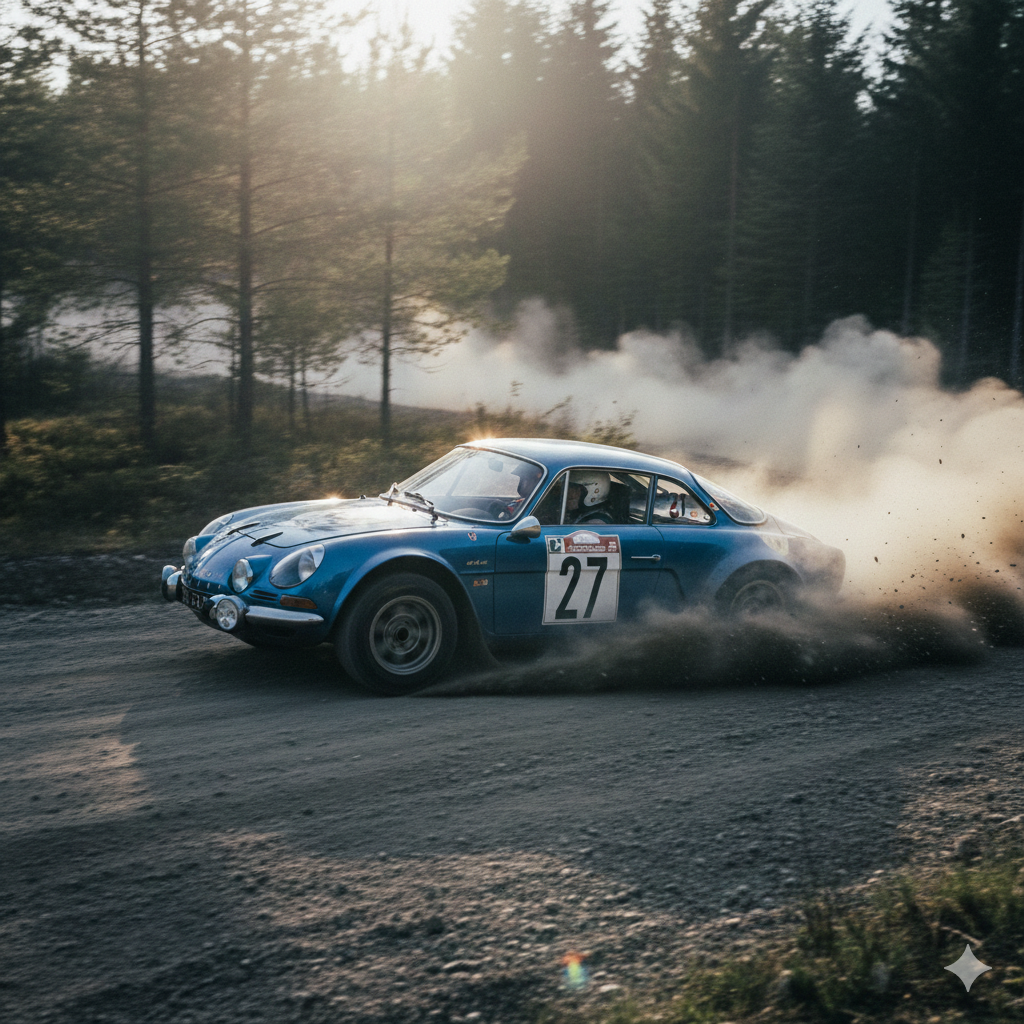
To understand the A110’s impact, you have to look at January 1971. The Monte Carlo Rally was—and remains—the most prestigious event on the world calendar.
The Favorites: Porsche 911S (210 HP), Lancia Fulvia HF (130 HP), Ford Escort RS (150 HP).
The Outsider: Alpine A110 1600S (138 HP).
On paper, the A110 had nearly 70 HP less than the Porsche and shouldn’t have stood a chance. Ove Andersson won in the Alpine. Not only did he win, but the A110 swept the podium (1st, 2nd, and 3rd). It was the first time a French manufacturer dominated Monte Carlo so completely.
How? Agility. The A110 was faster through the tight corners, and its drivers could push harder because they felt the car’s limits more clearly. The Porsche was faster on the straights, but straights don’t win rallies in the Alps.
1973: The Championship Year
In 1973, the FIA created the World Rally Championship (WRC) for manufacturers. Alpine-Renault fielded a “dream team”:
- Jean-Pierre Nicolas (The Scientist)
- Jean-Luc Thérier (The Artist)
- Bernard Darniche (The Tactician)
The 1973 Alpine A110 1800 produced 170 HP. It was still less powerful than rivals like the developing Lancia Stratos (275 HP), but it was the most balanced car in the field.
1973 Results:
- Monte Carlo: 1st (Andruet)
- Tour de Corse: 1st (Nicolas)
- Acropolis: 1st (Thérier)
- Morocco: 1st (Thérier)
- San Remo: 1st (Thérier)
Alpine was crowned the first-ever World Rally Champion. A small French brand had defeated giants like Porsche, Lancia, Ford, and Fiat with a car that cost half as much and produced significantly less power.
Technical Secret: The Rear-Engine “Overhang”
The A110’s engine layout is fascinating—and controversial. The Renault engine was mounted behind the rear axle, hanging off the back. Roughly 58% of the weight sat over the rear wheels.
- Pros: Exceptional traction under acceleration, neutral behavior in slow corners, and a very low center of gravity.
- Cons: A tendency for violent “snap oversteer” in fast corners. If you lost it, recovering was nearly impossible.
Alpine drivers learned a specific technique: enter corners with deliberate over-correction, use the throttle to control the slide, and never, EVER lift off the gas in the middle of a curve. It was a high-wire act, but once mastered, the A110 was untouchable.
Essential Versions
- A110 Tour de France (1963): 1.1L Renault R8 engine (66 HP). The first competition A110.
- A110 1300 (1966): 1.3L Renault Gordini engine (95-130 HP). The popular “club” racer.
- A110 1600S (1969): 1.6L Renault 16 TS engine (120-138 HP). The iconic road-going version.
- A110 1800 Group 4 (1972-1973): 1.8L Renault Gordini engine (170-185 HP). The WRC champion.
- A110 1600SC (1974-1977): 1.6L with Weber carburetors (115 HP). The final production version.
“Alpine Blue”: A Registered Trademark
“Bleu Alpine” (Renault code 418) wasn’t a random choice. Jean Rédélé chose the shade because it popped in black-and-white photography. Sports newspapers in the ’60s rarely printed in color, and Rédélé wanted his cars to stand out on the page.
Today, an original Alpine Blue A110 is worth roughly 25% more than any other color. It is the “correct” color for these machines.
Curiosities and Trivia
- The Gendarmes: The French Gendarmerie used A110s as high-speed interceptors on the highways to catch criminals in German luxury cars.
- Midnight Workshop: In the early years, Rédélé built cars at night because his father wouldn’t let him use the dealership workshop during business hours.
- The Le Mans Crash: In 1966, an Alpine A210 flipped at over 124 mph (200 km/h). The driver walked away because the fiberglass body disintegrated, absorbing the impact. Rédélé used this to market the car’s safety.
- The Renault Takeover: Renault bought Alpine in 1973. While some fans felt this “killed” the independent spirit, Renault produced Alpines until 1995.
- The Rebirth: In 2017, Renault resurrected the brand with the modern A110. It weighs 2,425 lbs (1,100 kg), produces 300 HP, and keeps the mid-rear engine spirit alive.
The Controversy: Better Than the Porsche 911?
This question has divided enthusiasts for 50 years.
- Alpine Supporters: Argue the A110 won the first WRC title, was lighter, purer, and more affordable.
- Porsche Supporters: Point out that the 911 dominated for decades, while Alpine faded. They argue the 911 was more reliable on the street and faster on the track.
My Take: They represent different philosophies. The 911 is German engineering—constant, iterative evolution. The Alpine is French brilliance—a perfect moment frozen in time. The 911 won the war, but the A110 won battles that will never be forgotten.
Current Market (2026 Estimates)
| Version | Excellent Condition | Driver Condition | Project Car |
| A110 1300 | $85k – $130k | $55k – $75k | $27k+ |
| A110 1600S | $110k – $160k | $75k – $95k | $43k+ |
| A110 1800 Gr. 4 | $215k+ | $160k+ | Extremely Rare |
Note: Cars with documented competition history can worth up to double.
Conclusion: The Triumph of Wit Over Budget
The Alpine A110 is proof that resources don’t determine results. Jean Rédélé didn’t have Porsche’s infrastructure or Ford’s budget. He had an idea, a small shop in Normandy, and the guts to prove that a lightweight, well-designed car could beat anyone.
For Discussion: Does the modern A110 (2017–present) truly honor this legacy, or is it a marketing product using a legendary name? Can a $65,000 modern car ever truly capture the “underdog” spirit of the original?