
The Audi RS4 B5 Avant: The Station Wagon That Embarrassed Supercars
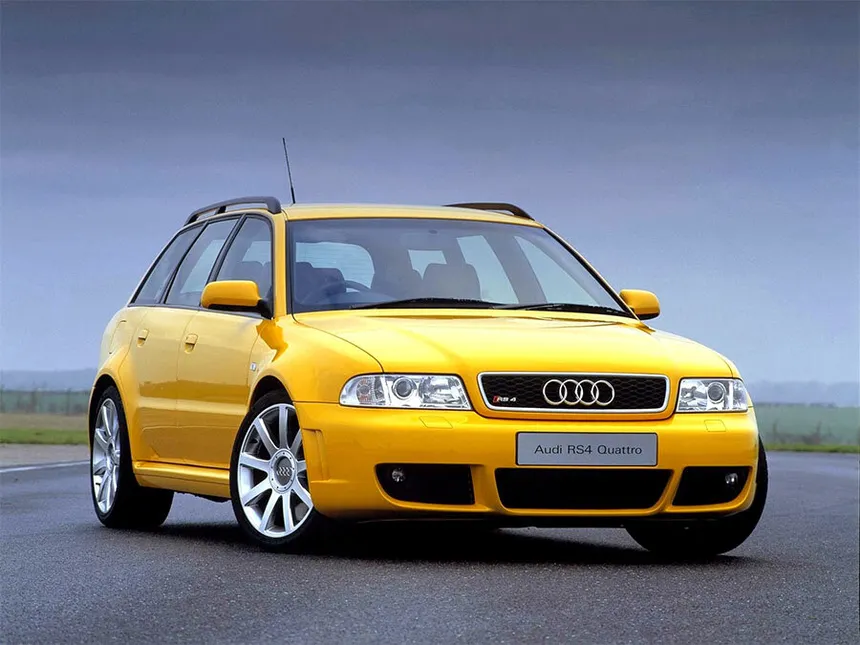
Let me tell you something that’s going to upset some people: one of the most savage performance cars ever built is a station wagon. Not a coupe. Not an Italian mid-engine exotic. A station wagon. With a trunk big enough for strollers, grocery bags, and a couple of bikes.
The Audi RS4 B5 Avant is proof that body style means absolutely nothing when what’s under the hood and beneath the chassis can demolish cars costing three times as much. It’s a wolf in sheep’s clothing, a great white shark disguised as a dolphin, and quite possibly the greatest Q-car — the car world’s term for a sleeper — ever manufactured.
What quattro GmbH Was Thinking
The RS4 B5 was born in 2000 inside quattro GmbH — Audi’s high-performance division, their equivalent to BMW’s M or Mercedes’ AMG. But quattro GmbH had a different philosophy. They weren’t interested in flashy or loud. They were interested in brutally fast cars that looked completely ordinary.
The foundation was the Audi A4 B5 platform, a solid midsize sedan that Americans knew primarily as a sensible European alternative to the BMW 3 Series. The S4 B5 — the mid-tier performance variant — ran a 2.7-liter twin-turbo V6 making 265 horsepower. Competent but not crazy.
The RS4 took that concept to the extreme. And here’s the first surprise: it was only sold as an Avant — Audi’s term for their station wagon body style. No sedan. No coupe. Audi deliberately decided that their most radical car would be exclusively a wagon. In the year 2000, that was a statement nobody else dared to make.
Unfortunately for American enthusiasts, the RS4 B5 was never officially sold in the United States. This remains one of the great what-ifs of the American enthusiast market. Some examples have been privately imported under the 25-year rule, and their arrival stateside has only intensified their legend.
The Engine: 2.7 Twin-Turbo Pushed to the Edge
The heart of the RS4 B5 was a deeply reworked version of the 2.7-liter V6 twin-turbo (engine codes ASJ/AZR). In the S4, this engine made 265 hp. In the RS4, quattro GmbH cranked it to 380 horsepower at 7,000 rpm and 324 lb-ft of torque at 6,100 rpm.
The modifications were extensive: larger KKK K04 turbochargers replacing the S4’s K03 units, bigger intercoolers, revised Bosch Motronic engine management, optimized exhaust manifolds, improved lubrication systems for higher thermal loads, and ported cylinder heads for better airflow.
The result was an engine that pulled hard from 2,500 rpm and didn’t quit until nearly 7,500. Power delivery was progressive but relentless — twin-turbo configuration with moderately-sized turbos meant negligible lag above 3,000 rpm.
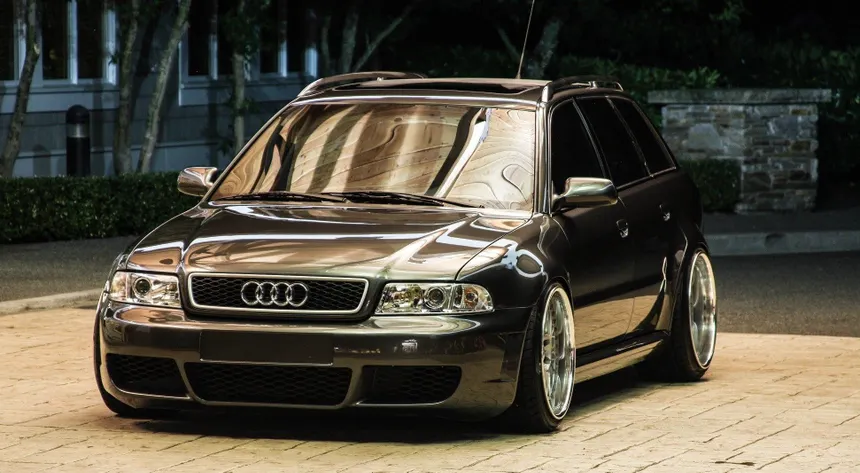
But here’s what made the 2.7 twin-turbo legendary in the tuning community: its modification potential. With bigger turbos, remapped engine management, and reinforced internals, this engine could jump from 380 hp to over 600 hp without breaking a sweat. Tuners like MTM, Oettinger, and ABT offered packages pushing 500+ hp as catalog items. Private builders regularly exceeded 700 hp on fully built motors. It’s one of the most tuner-friendly engines in the history of street cars.
quattro: The Unfair Advantage
The RS4 B5 ran Audi’s quattro all-wheel-drive system with a Torsen Type C center differential. Default torque split was 50:50 front-to-rear, with the ability to shuttle up to 75% to whichever axle had more grip. Open differentials at both axles with electronic traction control managed wheel-to-wheel distribution.
What this meant in practice was simple: all 380 hp and 324 lb-ft reached the pavement effectively in virtually any condition. Where a BMW M3 E46 or a rear-drive competitor would spin its tires in rain or on cold asphalt, the RS4 just launched. Four wheels pulling, four wheels working.
For Americans who know the advantages of all-wheel drive from brands like Subaru, imagine that concept executed at the highest possible level with German engineering precision and over 100 more horsepower than a WRX STI.
Suspension was sport-tuned from the factory with specific springs and dampers — lower and stiffer than the S4. Steering was hydraulic rack-and-pinion, direct and communicative in a way that modern electric systems still struggle to match. Brakes were ventilated discs all around — 12.6-inch fronts with four-piston calipers, 10.6-inch rears.
Numbers That Don’t Add Up
Audi’s official claims were:
- 0-62 mph: 4.9 seconds
- Top speed: 155 mph (electronically limited)
- Weight: 3,571 lbs (1,620 kg)
But everyone knew those numbers were conservative. Independent tests consistently recorded 0-60 times of 4.5 seconds or less. With the speed limiter removed, the RS4 comfortably exceeded 174 mph.
Context: a 2000 Porsche 911 Carrera (996) made 300 hp and did 0-60 in 5.0 seconds. A BMW M3 E46 made 333 hp and did 4.8 seconds. The RS4 was quicker than both — and it was a station wagon.
A Ferrari 360 Modena did 0-60 in 4.5 seconds. The RS4, with a full trunk and all-wheel drive, matched it. Think about that for a second.
Production and Rarity
Audi produced approximately 6,030 RS4 B5 units between 2000 and 2001. Just two years of production. Avant only. Twin-turbo V6 only. quattro only. Six-speed manual only — no automatic option was available.
Available colors were limited and named after racing circuits: Imola Yellow, Misano Red, Nogaro Blue, Avus Silver, Mugello Blue, and a handful of others. When your color palette is named after racetracks, the intent is clear.
The fact that this car was never sold in North America has created a mystique around it that few European imports can match. As examples become eligible for importation under the 25-year rule, prices for clean specimens have climbed significantly.
The Tuning Scene: Where Things Get Insane
If the stock RS4 B5 was already an animal, the aftermarket community turned it into a legend. The 2.7 twin-turbo responded extraordinarily well to modifications, and the quattro platform could handle power levels far beyond stock.
MTM in Germany offered packages pushing 530 hp. ABT Sportsline reached 510 hp. Oettinger offered 480 hp kits. And private builders with hybrid turbos and standalone engine management routinely exceeded 600 hp.
The unofficial quarter-mile record for a tuned RS4 B5 sits under 10 seconds. A station wagon. Under 10 seconds in the quarter. There are purpose-built drag cars that can’t match that.
For the American tuner community — where power is king and sleepers are sacred — the RS4 B5 represents the ultimate starting platform. Four-wheel drive, turbocharged engine with massive headroom, manual transmission, and unassuming wagon looks. It checks every box.
The Avant Legacy
The decision to sell the RS4 B5 exclusively as a wagon wasn’t random. Audi had a tradition of high-performance wagons dating back to the RS2 Avant of 1994, developed in collaboration with Porsche. The RS2, with its turbocharged five-cylinder making 315 hp, had already proved that the Avant format was compatible with extreme performance.
The RS4 B5 continued and elevated that tradition. The message was clear: you don’t need a sports coupe to go fast. You can drop the kids at school Monday, hit the track Saturday, and load up at Costco on Sunday. Same car. Same key.
This philosophy is what makes the RS4 B5 special. In a world where manufacturers equated speed with impracticality, Audi said “you can have everything” — and delivered.
Current Market and Collectibility
The RS4 B5 has become a sought-after modern classic. Well-preserved, low-mileage examples in Europe trade between $45,000 and $80,000, with prices trending upward. Nogaro Blue and Imola Yellow command the highest premiums.
Known weak points include the K04 turbochargers (the stock turbos are the primary failure point at high mileage), timing chain guide wear (a notorious issue with the 2.7 V6), and electrical gremlins typical of early-2000s Audi products.
But a well-maintained RS4 B5 is one of the most rewarding cars you can drive. The combination of power, traction, practicality, and stealth is unrepeatable. Nothing existed like it before, and while Audi has since built more powerful RS cars, none have captured that raw, unfiltered character.
The Bottom Line
The Audi RS4 B5 Avant is one of the most important performance cars of the past 30 years. Not because it’s the fastest, the prettiest, or the most exclusive — but because it represented an idea nobody else dared to execute: the ultimate station wagon.
380 horsepower, all-wheel drive, six-speed manual, and a trunk that fits half your life. A car that matched Ferraris at stoplights and then picked up the kids from school. No spoilers. No bragging. No need to prove anything to anyone.
That’s class. That’s engineering with purpose. And that’s exactly what Audi should always represent.
Greasy hands, no filter. That’s NEC.