
BMW 850 CSi: The 380 HP V12 BMW Built to Humiliate Mercedes and Failed Gloriously
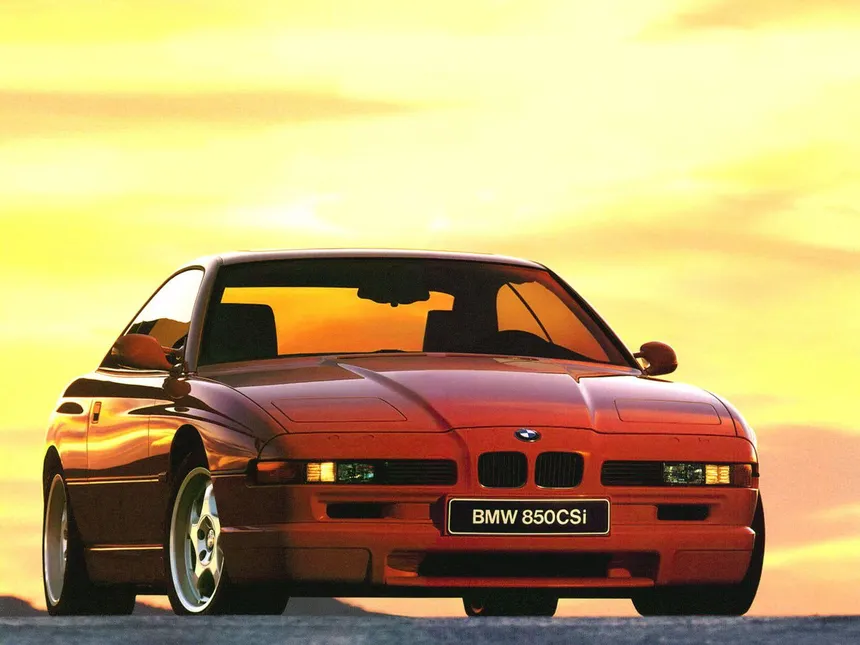
The Grand Tourer That Arrived at Exactly the Wrong Moment
In 1992, BMW presented the world with the 850 CSi: a Grand Tourer with a 5.6-liter V12 engine, 380 hp of power, a 6-speed manual transmission as the only option, and a level of technology that seemed like it came from a 21st-century spaceship. It was the most technically advanced car BMW had ever built, the result of a colossal investment in engineering and development.
It also arrived just as the global economy decided to collapse, the luxury GT market sank with it, and potential buyers disappeared like money in a recession. The BMW 850 CSi was one of the most spectacular commercial failures in BMW’s history. The company lost money on every unit sold.
Today, more than three decades later, the 850 CSi is one of the most desired and valued BMWs among collectors who truly understand cars. The cars nobody wanted to buy in the 90s are now worth more than they cost new, adjusted for inflation.
This is the story of how excessive engineering, disastrous timing, and an absolute refusal to make concessions created a Grand Tourer the world wasn’t prepared to appreciate.
The Context: An Automotive Cold War Between Munich and Stuttgart
To understand the 850 CSi, you need to understand the rivalry that spawned it. In the late 80s, Mercedes-Benz dominated the luxury Grand Tourer segment with the SEC (C126 chassis), a massive coupe with a V8 engine that represented the pinnacle of German luxury on two doors.
BMW had no direct response. The E24 6 Series, which had served well for over a decade, was visibly aged. It was a competent car, even elegant, but it couldn’t compete with Mercedes in terms of presence, technology, or perception of exclusivity.
BMW executives made a decision that would define the E31 project: they weren’t going to match Mercedes. They were going to surpass it in every measurable technical aspect, regardless of cost. The goal wasn’t to compete; it was to humiliate.
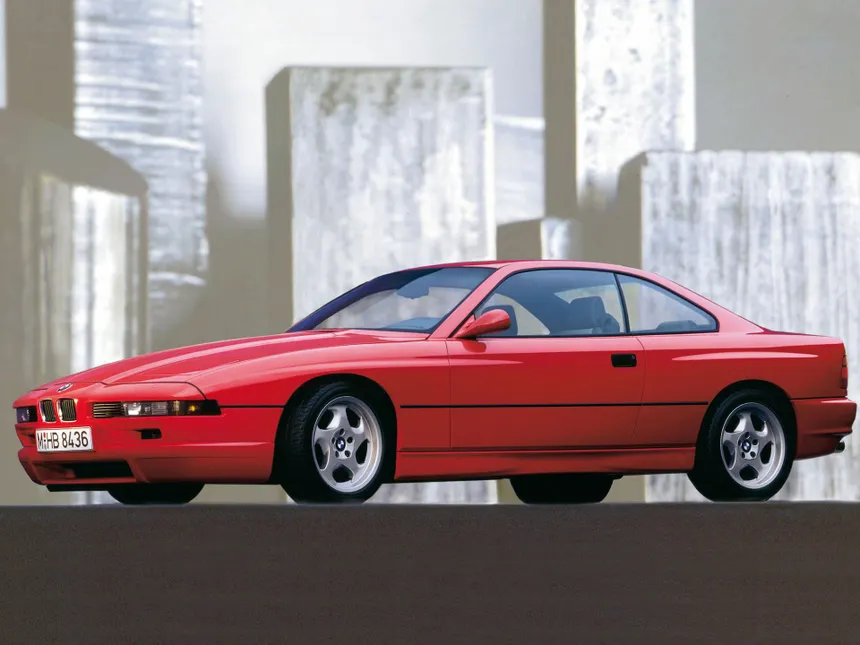
The Investment in the E31 Project
BMW invested amounts of money that would make modern finance departments pale in the E31’s development:
Specifically developed M70 V12 engine: BMW created an entirely new engine for this car. The M70 was essentially two inline-six engines joined by a common crankshaft, with 5.0 liters of displacement and a smoothness of operation no V8 could match.
Wind tunnel-designed body: The E31 achieved a drag coefficient of 0.29, an extraordinary figure for the era and still respectable by modern standards. Every line of the car was optimized for aerodynamics.
Pop-up headlights: The last BMW would ever use, designed to maintain the purity of the front line when closed.
Cutting-edge electronics: Electronic engine control, variable damping suspension, partially digital instrumentation, and management systems that anticipated what would come decades later.
Mixed aluminum and steel construction: Aluminum panels where weight reduction mattered, high-strength steel where rigidity was the priority.
The 850 CSi: When “Good” Simply Wasn’t Enough
The base 850i, with its 5.0-liter V12 engine and 300 hp, was already an impressive car. But BMW M engineers had orders to create something more, something that would leave no doubt about who ruled the high-performance Grand Tourer segment.
The result was the 850 CSi, and the difference from the 850i wasn’t just in numbers.
The S70 Engine: The Definitive V12
BMW took the M70 V12 engine and transformed it into the S70. The changes were deep and meticulous:
Increased displacement: From 5.0 to 5.6 liters, through an increase in cylinder bore and piston stroke.
Forged pistons: Capable of withstanding higher revs and more extreme temperatures.
More aggressive camshafts: Cam profiles optimized to extract more power in the high rev range.
Improved intake system: Greater airflow to feed the cylinders’ increased demand.
Optimized exhaust system: Less restriction to allow gases to exit faster.
The result: 380 hp at 5,300 rpm and 406 lb-ft of torque at 4,000 rpm. In 1992, these figures didn’t just compete with Ferrari and Lamborghini; in some aspects, they surpassed them. Ferrari’s 348, the mid-engined sports car of the era, produced 300 hp. The 850 CSi exceeded it by 80 hp and cost less money.
Compared Specifications: 850i vs 850 CSi
| Specification | 850i | 850 CSi | Difference |
|---|---|---|---|
| Engine | M70 V12 5.0L | S70 V12 5.6L | +600cc |
| Power | 296 hp @ 5,200 rpm | 380 hp @ 5,300 rpm | +84 hp |
| Maximum torque | 332 lb-ft @ 4,100 rpm | 406 lb-ft @ 4,000 rpm | +74 lb-ft |
| 0-60 mph | 6.4 seconds | 5.4 seconds | -1.0 s |
| Top speed | 155 mph (limited) | 155 mph (limited)* | – |
| Transmission | Auto 4sp / Manual 6sp | Manual 6sp exclusively | – |
| Weight | 4,057 lbs | 4,167 lbs | +110 lbs |
*Without the electronic limiter, the 850 CSi was capable of exceeding 175 mph.
Manual Only: A Statement of Principles
BMW made a decision many considered commercially suicidal: the 850 CSi would only be available with the Getrag 560G 6-speed manual transmission. There was no automatic option under any circumstances.
The reasoning was clear: the CSi wasn’t a car for comfortable cruising. It was a driving machine designed for drivers who wanted to be actively involved with every gear shift, every clutch application, every decision about which ratio to use.
This decision probably cost sales, but it defined the car’s character in a way an automatic gearbox could never have achieved.
Technology That Seemed From the Future (And Was)
The E31 incorporated technological systems that would take years, in some cases decades, to become common equipment:
EML (Elektronische Motorleistungsregelung)
Electronic throttle control, also known as “drive-by-wire.” In 1992, most cars still used physical cables to connect the accelerator pedal to the engine’s throttle body. The E31 eliminated that mechanical connection, using electronic sensors and computer-controlled actuators.
This not only improved the precision of engine response but allowed integrating traction and stability control systems in ways that were impossible with conventional mechanical systems.
ASC+T (Automatic Stability Control + Traction)
A traction and stability control system that anticipated what we now know as ESP. The ASC+T could detect loss of traction and selectively apply brakes to individual wheels, as well as reduce engine power, to keep the car under control.
In 1992, this was racing technology applied to a road car.
EDC (Electronic Damper Control)
The CSi’s suspension incorporated dampers with electronic firmness adjustment. The system could modify damping characteristics in real time based on driving conditions, speed, and driver style.
It wasn’t a full air suspension, but it anticipated the adaptive systems that are common in luxury cars today.
Partially Digital Instrumentation
The E31’s instrument cluster combined traditional analog gauges with digital displays for secondary functions. The onboard computer was capable of showing information that many cars wouldn’t include until a decade later.
Computer-Aided Design (CAD/CAM)
The E31 was one of the first cars designed and developed almost entirely using CAD/CAM systems (computer-aided design and manufacturing). This approach allowed precision in design and engineering that would have been impossible with traditional methods.
Why It Failed Commercially: Timing Is Everything
The 850 CSi arrived on the market at the worst possible moment. A combination of external factors aligned to condemn the car to commercial failure:
The Early 90s Global Recession
The world economy entered recession in the early 90s. The luxury goods market, including high-priced cars, contracted brutally. Potential buyers for cars costing over 200,000 German marks simply disappeared.
The Gulf War and Geopolitical Uncertainty
The first Gulf War (1990-1991) created geopolitical uncertainty that especially affected luxury markets. Oil prices rose, and the idea of buying a GT with a nearly 6-liter V12 engine seemed irresponsible.
Price in Ferrari Territory
The 850 CSi cost over 200,000 German marks in Germany, equivalent to approximately €170,000 at the time. For that money, a buyer could seriously consider a Ferrari 348 or a Porsche 911 Turbo. BMW was asking supercar prices for a Grand Tourer, however technically advanced it was.
Terrifying Maintenance Costs
A BMW V12 from that era wasn’t cheap to maintain. Regular services were expensive, repairs astronomical, and the car’s technical complexity meant few mechanics were qualified to work on it.
Questionable Practicality
Despite its imposing size, the 850 CSi wasn’t a practical car. The rear seats were token, useful for small luggage but not adult passengers. The trunk was decent but not generous for a car of those dimensions. It was a 2+2 very oriented toward the “2.”
The Numbers of Failure
BMW manufactured only 1,510 units of the 850 CSi between 1992 and 1996. The complete E31, including all variants (850i, 850Ci, 840Ci, 850 CSi), reached approximately 31,000 units in its commercial life.
To put this in perspective: Mercedes sold more SECs in a good year than BMW sold of the entire E31 throughout its useful life.
Current Value: The Market Corrects Its Mistakes
Fast forward three decades and the 850 CSi has experienced one of the most dramatic appreciations in the German classic car market.
An 850 CSi in good condition, with reasonable mileage and complete documentation, costs between $85,000 and $130,000 today. Exceptional examples, with low mileage, impeccable dealer service history, and desirable colors, have exceeded $165,000 in recent transactions.
Compare this with new prices, adjusted for inflation: the CSi cost approximately $130,000 in today’s money when new. The best examples are now worth significantly more.
Factors Behind This Appreciation
BMW’s last manual V12: This combination would never be repeated. Later BMW V12s (in the 7 Series and Rolls-Royce) only came with automatic transmissions. The CSi is the last of its kind.
Truly minimal production: 1,510 worldwide units in four years of production. It’s not exaggerated marketing; it’s a real figure meaning extreme rarity.
Ahead of its time: The E31’s technology anticipated developments that would take years to become common. Driving one today still feels surprisingly modern.
Timeless design: The E31 hasn’t aged visually. Its lines, designed with aerodynamic rigor but without excess, remain elegant and desirable 30 years later.
Unique driving experience: No modern car drives like an 850 CSi. The combination of a naturally aspirated V12, 6-speed manual, hydraulic steering without variable assistance, and considerable weight creates an experience that no longer exists.
The Legacy: Overengineering as Art Form
The BMW 850 CSi represents a manufacturing philosophy that modern companies, obsessed with profit margins and cost efficiency, would consider irrational.
BMW built the 850 CSi knowing they would lose money on every unit sold. The development costs of the S70 engine, of the electronic technology, of the obsessive build quality, far exceeded what they could recover in the sale price.
Executives at the time probably considered it a strategic error. Shareholders probably questioned the engineering department’s decisions.
But today’s collectors consider it a masterpiece, precisely because BMW refused to make concessions. Every system, every component, every engineering decision was made seeking excellence, not profit margin.
The 850 CSi proved that BMW could compete with any manufacturer at the absolute top of the Grand Tourer market. It proved that German engineering had no limits when artificial budget restrictions weren’t imposed.
That message, communicated through every kilometer driven in an 850 CSi, was worth more to BMW’s brand image than any short-term profit could have generated.
Sometimes commercial “mistakes” are exactly the products that define what a brand is capable of achieving when it decides not to hold back.
Is the 850 CSi the most undervalued Grand Tourer of its generation? Has the market correction it deserved finally arrived? Or does it still have room to appreciate? Leave us your opinion in the comments.
Article published on Not Enough Cylinders – The blog where gasoline and strong opinions flow equally.