
The BMW M57D30: The Diesel That Silenced the Sceptics
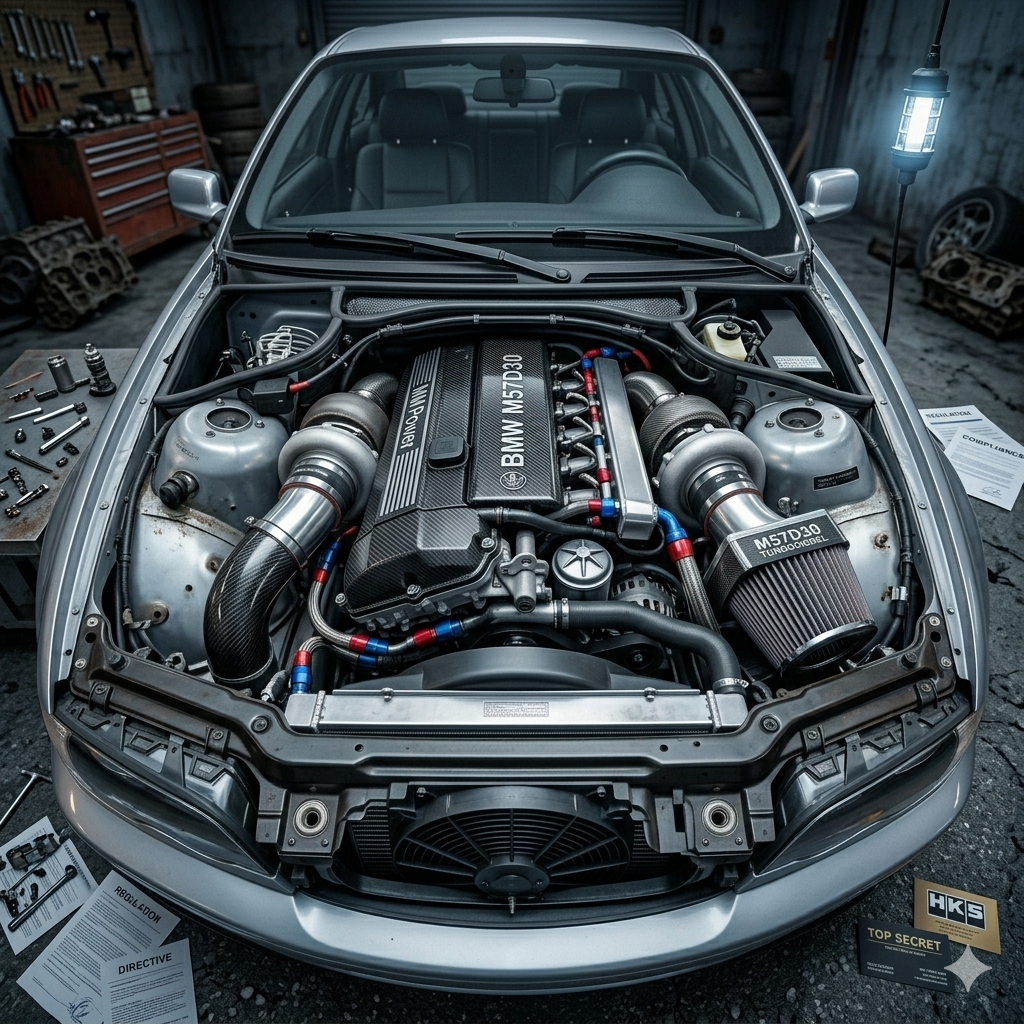
In a world where “diesel” and “excitement” rarely share a sentence, BMW built an engine that defied every prejudice. The M57D30, the inline-six turbodiesel that powered the E46 330d among other applications, didn’t just prove that a diesel could be refined and powerful. It proved that a diesel could be legendary. If the M50B25 was the German petrol 2JZ, the M57D30 is the 2JZ of the diesel world. And that’s no exaggeration.
The Context: When Diesel Stopped Being Boring
In the late 1990s, passenger car diesel was undergoing a quiet revolution. Common rail direct injection was transforming engines that had been noisy, slow, and smoky into refined units capable of rivalling their petrol equivalents in performance. BMW, which had always placed driving as the cornerstone of its philosophy, couldn’t afford to offer a diesel that didn’t live up to its reputation.
The M57D30 debuted in 1998 and was, from its first crankshaft revolution, a statement of intent. BMW didn’t simply want an efficient diesel engine. It wanted a diesel engine that would make the driver smile. And it achieved this in a way that very few anticipated.
Architecture of a Champion
The M57D30 is a 2,926 cc inline-six with a cast iron block and aluminum cylinder head. The choice of cast iron for the block is no coincidence: as with the M50B25, cast iron offers rigidity and resistance to combustion pressures that are critical in a diesel engine, where working pressures are significantly higher than those in an equivalent petrol engine.
With a bore of 84 mm and a stroke of 88 mm, the M57 features an undersquare ratio (stroke greater than bore) that favors torque generation at low and mid-range rpm. This configuration is ideal for a diesel engine, where torque delivery is the absolute priority.
The Bosch common rail injection system fitted to the M57 operated at pressures of up to 1,350 bar in the earliest versions, enabling extraordinarily fine fuel atomisation that translated into more complete combustion, lower emissions, and a smoothness uncharacteristic of a diesel. Later versions of the engine progressively increased this pressure, further improving efficiency and performance.
The aluminum cylinder head with four valves per cylinder and dual overhead camshafts (DOHC) provided excellent gas flow, contributing to the engine’s volumetric efficiency. The piezoelectric injectors in the most advanced versions allowed multiple injections per cycle, smoothing combustion and reducing the characteristic diesel clatter to near-silence at cruising speed.
Power and Torque: The Numbers That Matter
In its initial version for the E46 330d, the M57D30 produced 184 hp and 390 Nm of torque. These already impressive figures don’t tell the whole story. Maximum torque was available from just 1,750 rpm, meaning the driver had access to massive thrust practically from idle.
To put this in perspective: the E46 330d accelerated from 0 to 100 km/h in 7.3 seconds, a time that surpassed many petrol sports cars of similar displacement. But beyond the sprint, it was the engine’s recovery ability and elasticity that truly impressed. Overtaking on the motorway, climbing mountain passes with a full load, completing long-distance journeys without mechanical or driver fatigue: the M57 did all of this with an ease that bordered on the obscene.
Later versions of the M57 progressively increased performance. The M57TU (Technical Update) raised output to 204 hp and 410 Nm. The M57TU2 version that powered the E60/E61 530d reached 218 hp and 500 Nm. And the most powerful version, the M57TU2 TOP fitted to the 535d, achieved 272 hp and 560 Nm with sequential twin-turbo. Numbers that would make many larger-displacement petrol engines blush.
The E46 330d: The Saloon That Humiliated Sports Cars
If the M57D30 was an extraordinary engine, its combination with the E46 chassis created something truly special. The BMW E46 is widely considered the last “analogue” 3 Series, the last to offer a pure driving experience before electrification and electronic assistance began filtering the sensations.
The 330d with its six-speed manual gearbox was a secret weapon on European roads. From the outside, it appeared to be a discreet executive saloon. From inside, the driver knew they had access to nearly 400 Nm of instant torque, a 50/50 balanced chassis, and steering that communicated every road surface imperfection with surgical precision.
The E46 330d community in Europe is enormous and devoted. Specialist forums have spent over two decades documenting every aspect of the car, from preventive maintenance to performance modifications. The accumulated knowledge is encyclopaedic, and parts availability remains excellent.
Reliability: The 500,000 Kilometre Engine
The M57D30’s reliability is arguably its most impressive characteristic. There are countless documented examples of M57s that have exceeded 500,000 kilometres without requiring a major rebuild. Taxi drivers, commercial representatives, and long-distance drivers across Europe can attest to this engine’s ability to accumulate kilometres without flinching.
Preventive maintenance points are known and manageable. The intake manifold tends to accumulate carbon deposits over time due to the EGR system, a problem common to virtually all modern diesels that can be addressed with periodic cleaning. The injectors, while expensive to replace, typically last over 200,000 kilometres when quality fuel is used. The valve cover and sump gaskets, as with their petrol siblings, may require attention over time.
The turbocharger, a component that in many competing diesels represented an Achilles’ heel, demonstrates remarkable longevity in the M57. With regular oil changes and respecting turbo cool-down times after spirited driving, the original turbo can last the engine’s entire lifetime.
The timing chain, as in the M50, is a robust and durable unit. Unlike engines with timing belts, it doesn’t require scheduled periodic replacement, eliminating a significant maintenance cost and a potential source of catastrophic failure.
Tuning Potential: The Best-Kept Secret
If the M57D30 already impresses in stock form, its modification potential is where the engine enters legend territory. The robustness of the cast iron block, the quality of internal components, and the sophistication of the common rail injection system create an extraordinary base for forced induction.
A simple ECU remap can extract between 220 and 240 hp from the original 184 hp engine, with proportional torque increases. This type of modification, conservative and safe, completely transforms the car’s character without compromising long-term reliability.
For those seeking more, replacing the turbo with a larger unit, combined with an aggressive remap, uprated injectors, and a larger intercooler, can take the M57 into 300-350 hp territory with proven daily reliability. The most extreme projects, with large turbo setups and complete internal preparation, have demonstrated that the M57 block is capable of withstanding power outputs exceeding 500 hp.
The diesel tuning community, particularly active in countries like Germany, the UK, the Netherlands, and the Scandinavian nations, has developed a complete ecosystem of components, knowledge, and solutions specific to the M57. This infrastructure makes engine modification accessible and well documented, reducing the risks associated with tuning.
The M57 in Competition
Although it may seem unusual, the M57D30 has had a presence in competition. BMW used versions of the engine in the 24 Hours of Nürburgring with the E46 330d, demonstrating that a diesel could compete in endurance racing against significantly more powerful petrol rivals. The engine’s efficiency allowed less frequent refuelling stops, a considerable strategic advantage in long-duration races.
In the European drag racing world, prepared E46 330ds are common in diesel classes, where their modification potential and block robustness make them competitive platforms. Watching a turbodiesel E46 330d humiliating petrol sports cars over the quarter mile is one of those pleasures that only true engine enthusiasts can appreciate.
The Legacy and Current Reality
The M57D30 represented the peak of what a passenger car diesel engine could be before emissions regulations and the demonisation of diesel changed the landscape. It was powerful, efficient, reliable, and exciting. It was everything an engine should be, regardless of the fuel it burns.
Today, with diesel in progressive retreat across many markets, the M57D30 has become a cult engine. Well-preserved E46 330ds are beginning to be sought by collectors and enthusiasts who recognise what BMW created. Prices, though still accessible compared to other classics, show an upward trend suggesting the market is beginning to understand these cars’ value.
The M57D30 proved that mechanical excellence doesn’t depend on fuel type. It proved that a diesel engine can be as exciting, as reliable, and as capable as the best petrol engine. And it proved that when BMW sets out to build something extraordinary, the result transcends categories and prejudices.
If the 2JZ is the king of Japanese petrol engines, the M57D30 is the king of European diesels. And its crown has no rival.