
BMW Z1 (1989–1991)
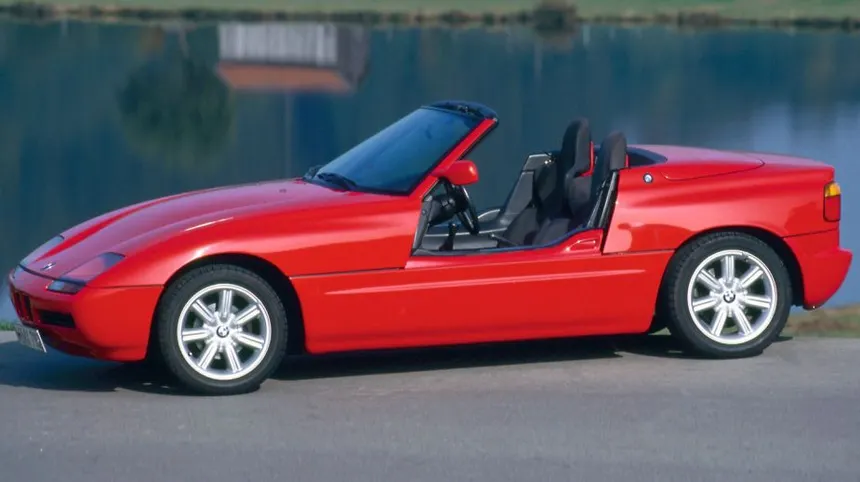
BMW Z1: The Sliding-Door Roadster That BMW Built as a Science Experiment (And Accidentally Made a Classic)
Some projects in automotive history are not born to sell. They are born to learn. To explore technologies that do not yet have names, to patent solutions that might be useful someday, to create the engineering departments and design teams that will later produce the cars that actually sell millions. The BMW Z1 was, officially, exactly one of those projects.
The problem — or the fortune, depending on how you look at it — is that it turned out to be so fascinating that people wanted to buy it. And BMW ended up selling 8,000 units of a car that had been designed not to sell.
BMW Technik GmbH: The Laboratory of Dreams
The Z1 did not emerge from BMW’s standard development pipeline. It was born within BMW Technik GmbH, a special division created with a clear mandate: experiment without restrictions. The car was conceived and developed under the direction of Ulrich Bez and designed by Harm Lagaay, with a team of barely 60 people. The first rolling prototype was completed within a year, and when BMW’s management saw it, they made the immediate decision to take it to production. Not because they believed it would be a commercial success. Because the car was too extraordinary to leave sitting in a drawer.
The “Z” in the name came from Zukunft, the German word for “future.” The same letter BMW would use decades later for the Z3, the Z4, and the Z8. The Z1 was the first — the prototype for an entire family of ideas.
The Doors That Drop: The Z1’s Most Famous Trick
The most striking feature of the BMW Z1 is its vertical sliding doors, which instead of opening outward or upward, retract downward, sinking into the oversized sills of the body. The mechanism was electric, with manual override available for emergencies. The doors took approximately 4.5 seconds to fully open and 6.5 seconds to close. The side windows retracted automatically when the doors were lowered.
The conceptual inspiration came from traditional roadsters with removable or leather doors, but the technical solution was completely new. Most interestingly, from a crash safety perspective, the oversized sill that housed the door acted as an independent lateral structural protection element. In other words: the car could be driven legally with the doors fully lowered, because the sill alone provided the required lateral protection. In most European countries, this was entirely legal. In the United States, it was not.
This peculiarity contributed to the Z1 never being homologated for the North American market — along with the cost of the certification process for such limited numbers — which explains its extreme rarity in North America today.
An Architecture That BMW Used for Decades
The doors are the most visible innovation, but the Z1’s architecture was revolutionary on several fronts simultaneously. The chassis was a steel monocoque that had been subjected to hot-dip zinc galvanisation, increasing the rigidity of joints by 25%. The exterior bodywork — bonnet, boot lid, side panels and doors — was made from injection-moulded thermoplastic panels developed by GE Xenoy, which could be individually removed and replaced. This meant that, in theory, the owner could change the car’s colour at a specialist workshop simply by swapping the exterior panels.
The floor was a 15 kg fibre-reinforced plastic tray, bonded and bolted to the steel chassis. The combination of these materials resulted in an exceptionally rigid car for its era, and a surprisingly light one: kerb weight was approximately 1,250 kg.
The Z1’s rear suspension was another technical advance worth highlighting specifically. The specific multi-link rear axle — referred to internally as the “Z axle” — was developed exclusively for the Z1 and was later adapted and refined for the BMW E36 3 Series. Every owner of a 1990s BMW 3 Series was driving, without knowing it, a car whose rear suspension existed because of the Z1.
The Engine: Shared With the 325i and Thoroughly Competent
Under the bonnet of the Z1, there was no exotic surprise. The engine was the M20B25 — the same 2.5-litre twelve-valve straight-six that powered the BMW E30 325i. Mounted in the Z1 at a 20-degree angle to allow a lower bonnet line, it produced 170 bhp at 5,800 rpm and 222 Nm of torque. Transmission was through a five-speed Getrag manual gearbox.
Performance was adequate for the era and segment, not extraordinary: top speed of 225 km/h and 0 to 100 km/h in approximately 7.9 seconds. But the Z1 never pretended to be an extreme performance car. Its objective was different: to deliver a pure, connected, sensory roadster experience that compensated for modest numbers with quality of sensation.
The Z1’s chassis, with its specific “Z axle” rear suspension and 47/53 weight distribution (front/rear), was significantly superior to its numerical performance figures. Journalists who tested it on circuit described a handling balance that was clean, predictable, and more fluid than the engine figures alone would suggest.
Eight Thousand Units That Are Now Worth a Fortune
BMW originally planned to build between 4,000 and 5,000 Z1 units. Demand far exceeded expectations and production was extended to exactly 8,000 units, manufactured in Munich at a rate of approximately 20 cars per day, all in left-hand drive configuration (a right-hand drive version was never produced). Production began in 1989 and ended in June 1991.
The launch price in Germany was approximately 83,000 Deutschmarks, a significant sum for a 170 bhp roadster. Many buyers purchased the Z1 as an investment, immediately storing it in a garage with minimal use. This explains why today many Z1s exist with ridiculously low mileage for their age.
In the current European market, well-preserved examples are valued between 45,000 and 70,000 euros, with the most exclusive specimens — very low mileage, single owner, special colours — occasionally exceeding 100,000 euros. Considerable appreciation for a car that many considered a laboratory curiosity when it was made.
The Legacy: Everything the Z1 Taught BMW
The Z1 was not a mass-market sales success. But it fulfilled its original function with interest. The patents generated during its development — high-intensity discharge lamps, integrated anti-roll bars, the door mechanism, the thermoplastic floor tray — laid the groundwork for technologies BMW would use in mass-production models throughout the following decade. The “Z axle” rear suspension transferred to the E36. The thermoplastic materials informed BMW i3 development decades later.
And, of course, the Z family — Z3, Z4, Z8 — would not have existed without the Z1 to prove that BMW could build roadsters with genuine personality.
Conclusion (The Honest Version)
The BMW Z1 is one of those cars that the automotive industry produces every twenty or thirty years, when someone in management has the courage to say: “Let’s build something without knowing exactly what it is for — just to see what we learn.” The result was a technically extraordinary, visually unique, and commercially risky roadster that became a classic entirely on its own merits.
The problem is that the industry never quite learns this lesson. Idea laboratories exist at many brands, but the cars they produce rarely make it to the road. BMW had the courage to build the Z1 when nobody was asking for it. That would be unthinkable today in a sector obsessed with market research and profitability analysis. And that, unfortunately, makes the automotive world a slightly poorer place.