
The Chevrolet El Camino: America’s Confused Masterpiece

The Vehicle That Shouldn’t Exist
In 1959, General Motors did something that made absolutely no sense: they took a perfectly good Impala, chopped off the back, welded on a truck bed, and called it the El Camino.
A car that couldn’t decide if it wanted to haul groceries or grandma. A truck that thought it was too good for actual truck work. A vehicle that, by all logic, should have been a commercial disaster.
Instead, it became an American icon.
And here’s the thing nobody wants to admit: the El Camino might be the most honest vehicle America ever produced. Not because it was good at everything. But because it refused to pretend it was something it wasn’t.
The Birth of Automotive Confusion
The El Camino’s origin story reads like corporate desperation.
In the late 1950s, Ford’s Ranchero was stealing sales from Chevrolet. The Ranchero—essentially a Ford sedan with a truck bed—had created a new category: the “coupe utility” or “ute” as Australians had called it since the 1930s.
GM’s response was pure American overkill. They didn’t just match Ford; they took their full-size Impala platform and created something far more ambitious. While the Ranchero was based on the compact Falcon, the El Camino shared bones with Chevy’s flagship.
This decision defined the El Camino’s character forever. It was never going to be a practical work truck. It was going to be a statement.
First Generation: Beauty and Confusion (1959-1960)
The first El Camino arrived wearing the same dramatic styling as the 1959 Impala—complete with those outrageous cat-eye taillights and enough chrome to blind passing aircraft.
It was gorgeous. It was impractical. It sold reasonably well.
But here’s what GM didn’t anticipate: customers weren’t using it the way they expected. Ranchers weren’t buying it for ranch work. Contractors didn’t want it for job sites. The people buying El Caminos were guys who wanted a cool car that could occasionally haul a couch.
After just two years, GM killed it. The bean counters looked at the sales figures, looked at the market confusion, and pulled the plug.
The El Camino’s first death lasted only four years.
The Resurrection: Chevelle Platform (1964-1967)
When the El Camino returned in 1964, GM had learned its lesson. Sort of.
Instead of the full-size platform, they based the new El Camino on the Chevelle—GM’s new mid-size muscle car. This made it lighter, more agile, and crucially, more affordable.
But here’s what they really did: they made it cool.
The Chevelle was becoming a street racing legend. The El Camino inherited that DNA while adding genuine utility. You could smoke Mustangs at the stoplight, then haul their broken parts to the junkyard in the same vehicle.
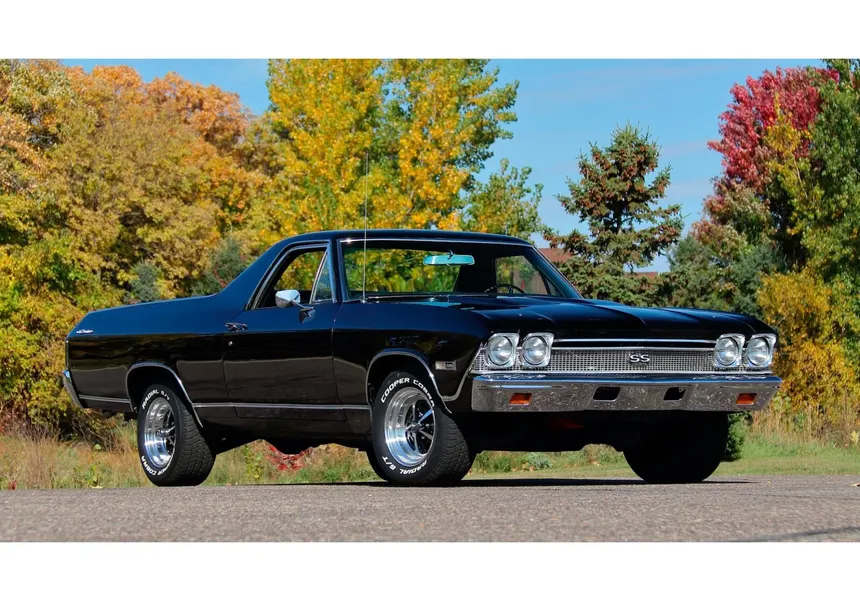
This era also introduced the SS (Super Sport) package. An El Camino SS with the 396 big-block was simultaneously the most practical muscle car and the most ridiculous truck ever built.
The Golden Era: 1968-1972
This is where the El Camino transcended transportation and became culture.
The 1968 redesign gave it cleaner lines that have aged better than most cars of the era. The 1970 update added aggressive curves and, more importantly, access to the LS6 454—a 450-horsepower big-block that had no business being in anything with a truck bed.
The LS6 El Camino is one of the most wonderfully absurd vehicles ever produced. It could run low 13-second quarter miles while carrying a full load of lumber. No vehicle before or since has combined such raw power with such genuine utility.
But here’s the cultural moment that mattered: in the early 1970s, the El Camino became the working-class hero’s chariot. Blue-collar workers who couldn’t afford separate vehicles discovered that the El Camino could be their daily driver, weekend warrior, and work truck simultaneously.
It was the ultimate democratization of automotive enthusiasm. You didn’t need three vehicles to live a full life. You needed one El Camino.
The Malaise Era: 1973-1977
The 1973 redesign, coinciding with the Colonnade body style, marked the beginning of the El Camino’s middle age.
Crash standards killed the chrome bumpers. Emissions regulations strangled the engines. The fuel crisis made big-blocks seem irresponsible. The LS6 was dead, replaced by motors that made 200 horsepower on a good day.
But something unexpected happened: sales actually increased.
While traditional muscle cars were dying, the El Camino’s practical nature suddenly seemed wise rather than confused. People still needed to haul things. The El Camino could do that without being a “real” truck that cost more and rode like a covered wagon.
This era proved the El Camino’s core appeal wasn’t just performance. It was flexibility. It could adapt to whatever America needed it to be.
The Final Generation: 1978-1987
The fifth-generation El Camino, based on the downsized G-body platform, represents the vehicle’s final form.
Smaller, lighter, and more fuel-efficient, these final El Caminos were genuinely good vehicles by any objective measure. The 1983-1987 models with the 305 V8 balanced performance and efficiency in ways that would have seemed impossible a decade earlier.
But the cultural moment had passed. SUVs were beginning their domination. Traditional trucks were becoming daily drivers. The El Camino’s unique niche—car comfort with truck utility—was being squeezed from both sides.
Chevrolet quietly discontinued the El Camino after 1987. No fanfare. No special editions. Just silence.
Why America Loved It
The El Camino worked because it reflected something true about American life: we never really know what we want to be.
Are we working people or leisure people? Do we haul stuff or haul ourselves? Do we want practicality or pleasure?
The El Camino said: yes.
It was the automotive equivalent of wearing work boots to a wedding. Inappropriate? Maybe. Honest? Absolutely.
In an industry obsessed with market segments and demographic targeting, the El Camino stubbornly refused to pick a lane. It was a car for people whose lives didn’t fit neatly into categories.
The Collector Market Today
Here’s where things get interesting for modern enthusiasts.
First-generation El Caminos (1959-1960) are now valued similarly to Impalas of the same era—$40,000 to $80,000 for well-preserved examples.
The muscle era cars (1968-1972) have exploded in value. An LS6-optioned 1970 El Camino SS recently sold for over $200,000. Even basic SS models from this era command $50,000 or more.
The malaise era (1973-1977) remains affordable—clean examples can still be found for $15,000 to $30,000.
The final generation (1978-1987) is the emerging collector sweet spot. Prices are rising but haven’t reached absurdity yet. A pristine 1987 El Camino SS can still be had for under $25,000.
The market is recognizing what enthusiasts have always known: the El Camino offers something unique that no longer exists in the modern automotive landscape.
The Spiritual Successors
Today, there is no El Camino.
The Honda Ridgeline tries to split the difference between truck and car, but it’s too truck. The Subaru Baja tried and failed. The Hyundai Santa Cruz is attempting it, but it’s too small to be taken seriously.
The actual spiritual successor might be the performance pickup: vehicles like the Ford Raptor or Ram TRX. These are trucks that prioritize driving pleasure over work capability—the inverse of the El Camino’s approach, but the same fundamental idea.
But nothing quite replicates what the El Camino offered: car driving dynamics with just enough truck capability to be useful. That formula seems to have died with the 1980s.
The Final Assessment
The Chevrolet El Camino was never the best car. It was never the best truck. It was never the fastest, most capable, or most practical vehicle GM produced.
What it was, consistently across five generations and nearly three decades, was the most interesting.
The El Camino asked a simple question: why choose? Why accept that you need different vehicles for different parts of your life? Why let automotive convention dictate how you live?
For millions of Americans, the answer was: you don’t.
The El Camino proved that you could refuse the categories entirely. You could be a gentleman and a roughneck simultaneously. You could haul your boat and haul ass without switching vehicles.
That’s not confusion. That’s freedom.
And maybe that’s why, nearly 40 years after production ended, people still remember the El Camino with such fondness. It wasn’t just a vehicle. It was permission to be complicated.
Which is, when you think about it, the most American thing of all.
Do you think the El Camino deserves a modern revival? Or is it a product of a specific time that shouldn’t be resurrected? The bed’s open for your payload of opinions.