
COSWORTH: THE HISTORY
Cosworth: The Company That Powered Half the World in Competition
In competitive motorsport, there exists a name that appears on more winning cars, more championships, and more victory stories than any independent engine manufacturer in history. It’s not Ferrari. It’s not Mercedes. It’s not Honda. It’s Cosworth. A company founded in a garage in north London by two engineers who could barely afford a test bench, which ended up providing the mechanical heart for everything from Formula 1 to WRC, from the Indianapolis 500 to the most savage road cars ever to leave a European production line.
The Cosworth story is the purest demonstration that engineering without commercial compromises can dominate motorsport for more than half a century.
The Edmonton Garage: Duckworth and Costin
It all started in 1958, when two extraordinarily talented engineers decided they could build better engines than anything available on the market. Mike Costin and Keith Duckworth had met while working at Lotus, Colin Chapman’s demanding and brilliant company, where both had demonstrated an uncommon level of mechanical brilliance. Costin specialized in aerodynamics and chassis design, while Duckworth was obsessed with internal engine engineering, applying almost scientifically pure methods to every design decision.
The name “Cosworth” is simply the fusion of their surnames: COStin + duckWORTH. They set up in a garage at Shaftesbury Mews in Edmonton, north London, with a minimal budget, a basic test bench, and ambition that exceeded any reasonable forecast. Their first project was a competition engine based on the humble Ford Anglia 105E block, the MAE (Modified Anglia Engine), which quickly proved competitive in the period’s Formula Junior. What set them apart was their rigorously scientific approach. As Duckworth himself stated: “We are too small as a company to allow development and debugging to win over sound design.”
The DFV: The Engine That Changed Formula 1 Forever
In 1966, the FIA changed Formula 1 engine regulations from 1.5 to 3.0 liters, a seismic shift that left most teams without a competitive engine overnight. Walter Hayes, Ford Europe’s public relations director and one of motorsport history’s most influential yet underappreciated figures, saw strategic opportunity where others saw chaos. He proposed Ford finance development of an F1 engine designed by Cosworth, branded as Ford.
The catalyst was Colin Chapman, who desperately needed an engine for the new 3.0-liter era following Coventry Climax’s withdrawal from competition. Chapman approached Cosworth, Cosworth needed funding, and Hayes convinced Ford to put £100,000 on the table — extraordinarily modest even for 1966.
Keith Duckworth designed what would become legend: the Cosworth DFV (Double Four Valve). A 2,993cc V8 with four valves per cylinder, 90-degree bank angle, flat-plane crankshaft, and a revolutionary approach using the engine block as a structural element of the car, eliminating the need for a heavy rear subframe. Rear suspension mounted directly to the engine casing and Hewland gearbox. Initially producing over 400 bhp at 9,000 rpm, eventually reaching 510 bhp at 11,200 rpm by career’s end.
The DFV debuted at the 1967 Dutch Grand Prix in the Lotus 49. Graham Hill took pole but retired with a cam gear failure. Jim Clark, starting from the back after qualifying problems, carved through to win. Victory on its first outing.
What followed was one of the most absolute dominations in any sport’s history. The DFV won 155 Formula 1 Grands Prix between 1967 and 1983. According to Ford figures and multiple historical sources, Ford-Cosworth engines accumulated 10 Constructors’ World Championships and 12 Drivers’ World Championships between 1968 and 1982. In 1969 and 1973, absolutely every championship race was won by DFV-powered cars. During much of the 1970s, over 70% of the F1 grid used Cosworth engines.
The key wasn’t just raw performance but Ford’s commercial policy: the engine was available to any team that could pay. This open-door approach democratized Formula 1 without precedent. Small and medium teams like Tyrrell, McLaren, Williams, Brabham, March, Hesketh, Ligier, Shadow, Wolf, and Penske could compete on equal mechanical terms because they accessed the same championship-winning engine.
Tyrrell won drivers’ titles with Jackie Stewart in 1969, 1971, and 1973. McLaren with Emerson Fittipaldi in 1974 and James Hunt in 1976. Lotus with Mario Andretti in 1978. Williams with Alan Jones in 1980. Brabham with Nelson Piquet in 1981. Keke Rosberg won the 1982 championship with Williams. All with Cosworth power. Around 375 DFV units were produced across its lifetime.
Michele Alboreto took the DFV’s last F1 win at the 1983 Detroit Grand Prix in a Tyrrell. Martin Brundle was the last to race a DFV in F1, also in a Tyrrell, at the 1985 Austrian Grand Prix.
Beyond F1: Total Domination
Reducing Cosworth to the DFV would be like reducing Mozart to one symphony. The company powered virtually every motorsport category simultaneously, often dominating several at the same time with different engine families tailored to each discipline’s specific demands.
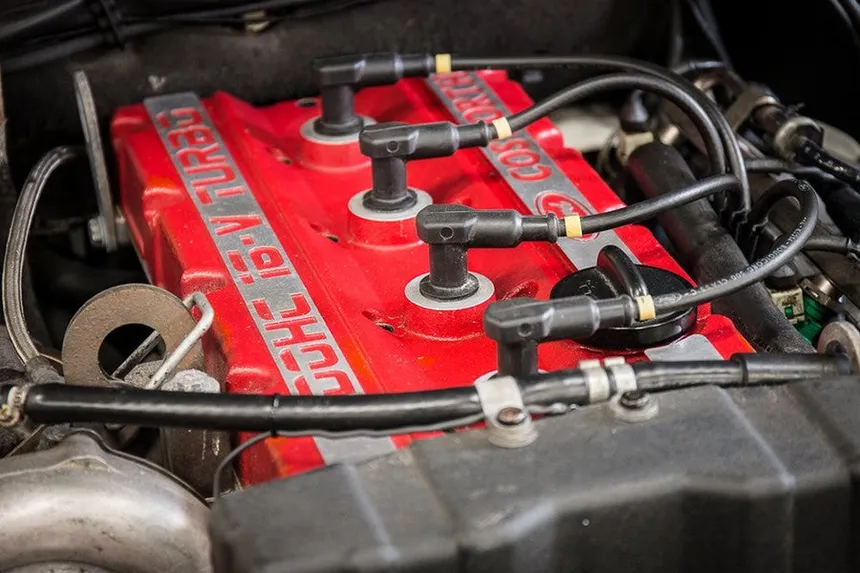
In the World Rally Championship, Cosworth developed the turbocharged 16-valve YB four-cylinder engine that became the beating heart of Ford’s rally program throughout the late 1980s and 1990s. The YBT variant, with its Garrett turbocharger and dual overhead camshaft configuration, powered the Ford Sierra Cosworth and the Ford Escort RS Cosworth through some of the most competitive eras in WRC history. These engines competed directly against the Subaru Impreza‘s EJ20 boxer and Mitsubishi’s 4G63 on rally stages worldwide, forming part of an epic three-way rivalry that defined a generation of rallying.
In IndyCar and CART racing, the Cosworth DFX engine told perhaps the most dominant chapter outside Formula 1. The DFX was a turbocharged derivative of the DFV, reduced to 2.65 liters and fitted with forced induction specifically for American open-wheel racing. It proceeded to dominate the Indianapolis 500 in a manner that had never been seen before and likely never will again: ten consecutive Indy 500 victories between 1978 and 1987. This extraordinary run ended the historic reign of the Offenhauser engine that had been synonymous with Indianapolis racing for decades. Between 1979 and 1987, the DFX also powered nine CART championship-winning campaigns, establishing a level of dominance in American racing that mirrored the DFV’s supremacy in Formula 1.
In endurance racing, DFV derivatives proved they could last as well as sprint. The engine won the 24 Hours of Le Mans twice in its original 3-liter form: first in 1975 with the Gulf Mirage GR8 driven by Derek Bell and Jacky Ickx, and again in 1980 with Jean Rondeau’s car. The 1980 victory was particularly remarkable because Rondeau won as both driver and constructor simultaneously, an unprecedented achievement in Le Mans history. Longer-stroke DFL variants in 3.3 and 3.9-liter configurations continued to compete in endurance racing through the early 1980s.
In touring car racing, versions of the YB turbocharged engine proved dominant in both the British Touring Car Championship and the Deutsche Tourenwagen Meisterschaft. The Ford Sierra RS500 Cosworth became one of the most successful touring cars of its era, and the sound of its turbocharged four-cylinder screaming through circuits like Brands Hatch and Bathurst became iconic to an entire generation of motorsport fans.
In Formula 3000, the category that served as the primary feeder series to Formula 1, Cosworth was the exclusive engine supplier for years using a rev-limited version of the DFV. It was here, on this proving ground, that future F1 champions and race winners cut their teeth with Cosworth power. Luca Badoer won the last Formula 3000 championship powered by the DFV in 1992, bringing the engine’s competitive story full circle.
The Road Cars: When Competition Hits the Street
One of Cosworth’s most tangible and emotionally resonant legacies for car enthusiasts are the road cars that carried its name and technology directly from competition to public tarmac. These vehicles represented the most direct possible transfer from motorsport to production, with minimal dilution of the racing intent.
The Ford Sierra RS Cosworth of 1986 was the car that put Cosworth on the map for the general European public. Its 2.0-liter turbo YB engine produced 204 hp, and it wore a rear wing of absurd dimensions that looked like it came straight off a racing car — because it effectively did. Performance humiliated considerably more expensive rivals, and the Sierra Cosworth quickly became legend in European car culture, particularly in the United Kingdom, where it simultaneously held the distinction of being the car every enthusiast dreamed about and the most stolen car in the country. Its theft rate was so scandalously high that British insurance companies either refused to cover it or charged premiums that practically doubled the car’s purchase price.
The Ford Sierra RS500 Cosworth of 1987 was limited to exactly 500 units, manufactured specifically to homologate the car for Group A touring car racing. Power was raised to 224 hp as standard, with a larger intercooler, higher-capacity injectors, and — in a detail that has become legendary among enthusiasts — a second set of four injectors installed in the intake manifold but not connected from the factory, sitting ready for activation in the competition version. The RS500 is today one of the most sought-after Fords in the collector market, commanding prices comfortably exceeding €100,000 for documented examples in good condition.
The Ford Escort RS Cosworth of 1992 remains perhaps the most iconic road Cosworth of all. Designed from its first sketch for rally competition, it featured permanent all-wheel drive and a 2.0-liter YBT turbo engine producing 227 hp as standard. The double rear wing, designed by Frank Stephenson (who later designed the new MINI and the Ferrari F430), wasn’t decorative: it was functional and generated significant aerodynamic downforce that kept the rear axle planted at high speeds. The Escort RS Cosworth competed directly in the WRC against the Subaru Impreza and Mitsubishi Lancer Evolution, establishing an epic three-way rivalry that defined an era of rallying and created tribal loyalties that persist to this day.
The Mercedes-Benz 190E 2.3-16 Cosworth, unveiled in 1983 and commercially launched in 1984, stands as one of Cosworth’s most surprising and unexpected projects. Mercedes commissioned the British engineering firm to develop a 16-valve DOHC cylinder head for the compact executive 190E’s four-cylinder engine, a car nobody would have associated with pure competition engineering. The Cosworth-headed engine transformed the humble 190E into a car that won the DTM touring car championship dominantly and established the technical and philosophical foundations for what would later become Mercedes’ AMG high-performance line. In many ways, AMG’s current identity traces back to the partnership between Stuttgart’s precision and Northampton’s racing pedigree.
The Vauxhall/Opel Calibra Turbo 4×4, less well-known but equally impressive, used the Cosworth-designed C20LET 2.0-liter turbo engine producing 204 hp. This engine appeared in several Vauxhall/Opel models throughout the 1990s, providing sports car power to bodyshells that would otherwise have been completely unremarkable family vehicles.
The Modern Era and the Valkyrie Engine
Cosworth returned to F1 in 2010 with the CA2010 engine, supplying HRT, Lotus Racing, and Marussia. It wasn’t DFV-level domination, but proved the company could still design functional F1 engines after years away. Outside F1, Cosworth diversified into electronics, telemetry, aerospace, defense, and hydrogen technologies.
The most impressive engine Cosworth engineers have produced for a road car in recent times is the naturally aspirated 6.5-liter V12 developed for the Aston Martin Valkyrie. Producing over 1,000 hp without any turbocharging or supercharging, purely from natural aspiration, revving beyond 11,000 rpm, this engine represents the absolute culmination of decades of competition engine experience transferred to a vehicle that can, at least theoretically, drive on public roads.
Why Cosworth Matters
Cosworth matters because it proved engineering excellence can come from anywhere — any garage, any budget. Keith Duckworth never built a complete car. Never had a brand bearing his name. Was never famous outside motor racing circles. But his engines won more championships than virtually any other independent company in motorsport history. His designs changed Formula 1 forever by proving an engine could serve as a structural element. His rigorous engineering philosophy influenced generations of engine designers worldwide.
When you drive a Sierra RS Cosworth on a mountain road and feel turbo lag transform into a brutal, addictive shove of power, you’re feeling the same uncompromising engineering spirit that put Jim Clark on top of the podium at Zandvoort in 1967. When you hear an Escort RS Cosworth screaming through a rally stage at full boost, you’re hearing the same philosophy that won ten consecutive Indianapolis 500s.
Cosworth powered half the world in competition. But more importantly: it proved that a small company born in a garage with more ambition than budget can change an entire sport.