F1 Halo: 15 Pounds of Titanium Almost Nobody Wanted
Formula 1 did to the halo what NASCAR did to the head restraint. It waited for the funerals, then argued about the looks. Hand a racing paddock a device that keeps heads attached to drivers and the first question out of the room is whether it spoils the lines of the car.
American fans already know how this movie goes. The HANS device sat around for years selling a few units at a time until Dale Earnhardt hit the Turn 4 wall at Daytona in February 2001. Fourteen years later, a flying nose cone killed a very popular driver on American soil. His name is one of the reasons the F1 halo exists.
The nose cone at Pocono
August 23, 2015, Pocono Raceway, Pennsylvania. Twenty laps from the end of the IndyCar race, Sage Karam spun into the wall. The nose of his car came off, bounced across the Tricky Triangle and hit Justin Wilson’s helmet. The tall, soft-spoken Englishman, one of the best-liked men in the garage, died the next day at 37.
When the FIA later ran real crashes through its halo study, it asked one question of each: would this part have changed anything? For Wilson the answer came back positive. A loose piece of car flying at a driver’s head is exactly what a bar across the front of the cockpit is for.
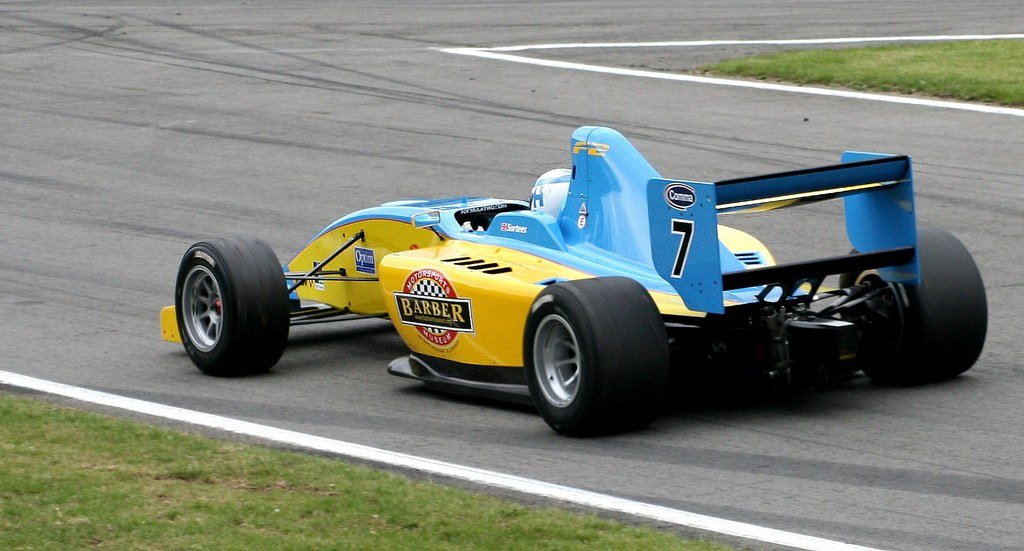
The same verdict went to a much younger victim. On July 19, 2009, in a Formula 2 race at Brands Hatch, a wheel came off Jack Clarke’s car after it spun into the wall. It weighed 64 pounds, it snapped its tether, and it rolled back into the path of Henry Surtees at something like 100 mph. Surtees, son of the 1964 world champion John Surtees, was 18. He died that day.
Six days later a coil spring about eight inches long fell off Rubens Barrichello’s Brawn during qualifying in Hungary. Felipe Massa’s Ferrari met it at more than 155 mph. It weighed under two pounds. It punched a hole above his visor, injured his skull and knocked him out cold, and the car ran straight on into the tire wall at Turn 4. He spent days in an induced coma. Racing’s governing body opened its file on head protection that summer.
Why a bar and not a windshield
Most Americans watching IndyCar think of this problem as solved by a screen, and that’s the fork in the road. By 2016 the FIA had three candidates in front of it. Mercedes had shown the halo in 2015. Red Bull had the aeroscreen. The FIA was working on a transparent shield of its own. They all went into a test program that included firing an F1 wheel at a cockpit at about 140 mph.
The shield flunked the required impact tests. Its road debut was worse. Sebastian Vettel took it out in practice for the 2017 British Grand Prix, came back after one lap dizzy, with his vision swimming, and that was that. The aeroscreen lost out too, and its creators did not take it well.
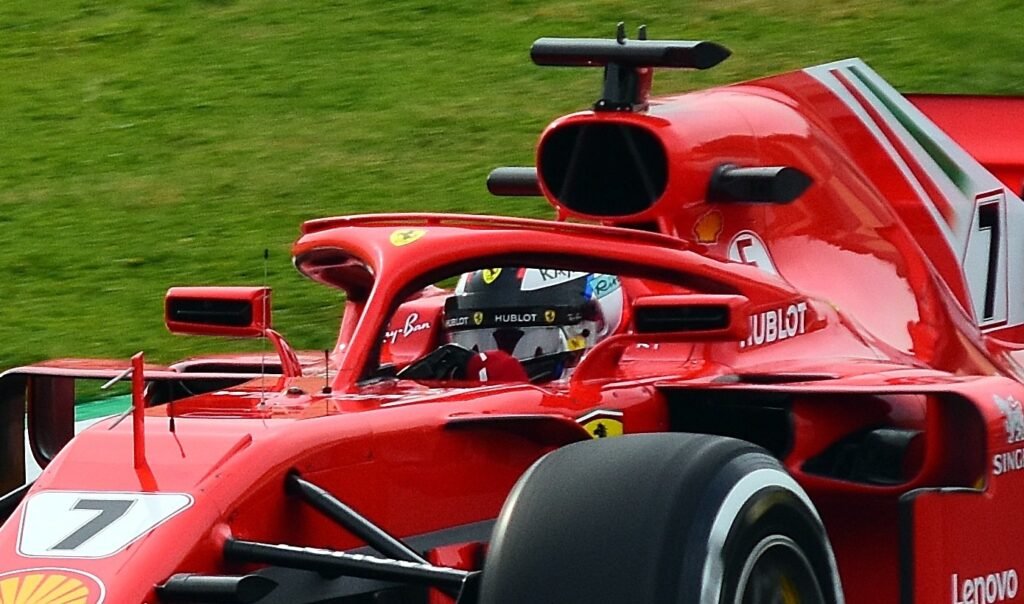
So the winner was a three-legged bar. Lewis Hamilton saw it first on Kimi Räikkönen’s Ferrari at a Barcelona test on March 3, 2016, a temporary carbon-fiber version made just to check sight lines, and his reaction went straight to Instagram: “Please no,” with a line about the worst-looking mod in Formula 1 history. He softened that within hours and came around that summer after the FIA’s presentation at the Hungarian Grand Prix. Plenty of his colleagues never bothered. Romain Grosjean, driving for America’s own F1 team, called its arrival a sad day for the sport and said he was still against it. Kevin Magnussen, same garage, same opinion. Max Verstappen didn’t like it. Niki Lauda said it distorted the essence of a race car.
Toto Wolff topped them all at the launch of Mercedes’ 2018 car, at Silverstone, when he said that given half a chance he’d take it off with a chainsaw. That was the boss of the team whose engineers had drawn it.
Nine teams against, and the FIA shrugged
In July 2016 the Strategy Group killed the halo for 2017. A year later in Geneva, per Autosport’s sources, nine of ten teams voted against it again. The FIA pushed it through anyway for 2018 on safety grounds, which is the one card the governing body can play over the heads of the people writing the checks. Laurent Mekies, the French engineer running FIA safety at the time, described those years to RacingNews365 like this: “Every single person was against us.” The push, he said, came from president Jean Todt, who wouldn’t take compromises. Mekies today runs Red Bull, the outfit whose screen lost.
The number the FIA waved around was 17%. Its model, built from 40 real accidents both fatal and not, put the theoretical gain in driver survival at 17%. Note the word theoretical. Nobody counted bodies. Still, none of the cases they ran came out negative, and only a few came out neutral, Jules Bianchi’s among them.
The drivers who backed it never got much credit. Daniel Ricciardo was in favor. So was Sergio Pérez. Fernando Alonso said safety came first if the thing helped in fatal crashes. Sir Jackie Stewart, who knew more about burying friends than anyone in that paddock, compared it to the arrival of the seat belt. We’ve covered how well that one went over, too.
26,000 pounds, straight down
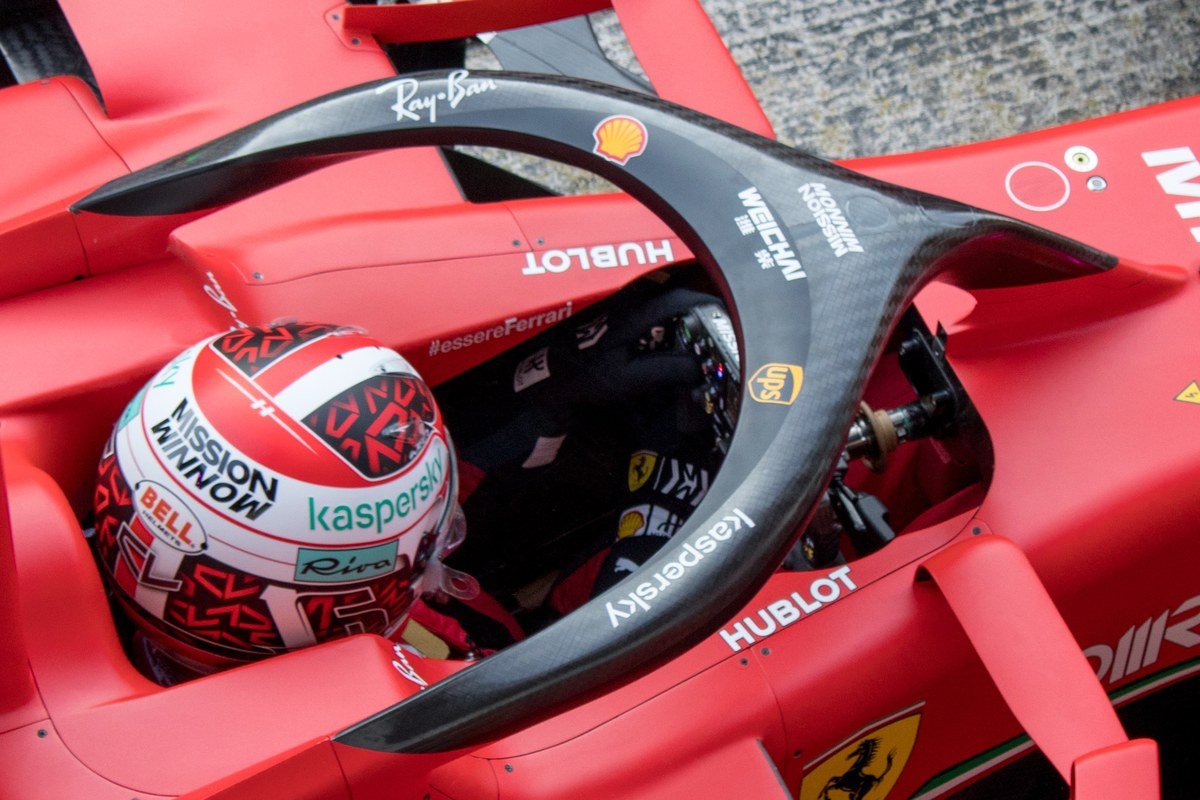
The part itself is less exotic than the arguments. Five pieces: two quarter-circles forming the top hoop, two tails that bolt in at the back and a central post about 0.8 inches wide. Three mounting points to the tub. Under FIA Standard 8869-2018 the assembly must be Ti6Al4V Grade 5 titanium, the aerospace alloy, and must weigh 7.0 kg, which is 15.4 pounds, within a window of about a third of a pound. The same document allows a 30-pound steel version for series that can’t justify the metal. That’s what the titanium buys you: half the weight.
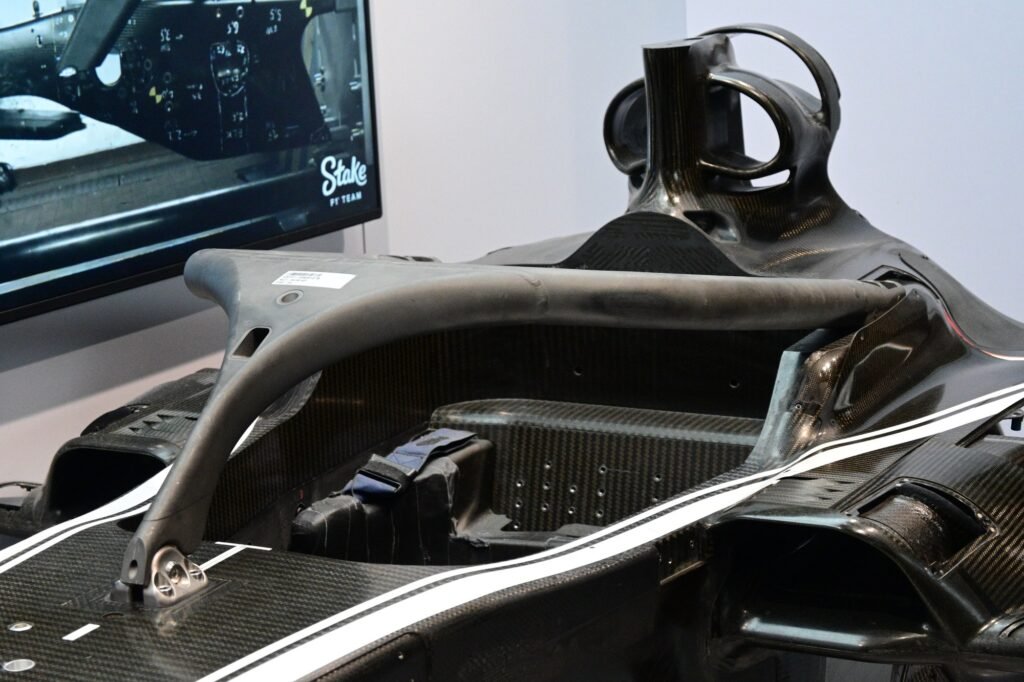
Now the load test, where online arguments go to die. Early reports said the thing had to take 125 kilonewtons from above. Others say 116. Go read the standard and both are right. Test one applies 116 kN straight down and 46 kN rearward at once. That’s about 26,000 pounds of force down and 10,000 back. Test two pushes 93 kN inward and 83 kN rearward. Do the vector math on either pair and you land on 125 kN, about 14 US tons. Peak load arrives inside three minutes and has to hold for five seconds. In the first test the structure can’t bend more than 17.5 millimeters, around seven-tenths of an inch. In the second it gets about 1.8 inches and must soak up at least 7 kilojoules.
James Allison, then Mercedes’ technical director, said the chassis had to be built to hold a London double-decker bus parked on the halo. That’s why the real bill was never the part. Teams paid somewhere between €13,000 and €24,000 per unit, and Force India reckoned the job of re-engineering a car around it ran up to a million dollars, with 31 to 33 pounds installed once the reinforcement was counted.
Three firms got the FIA’s nod: CP Autosport in Germany, SST Technology in Britain and V System in Italy. CP passed first and sold to nine of the ten F1 teams, buying around ten tons of high-strength titanium in six weeks to do it. They weld in a sealed chamber to keep the metal from contaminating, then x-ray every weld, check for cracks with penetrant dye and measure the walls by ultrasound. And if you’ve wondered how rescue crews get through it, the medical car carries cutters that take about two seconds on the front post and about five on each rear leg.
An American team’s car in a Bahrain guardrail
Every safety device gets its one piece of footage. This is the halo’s, and it belongs to Haas.
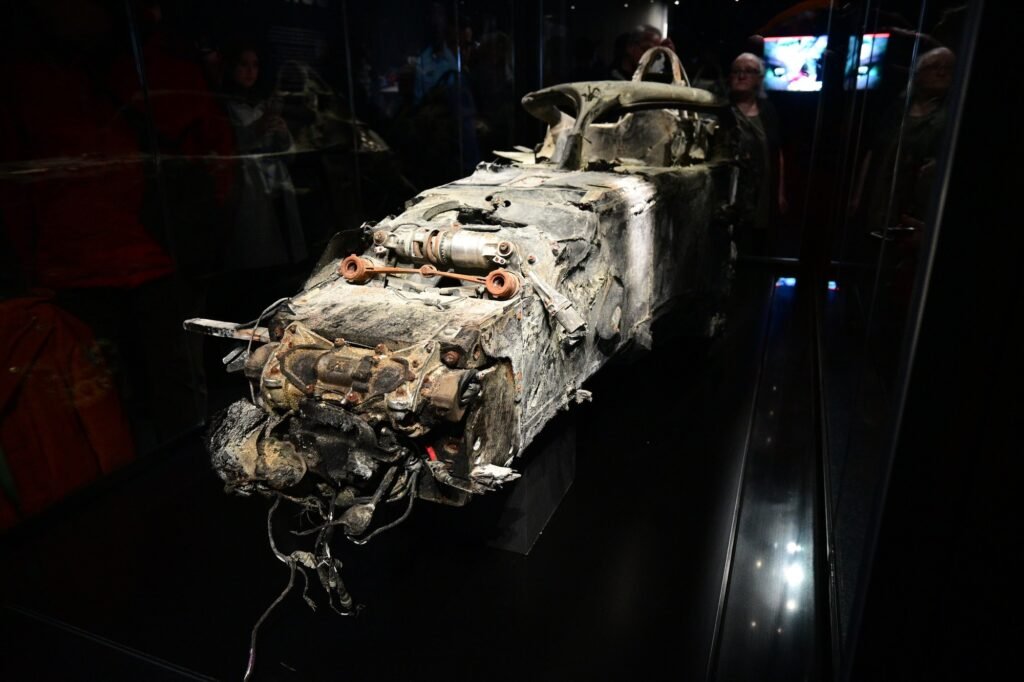
November 29, 2020, Bahrain, first lap. Grosjean clipped Daniil Kvyat and hit a triple-rail barrier at 119 mph. The FIA’s final report put the peak at 67 g, up from an earlier 53. The car tore in half. The front end went through the steel, splitting the middle rail, with the fuel tank hatch ripped open and fire all around. Twenty-seven seconds later he climbed out with burned hands. He’s the man who had called the thing a sad day. “Without it I wouldn’t be able to speak to you today,” he said.
Its first proof came two years earlier, on May 13, 2018, in an F2 sprint in Barcelona, when Nirei Fukuzumi’s left rear wheel came down on Tadasuke Makino’s halo. Then Spa, August 26, 2018, F1’s turn: Nico Hülkenberg, who had never much supported the idea, missed his braking and launched Alonso’s McLaren over Charles Leclerc’s Sauber. The right front wheel landed on the titanium with 58 kN, less than half the test load, and the part wasn’t even deformed. The FIA’s investigators then did something rare in this business, which was to play down their own hero: the wheel wouldn’t have reached Leclerc’s helmet, they said, but the McLaren’s wing endplate would have touched his visor, and nobody could say how hard. Alonso looked at the replay and said it was a very good thing to have that day. That was enough to turn Hülkenberg.
Monza, September 12, 2021. Verstappen and Hamilton touched at the first chicane in the middle of the most poisonous title fight in decades. The Red Bull rode up the Mercedes engine cover, hit the roll hoop, then sat on the halo, with its rear tire brushing Hamilton’s helmet. Because the bar carried the car, he came away with a sore neck. “Thank God for the halo,” he said. “That ultimately saved me. And saved my neck.” Wolff, chainsaw put away, said it had saved a life.
Silverstone, July 3, 2022, might be the wildest of the bunch. Zhou Guanyu’s Alfa Romeo was flipped at the start after contact with George Russell, and the roll hoop was gone almost immediately. Team boss Fred Vasseur put the load on it at more than twice the FIA test figure. From there on, a bar nobody had designed as a skid plate held the car off the ground for several hundred meters of sliding, over the tire barrier and against the catch fence. “The halo saved me today,” Zhou said. The FIA toughened roll-hoop testing for 2023, and the 2026 rulebook raised it again, from 16 g to 20 g.
Still, the line “four lives saved” that gets passed around online is a slogan. Leclerc’s own investigation says as much. Tubs, helmets, HANS, belts, fire suits and medical crews were doing their share in every one of these crashes.
What it doesn’t do
Spa, August 31, 2019, is the crash halo fans prefer to skip. In the F2 race Anthoine Hubert’s car came to rest sideways in the runoff, almost stopped, after hitting the barrier. Juan Manuel Correa, the Ecuadorian-American driver, arrived at about 135 mph at an angle of around 86 degrees. Hubert’s car took 81.8 g. He died at 22. Correa survived with devastating leg injuries. Both cars had halos. That hit came through the side, where the part has no job.
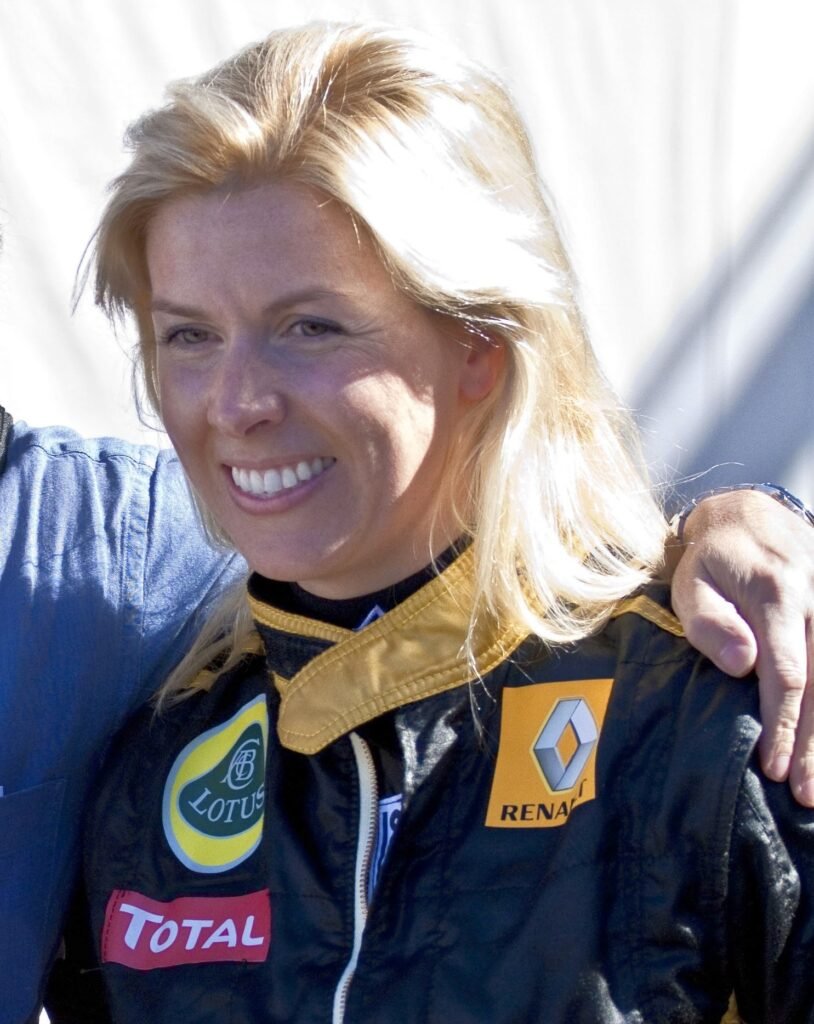
The other hole in the story is Bianchi at Suzuka on October 5, 2014, who slid his Marussia under a recovery crane in the rain and hit his helmet on its underside. He died nine months later. The FIA’s own model rated his case neutral. And two years before that, in England, another Marussia driver had already met a heavy vehicle head-on: Spanish racer María de Villota, testing at Duxford Aerodrome on July 3, 2012, rolled at low speed into a truck’s tail lift sitting at eye height. She lost her right eye and died in Seville in October 2013, at 33. Same team, same kind of hit, two years apart. We found no public FIA assessment of whether a halo would have mattered in her case, and we aren’t going to invent one.
Back home in Indiana
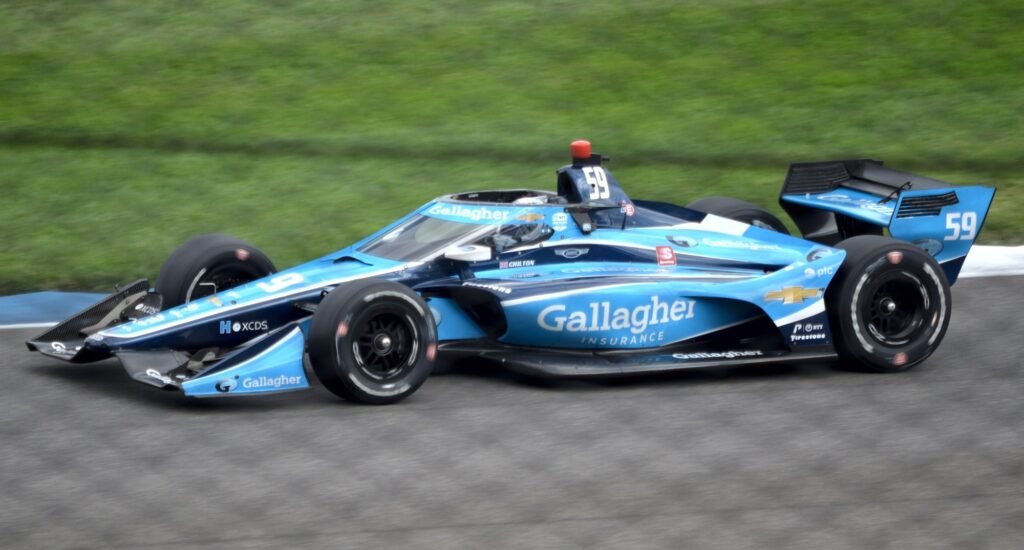
IndyCar took the road F1 declined. Its aeroscreen, a Red Bull Advanced Technologies design built with Pankl, PPG and Dallara, went racing in 2020, with a halo-style titanium frame holding up a laminated screen. It came in around 52 pounds, and Red Bull Advanced Technologies claimed 150 kN against the halo’s 125. A second version shed 11.1 pounds in April 2024 at Long Beach, to offset the hybrid system. Kyle Kirkwood found out what it was worth at the 2023 Indianapolis 500, sliding upside down along the wall with nothing touching his head.
Formula 1 went the other way. Teams faired the bar, hung little winglets on it and started hunting tenths around a required safety part. For 2026 the FIA went out to tender for a lighter titanium one, up to a kilo less, after its single-seater chief Nikolas Tombazis admitted the cars had got too big and heavy.
The ugly black arch stays. Ask anyone who has had a Red Bull parked on it.
The Bianchi name had already been through this once: Lucien, Jules’s great-uncle, died at the 1969 Le Mans test in a three-liter Alfa Romeo Tipo 33.
Check you’re still alive.
Photos: Jen Ross (CC BY 2.5), Glen from United Kingdom (CC BY 2.0), David Hernandez (CC BY 2.0), Artes Max (CC BY-SA 2.0), Hullian111 (CC BY-SA 4.0), Doctorindy (CC BY-SA 4.0).