
Ford Festiva SHOgun: Beers, a Yamaha V6, and the Maddest Build Ford Never Acknowledged
Builds & Swaps | Not Enough Cylinders
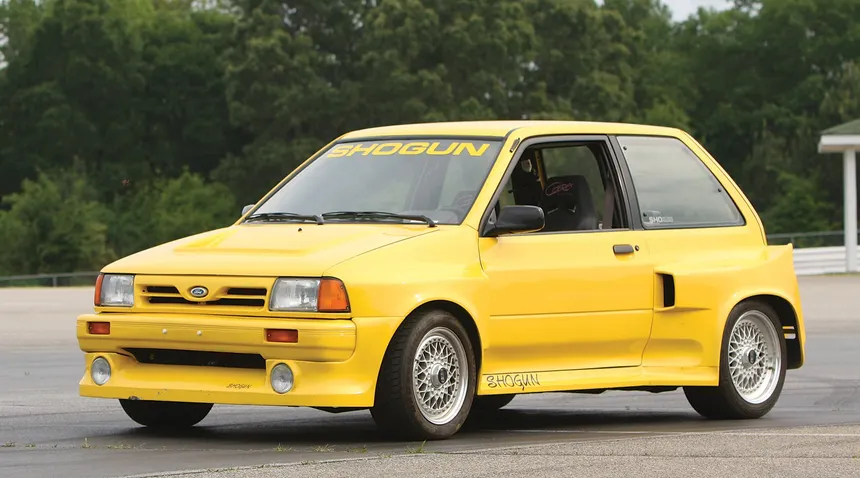
63 horsepower is not enough. 220, mounted behind the seat, is.
In 1989, the Ford Festiva was exactly what it looked like: a shoebox on wheels. Designed by Mazda in Japan, built by Kia in South Korea, and sold by Ford in the United States, it weighed 1,700 pounds and its 1.3-liter SOHC engine produced 63 hp. Sixty-three. It was the cheapest car you could buy in North America, built to go from point A to point B while burning as little fuel as possible. Its interior smelled of virgin plastic and its options list could fit on a bar napkin.
But it was precisely in a bar — or rather, during a beer-fueled evening — where two men decided that this car was perfect. Not for running errands. For turning it into a mid-engine supercar.
The night that changed everything: an RS200, an R5 Turbo, and a Festiva
Chuck Beck was a car builder to his core. His company, Special Edition Inc., had been building replicas of the Porsche 550 Spyder since 1982 that have since become cult objects: over 2,500 units built by hand throughout his career. He had worked with Carroll Shelby, built dragsters, street cars, and Lister replicas pushing north of 800 hp. By the late ’80s, Beck was in his fifties and still couldn’t sit still.
Rick Titus was a different story from the same book. Son of Jerry Titus — a professional racing driver and editor of Sports Car Graphic magazine, killed in a racing accident in 1970 — Rick grew up literally surrounded by Shelby Mustangs and Camaro prototypes. He raced professionally in the SCCA, won an endurance championship as Steve Saleen’s teammate driving a Saleen Mustang in 1988, and worked as technical editor at Hot Rod and Motor Trend. He wasn’t an enthusiast with opinions. He was an engineer with a racing license.
One evening, Titus had just come back from driving a Ford RS200 — the Group B monster, mid-engine, Cosworth-powered, all-wheel drive — and the conversation with Beck drifted to the Renault 5 Turbo. That car had taken a front-wheel-drive economy car and transformed it into a homologation weapon: rear-mounted turbo engine, brutal fender flares, rear-wheel drive. The question hung in the air between beers: could you do something like that using parts you could find at any Ford junkyard?
Beck set himself one condition: everything had to be repairable with catalog parts. No exotic components impossible to replace. And the ideal donor had just hit the market.
The heart of the monster: the Yamaha SHO V6
In 1989, Ford surprised the world with the Taurus SHO. What looked like just another family sedan on the outside carried an engine under the hood that had no business being there: a 3.0-liter, 60-degree, DOHC, 24-valve V6 developed entirely by Yamaha Motor Corporation. The contract had been signed in 1984, and Yamaha delivered a masterpiece.
The numbers spoke for themselves: 220 hp at 6,200 rpm and 200 lb-ft of torque at 4,800 rpm. Redline at 7,000 rpm, fuel cutoff at 7,300. For a late-’80s production engine, that was European sports car territory. Its iron block and aluminum heads followed an oversquare, symmetrical design with an 89 mm bore and 80 mm stroke. But the detail that made it perfect for a swap was something else: its variable-length intake manifold was bilaterally symmetrical, meaning you could rotate it 180 degrees to ease the transition from transverse to longitudinal mounting. An engine designed to sit sideways in a Taurus that, by pure engineering, could be pointed in any direction.
Beck found a wrecked Taurus SHO with barely 5,000 miles on it. He had his donor.
The surgery: how to fit a Taurus inside a Festiva
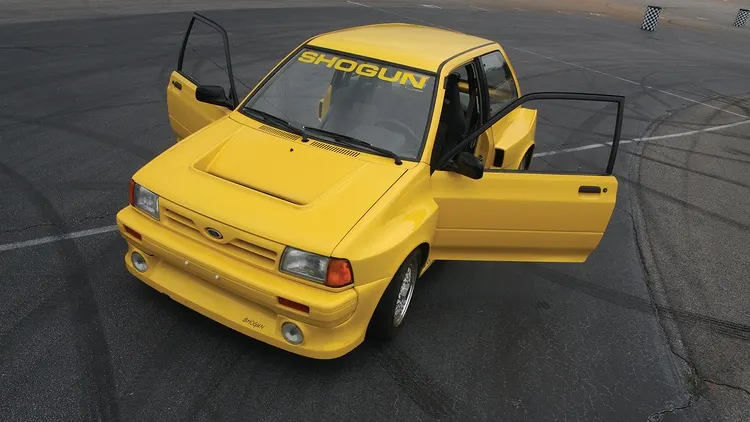
What Beck and Titus did wasn’t a conventional swap. It was a ground-up reconstruction. The Festiva body was kept, but virtually everything underneath it disappeared.
The complete rear subframe from the Taurus SHO was welded and bolted directly to the Festiva’s rear structure, keeping the engine-gearbox assembly intact. This meant the Yamaha V6 retained its original Ford MTX-IV five-speed manual transmission, cable-actuated — exactly as it left the factory. That was an engineering masterstroke: by keeping the powertrain unmodified, all the factory reliability transferred straight to the SHOgun. No adapters, no conversions, no artificial weak points.
But a Taurus measures 71.9 inches wide. A Festiva, 62.5. There’s no hiding that difference. The three-piece BBS wheels — 15-inch front with 205/50 tires, 16-inch rear with 245/45 — stuck out considerably. Special Edition designed three-piece box flares with functional scoops: the side intakes fed the engine bay and intake, while rear louvers evacuated hot air. The steel hood received a hand-formed ventilation scoop using basic metalworking.
Where the Festiva’s engine once lived, there was now a Taurus radiator and a fuel cell. The gas tank was relocated to the front compartment. Production cars received polished fuel cells with air diverters to channel hot air upward through the hood vent. The prototype, as Beck admitted with a grin, was built with leftovers from other projects.
Suspension: when factory components can’t keep up
The front suspension was a calculated hybrid: control arms and unassisted steering rack from the Festiva, but steering knuckles and hubs from the SHO. Front brakes were the same units as the rears — Taurus components — proportioned by axle. Two anti-roll bars worked the front end: the original Festiva bar, which doubled as a control arm locating link, and the SHO bar.
The problem appeared during early testing. The Taurus SHO’s struts couldn’t handle the grip generated by the SHOgun’s tires. They were flexing under load — a load that, on the skid pad, measured between 0.95 and 1.04g of lateral acceleration. On 1990 tires. For context: a Porsche 911 Carrera of that generation managed around 0.89g.
Special Edition scrapped the factory components and fabricated new, stiffer struts for all four corners, incorporating Koni adjustable dampers. The rear suspension retained the Taurus SHO geometry, with one modification: caster was eliminated from the rear wheels, as it served no functional purpose on a rear-drive axle.
The numbers that explain everything
| Spec | Value |
|---|---|
| Engine | Ford SHO V6 3.0L DOHC 24V (Yamaha) |
| Power | 220 hp / 223 PS @ 6,200 rpm |
| Torque | 200 lb-ft (271 Nm) @ 4,800 rpm |
| Fuel cutoff | 7,300 rpm |
| Transmission | 5-speed manual Ford MTX-IV |
| Drivetrain | Rear-wheel drive (mid-engine) |
| Weight | 2,190 lb (993 kg) |
| Power-to-weight | 10.0 lb/hp |
| 0–60 mph | 4.6 seconds |
| Quarter mile | 12.9 s @ 100.9 mph |
| Lateral acceleration | 0.95 – 1.04g |
| Top speed | 145 mph (233 km/h) |
| Weight distribution | 57/43 (front/rear) |
| Wheelbase | 91 inches (2,311 mm) |
| L / W / H | 143.1 / 74.6 / 55.8 inches |
| Ground clearance | 5.75 inches (146 mm) |
| Track front / rear | 56 / 62 inches |
| Front tires | 205/50 R15 |
| Rear tires | 245/45 R16 |
| Wheels | Three-piece BBS |
| Brakes | Taurus SHO discs, all four corners |
| Dampers | Custom Special Edition with Koni valving |
| Price (1990) | $41,000 – $47,500 (varied by unit) |
| Base Festiva L-Plus (1990) | $6,800 |
| Inflation-adjusted (2025) | ~$82,000 – $98,000 |
| Planned production | 250 |
| Units built | 7 + 1 prototype |
| Surviving units | 6 (one destroyed in 2021) |
The exhaust detail Ford couldn’t solve
Beck called Ford during development to ask about the optimal exhaust configuration downstream of the original catalytic converters. Ford’s engineers were straightforward: they’d see performance gains if he could get at least 48 inches (1.22 meters) of exhaust length after the cat.
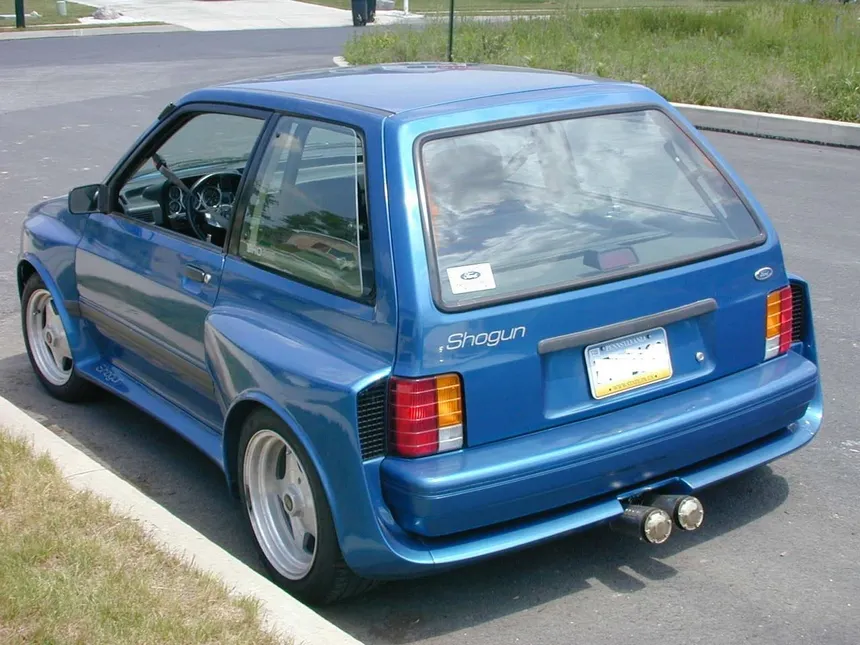
Beck laughed. The entire Festiva is 143 inches long. With the engine behind the driver and the catalytic converters squeezed into whatever space was left, there was no physical way to fit four feet of exhaust pipe. The SHOgun’s exhausts exit center, twin tips, absurdly short, and they sound — according to everyone who’s heard them — like an angry hornet’s nest.
$42,000 for a Festiva: the price that killed the SHOgun
Here lies the project’s commercial tragedy. In 1990, the plan was to build 250 units. Each SHOgun required two brand-new donor cars — a Festiva and a Taurus SHO — plus hundreds of hours of hand labor, custom suspension components, fiberglass flares, three-piece BBS wheels, reupholstered interior with “SHOgun”-embroidered cloth, Cobra seats, Momo steering wheel, full VDO instrumentation, air conditioning, and a sound system.
The result: a sticker price between $41,000 and $47,500 per unit, depending on spec. For perspective: a base Ford Festiva L-Plus was $6,800. A Chevrolet Corvette C4, $31,979. A Porsche 911 Carrera, around $51,000. The SHOgun was faster than both in a straight line and matched them through corners. But explaining to a 1990 buyer that they should pay more than Corvette money for a Festiva on steroids was, simply put, impossible.
Seven customer cars plus the original prototype were built. Each painted a different color. Number three, silver, was bought by Jay Leno for around $35,000. He’s owned it for over 30 years and added a nitrous oxide system that pushes output to 300 hp. Leno describes it as “a Renault 5 Turbo on steroids” and says it’s one of the most fun cars in his entire collection — a collection that includes McLarens, GT40s, and Bugattis.
The legacy you can’t buy: replicas, tributes, and a fire
The community never forgot the SHOgun. Over the years, several enthusiasts have built their own versions. The most notable is SHOgun #8, a replica created by a builder who invested six years completing it. On SHO Forum, the build of #9 is documented — another project replicating the original formula by welding a Taurus SHO subframe to a junkyard Festiva.
At the Grassroots Motorsports $2003 Challenge, a builder named Bill brought his own version — the “Fastiva” — and finished fifth overall. His total budget, including both donor cars and all components, came in under the $2,003 limit. Five faulty master cylinders later, he finally got the brakes to bleed with a $68.90 Wilwood unit.
But the darkest chapter came on December 30, 2021. The Marshall Fire, the most destructive wildfire in Colorado history, razed over 1,100 homes in the Louisville area near Denver. Among the ashes, in Linda Jackson’s garage — she was storing it for a neighbor — was one of the seven original SHOguns. The fire consumed the fiberglass flares, burst every piece of glass, and charred the chassis to its bones. The SHO community shared photos of the carbonized skeleton with a grief that went beyond metal.
Six remain. And none are for sale.
Why the SHOgun matters: engineering as an act of rebellion
The Ford Festiva SHOgun wasn’t a marketing exercise, wasn’t a motor show concept, and had no official Ford backing. It was what happens when a car builder and a professional racing driver refuse to accept that a cheap car can only ever be cheap.
Everything on the SHOgun has an engineering reason behind it: the flares exist because the Taurus subframe is wider, not for aesthetics. The air intakes feed the engine, not decoration. The center exhausts are short because there’s no physical space to make them longer. Even the 993 kg curb weight was an achievement — compared to the 1,400 kg of the Renault Clio V6 that would arrive a decade later attempting the same formula.
The SHOgun proved that specific output matters less than power-to-weight ratio. That a naturally aspirated V6 from a family sedan, placed in the right spot inside a body light enough to exploit it, can humiliate cars costing five times as much. And that the best ideas in automotive history sometimes come from a night of beers between two men who know exactly what they’re doing.
Only seven were built. Six remain. And each one is rarer than most of the Ferraris you’ve ever seen.
Check that you’re still alive.