
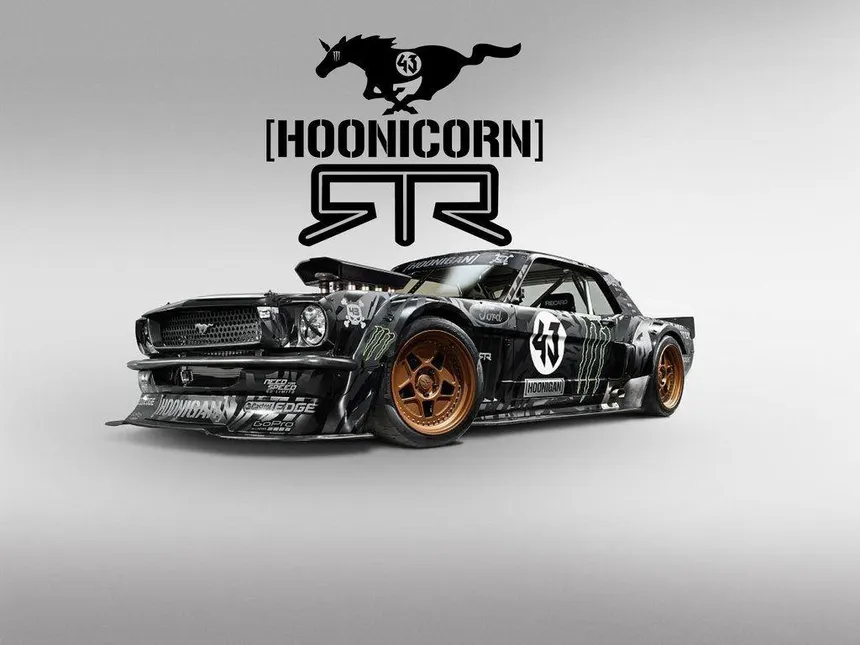
Hoonicorn: a 1965 Mustang doing donuts on 1,400 horsepower of methanol
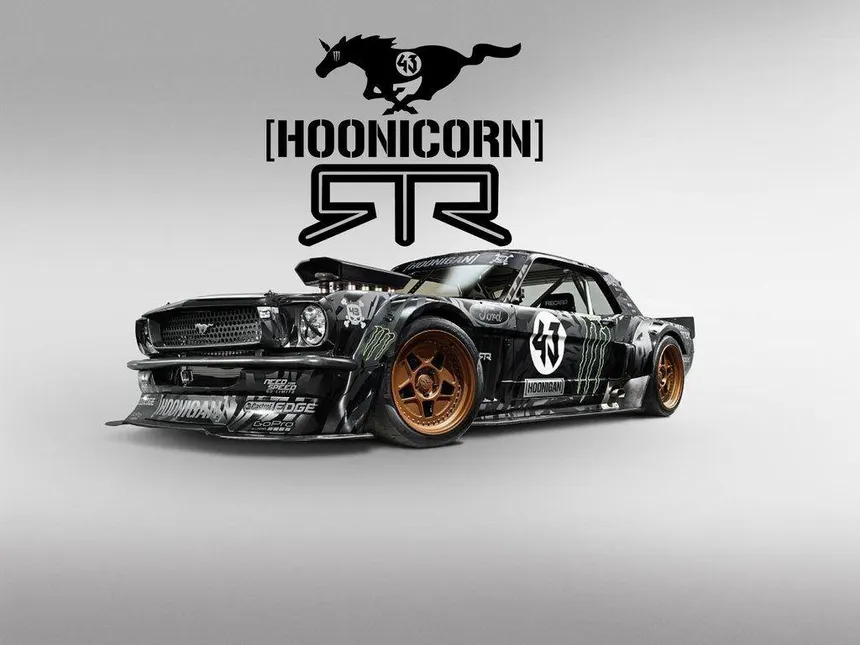
Take a 1965 Ford Mustang Notchback. Steel body. The kind your dad watched go past the diner with fenders so wide they looked hand-drawn. Strip everything inside. Drop in a NASCAR-spec tubular chassis fabricated in Charlotte. Bolt up a 410 cubic-inch Roush Yates V8. Add all-wheel drive, three mechanical limited-slip diffs, a six-speed Sadev sequential gearbox. And then, when you’ve already got 845 horsepower at all four wheels, decide it’s not enough. Strap on twin Garrett turbos. Switch to methanol fed through sixteen 1,050cc injectors. Pull the intercooler — you don’t need it anymore. Push the dyno chart to 1,400 horsepower.
That’s the Hoonicorn.
No rulebook on Earth permits a car like this. No category would homologate it. And that’s exactly the point.
The original brief: a 1965 Mustang with all-wheel drive
Stop here for a second. Because the Hoonicorn started with an idea any old-school mechanic would call impossible. A ’65 Mustang with all-wheel drive. It doesn’t sound weird to you because you’ve seen it a hundred times on YouTube. But think it through from the bench: you’re taking a sixty-year-old body shell, designed for engine in front and drive axle in back, and you have to fit a front halfshaft, a front diff, a transfer case, suspension geometry that wasn’t designed to push and pull at the same time, all inside a silhouette the public has to keep recognizing as a ’65 Mustang.
In 2012 Ken Block walked into RTR Vehicles — Vaughn Gittin Jr.’s shop — and told him what he wanted. Gittin listened. Then he called ASD Motorsports in Charlotte, North Carolina — the guys who fabricate tube chassis for NASCAR — and between the three teams they started turning the idea over. Two years of work. The name came from somebody in the workshop: Hoonigan plus Unicorn. Hoonicorn. Because it was a mythical animal that didn’t exist. Until it did.
What’s left of the original Mustang
Let me tell you what survives of the ’65 inside the Hoonicorn. Because it matters.
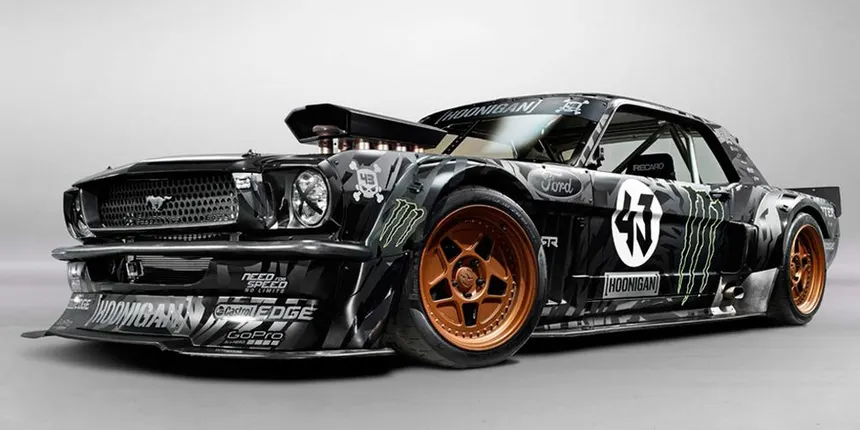
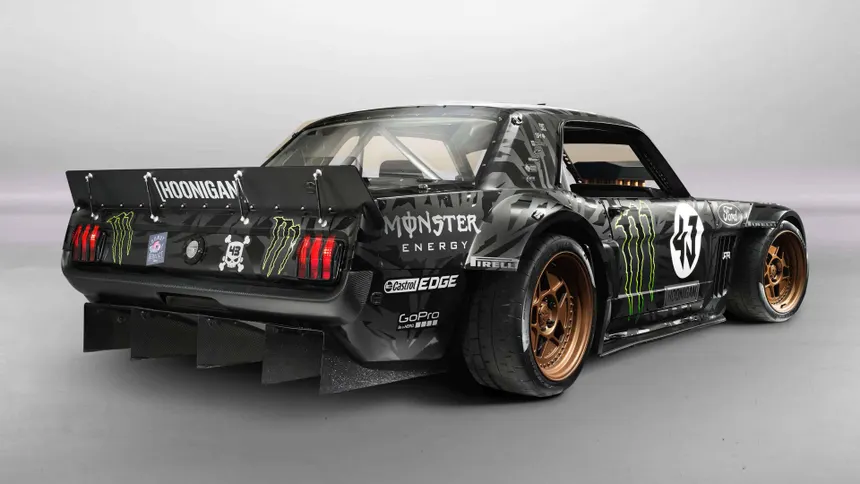
The A-pillars stay. The C-pillars stay — those are what give you the side profile you recognize. The roof stays. The doors stay. And the VIN plate, original chassis number, welded in place. That’s it. Everything else is new tube chassis welded piece by piece, integrated roll cage with no separating panels, suspension pickup points welded straight to the main tubing. The body you see outside is RTR-built carbon fiber. Widened fenders, valances, bumpers, front splitter, all carbon. The rear arch is wider than anything that ever rolled out of Dearborn on a Boss 429. The front nose feeds air to radiator and brakes through ducts running inside the chassis tubes themselves, like a single-seater.
Worth saying clearly: the Hoonicorn isn’t a restored car. Isn’t a restomod. Isn’t even a replica. It’s a competition prototype wearing a ’65 Mustang silhouette. What it shares with a real ’65 Mustang is just enough for your brain to recognize it. Inside it’s something else entirely.
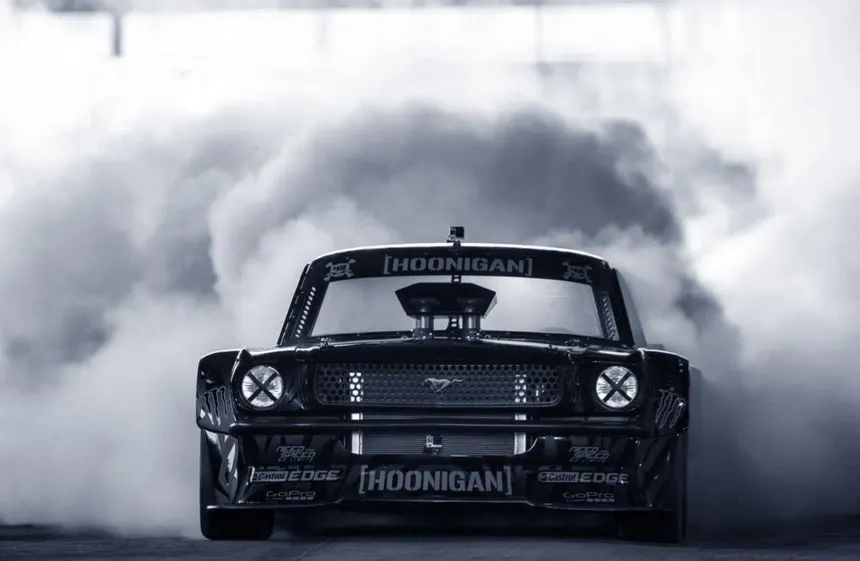
V1 engine: naturally aspirated, 845 horsepower, race gas
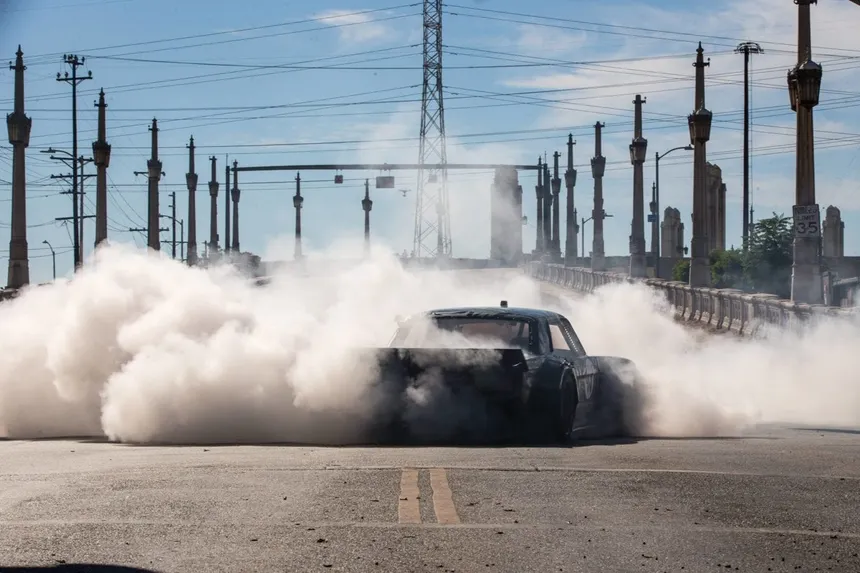
When the Hoonicorn debuted in Gymkhana 7 — Los Angeles, 2014, Downtown streets shut down, an apocalyptic-looking car launching past skyscrapers — it ran the original setup.
A Roush Yates 410 cubic-inch V8. That’s 6.7 liters for the metric crowd. The architecture comes from Ford’s small-block Windsor, but very little of the generic block is left. Forged internals, solid-roller cam, race-spec valvesprings, ITBs — individual throttle bodies, one per cylinder, no shared plenum — and a bespoke ECU calibration. 845 horsepower at the wheels. 720 lb-ft. Naturally aspirated. Race gas.
That motor produces those numbers because it’s built to. It isn’t a hot V8 from the parts store. It’s a competition motor from the first second. Roush Yates is the company that’s been building motors for Ford NASCAR Cup teams for twenty years, and the EcoBoost V6s that won Le Mans in the Ford GT are theirs too. When Block called Roush Yates, he didn’t call a tuner. He called the OEM.
The transmission: the part nobody sees that holds everything together
Here’s the bit that only makes sense if you’ve had your hands inside a gearbox. The Hoonicorn’s transmission is a Sadev SC90-24. Sadev is a French manufacturer that builds sequential transmissions for rally, hillclimb, and endurance racing. The SC90 is rated for up to 800 Nm of torque — about 590 lb-ft. The Hoonicorn V1, with its naturally aspirated V8, was already over that limit at 720 lb-ft. And it held.
Why does it hold? Because when you work with properly engineered components, the manufacturer’s safety margins are more than margins — they’re recommendations for sustained continuous use. In a competition application with brutal mechanical maintenance schedules, those numbers stretch. Block stretched them. And then he stretched them double.
The gearbox is a six-speed sequential, with a front-and-back paddle action. It has the hydraulic handbrake circuit integrated into the clutch — that’s the trick that lets Block pull the handbrake and not just lock the rear wheels but disengage the gearbox for an instant, so the car pivots on the front axle like a drone. You can’t do that with a road-car handbrake. That solution comes from rally pure and simple.
Front, center, and rear differentials, all Sadev, all mechanical with locking. No electronic torque vectoring. No traction control. When the Hoonicorn is on all four wheels doing donuts, that isn’t electronics. It’s pure rally mechanics interpreted by a driver who knows what he has in his hands.
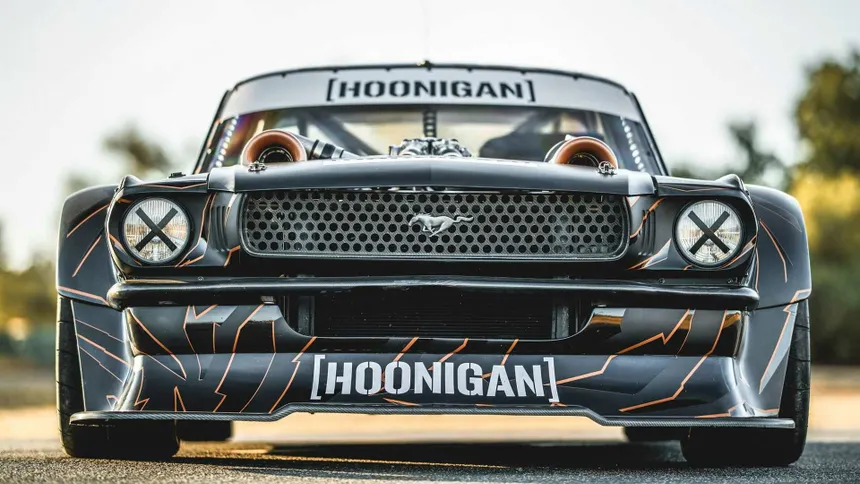
V2 engine: Pikes Peak, methanol, double the power
In 2016 Block decided to take the Hoonicorn up Pikes Peak. And here’s something most people don’t get: at 14,000 feet of altitude, a naturally aspirated engine loses about 30% of its power. That’s basic physics. Less air density, less oxygen per cylinder stroke, less burn, less power. Take the V1 with its 845 horsepower up Pikes Peak and you arrive at the summit with under 600. To set times, that doesn’t cut it.
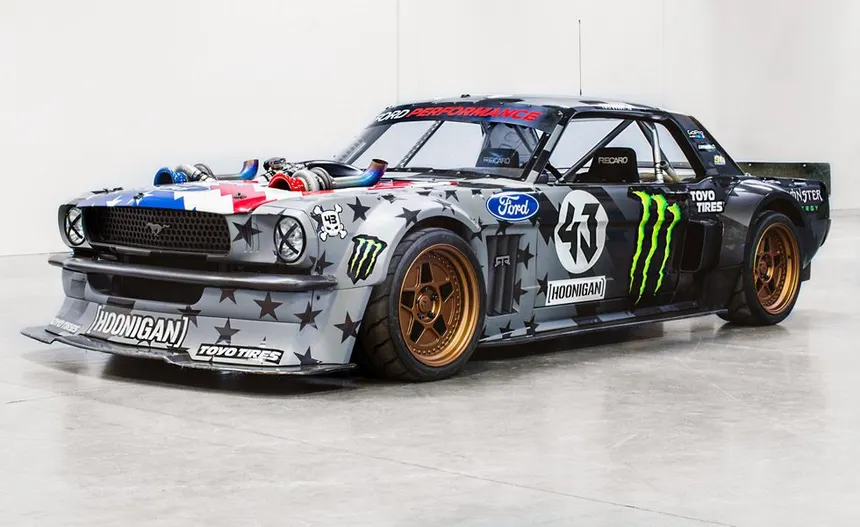
Solution: turbos. Not shy little ones. Twin Garrett GTX3584RS pushing more than 20 psi into the manifold. Forced induction in earnest. But if you blow that much air into a 6.7-liter V8 with naturally aspirated compression, you’ll grenade it in two laps from detonation. Solution: change the fuel.
Methanol. Methyl alcohol. What dragsters run, what sprint cars run, what IndyCar used to run. Methanol has three advantages over gasoline when you’re running boost: stratospheric octane, brutal evaporative cooling, and higher energy density per stoichiometric charge. The practical result is you can crank up the boost to ridiculous levels without detonation.
The downside? You need much more of it. Methanol burns at roughly a 6.5:1 stoichiometric ratio versus gasoline’s 14.7:1. That’s more than double the fuel injected per cycle. Which is why the Hoonicorn V2 carries sixteen 1,050cc injectors. Sixteen. Not eight. Two per cylinder. The only way to feed that flow without missing milligrams when the engine asks for everything.
And the intercooler comes off. Because methanol cools the intake charge by itself as it evaporates inside the cylinder. What an intercooler does on a gasoline engine — drop the temperature of the boosted air before it enters the engine — the V2 does with the fuel itself during evaporation. Result: turbos mounted directly on top of the engine, no intercooler plumbing in between, no heat exchanger. More compact, lighter, more responsive.
ECU is a MoTeC M150. Intake manifold by Switzer Dynamics, 3D-printed because the geometry is too complex to machine. Result: 1,400 horsepower. 1,250 lb-ft. 1,695 Nm of torque. More than double the V1 from the same base block.
The block math worth understanding
You’re adding double the power and double the torque to the same engine. Same block. And it holds. The reason is the Roush Yates block is engineered to make 900-1,000 horsepower naturally aspirated in NASCAR over 500 miles at sustained 9,000 rpm. When you boost it, combustion pressure rises, sure. But the motor is built with so much margin it absorbs it.
The Sadev gearbox — the same SC90-24 from V1, untouched — now handles 1,250 lb-ft. That’s more than double what the manufacturer rates. How? Maintenance. Every Hoonicorn outing means opening it up and checking parts. There are no 50,000-mile intervals on this car. There are 50 minutes of driving and then back on the bench. It’s what any mechanic with endurance time will tell you: gearboxes hold if you look after them. The Hoonicorn V2 gets looked after.
The methanol that washes the oil away
Now here’s the catch. The one that doesn’t make the videos.
If you’ve worked with methanol engines, you know what’s coming. If not, listen up. Methanol cools the intake charge by evaporation inside the cylinder — that’s the upside. But that same efficient evaporation has a very specific side effect: liquid methanol enters the cylinder mixed with air, and on its way from injection to combustion, it strips the thin film of oil that coats the cylinder walls. Literal stripping. As if you’d run a wet rag down the bore.
In a short session, you don’t notice. The engine recovers the oil film between strokes because the crankcase keeps pushing lubricant up. But in long sessions at sustained rpm — read Pikes Peak with its fifteen-minute flat-out climb — the film doesn’t recover at the rate it gets stripped. The engine starts losing localized lubrication in specific cylinder zones. At first nothing fails. It just wears faster. Push it further and things get worse.
That got discovered on the fly with the Hoonicorn V2. The fix took oil calibration changes, full engine teardown after every big climb, and finer engineering on fuel injection quantity and timing to minimize the washing. That kind of detail doesn’t show up in the videos. It’s the kind of detail that separates a prototype motor from a production motor. Drive it just enough, it holds. Push it, you open it.
Worth saying clearly because it matters: anyone can bolt twin turbos onto a V8 and feed it gas until it grenades. Doing the same with methanol and keeping it alive for years is another league. That’s engineering, not a garage.
Climbkhana: 14,000 feet, 156 corners, asphalt over rock
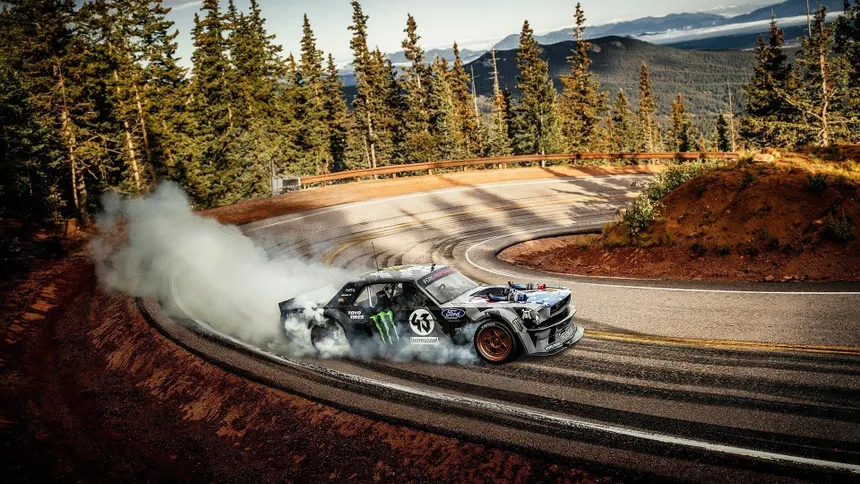
Pikes Peak is what it is. 12.42 miles of climb. Average grade of 7%. 156 corners. Start at 9,390 feet, finish at 14,115. And as of 2011, fully paved end to end. That means when Block ran it in 2017 with the Hoonicorn V2, it wasn’t Walter Röhrl’s Pikes Peak with gravel everywhere. It was tarmac.
Why does that matter? Because Climbkhana wasn’t a timed run. It was a statement. Block went up Pikes Peak drifting every corner. Yanking the handbrake. Letting the whole car loose at the edge of a cliff. That, with a Sadev gearbox at double its rated torque, with a motor still being calibrated, at 14,000 feet, on tarmac, is one of the most reckless acts ever committed to camera. And it worked.
The numbers that don’t make sense
Right, numbers. So you have them.
Zero to sixty miles per hour: 1.8 seconds. That’s 1.8 seconds to 60 mph. Top speed claimed: 255 mph — 410 km/h theoretical. Acceleration so violent that the suspension is one of the trickiest parts of the car, because when you put 1,400 horsepower through all four Toyo Proxes R888R 295/35-18s in a square setup — all four the same size, rare in anything that isn’t pure competition — weight transfer is brutal and geometry has to keep contact patches loaded.
The suspension was designed by ASD Motorsports with consulting from Vaughn Gittin Jr. Inboard configuration, similar to what you see in F1 and IndyCar — dampers and springs mounted horizontally inside the chassis and connected to the arms via push-rods with progressive rates. That allows fine-grain adjustment and protects the suspension from outside impacts. In a car that’s going to be doing donuts next to freight trains, that last point matters.
Wheels: Fifteen52 Tarmac R43 forged 3-piece, 18 by 10.5 inches. Tires: Toyo Proxes R888R semi-slick. On any other car, overkill. On the Hoonicorn, they’re barely enough.
Hoonicorn in context: how it compares to its contemporaries
The editorial exercise NEC always asks for: place it against rivals from the same window.
In 2014, year of the V1 debut, the most powerful production cars you could buy were the Bugatti Veyron Super Sport (1,200 hp) and the Koenigsegg One:1 (1,341 hp). The Hoonicorn V1 at 845 hp wasn’t playing in that league — but no 2014 hypercar had the versatility to do donuts in a parking lot, drag-race a Lambo, then send it sideways on gravel. That was the Hoonicorn’s edge: not the most powerful. The most unrestricted.
In 2016, year of the V2, the Bugatti Chiron arrived with 1,500 hp and the Koenigsegg Regera with 1,500 hp hybrid. The Hoonicorn V2 at 1,400 hp moved into that power class — but with a wrinkle: it weighs 1,360 kg. The Chiron weighs 1,995 kg. The Regera weighs 1,628 kg. The Hoonicorn has a better power-to-weight ratio than any hypercar of its era. And all-wheel drive with three mechanical diffs. And a sequential rally gearbox.
Does it compete with them? No. Is it comparable? Not really. Would it survive a flying lap of the Nordschleife against a Chiron? Probably not — the Hoonicorn doesn’t have the aero for sustained high-speed work. Would a Chiron survive a 30-minute drift session on a concrete lot? Also no. Each is what it is. The point of the Hoonicorn is that it isn’t anything that already existed. It’s an open question fired into the air in the shape of a car.
Public appearances: the chronology that matters
To understand the Hoonicorn’s journey, you have to see the order of milestones. It isn’t a car that showed up in one video and that was it. It’s a story with timing.
Gymkhana 7 — Los Angeles, 2014. The debut. Streets shut down in Downtown LA, fake police cruisers, choppers overhead, real buildings as backdrop. Over 100 million accumulated views. At this point the Hoonicorn was still V1 — naturally aspirated, 845 horsepower, gasoline. The official global reveal.
Top Gear — London, 2016. The BBC jump. Matt LeBlanc behind the wheel of a stock ’65 Mustang next to the Hoonicorn. Block sliding through empty London streets at dawn. LeBlanc’s face stepping out of the car is the closest a British TV moment has ever come to begging for mercy. Still V1.
Climbkhana — Pikes Peak, 2017. Here’s where V2 debuts. Turbos, methanol, 1,400 horsepower. The full climb with drift in every corner, on tarmac, at 14,000 feet altitude. This is what kills the engine internally — the methanol-stripped lubrication issue we just walked through. But it’s also what cements the car as an icon. Climbkhana turned the Hoonicorn V2 into something else.
Gymkhana 10 — Detroit, St. Petersburg, Tokyo, Nashville, 2018. A five-car, five-city superproduction. The Hoonicorn V2 shows up doing its thing alongside the Hoonitruck, the Cossie, and others. It’s the last big Gymkhana of the Block-Ford era. And between engine calibration and the rhythm of the shoots, the car enters its mechanical sweet spot — everything they learned at Pikes Peak is now applied.
Climbkhana 2 — Tianmen Mountain, China, 2019. Seven miles of climb with 99 staircase-like switchbacks leading to a Buddhist pagoda at 4,700 feet. Narrow paved road with stone walls inches from the car. Block plugs the Hoonicorn V2 in there, two years after the first Climbkhana, with the engine now optimized. The video becomes one of the most-watched on the Hoonigan channel. And narratively it matters because it closes the trilogy: the Hoonicorn V2 has now conquered two real summits.
Hoonicorn vs The World — YouTube, 2020. The Hoonicorn against challengers from every category, on a drag strip. Eleven episodes. A McLaren Senna, dragsters, JDM extremists, a record-setting donk, modified GT-Rs all stepped up. Almost all lost. The last one — Kimbo, a turbocharged GT-R — was the first to break the streak.
Drag race versus McLaren Senna. Quarter mile. The Hoonicorn won the launch on raw acceleration. Drift car versus circuit hypercar — all-wheel drive and low weight (1,360 kg vs the Senna’s 1,198 kg, but the Senna is rear-drive) beat rear-drive and aero on a quarter mile. A longer fight would tell a different story. But the quarter mile goes to the ’65 Mustang. That’s already legend.
Between 2020 and January 2021, while Block prepares his Ford exit — everything points to the brand wanting to cut spending and refocus toward the Bronco and Mustang Mach-E, leaving rallycross behind — the Hoonicorn does its last official runs. Block will drive it occasionally after the split, in arrangements negotiated with Ford, with Lia at the wheel for some of them. But the exclusive contract closes in January 2021. And with that closure, an era closes.
Where it ended up: from Ford’s archive to the Petersen Museum
January 2021. Block and Ford officially split. Eleven years together ended with a press release and a farewell video from CEO Jim Farley thanking him for “10 great years of Hooning”. The official partnership tally: 19 race wins, 17 additional podiums, 2 X Games medals, the first WRC points scored by an American for the brand, and over a billion accumulated video views. Not bad for a guy who signed thinking he was going to make two videos.
The Hoonicorn was Ford’s property. When they split, the car stayed with Ford. Block said it later in an interview: “I hadn’t planned to race the Hoonicorn again since my contract with Ford expired at the end of 2020, but at the same time Lia was taking a very serious interest in racing — so the stars just aligned to make this opportunity happen.” That sentence confirms Lia drove the car occasionally under some arrangement between Block and Ford. It wasn’t a sale. It was a loan.
Block dies on January 2, 2023. And here’s the part that matters: somewhere between that date and February 2025, the cars that belonged to Ford — the Hoonicorn V2, the Hoonitruck, and the Cossie V2 — pass into the Block family’s possession. The transfer details aren’t public. What is public is the result.
On February 15, 2025, the Petersen Automotive Museum in Los Angeles opened “People’s Champ: The Impact of Ken Block”. The Hoonicorn V2 is there on display. Next to the Hoonitruck. Next to the Cossie V2. The Petersen’s official label credits the cars as “Courtesy of the Block Family”. That means the cars are no longer Ford’s — they’re owned by or on loan from the Block family, and they’re part of a long-running exhibit at one of the most respected automotive museums in the world.
That’s the concrete data point that changes the story. The Hoonicorn isn’t sitting forgotten in a Ford warehouse. It’s in a Petersen display, public-facing, paid-entry. Brian Scotto, Hoonigan co-founder, has done video interviews inside the exhibit explaining the car. So has Vaughn Gittin Jr. The opening was a “Ken Block Week”. Visitors can take photos, walk around all three cars, read the spec plates.
The Hoonicorn no longer gets driven. But it’s not hidden. It’s where it should be: in a museum, told by the people who built it, looked at by the people who walked into car culture because of it.
The unanswered question
The Hoonicorn is what happens when somebody with money and obsession decides the rules don’t apply. When ASD Motorsports builds you a tube chassis, RTR Vehicles designs you a body, Roush Yates hands you a V8 that would win NASCAR if they let it run, Garrett calibrates your turbos, Sadev gives you the gearbox, MoTeC programs the ECU, all inside a ’65 Mustang with all-wheel drive — what comes out is an open question. How far could it have gone? Nobody knows. Nobody fully tested it. The car is in a museum.
That’s where the frustration lives. The Hoonicorn hadn’t shown its ceiling yet. Every fresh outing, the engine made more. The gearbox absorbed more. The driver pulled more. But the entire ecosystem — Block, Ford, Hoonigan — broke before anyone found the limit. What’s left is an incredible car in a Petersen display case and a driver who died on a snowmobile. That’s the reality.
If you stop and think about it from the bench, the whole Hoonicorn tells a bigger story than the car itself. It tells the story of what happens when an eccentric driver with a budget convinces a legacy brand and a roomful of competition suppliers to break every rule. The result is an object that shouldn’t exist. But it does. And as long as you keep watching it do donuts on YouTube, it keeps existing. That’s the beautiful thing about cars built without a rulebook. They don’t age the way the rest do. They freeze inside their own legend.
Check you’re still alive.