
Hot Wheels: How a 98-Cent Toy Car Built a $175,000 Collecting Empire
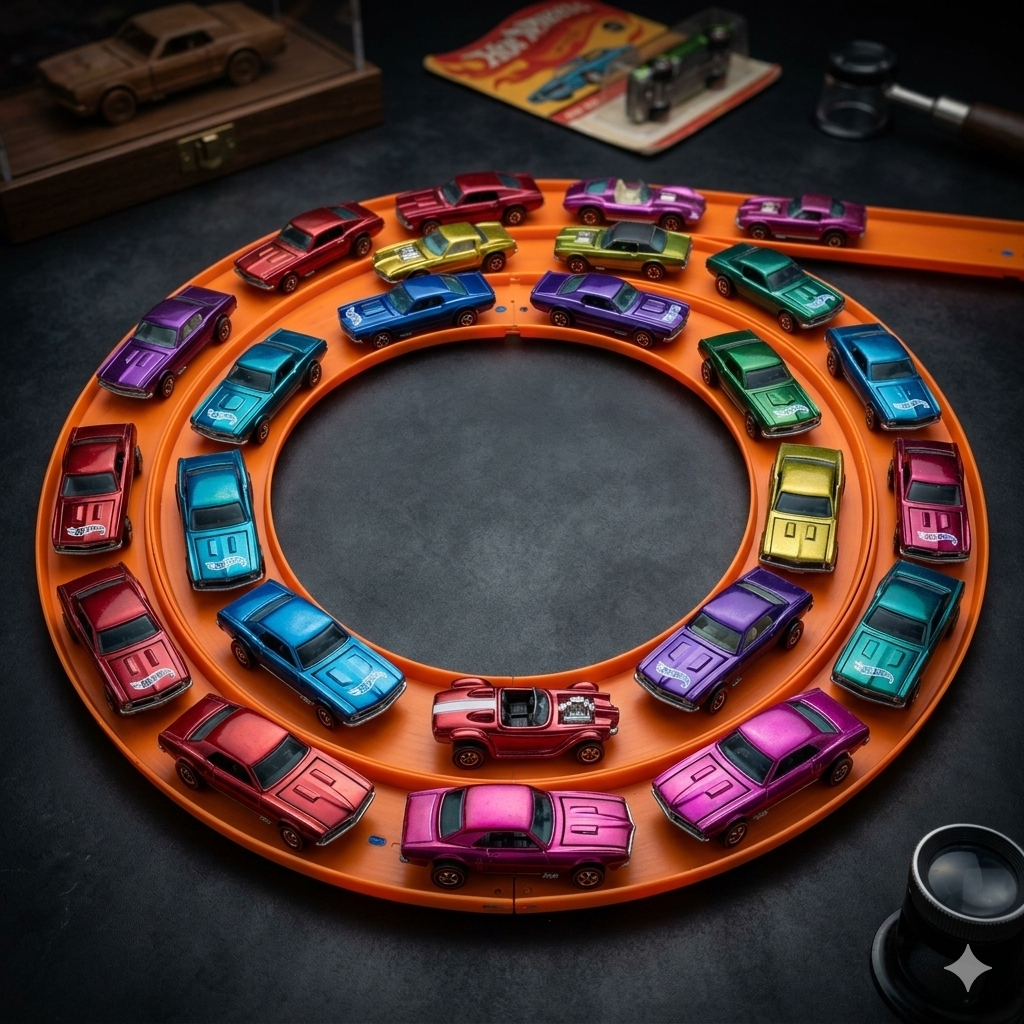
Here’s an uncomfortable truth for car enthusiasts: the single object that has done more to shape global automotive culture than any magazine, TV show, or motorsport event fits in the palm of your hand and costs about a dollar.
Hot Wheels isn’t just a toy. It never was. Since 1968, Mattel’s die-cast empire has sold over 6 billion units, created a secondary market where a single prototype can fetch $175,000, and quietly built the largest pipeline of future car enthusiasts the world has ever seen. If you’ve ever wondered why someone who grew up in a city with no car culture whatsoever can still tell a Camaro from a Mustang at 50 paces — thank Hot Wheels.
Let’s talk about how a plastic track and some tiny metal cars changed everything.
Born in California, Built to Kill Matchbox
The story begins with a frustration. In the mid-1960s, Elliot Handler — co-founder of Mattel and the man behind Barbie — watched his son play with Matchbox cars. The British-made die-casts were the undisputed kings of the miniature car world: detailed, accurate, and hopelessly slow. They were scale models. They sat there. They looked nice.
Handler wanted more. He wanted speed. He wanted California attitude — the muscle cars, the custom hot rods, the chrome and flames that defined the Southern California car scene. And he wanted wheels that actually rolled.
His executives told him it was a terrible idea. He did it anyway.
Handler recruited Harry Bentley Bradley from General Motors’ design studio and Jack Ryan, a Yale-educated missile systems engineer. A car designer and a rocket scientist. This wasn’t a toy company trying to make cars — this was automotive engineering applied to a 1:64 scale platform.
The breakthrough was the wheel system. Bradley and Ryan developed a torsion bar suspension using piano wire axles with Delrin bearings that practically eliminated friction. A gentle push sent these cars flying across the floor. When Handler first saw the prototype roll, his reaction became the brand’s name: “Those are some hot wheels!”
The Sweet 16: May 18, 1968
Hot Wheels officially launched on May 18, 1968, with 16 models that collectors now call “The Sweet 16.” Before they even hit retail shelves, a Kmart executive visited Mattel’s LA headquarters for a preview. After watching a single 1:64-scale muscle car shoot down a track and across the floor, he placed an order for 50 million cars. On the spot.
The original lineup reads like a love letter to American automotive culture: Custom Camaro, Custom Mustang, Custom Barracuda, Custom Corvette, Custom Firebird, Custom Cougar, Custom Eldorado, Custom T-Bird, Custom Volkswagen, Custom Fleetside, Hot Heap, Beatnik Bandit, Deora, Ford J-Car, Python, and Silhouette.
Each car wore Mattel’s proprietary Spectraflame paint — a transparent candy color sprayed over mirror-polished bare metal. The wheels carried a distinctive red stripe that became the trademark of what collectors call the “Redline era” (1968-1977). Flexible orange tracks with loops completed the package.
Over 16 million units sold in the first year. Matchbox, the market leader for 15 years, never recovered. Mattel eventually acquired Matchbox’s parent company in 1997.
Engineering in Miniature
What made Hot Wheels revolutionary wasn’t aesthetics — it was physics.
The piano wire axle suspension with Delrin bushings was a legitimate engineering solution to a friction problem. The Spectraflame paint process was borrowed from actual automotive finishing techniques. The track system, designed by Mattel engineer Marjorie Ann M. Smith in 1967, used calculated curves and banked turns to maintain momentum — you needed a minimum entry speed to complete a loop, just like a real track.
Each generation pushed further. The Sizzlers line (1970) added built-in rechargeable electric motors. The “Flying Colors” era (1974) introduced tampo printing directly onto metal — a technique the entire toy industry eventually copied. Pneumatic elements arrived in 1985. Power Functions and app-controlled models came in 2018.
Today, Mattel produces roughly 519 million Hot Wheels per year — about 17 cars every second. The design and engineering team numbers over 50 people. More than 20,000 variations have been catalogued. If every Hot Wheels car ever sold were placed end to end, they’d circle the Earth four times.
The Collecting Rabbit Hole: From Pocket Change to Six Figures
This is where Hot Wheels transcends toydom and enters the realm of genuine alternative investment.
The original Sweet 16 retailed for 69 to 98 cents. Today, the most valuable Hot Wheels car on the planet — a 1969 Pink Rear-Loading Beach Bomb — is valued at over $175,000.
The Beach Bomb story is a masterclass in how rarity is created by accident. In 1969, designer Howard Rees created a VW Bus die-cast with surfboards loading from the rear window. The prototype was too top-heavy for the orange tracks, so Mattel redesigned it with side-mounted surfboards for mass production.
Only a handful of rear-loading prototypes survived. Of those, just two exist in pink — a color Mattel briefly tested to market Hot Wheels to girls in an era when toy cars were considered exclusively for boys. The experiment failed commercially, but it accidentally created the rarest collectible in toy history.
Bruce Pascal, a Washington D.C. commercial real estate executive and the world’s foremost Hot Wheels collector, owns one of those two pink Beach Bombs. His 7,000-piece collection is estimated at $2 million. The Beach Bomb appeared on Pawn Stars, where the owner asked $150,000 and Rick Harrison offered $70,000. No deal was made.
But you don’t need a Beach Bomb to find serious value. Redline-era models in good condition regularly command four-figure prices. A White Enamel Custom Camaro prototype fetches a minimum of $2,500. A spectraflame purple 1971 Bye-Focal, loosely based on the Dodge Challenger, is worth approximately $6,000. The “Over Chrome” series from 1968 can reach $10,000 to $50,000 per car.
The modern collecting game revolves around Super Treasure Hunts (STH) — special models randomly inserted into distribution cases. The complete 2024 STH collection trades for between $446 and $2,240 on the secondary market. Every Tuesday morning, dedicated hunters stalk toy aisles worldwide, hoping to find one before anyone else.
The $175,000 VW Bus and Why It Matters
The Pink Beach Bomb isn’t just the most expensive Hot Wheels. It’s a case study in what creates value in any collectible market: provenance, scarcity, condition, and story.
The car was originally bought as part of a lot of 250 vintage Hot Wheels — including 25 prototypes — from a former Mattel engineer for $9,000 in 1998. When the buyer, Chris Marshall, announced the find, he received hundreds of emails calling it “the Holy Grail of toys.” Someone offered to trade a new $25,000 Blazer for it. Pascal eventually acquired it for over $50,000 after the original $72,000 sale fell through.
Today, a red rear-loading Beach Bomb prototype was appraised on PBS’s Antiques Roadshow at $100,000 to $150,000. The pink one sits in Pascal’s collection, and he has no plans to sell. Worth more than a real vintage VW Bus (average market price around $28,751), this toy car proves that perceived value has nothing to do with size.
Hot Wheels and Real Car Culture: The Feedback Loop
Hot Wheels doesn’t just reflect automotive culture — it actively shapes it.
In 2018, a Hot Wheels Tesla Roadster went to space aboard a real Tesla Roadster launched on SpaceX’s Falcon Heavy. A $1 toy orbiting the Sun inside a $200,000 car on a $90 million rocket. The cultural symbiosis is literal.
Mattel holds official licensing agreements with Ferrari, Porsche, Lamborghini, BMW, Mercedes, Ford, Chevrolet, Dodge, and virtually every major manufacturer. But Hot Wheels also creates original “fantasy cars” — and some have been built for real. The Twin Mill, designed by Ira Gilford in 1969, was constructed as a full-size running car with dual V8 engines in 2001.
The SEMA show in Las Vegas regularly features full-size builds inspired by Hot Wheels designs. The Petersen Automotive Museum in Los Angeles has hosted permanent Hot Wheels exhibitions. And the annual Hot Wheels Legends Tour invites real car builders to submit their vehicles for the chance to be immortalized as a production die-cast model.
The circuit from asphalt to toy shelf and back again never stops.
By the Numbers
Hard data, verified and sourced, to dimension the phenomenon:
Mattel produces approximately 17 Hot Wheels per second. Over 6 billion units sold since 1968. More than 20,000 different variations catalogued. In 2017, Hot Wheels generated $847 million in revenue for Mattel — roughly 13% of total company revenue. The average collector owns around 1,500 cars. Children aged 5 to 15 own an average of 41 vehicles each. At any given moment, approximately 25,000 Hot Wheels are listed on eBay. A diamond-encrusted 50th anniversary model created in 2018 was valued at $140,000.
The NFT Era and What Comes Next
Hot Wheels collecting is evolving. In 2024, NFT-redeemable physical cars dominated the year’s most valuable releases, with some models reaching $500 on the secondary market. The Red Line Club (RLC) subscription service drops exclusive models that sell out in under 60 seconds. The Overdrive Membership tier was created specifically to manage the overwhelming demand.
Yet the core of Hot Wheels hasn’t changed since 1968. It’s still a 1:64 scale die-cast car, still costs about a dollar at retail, and still has the power to make a grown adult feel five years old when they spot a rare livery on a peg hook at their local supermarket.
If Hot Wheels sparked your love for American muscle, check out our deep dives on theHemi 426 engine, the Small Block Chevy, and the Ford Mustang story. And if you’re curious about another world of automotive replicas, don’t miss our piece on LEGO Technic and its supercar reproductions.
The Hot Take: Hot Wheels Did More for Car Culture Than Any Car Magazine Ever Did
I’ll say it plainly: Hot Wheels has done more for automotive culture than Motor Trend, Top Gear, and every car magazine combined.
Here’s why. Those outlets preach to the converted. They reach people who already love cars. Hot Wheels creates car people from scratch. There’s a fundamental difference between reinforcing an existing passion and planting the seed of one, and Mattel has been planting seeds at a rate of 17 per second for over 55 years.
When a five-year-old pushes a Custom Camaro down an orange track, they’re not “playing with a toy.” They’re experiencing aerodynamics, inertia, friction, and the principle that speed and design are connected — for the first time. They don’t know it yet, but they’re being recruited.
That kid grows up. Buys their first real car with some echo of that Spectraflame blue Camaro bouncing around in their memory. Starts reading about engines. Joins online forums. Goes to SEMA. Restores a classic. Hands their kid a Hot Wheels. The cycle restarts.
No magazine has ever built a pipeline like that. No TV show has ever converted that many non-believers into enthusiasts. And no other toy has ever made the jump from children’s product to legitimate cultural artifact with such seamless credibility.
The track is infinite. And it starts with 98 cents.
Disagree? Tell me in the comments.