
JAGUAR E-TYPE (1961–1975)
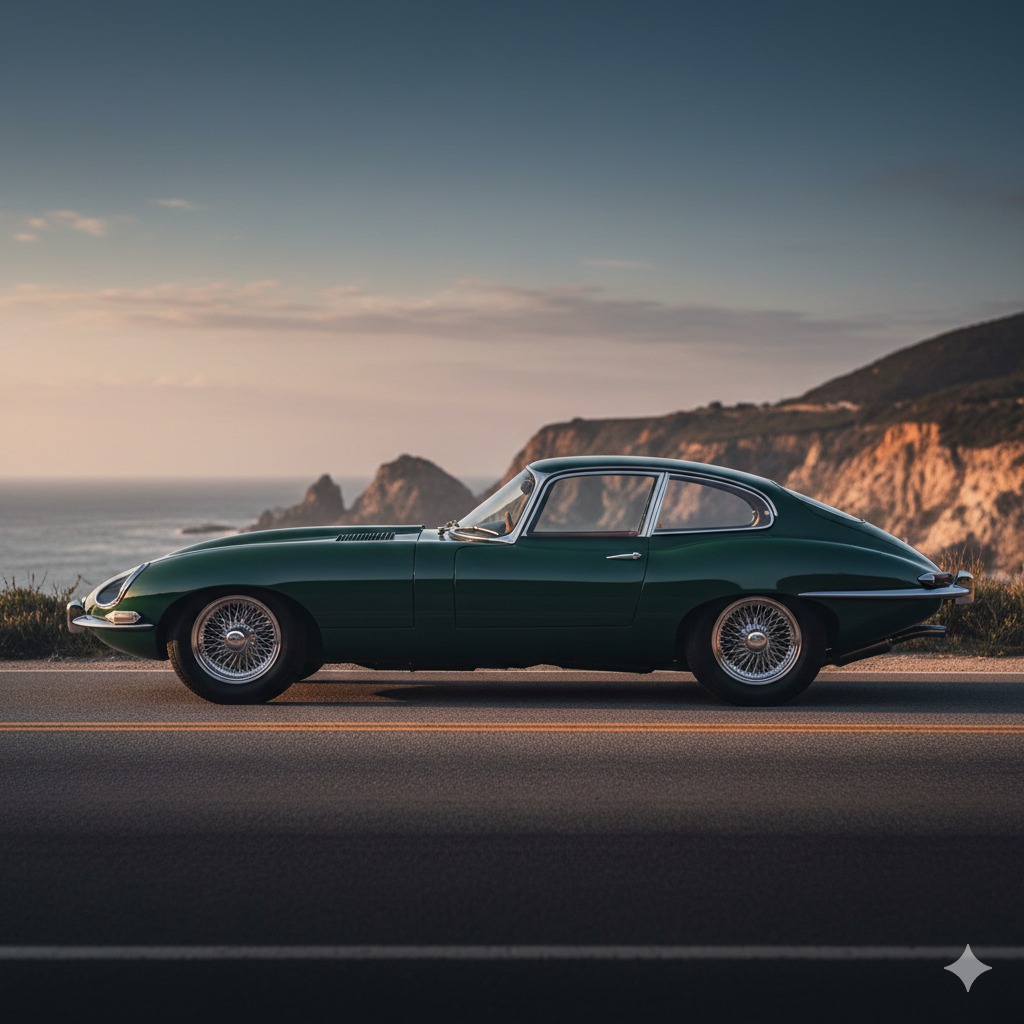
Jaguar E-Type: The Most Beautiful Car Ever Made (And I’ll Explain Why This Isn’t Just a Cliché)
There are phrases in automotive history that have survived for decades without ever being successfully challenged. One of the most frequently quoted is the one that Enzo Ferrari reportedly uttered upon seeing the Jaguar E-Type for the first time at the 1961 Geneva Motor Show: “It is the most beautiful car ever made.” Ferrari was a man austere with compliments and generous with insults. The fact that he said something like that about a car that had not come out of Italy is, at the very minimum, significant.
And he was right. Not in a poetic sense — in a technical one. The E-Type was not beautiful by accident.
The Man Who Thought in Aerodynamics and Drew Beauty
The E-Type was designed by Malcolm Sayer, an aeronautical engineer who had worked at De Havilland before joining Jaguar. Sayer did not think in terms of aesthetics: he thought in mathematical equations and aerodynamic curves. For him, beauty was the visual consequence of aerodynamic efficiency. Every curve on the E-Type had a functional reason for existing.
The result was a silhouette that combined the long, torpedo-shaped bonnet — designed to house the enormous straight-six engine with its overhead camshaft — with a fluid beltline and a rear end that closed naturally and cleanly. The E-Type was aerodynamically superior to virtually every other road car of 1961. And it was also, visually, incomparable.
It was not designed to be beautiful. It was designed to be fast. Beauty was the unexpected reward.
The Racing DNA: From the D-Type to the E-Type
The story of the E-Type cannot be told without acknowledging the Jaguar D-Type, the racing car that won the 24 Hours of Le Mans in 1955, 1956, and 1957 three consecutive years. The E-Type was not a touring car that had performance grafted onto it: it was, from its conceptual roots, a racing car fitted with a leather interior and a licence plate.
The E-Type’s structure used a front tubular subframe made from Reynolds 531 alloy, bonded to a central monocoque body. The same construction philosophy as the D-Type racer. Front suspension used double wishbones and the rear adopted independent suspension with coaxial dampers — completely unusual for a road car in 1961 — delivering dynamic behaviour far superior to any direct rival.
Disc brakes on all four wheels — when most sports cars still used rear drums — and rack-and-pinion steering completed a technical package that in 1961 was easily a decade ahead of any direct competition.
The Three Series: An Evolution That Never Lost Its Soul
The E-Type was produced across three clearly defined series between 1961 and 1975, with body styles that included the Open Two-Seater roadster, the Fixed Head Coupé (with a glass rear hatch in fastback form), and from 1966, the longer-wheelbase 2+2 coupé with two small rear seats.
Series 1 (1961–1968): The Series 1 is the most valued and the most pure. The earliest examples of 1961 and 1962 — known as “flat floor” cars, with external bonnet catches that required a tool to open — are the rarest and most sought-after. The original engine was the XK straight-six of 3.8 litres, derived directly from the unit used in the XK150S with triple SU carburettors, producing 265 bhp and a top speed of 150 mph (241 km/h). In 1964 the engine grew to 4.2 litres, maintaining the 265 bhp power output but improving torque by approximately 10%, with a fully synchronised gearbox that made the car considerably more pleasant to drive daily. Enzo Ferrari saw the 3.8-litre version. If he had seen the 4.2, he probably would have closed his factory.
Series 2 (1968–1971): The Series 2 arrived shaped by US safety requirements — at the time the E-Type’s primary market — and adopted open headlamps without glass covers, a larger windscreen, front fog lamps integrated into the bumper and a redesigned dashboard with more accessible controls. The 4.2-litre engine continued with no significant power changes. The Series 2 is perhaps the least pure aesthetically of the three, but it remains an unmistakable E-Type.
Series 3 (1971–1975): The Series 3 was the V12 version. Jaguar dropped the straight-six and introduced a 5.3-litre V12 engine with Zenith carburettors, producing 272 bhp. This engine — one of the most refined V12s ever fitted to a production road car — was virtually inaudible at cruising speeds, with a refinement level worthy of a Rolls-Royce. The Series 3 is identified by the slatted front grille, wider wheel arches, and the lengthened wheelbase that became the only configuration available for the open body. Top speed reached 240 km/h with the V12.
Frank Sinatra, George Harrison, and the Hall of Fame
The E-Type was a celebrity car before celebrity endorsement was a marketing strategy. Frank Sinatra, who saw the car at the 1961 reveal, reportedly demanded one immediately. George Harrison owned one. So did Roy Orbison. Steve McQueen drove one. Peter Sellers owned several. Tony Curtis was not going without his E-Type either.
It was the Ferrari for those who did not want to buy Italian — with comparable performance at a considerably lower price — and it was the most powerful style statement you could make from behind the wheel in the 1960s and early 1970s.
The Numbers: Production and Current Values
Jaguar produced a total of 72,520 E-Types between 1961 and 1975, distributed across three series and different body styles. The flat floor Series 1 3.8-litre Roadsters are the scarcest and most valuable: at auction, the finest examples with matching numbers and complete documentation have exceeded 500,000 US dollars. A 1961 flat floor E-Type sold at auction in 2014 for 528,000 dollars.
The most economically accessible models are the Series 3 V12 cars, although “accessible” in the E-Type world is a relative term: the finest Series 3 examples regularly exceed 100,000 euros on the current market.
Conclusion (With Teeth)
The Jaguar E-Type demonstrated in 1961 that the British were capable of building a Grand Tourer that could defeat the Italians on their own territory: design, performance, and exclusivity. They did it at a price no Ferrari or Maserati could match, with an engine that sounded as it should, and a build quality that was, well, perfectly British — which in 1961 meant certain details had a tendency to rattle loose, but the whole package was incomparable.
The problem with the E-Type is that after it, every manufacturer promised to build something equally revolutionary. None of them managed it. Seventy years later, we are still waiting for the spiritual successor to the E-Type. Which says a great deal about the bar that Jaguar set in 1961, and very little about the daring of everyone else who came after.