
The Lamborghini Miura: The Bull That Invented the Modern Supercar
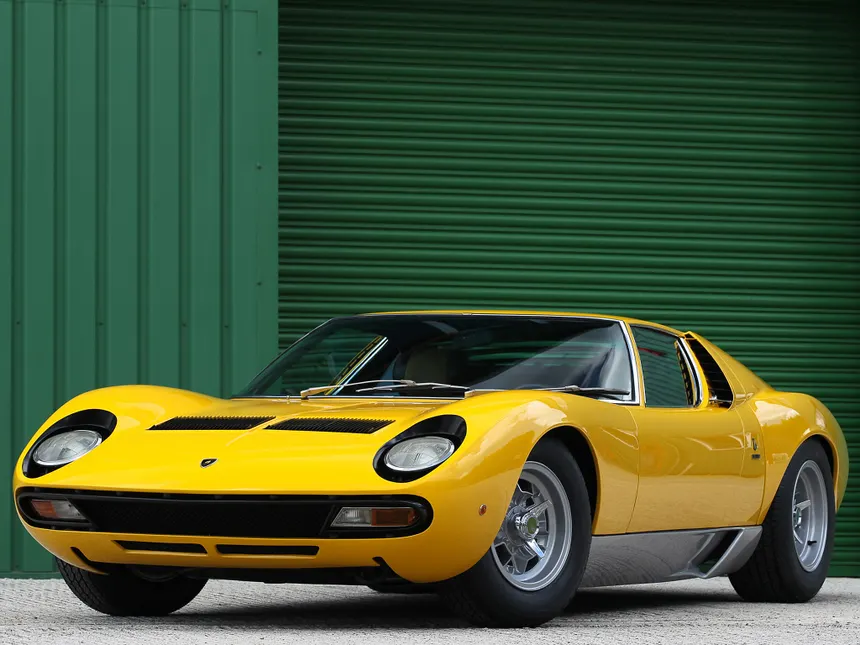
Every car has a father. But very few cars are the father of everything that came after. The Lamborghini Miura is that car. This isn’t hype. It’s not marketing speak. It’s a verifiable fact: before the Miura, the concept of a “supercar” as we know it today simply did not exist.
Mid-engine layout. Heart-stopping design. Terrifying speed. The kind of presence that stops traffic. Those four things, together, in a road-legal car, came together for the first time in Sant’Agata Bolognese, Italy, in 1966. And the automotive world was never the same.
The wildest part? The Miura was never supposed to exist. Ferruccio Lamborghini didn’t want to build it. His engineers designed it secretly, on their own time, without permission. And when they unveiled it to the world, they created the template for every supercar that followed — from the Ferrari Berlinetta Boxer to the McLaren F1, from the Bugatti Veyron to Lamborghini’s own Aventador.
Ferruccio’s Grudge: Another Italian Origin Story
To understand the Miura, you first need to understand Ferruccio Lamborghini. And to understand Ferruccio, you need to know that Lamborghini as a car company was born — like the Ford GT40 — from wounded pride.
Ferruccio was a successful manufacturer of tractors and heating equipment in 1960s Italy. He made serious money and spent it on fast cars — Ferraris, specifically. But he had a recurring problem: the clutches kept breaking.
According to legend — and in Italy, the legends are better than the facts — Ferruccio went directly to Enzo Ferrari to complain. And Enzo, with characteristic diplomacy, told him that a tractor manufacturer had nothing to teach him about building sports cars.
Ferruccio, who had as much pride as money, decided to build his own grand tourer. Not a race car — Ferruccio considered racing an absurd expense — but a road car that would be better than any Ferrari. More refined, more comfortable, better built, without the chronic quality issues that plagued Ferraris of the era.
In 1963, he founded Automobili Lamborghini in Sant’Agata Bolognese, near Bologna. The first car, the 350 GT, arrived in 1964. It was exactly what Ferruccio wanted: an elegant, fast, well-built grand tourer. A gentleman’s car.
But three young engineers on his staff had a very different vision.
The Three Musketeers: Dallara, Stanzani, and Wallace
Gian Paolo Dallara was the chief chassis engineer. He was 29 years old. Paolo Stanzani was a development engineer. Bob Wallace was a New Zealander working as test driver and mechanic. All three shared an obsession: building a mid-engine road car.
In racing, the mid-engine layout was already standard — F1 had used it since the late 1950s, and cars like the Ford GT40 had proven its advantages in endurance racing. But nobody had put a mid-engine in a street car intended for series production. The idea was considered impractical: too noisy, too hot, too difficult to maintain.
Dallara, Stanzani, and Wallace started working on the project after hours, without Ferruccio’s authorization. They designed a chassis with Lamborghini’s four-liter V12 mounted transversely behind the seats. Transversely — that was the key breakthrough. Mounting a V12 sideways allowed a shorter wheelbase and a more compact, more agile car.
The engine was designed by Giotto Bizzarrini — a former Ferrari engineer who had been part of the famous 1961 walkout from Maranello. Bizzarrini had created Lamborghini’s original 3.5-liter V12, which grew to 3,929 cc for the Miura. It featured dual overhead cams per bank, fed by six Weber twin-throat carburetors. Americans might recognize Bizzarrini’s name from the Iso Grifo — another car powered by his engineering genius, that one using a Chevrolet V8.
The Bare Chassis That Started a Revolution
The masterstroke was presenting just the chassis — no body — at the Turin Motor Show in November 1965. The naked chassis, with the transverse V12 visible in all its mechanical glory, caused a sensation. It was a sculptural object of engineering: the engine shared its crankcase with the five-speed gearbox, an incredibly compact solution nobody had seen before.
The response was so overwhelming that Ferruccio — who, remember, didn’t want this car — had no choice but to greenlight production. Orders started arriving before a complete car even existed.
For the bodywork, Lamborghini turned to Bertone. And Bertone assigned the project to a 25-year-old designer named Marcello Gandini. It was his first major commission. And what he created is, without debate, one of the most beautiful automobile designs in history.
Gandini’s Design: When Beauty Has an Engine
Gandini shaped the Miura with lines that, sixty years later, still look like they’re from the future. The low, pointed nose. The headlights hidden behind “eyelids” that open when illuminated. The sensual curves of the flanks. The rear louvers that reveal the V12 breathing underneath — every line serves a purpose, and every purpose is also beauty.
The car stood just 41.3 inches tall. For a road car in the 1960s, that was radical. Width was generous (69.3 inches) for stability, and the wheelbase (98.6 inches) was short for agility.
Gandini’s Miura design directly inspired entire generations of designers. He went on to create the Lamborghini Countach, the Lancia Stratos, and the De Tomaso Pantera, among others. But the Miura was his masterpiece. The one that changed everything.
For American audiences who know Gandini primarily through the Countach — the poster car that defined bedroom walls in the 1980s — the Miura is the car that made the Countach possible. Without the Miura’s commercial success proving that extreme mid-engine supercars could sell, Lamborghini never greenlights the Countach.
The Versions: P400, P400 S, P400 SV
The Miura evolved through three main variants:
P400 (1966-1969): The original. 3,929 cc V12 producing 350 horsepower at 7,000 rpm and 270 lb-ft of torque. Five-speed manual transmission integrated with the engine crankcase. Weight approximately 2,480 pounds. Claimed top speed of 174 mph, with period road tests recording between 171 and 177 mph depending on conditions. The 0-60 mph sprint took approximately 6.3 seconds.
The chassis was a steel platform with a central tub providing rigidity. Suspension was independent at all four corners with double wishbones and coil springs. Brakes were ventilated Girling discs all around.
P400 S (1968-1971): The improved version. Power rose to 370 hp through revised carburetors and optimized valve timing. Interior received better sound insulation and higher-quality materials. Power windows became standard. The P400’s known weakness in the rear suspension was addressed. Approximately 140 units were built.
P400 SV (1971-1973): The definitive version. Peak power reached 385 hp. The engine received a dry sump lubrication system to maintain oil supply during hard cornering — the P400 had a reputation for front-end lift above 155 mph, and the SV corrected this with revised suspension geometry and a subtle rear spoiler.
The SV’s rear bodywork was slightly redesigned — the famous taillight “eyelashes” changed, and rear panels were widened to accommodate wider tires. Approximately 150 SV units were produced.
There were also a handful of special versions. The most legendary is the Miura SVJ (Jota), of which between 4 and 5 examples were built. Bob Wallace constructed the original Jota as a personal research project — a lightened, uprated Miura intended for track use. The original Jota was destroyed in an accident, but client demand led Lamborghini to produce a few SVJ models inspired by it. Today, an authentic Miura SVJ is among the most valuable automobiles in the world.
Total Production
Approximately 764 Miuras were built between 1966 and 1973:
- P400: ~275 units
- P400 S: ~140 units
- P400 SV: ~150 units
- Special variants (SVJ and others): ~5 units
The remainder includes prototypes and pre-production cars. Every Miura was essentially hand-assembled in the small factory at Sant’Agata Bolognese.
The Name: Fighting Bulls
The name “Miura” comes from the Spanish ranch of Don Eduardo Miura, famous for breeding some of the bravest and most dangerous fighting bulls in history. Ferruccio Lamborghini was a Taurus by zodiac sign and had a passion for bulls. Nearly every Lamborghini model carries a name related to bulls or bullfighting — Diablo, Murciélago, Aventador, Reventón — and the Miura was the first to establish that tradition.
For Americans less familiar with Spanish bullfighting culture, think of the Miura bulls as the heavyweight champions of the ring — the ones that even the most experienced matadors feared. Naming the car after them was a statement of intent: this car was wild, dangerous, and magnificent.
The Legacy: DNA of Every Supercar
The Miura established the format that would define the supercar for the next six decades: high-performance mid-engine powertrain, extreme and low design, two seats, top speed far beyond what any public road allows, visual presence that draws crowds, limited production.
Every supercar that has existed since 1966 — every mid-engine Ferrari, every subsequent Lamborghini, every McLaren, every Pagani, every Koenigsegg — owes something to the Miura. It was the car that proved the mid-engine configuration wasn’t just viable in a road car but was superior in every aspect that matters: weight distribution, agility, stability, and the ability to generate pure, visceral desire.
Ferrari took eight years to respond with the Berlinetta Boxer in 1973. Eight years. That tells you everything about how far ahead of its time the Miura was.
For the American market specifically, the Miura’s influence runs deeper than many realize. The De Tomaso Pantera — the mid-engine Italian-American hybrid that Ford sold through Lincoln-Mercury dealers starting in 1971 — owes its fundamental concept to the Miura proving that a mid-engine exotic could be commercially successful.
Current Valuations
Miuras have become some of the most valuable classic cars in the world. A P400 in good condition trades between $1.7 and $2.2 million. A well-preserved P400 S exceeds $2.3 million. A P400 SV can reach $3.5 to $4.5 million. And an authentic SVJ — if one ever comes to market — easily surpasses $5 million.
At major American auction houses like Gooding & Company and RM Sotheby’s in Monterey, Miuras consistently command premium prices. This isn’t a car that depreciates — it’s an investment that happens to have the most beautiful shape ever given to an automobile.
The Bottom Line
The Lamborghini Miura isn’t just another classic car. It’s the car that defined an entire category. The one that proved three young engineers with a brilliant idea could create something that would change the automotive industry forever — even against their own boss’s wishes.
Born from rebellion. Designed by a 25-year-old genius. Named after Spain’s bravest fighting bulls. If there exists a machine that represents the perfect intersection of engineering, art, and courage, this is it.
764 units. Sixty years of influence. The father of every supercar.
All because three young guys stayed late at the factory and dreamed of something nobody thought was possible.
Greasy hands, no filter. That’s NEC.